

A Four-Day Global Call to Turn the SDGs into Lived Reality
Jakarta, one of Asia’s most energetic crossroads of culture, commerce, policy and innovation, is preparing to become the global capital of sustainable transformation. From 22 to 25 June 2026, the Indonesia Convention Exhibition in Jakarta will host the fifth annual Global Sustainable Development Congress, a major international gathering designed around one urgent conviction: the world no longer needs sustainability as a slogan; it needs sustainability as a system of action.
Convened by Times Higher Education, the Global Sustainable Development Congress 2026 arrives at a critical hour. The 2030 deadline for the United Nations Sustainable Development Goals is no longer distant. It is near enough to demand accountability, yet far enough to permit courage, course correction and collaboration. Against this backdrop, the congress has framed its message around “collective action for a sustainable future,” bringing together the people and institutions capable of translating aspiration into measurable change: university leaders, researchers, government representatives, business executives, investors, NGOs, foundations, civil society actors, HR and people-development leaders, sustainability professionals, students and emerging young leaders.
This is not designed as a routine conference of speeches and ceremonial networking. It is being positioned as a working platform where knowledge, capital, policy, entrepreneurship, education and social purpose meet. Over four days, the congress will seek to do what many sustainability forums promise but few achieve: connect the evidence of universities, the authority of governments, the resources of business, the creativity of innovators and the conscience of civil society.
Why Jakarta, Why Now?
The choice of Indonesia is not incidental. Southeast Asia sits at the centre of several of the twenty-first century’s defining sustainability challenges: rapid urbanisation, coastal vulnerability, biodiversity protection, clean energy transition, food security, sustainable finance, equitable education, responsible industrialisation and the future of work. Indonesia, as one of the region’s largest economies and most strategically important democracies, gives the congress a powerful geopolitical and developmental setting.
The Government of Indonesia, through the Ministry of National Development Planning, Bappenas, has joined as co-host, giving the event a sharper policy significance. This is important because sustainability conversations often fail when they remain either academic or corporate GSDC 2026 is attempting to bridge that divide by placing national planning, higher education, business transformation and civil society engagement in the same arena.
The participation of Indonesian ministers and regional education leadership also signals that Southeast Asia is not merely hosting the global conversation; it is helping shape it. For the Global South, and particularly for Asia, the congress has the potential to reposition sustainability from a compliance burden to a development opportunity. It asks a decisive question: can emerging economies design a growth model that is cleaner, fairer, more resilient and still ambitious?
From Universities to the Real World
At the heart of the congress is a strong belief in the transformative role of higher education. Universities are no longer being asked simply to teach sustainability or publish research on the SDGs. They are being asked to become living laboratories of climate action, social inclusion, public health, gender equity, innovation, entrepreneurship and community resilience.
Times Higher Education’s involvement gives the congress a distinctive academic spine. THE has built a global reputation through its university rankings and its Impact Ratings framework, which measures how universities contribute to the UN SDGs. At GSDC 2026, the live global reveal of the THE Sustainability Impact Ratings 2026 is expected to be a major moment, bringing visibility to institutions that are not only producing graduates but shaping measurable public good.
This is particularly significant for universities in Asia, Africa, the Middle East and Latin America, where institutions often operate close to the lived realities of inequality, climate vulnerability, public health gaps and employment transition. The congress can become a stage where universities from developing and emerging economies showcase not just academic excellence but social relevance.
In this sense, GSDC 2026 may help redefine the prestige of a university. The future-facing institution will not be judged only by citations, patents and graduate salaries, but also by how deeply it contributes to clean energy systems, inclusive cities, gender justice, local livelihoods, responsible innovation and ecological restoration.
Six Pillars for a Planet Under Pressure
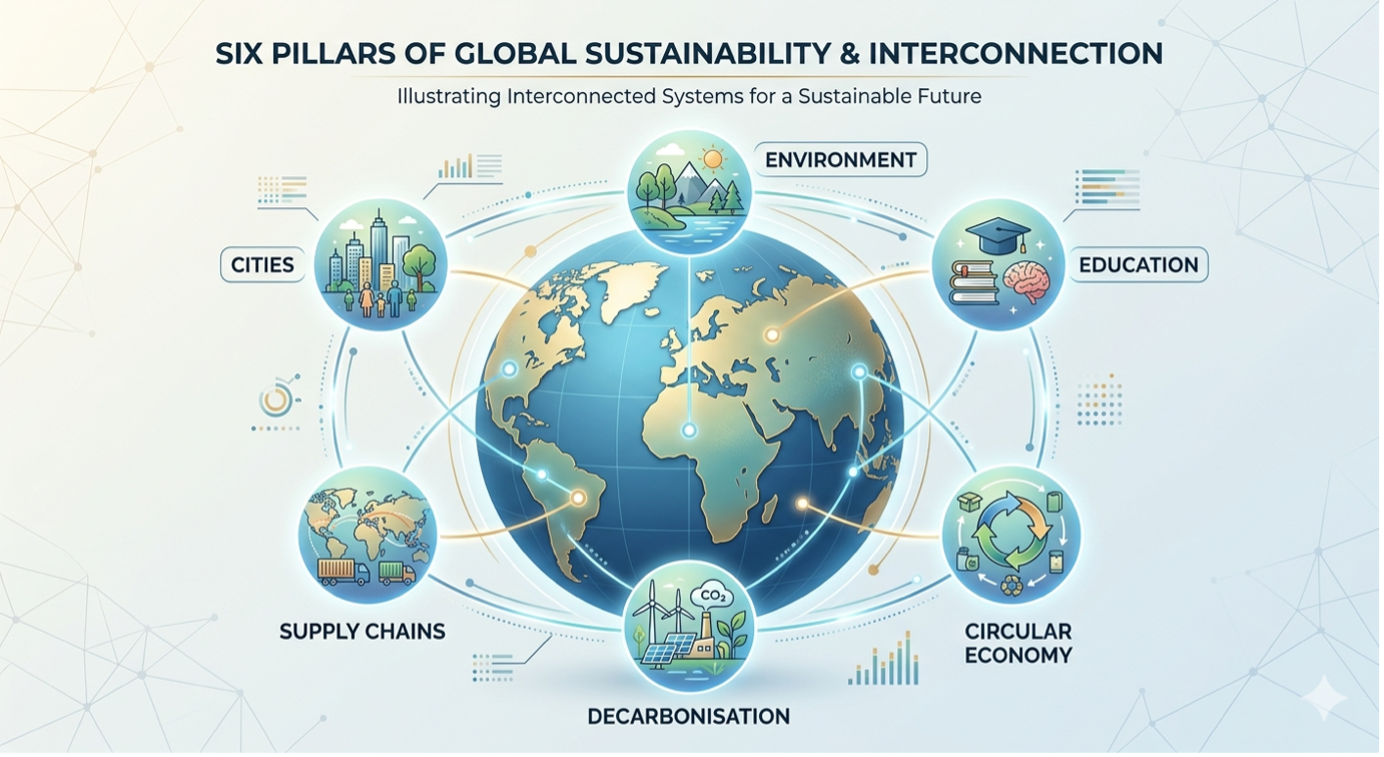
The programme brings together research, policy and industry leaders across six broad agenda pillars: cities and communities; education, gender and inequality; environment; circular economy and materials; decarbonisation and energy; and supply chains and resources. Each of these tracks addresses a crisis that is no longer theoretical.
Cities and communities will look at the future of urban life, resilience and inclusion. This is crucial in a world where cities are both engines of opportunity and epicentres of climate risk. From heat stress and flooding to affordable housing, transport and waste systems, the urban question is now inseparable from the sustainability question.
Education, gender and inequality will examine how social justice must sit at the centre of any credible sustainability agenda. The SDGs cannot be achieved if millions remain excluded from quality education, digital access, health systems, secure livelihoods and leadership pathways. Gender equality, in particular, is not an isolated goal; it is a multiplier across every other goal.
The environment pillar speaks to biodiversity, ecosystems, climate adaptation and the delicate balance between development and ecological survival. In a region like Southeast Asia, where forests, seas, agriculture and livelihoods are tightly interconnected, environmental policy is also economic policy and social policy.
Circular economy and materials will focus on one of the most important shifts of our time: moving from extract-use-discard models to systems that design out waste, reuse materials, extend product life and create new industrial value chains. For manufacturers, cities and consumers alike, circularity is fast becoming a practical necessity.
Decarbonisation and energy will take on the complex challenge of powering economic development while reducing emissions. This is not merely a technology question. It involves finance, policy, grid systems, industrial transitions, skills, political will and just transition frameworks for workers and communities.
Supply chains and resources will examine transparency, resilience and responsibility in global production networks. Recent years have shown that fragile supply chains can disrupt economies and deepen inequality. Sustainable supply chains are now central to corporate credibility, investor confidence and national economic security.
The Business of Doing Better
A defining feature of the 2026 edition is the Asia-Pacific Sustainable Business Summit, co-located with the main congress and running across the four days. Its theme is direct and practical: connecting the value chain for sustainable growth.
This summit acknowledges a basic truth: sustainability will not scale unless business models change. Corporate leaders, financiers, innovators, procurement specialists, manufacturers, digital infrastructure players and policymakers will gather to examine how sustainability can drive competitiveness, long-term value and market creation.
The business summit’s tracks include AI, digital and finance; decarbonisation, energy and the built environment; natural resources, commodities and agriculture; nature, climate and the environment; social impact, equity and health; and supply chain, manufacturing and circular economy. This is a strong indication that the congress recognises sustainability as an operating system for the economy, not a CSR appendix.
Speakers and participants from companies and institutions such as Olam Agri, Bosch Power Tools, Coca-Cola Europacific Partners, Nickel Industries, UltraTech Cement, DBS Bank, Singtel Digital Infraco, the European Investment Bank and others suggest a programme designed to move from good intentions to implementable strategies. The business presence matters because governments can regulate and universities can innovate, but corporations control large parts of production, consumption, logistics, capital flow and employment.
The test of the summit will be whether it can push business leaders beyond brand positioning and into measurable commitments: cleaner operations, transparent sourcing, decarbonised supply chains, nature-positive investments, workforce reskilling and credible ESG governance.
Finance: The Missing Bridge Between Vision and Delivery

One of the most important additions to the GSDC ecosystem is the “Unlocking Capital for Sustainability” initiative, hosted with Eco-Business on 24 June. It focuses on a persistent barrier in sustainability: the gap between ambition and finance.
Across Asia, the ideas are present. The technologies are emerging. The policy frameworks are evolving. But the capital needed for renewable energy, resilient infrastructure, low-carbon industry, sustainable agriculture, inclusive health and climate adaptation often remains inadequate, expensive or misaligned. The summit’s theme, “Strengthening governance, securing resilience,” recognises that money follows trust. Investors need credible governance, transparent regulation, bankable projects and long-term policy stability.
This finance conversation is especially important for Indonesia and the wider Asia-Pacific region. The just transition cannot be achieved by moral appeal alone. It needs blended finance, carbon market integrity, public-private partnerships, development finance, green bonds, transition finance, climate-risk disclosure and new models of local investment. By bringing financiers, regulators, carbon-market experts and sustainability leaders into the congress, GSDC 2026 gives the SDG agenda a crucial economic engine.
Skills for the Green Economy
Another major component is the Sustainability Skills Summit, scheduled for 23–24 June. Its central concern is the workforce transformation required for a sustainable economy.
This is one of the most practical questions of the decade. The green transition will create new jobs, but it will also disrupt old ones. It will require engineers who understand renewable systems, managers who understand ESG metrics, designers who understand circularity, teachers who can embed sustainability into curricula, financiers who can evaluate climate risk, communicators who can fight misinformation, and public officials who can design integrated policy.
The summit’s focus on future-proof workforces, closing skills gaps, strengthening business resilience and driving inclusive growth is therefore essential. Sustainability cannot remain the language of experts. It must become a competence across sectors.
For universities, this means redesigning curricula. For companies, it means investing in reskilling rather than treating sustainability as a specialised compliance department. For governments, it means aligning education, industry and employment policy. For young people, it means preparing for a labour market in which green literacy, digital fluency and ethical leadership will be central to employability.
Policy, Prosperity and the New Social Contract
The Policy Summit, taking place on 22–23 June, adds another decisive layer. It convenes senior decision-makers from government, multilateral institutions, industry and finance to examine sustainable economic growth, trade frameworks, industrial strategy and cross-border cooperation.
This matters because the SDGs cannot be achieved through isolated projects. They require national plans, fiscal frameworks, international cooperation, regulatory coherence and institutional capacity. The policy summit appears designed to address the difficult terrain where sustainability meets competitiveness. How can economies remain globally competitive while becoming cleaner and fairer? How can trade systems support climate goals? How can regulation protect people and planet without strangling innovation? How can industrial strategy support both growth and inclusion?
These are not abstract questions. They are the core governance questions of the next decade.
A Stage of Global Voices
The confirmed speaker list reflects the congress’s multi-sector character. It includes Rachmat Pambudy, Indonesia’s Minister of National Development Planning; Brian Yuliarto, Indonesia’s Minister for Higher Education, Science and Technology; Sir Dr Jeffrey Cheah, Founder and Chairman of Sunway Group and Founder and Chancellor of Sunway University; Gita Sabharwal, United Nations Resident Coordinator in Indonesia; Habibah binti Abdul Rahim of the Southeast Asian Ministers of Education Organization; Dominic Jermey, the UK Ambassador to Indonesia and Timor-Leste; and sustainability leaders from major global and regional organisations.
The corporate and finance voice is also visible through leaders such as Nikita Asthana of Olam Agri, Elena Kapreeva of Bosch Power Tools, Lucia Karina of Coca-Cola Europacific Partners, Sunita Lukkhoo of the European Investment Bank, Muchtazar Muchtazar of Nickel Industries and others. The wider speaker list brings in experts from universities, technology, urban policy, public health, sustainable finance, ESG, procurement, agriculture, biodiversity and climate innovation.
This diversity is one of the strengths of the congress. Sustainability is not one profession. It is an interdisciplinary public mission.
What Outcomes Should Matter?
The success of GSDC 2026 should not be measured only by attendance, applause or media visibility. Its real test will lie in outcomes.
First, it should generate partnerships: university-to-university research collaborations, university-industry innovation projects, government-academia policy frameworks, NGO-business community programmes and cross-border sustainability networks.
Second, it should accelerate curriculum reform. Every university represented in Jakarta should return with a clearer commitment to embedding sustainability across disciplines, not confining it to environmental studies.
Third, it should push sustainability finance forward. If the congress can help connect bankable projects with credible capital, especially in Asia, it will have moved from conversation to transformation.
Fourth, it should strengthen measurement. The THE Sustainability Impact Ratings reveal will matter only if institutions use rankings not as a trophy but as a mirror: a way to examine gaps, improve practices and align strategy with public good.
Fifth, it should elevate youth and emerging leaders. The SDGs will ultimately be inherited by today’s students. Their presence must not be symbolic. They must be treated as co-creators of the sustainability agenda.
South Asia, the Middle East and the Wider Global South
For South Asia and the Middle East, GSDC 2026 has special relevance. These regions face extreme climate exposure, fast urban growth, water stress, youth employment challenges, energy transition pressures and the need for inclusive education. They also possess vast entrepreneurial talent, expanding higher education systems, growing digital economies and increasing capital flows into sustainability.
Universities from India, Bangladesh, Nepal, Sri Lanka, Pakistan, the Gulf and the wider Middle East can use the congress as a bridge to global partnerships. Incubators, sustainability portals, green business networks, social enterprises and policy schools can find collaborators in Jakarta. The congress can help shift the Global South from being seen merely as a site of vulnerability to being recognised as a source of solutions.
From Declaration to Delivery

The Global Sustainable Development Congress 2026 is arriving at a moment when the world is fatigued by promises. Climate pledges, ESG statements and SDG banners are everywhere, but implementation remains uneven. The power of the Jakarta congress will lie in its ability to insist that sustainability must now become institutional behaviour.
Its promise is not simply that leaders will gather. Its promise is that leaders from different worlds will be forced to listen to one another: ministers to scientists, CEOs to community actors, investors to educators, universities to young people, and policymakers to those living the consequences of unsustainable development.
If GSDC 2026 succeeds, it will not be remembered only as a large congress in Jakarta. It will be remembered as a moment when the sustainability movement matured—from advocacy to architecture, from concern to collaboration, from fragmented good work to connected global action.
The world has spoken about sustainable development for decades. In Jakarta, the challenge will be sharper: to build it.




Add a Comment