Advisory

Advisory services provide expert guidance to organizations on improving their strategies, processes, and performance in areas like sustainability, compliance, and corporate responsibility. The goal is to help businesses make informed decisions, manage risks, and align their operations with best practices and regulatory expectations.

Showing 12/19

24 Aug 2026

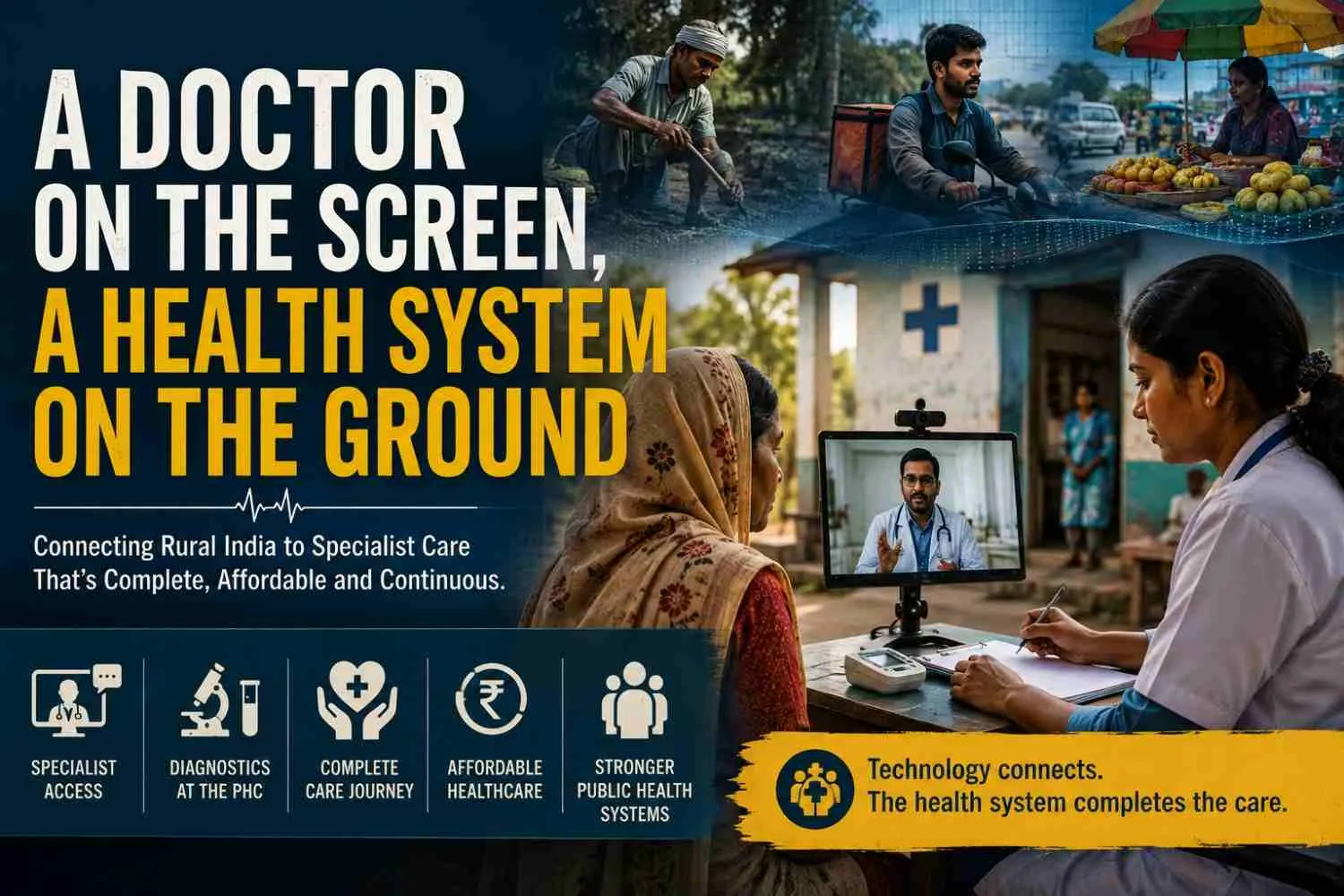
Kolkata |24 August, 2026  India’s telemedicine network is bringing specialist care closer to rural patients, but the real challenge is ensuring that a consultation leads to care that is complete, affordable and continuous. SummaryFor rural patients, seeing a specialist can mean a long journey, lost wages and repeated visits to a distant hospital. India’s telemedicine network is changing that equation by bringing specialist expertise closer to rural communities, while corporate partnerships are adding diagnostics, technology, mobile healthcare and specialist access to the mix. But a teleconsultation is only one part of the care journey. The real test is whether patients are diagnosed, treated and followed up without having to bear the same travel and financial burden. For CSR programmes, success also depends on whether public health facilities are strengthened, outcomes are measured against a clear baseline, money is actually spent as reported and systems continue functioning after corporate funding ends. KeywordsPhygital Healthcare, Rural Telemedicine, Digital Health India, eSanjeevani, Healthcare Access, Rural Healthcare, Primary Health Centres, Ayushman Arogya Mandirs, Digital Health Infrastructure, Teleconsultation, Diagnostics, Continuity of Care   Can a PHC become the gateway to a specialist hundreds of kilometres away? For many rural patients, the challenge is not simply finding healthcare. But is reaching the right doctor without travelling hundreds of kilometres, losing a day’s wages or making repeated trips to a distant hospital. India continues to face shortages and an uneven distribution of health professionals, particularly in rural and underserved areas, making specialist access a bigger challenge than simply counting the number of doctors available. Telemedicine can help change this equation by bringing specialist expertise closer to patients instead of requiring them to travel long distances for every consultation. India’s eSanjeevani platform has demonstrated the scale of this approach by connecting patients and health workers with doctors and specialists, including in rural and remote communities.But phygital healthcare cannot depend on a screen alone.The physical Primary Health Centre remains an important part of the care journey. A nurse or community health worker can examine the patient, record vital signs, conduct basic diagnostic tests, explain the specialist’s advice and help ensure that medicines, referrals and follow-up care are available. The technology can bring the specialist closer. But it is the local health system that turns a remote consultation into actual care. PHYGITAL CARE JOURNEY Village patient → Local PHC → Physical examination → Point-of-care diagnostics → Remote specialist → Treatment → Follow-up The screen connects the specialist. The PHC completes the care journey. What happens when telemedicine meets diagnostics? A specialist cannot always make a reliable diagnosis through a conversation alone. Basic diagnostic tests can provide the information needed to understand a patient’s condition and decide what treatment or referral is required. A blood-sugar or blood-pressure reading, pregnancy test, haemoglobin level or another point-of-care test can significantly change what happens after a teleconsultation. This makes diagnostics an important part of the phygital healthcare model, where digital specialist access is combined with physical healthcare services at the local level. NITI Aayog’s work across Aspirational Districts and Blocks includes healthcare interventions that bring together community outreach, frontline health workers, diagnostics and digital monitoring. The broader lesson is clear: technology works best when it is connected to the basic healthcare infrastructure patients can access locally. That means a teleconsultation should not end with a video call. It should connect to examination, diagnosis, medicines, referrals and follow-up care.Otherwise, a programme may be able to report thousands of consultations while leaving the more important question unanswered: Did those consultations actually lead to better care for patients? THE SCREEN IS ONLY ONE PART REMOTE SPECIALIST↓DIGITAL PLATFORM↓PHC / HEALTH WORKER↓DIAGNOSTICS + PHYSICAL EXAMINATION↓MEDICINES + REFERRAL↓FOLLOW-UP Technology connects the patient to expertise. Infrastructure turns that expertise into care. Can corporate partnerships strengthen the public health system? This is where corporate participation can become more than a funding exercise. Companies can bring technology, specialist networks, diagnostics, equipment, training and logistics that may help extend healthcare to communities that public facilities struggle to reach on their own.There are already examples of different approaches. Tata Trusts has worked with state governments on telehealth and mobile healthcare initiatives aimed at connecting underserved communities with doctors and specialist services. Apollo’s remote healthcare network offers another hybrid model. Its 2024–25 ESG report states that the network has delivered more than 16.5 million teleconsultations across 95 specialties, combining digital consultations with physical healthcare services. Meanwhile, Smile Foundation’s Smile on Wheels takes doctors, nurses, laboratory services and medicines directly to villages and other hard-to-reach communities through mobile medical units.These models also raise a bigger question for CSR: Should companies create separate healthcare systems of their own, or use their resources to strengthen the government facilities already serving these communities? The second approach could offer greater long-term value. Instead of creating parallel systems that may struggle to continue once funding ends, corporate partners can support existing PHCs with digital infrastructure, diagnostic equipment, specialist access, staff training and logistics, while keeping the public health system at the centre of care. The goal should not simply be to bring corporate healthcare to rural India. It should be to leave the rural healthcare system stronger than it was before the partnership began.WHO DOES WHAT? GOVERNMENT• PHCs• Health workers• Public health infrastructure• Referrals CORPORATES• Technology• Equipment• Diagnostics• Funding• Specialist networks NGOs / COMMUNITY GROUPS• Outreach• Awareness• Inclusion• Local access PATIENTS / COMMUNITIES• Care-seeking• Treatment• Follow-up• Feedback Can preventive healthcare produce a measurable social return? For CSR programmes, the focus needs to move beyond how many services were delivered to what actually changed for patients. Screening 10,000 people is an activity. Identifying patients with hypertension or diabetes, ensuring they begin treatment and helping them complete follow-up is an outcome. This distinction is particularly important when companies use technology to expand preventive healthcare. J-PAL South Asia has evaluated preventive-health interventions in India, including research on demand for hypertension screening and the impact of health camps on preventive-care investment. Its research also highlights an important limitation: technology and better monitoring systems do not automatically lead to better healthcare delivery. In Karnataka, for example, a biometric system successfully tracked the attendance of doctors at Primary Health Centres, but it did not improve attendance because the government struggled to enforce the incentives and penalties linked to the system.The lesson is relevant for corporate healthcare programmes too.A better dashboard does not automatically mean better healthcare.What matters is whether patients are being diagnosed earlier, starting treatment, completing follow-up and ultimately experiencing better health outcomes. The real measure of CSR is not the number of beneficiaries on a report, but the difference the programme makes to their lives. ACTIVITY VS OUTCOME 10,000 people reached↓7,500 screened↓2,100 diagnosed / referred↓1,600 started treatment↓1,200 completed follow-up Measure the care journey, not just the first contact. What do rural workers and migrant families need from these systems? Rural healthcare cannot be separated from the realities of work and income. For many people, accessing specialist care can mean more than a long journey. It can mean lost wages, travel costs, childcare difficulties and time away from work. A worker who has to travel to another town for a specialist consultation may lose a day’s earnings. Migrant workers may face additional barriers when their workplace and place of residence keep changing. Women may delay seeking medical care when travel, childcare responsibilities or the cost of treatment become difficult to manage. The Aajeevika Bureau’s work with migrant workers highlights how informal workers can face gaps in healthcare and social-security access, particularly when migration, low incomes and hazardous working conditions overlap. SEWA Bharat has similarly worked to improve women’s access to healthcare and social-security entitlements through community-based approaches. These experiences point to a simple principle:Healthcare technology should fit into people’s lives, rather than expect people to reorganise their lives around technology.That means rural healthcare systems also need to consider accessibility, language, affordability, mobility and physical access. These are particularly important for persons with disabilities, older people and workers who cannot easily travel. What should companies actually measure? This is where the evidence test becomes critical.Companies should report the full number of people covered, rather than using a single “beneficiaries reached” figure.If 10,000 people were enrolled, how many completed screening? How many were diagnosed? How many started treatments? And how many completed follow-ups? The baseline should be equally clear. If a programme claims that it reduced patients’ travel costs, companies should show what patients were spending before the intervention. If it claims to have improved access to specialist care, it should show how far patients previously had to travel and how that changed.The same applies to consultations. Reporting one lakh consultations does not show how many patients actually received the treatment, medicines or referrals they needed. Money also needs to be accounted for.How much was budgeted? How much was actually spent? How much went towards equipment, technology, staffing, diagnostics, training and maintenance? Companies should also report cost per outcome, rather than stopping at cost per consultation. For example, they could track the cost per completed treatment, cost per successfully screened patient or number of patients served per 1,000 people in the target population. Both absolute and intensity measures can provide a clearer picture. Absolute numbers show the scale of a programme, while intensity measures help show how efficiently resources are being used. Most importantly, the reporting boundary must remain clear.A consultation is not automatically a treated patient. A screening is not automatically a diagnosis. And a person reached by a programme cannot automatically be counted as someone whose health improved. The real evidence lies in what happened after the healthcare service was delivered. THE CORPORATE HEALTHCARE EVIDENCE SCORECARD MeasureWhat to askBeneficiary denominatorHow many people were actually covered?CompletionHow many completed screening, treatment or follow-up?OutcomeWhat changed for patients?BaselineWhat was the situation before the programme?CostHow much was actually spent?Cost per outcomeWhat did each successful outcome cost?IntensityWhat was achieved per 1,000 people or per ₹1 lakh?ContinuityWhat continued after CSR funding ended? Measure outcomes, not just activities. What happens when the CSR funding ends? This may be the most important test of any corporate healthcare partnership. A company can install telemedicine equipment, bring specialists into the system and fund diagnostics for three years. But rural healthcare needs to function long after a CSR funding cycle ends. If a programme cannot continue without corporate support, its long-term impact remains limited. So, who maintains the equipment once the funding ends? Who pays for internet connectivity? Who trains new health workers when trained staff leave? Who ensures medicines and diagnostic supplies remain available? Who manages patient referrals and follow-up? And who is responsible for the infrastructure and patient data? ESIC’s teleconsultation model offers a useful public-sector example. Its hub-and-spoke approach connects dispensaries with hospitals that act as specialist hubs, helping reduce patient travel while keeping local doctors involved in treatment and follow-up.The broader lesson is clear:Telemedicine creates lasting value when it becomes part of the regular healthcare system - not when it remains a temporary CSR project. For companies, that means the success of a partnership should be judged not only by what it delivers during the funding period, but also by what the health system is still able to deliver after the funding ends. WHAT SURVIVES AFTER CSR? DURING CSR FUNDING• Equipment purchased• Specialists connected• Staff trained• Patients reached ↓ FUNDING ENDS WHAT REMAINS?• Equipment maintained?• PHC staff still trained?• Specialist network still available?• Diagnostics still functioning?• Connectivity still paid for?• Patient follow-up still happening? CONTINUITY = REAL SYSTEM STRENGTH So, can corporate partnerships really bridge India’s rural specialist-care gap? Yes - but only if corporate healthcare moves beyond delivering services and starts strengthening the system that delivers them. India already has a network of Primary Health Centres, frontline health workers, digital platforms and an expanding telemedicine system. Corporate partnerships can add what many rural facilities struggle to access: specialists, diagnostics, technology, training, logistics and investment. But the real value of these partnerships will not be measured by how many teleconsultations were delivered or how many devices were installed. Nor should success be defined by the size of a CSR announcement.The stronger model is one in which corporate support makes the existing public health system more capable, more accessible and more sustainable. That means the evidence test has to go much further:Who was actually reached? Who completed care? How many patients received the treatment or referral they needed? What changed compared with the baseline? How much did patients save in travel, time or lost wages? What did the PHC gain? What did each successful outcome cost? And, most importantly, what continued after the corporate funding ended? These questions determine whether phygital healthcare is creating a lasting healthcare solution or simply another successful CSR activity on paper. For rural patients, however, the measure of success is much simpler.It means not having to travel hundreds of kilometres just to see the right specialist. It means being able to get basic diagnostics close to home, receive treatment without unnecessary delays and know that follow-up care will still be available.That is the real promise of phygital healthcare: bringing specialist expertise closer without leaving rural patients dependent on a screen - or on a company’s funding. The real CSR test is not whether a company can bring a doctor to a village once. It is whether its partnership can help build a rural healthcare system that continues to deliver care long after the company steps away. THE REAL TEST ACCESSCan patients reach specialist care?→ OUTCOMEDid their health actually improve?→ VALUEWas the intervention worth the cost?→ CONTINUITYDid the system survive after CSR funding? A consultation is an activity.Completed, affordable and continuous care is the outcome. The promise of phygital healthcare is not to replace the rural doctor with a screen. It is to bring specialist expertise, diagnostics and continuity of care closer to patients through the health system already in place. And ultimately, the strongest corporate partnership will not be the one that creates the biggest programme. It will be the one that leaves the rural health system more accessible, more capable and more sustainable - and less dependent on the corporate partner than it was before. Sources: Ministry of Health & Family Welfare — eSanjeevani National Telemedicine Service SourceMinistry of Health & Family Welfare — Telemedicine Services Guidelines SourceNational Health Authority — Ayushman Bharat Digital Mission (ABDM) SourceNational Health Authority — ABDM and Telemedicine FAQs SourceMinistry of Health & Family Welfare — Ayushman Arogya Mandirs, diagnostics and teleconsultation SourceMinistry of Health & Family Welfare — Annual Report 2024–25: eSanjeevani and digital health SourceMinistry of Health & Family Welfare / ABDM — eSanjeevani’s scale and assisted teleconsultation model Source Press Information Bureau — eSanjeevani integration with ABDM and continuity of care Source ...Read more

18 Aug 2026

SPECIAL INVESTIGATION  ·  CORPORATE GOVERNANCE & PHILANTHROPY   How India Inc Is Walling Off Its Own Charity — and What It Means for the Grassroots By Professor Ujjwal K. Chowdhury Behind India's ₹40,000-crore CSR economy lies a quiet institutional coup. A tightened Ministry of Corporate Affairs registration regime, a boardroom terrified of personal director liability, and SEBI's data-hungry ESG assurance machinery are together pushing corporate India to build its own foundations — and, in the process, are starving the small, community-rooted non-profits the law was written to reach. SUMMARYSince Form CSR-1 became mandatory on 1 April 2021, and more sharply since the Companies (CSR Policy) Amendment Rules, 2025 came into force on 14 July 2025, the Ministry of Corporate Affairs has converted CSR implementation into a licensed activity. The new web-based, CA/CS/CMA-certified CSR-1 form — demanding 12A/80G proof, NGO Darpan IDs, a three-year track record and digitally signed disclosures — now gates roughly ₹35,000-40,000 crore of annual statutory CSR spend. Boards newly exposed to personal liability for unspent funds under Section 135(5), (6) and (7) are responding by internalising social spending inside wholly owned Section 8 foundations: Tata Steel Foundation, JSW Foundation, Infosys Foundation, Wipro Foundation, SBI Foundation and dozens more. This feature traces the regulatory chain from 2014 to 2026, the cost-benefit and tax arithmetic of building versus outsourcing, hard data on where the money actually lands, and mounting evidence that grassroots NGOs — 84% of India's non-profits, most running on budgets under ₹3 crore — are being pushed out of a philanthropic economy their own advocacy helped build. KEYWORDS: CSR-1 registration, Section 8 foundations, Companies Act Section 135, corporate CSR India, Ministry of Corporate Affairs, BRSR Core, grassroots NGOs, CSR compliance, 12A and 80G registration, Tata Steel Foundation, Infosys Foundation, Social Stock Exchange, CSR governance, corporate philanthropy India HASHTAGS: #CSRIndia  #Section8Foundations  #CSR1Registration  #CorporateGovernance  #MCA  #BRSRCore  #GrassrootsNGOs  #CSRCompliance  #IndiaInc  #SocialStockExchange  #NonProfitIndia  #ESGIndia THE BOARDROOM THAT BROKE WITH CIVIL SOCIETY In a wood-panelled boardroom overlooking Mumbai's Bandra-Kurla Complex late last winter, the CSR committee of a top-tier industrial conglomerate faced an existential briefing. For nearly a decade the company had dispersed its mandatory 2% statutory spend — roughly ₹140 crore a year — across a decentralised constellation of 45 grassroots NGOs working the rural hinterlands from Kalahandi to Bastar. Then came the regulatory audit. A routine notice from the Registrar of Companies, coupled with statutory-auditor queries over third-party utilisation certificates, Form CSR-1 validations and unspent-escrow allocations under Section 135(6), pushed boardroom anxiety to a fever pitch. By the time legal counsel finished briefing directors on personal liability under the amended penalty provisions, the decision was unanimous: terminate 38 external partner contracts and incorporate a wholly owned, captive Section 8 not-for-profit. “Within eighteen months, our entire social budget was internalised. It wasn't philanthropic philosophy — it was regulatory survival.” — Chief Sustainability Officer, industrial conglomerate This boardroom pivot is neither isolated nor accidental. Across corporate India a seismic restructuring of statutory philanthropy is under way. What began in 2014 as a broad legislative mandate under Section 135 of the Companies Act has hardened into a tightly policed, data-audited compliance machinery — and in its place has arisen a sprawling new institutional class: the captive corporate foundation. FROM ‘COMPLY OR EXPLAIN’ TO A COMPLIANCE MACHINE Section 135 was notified in 2014 as a soft ‘comply or explain’ regime — a company could simply justify a shortfall in its board report. That leniency did not survive long. A High-Level Committee on CSR (2019-20) recommended tightening; the escrow mechanisms of Section 135(5) and (6) followed; then, in 2021, came Form CSR-1 and the decriminalisation-cum-mandatory-impact-assessment amendments. By 2023-26, SEBI's BRSR Core reasonable-assurance regime and the Social Stock Exchange had pulled CSR into the wider architecture of ESG disclosure. 20142019‑2020212023‑26Section 135 notified — the ‘comply or explain’ era begins.High-Level Committee on CSR; Section 135(5)/(6) escrow mechanisms introduced.MCA Form CSR-1 mandatory; decriminalisation amendments; mandatory third-party impact assessments.SEBI BRSR Core reasonable assurance rolls out; Social Stock Exchange goes live; CSR-1 re-engineered (July 2025). FORM CSR-1: THE FORM THAT REWROTE THE RULES The decisive shift began on 1 April 2021, when it became illegal for any company to route CSR capital to an implementing agency lacking an MCA-issued, eleven-digit unique CSR Registration Number. To secure that number, a Section 8 company, registered public trust or registered society had to demonstrate valid Section 12A/12AB and 80G registrations, a verified three-year operational track record in comparable development work (waived only for Section 8 entities established by the funding company itself), and Digital Signature Certificate verification certified by a practising Chartered Accountant, Company Secretary or Cost and Management Accountant. The ground shifted again on 14 July 2025, when the Companies (CSR Policy) Amendment Rules, 2025 replaced the old PDF-based process with a fully web-based e-form on the MCA21 V3 portal — now demanding an NGO Darpan ID as a compulsory field, governing-body member details with DIN/PAN, audited financials, and OTP-verified, digitally signed submission. MCA subsequently clarified that entities already holding valid CSR registration numbers need not register afresh merely because the form changed. Running in parallel, the Ministry of Home Affairs tightened the Foreign Contribution (Regulation) Act, cancelling the licences of over 6,000 civil society organisations and banning sub-granting between NGOs. CSR funds are technically domestic capital, but the institutional fallout — lost accounting staff, deep regulatory scrutiny, sudden instability — hit thousands of multi-funded grassroots entities regardless. THE ESCROW TRAP: WHEN NON-COMPLIANCE BECOMES PERSONAL For corporate legal teams, the cost of an implementing partner's compliance lapse has become intolerable. Under Section 135(5) and (6), unspent capital tied to an ‘ongoing project’ must move within 30 days of fiscal close into a designated Unspent CSR Account at a scheduled bank, to be utilised within three fiscal years — or, for one-off projects, surrendered within six months to a Schedule VII fund such as PM CARES or Clean Ganga. Section 135(7) penalises failure with fines running up to twice the unspent amount for the company, plus personal financial liability for every defaulting officer. Recent RoC adjudication orders — some now under appeal — show that enforcement is real, not theoretical. A further procedural tightening in 2025 requires companies to file Form AOC-4 (audited financial statements) before filing Form CSR-2, the annual CSR report; the CSR-2 web form must now carry the AOC-4 Service Request Number to link it algorithmically to audited accounts. Regulators can now cross-reference CSR spend against financials in real time, closing off the discretion companies once used to smooth over reporting gaps. THE GREAT SPIN-OFF: MAPPING INDIA INC’S CAPTIVE FOUNDATIONS The stampede toward captive vehicles has reshaped the institutional map of Indian philanthropy. Data compiled from the MCA portal, the Registrar of Companies and analytics platform CSRBOX show that over 65% of the NIFTY 100 now execute the majority of their social spend through promoter-backed Section 8 companies, captive trusts or dedicated operating foundations — and, since the 2025 CSR-1 overhaul, more than 60% of large corporate CSR budgets are routed through company-owned implementation arms. Yet corporate India is not converging on one model. In heavy industry, Tata Steel Foundation — a Section 8 company and wholly owned subsidiary of Tata Steel — has saturated 81 blocks and 4,500 villages across Jharkhand and Odisha, spending roughly ₹473 crore in FY2024-25, reaching between 5.77 million and 6.9 million lives across different reporting cycles and unlocking over ₹5,300 crore of public entitlements through grassroots mobilisers. Under its MANSI maternal-health programme, 93% of high-risk pregnancies now culminate in institutional deliveries; through Masti Ki Pathshala, 73% of 5,406 highly vulnerable children in Jamshedpur's urban slums have entered mainstream schooling. JSW Foundation scaled from ₹63 crore in FY2018-19 to ₹235 crore in FY2023-24 and ₹363 crore in FY2024-25, touching 30 lakh lives across Maharashtra, Karnataka and Odisha. In technology, Infosys Foundation — three decades old in FY2026 — has deployed cumulative spending above ₹4,800 crore, with FY2024-25 alone seeing ₹545 crore across healthcare, education and environment, and FY2025-26 global CSR of about ₹666 crore reaching more than seven million people across 200-plus projects; its annual report won a Gold Stevie in 2025, even as a 2026 fraud case — a former contractor who posed as a regional head to defraud the foundation of ₹6 crore — exposed governance vulnerabilities that scale alone cannot fix. TCS reported FY2024-25 CSR of ₹960 crore, rising to a global figure of about ₹1,153 crore in FY2025-26 with more than 18 million beneficiaries and over nine million volunteering hours, through flagship programmes such as goIT, Ignite My Future and BridgeIT reaching 7.1 million people worldwide. Wipro runs a deliberate dual-engine architecture: the endowment-backed Azim Premji Foundation, which holds an economic interest in Wipro and preserves pure civil-society funding, alongside Wipro Foundation and Wipro Cares, which executed statutory CSR of ₹259.4 crore in FY2024-25 and ₹227.4 crore in FY2025-26 against an adjusted obligation of ₹130.4 crore — a zero-shortfall result. Among banks, HDFC Bank's Parivartan posted a record ₹1,068 crore in FY2024-25 across seven focus areas — including a newly added natural-resource-management vertical — reaching over 100 million beneficiaries through 214 implementation partners. SBI institutionalised its CSR inside SBI Foundation, a Section 8 company, spending ₹610.77 crore. ICICI Bank earmarked ₹801 crore but spent only ₹527 crore, citing delays in statutory approvals — a reminder that even large, well-resourced banks face implementation lag. Axis Bank Foundation, notably, is a registered trust rather than a Section 8 company and openly runs a partnership model with multiple development-sector organisations, showing that the captive-foundation trend is not universal even among peer institutions. In agribusiness, ITC's Mission Sunehra Kal spent ₹325 crore in FY2023-24, embedding climate-smart agriculture and e-Choupal watershed development directly into its sourcing catchments, creating a circular loop in which agroforestry CSR supplies pulpwood for its paperboard business. Reliance Industries, largely through Reliance Foundation, led all spenders at ₹2,156 crore in FY2024-25. THE HIDDEN P&L: WHY BUILD BEATS BUY Running an in-house foundation is not cheap. Registering a Section 8 company — the preferred structure — costs roughly ₹18,000-35,000 in government and professional fees, with annual compliance of ₹15,000-40,000 covering statutory audits, RoC filings (MGT-7, AOC-4), income-tax returns and 12A/80G maintenance. That is markedly steeper than a trust (₹500-3,000 to register; ₹5,000-15,000 a year) — yet for companies with large, recurring CSR budgets the arithmetic still tilts toward internalisation. The decisive lever is Rule 7(1) of the CSR Rules, which caps administrative overheads at 5% of total CSR spend for the company itself — but explicitly excludes the administrative expenses of implementing agencies, including a company's own Section 8 foundation, from that cap. Grassroots NGOs typically need 15-20% institutional overhead to cover compliance, monitoring, senior management and rent; bound by the 5% ceiling, corporates routinely disallow these core costs when funding external partners, forcing NGOs into project-restricted budgets that erode their long-term health. A captive foundation, by contrast, allows structural reclassification: salaries of social workers, agronomists, project directors and field-monitoring teams are booked not as ‘administrative overhead’ but as direct programmatic implementation expense — full operational capacity, while the general-administration line on paper stays comfortably under 5%.  Outsourced NGO Model (₹100 Cr Spend)Captive Section 8 Model (₹100 Cr Spend)External grant / direct programme₹95 Cr grant, capped at 5% overhead (Rule 7(1))₹96 Cr — field salaries booked as direct delivery cost, not overheadOverhead / admin₹5 Cr — partner NGO's core costs largely disallowed₹4 Cr head-office admin, technically within the 5% capNet effectOperational friction for the NGO partnerFull in-house operational capacity retained inside the group Tax structuring compounds the advantage. A Section 8 foundation without 12A registration is taxed at the ordinary corporate rate — an effective 29-33% including surcharge and cess — which is why 12A is treated as non-negotiable; newly registered entities get a provisional 12A (Form 10A, valid three years) before moving to regular 12AB (Form 10AB, valid five years, extendable to ten years for foundations with annual income under ₹5 crore). Once secured, foundation income is 100% tax-exempt if applied to charitable objects. Section 80G then lets the donor — typically the parent company — claim a deduction of 50% on the donated sum, subject to a ceiling of 10% of Adjusted Gross Total Income (cash donations above ₹2,000 do not qualify; the foundation must file Form 10BD and issue Form 10BE to preserve the donor's claim). On a ₹10 crore contribution, that works out to a ₹5 crore deduction and, at a 30% marginal rate, roughly ₹1.5 crore of tax saved by the parent — while the foundation itself receives the full ₹10 crore tax-free. There is a catch worth flagging for the balance sheet: when a 12A-registered foundation passes money onward to other NGOs, 15% of that onward transfer is disallowed from tax exemption, creating an effective 30% tax cost on unstructured pass-through grants — one more reason captive foundations prefer to spend directly rather than sub-grant. And Mumbai ITAT rulings through 2025-26 have clarified that CSR donations to 80G-approved entities can claim the 80G deduction even though CSR itself is disallowed as business expenditure under Section 37(1) — clearly so for voluntary spending above the mandatory 2%, more contestably so for the mandatory 2% itself. FOLLOW THE ₹40,000 CRORE: WHERE THE MONEY ACTUALLY GOES Reported national CSR expenditure rose from ₹24,965.82 crore in FY2019-20 to ₹34,908.75 crore in FY2023-24 — more than ₹1.44 lakh crore across those five years, and over ₹2.17 lakh crore cumulatively since 2014. A July 2026 private analysis by Fulcrum, based on corporate filings, estimates FY2024-25 spending at about ₹40,794 crore across 29,546 companies and 72,233 projects — a research estimate, not yet the government's own consolidated figure, but directionally consistent with NSE data showing listed companies alone spent ₹22,212 crore in FY2025, up 23% year-on-year, with the top 10 companies contributing 34% of that total. Thematically, the captive model has produced herd behaviour. According to CSRBOX analytics, Education and Skill Development absorbs roughly 38% of national CSR capital and Healthcare and Sanitation another 27% — together nearly two-thirds of all corporate spending — while Rural Infrastructure takes 12%, Environmental Sustainability just 6%, and Gender and Vulnerable Groups only 4%.   ThemeShare of National CSR SpendEducation & Skill Development38%Healthcare & Sanitation27%Rural Infrastructure12%Other Schedule VII heads13%Environmental Sustainability6%Gender & Vulnerable Groups4% Environmental CSR, while the fastest-growing category — up 54% year-on-year in FY2023-24 to roughly ₹3,500 crore, per CEEW — remains a rounding error against India's climate-finance need: the Climate Policy Initiative India estimates ₹162.5 trillion (about $2.5 trillion) is required by 2030 to meet the country's Nationally Determined Contributions, of which current tracked green finance for mitigation covers only about 30%. CEEW argues CSR could become a major financing source for clean air — clean mobility, waste management, crop-residue solutions, construction-dust reduction — but notes that such programmes cluster around existing corporate locations and frequently lack measurable outcomes. WRI India separately flags biodiversity's marginal CSR share. Geography compounds the theme problem. Despite statutory language urging companies to prioritise their local operating areas, Maharashtra, Gujarat, Karnataka, Tamil Nadu and Andhra Pradesh — the states with the highest concentration of corporate headquarters — together absorb over 45% of all national CSR outlays. NITI Aayog's 112 Aspirational Districts and 500 Aspirational Blocks, precisely the geographies where marginal investment could generate the most disproportionate impact, receive only 2-4.5% of total CSR funds between them. And headline compliance conceals an implementation gap: NIFTY 500 annual reports show that even as reported compliance sits above 95%, 8-12% of committed capital is parked in Unspent CSR Accounts under Section 135(6); over ₹1,000 crore went unspent in FY2021-22 alone and had to be transferred to government Schedule VII funds. THE GRASSROOTS SQUEEZE The most consequential casualty of this restructuring is India's smallest, most rooted non-profits. Roughly 84% of Indian NGOs run on annual budgets under ₹3 crore — yet only 71% of CSR-1-registered NGOs actually accessed corporate funding in FY2023-24, leaving nearly three in ten locked out despite having cleared the registration bar. A 2025 Fulcrum survey of 325 NGOs across more than 20 states found that 89% held valid CSR-1 registration, but only 71% received any CSR money; about 80% reported inadequate opportunities to network with corporates; nearly half faced project-documentation difficulties; 40% experienced delayed fund disbursement; and 61% lacked the technical MIS expertise corporate due-diligence teams now expect. Small NGOs saw proposal-acceptance rates of roughly 50%, against about 73% for larger organisations. “A small organisation working on forest rights in Bastar cannot afford the compliance overhead that a corporate foundation's legal department takes for granted.” — Senior researcher, Centre for Science and Environment The barriers compound. Hiring a CA, CS or CMA solely to certify a CSR-1 filing adds ₹15,000-25,000 in professional fees — a material sum against a ₹20-30 lakh annual budget. The three-year track-record rule excludes newer or informally structured community organisations by design. The ban on sub-granting has eliminated the traditional intermediary model, through which large aggregator grantmakers once dispersed micro-grants to unheralded community groups; capital must now flow directly from company or foundation to final implementer, cutting hyper-local groups out of the pipeline entirely. Surviving small NGOs are increasingly demoted from co-equal strategic partners to third-tier field contractors — conducting surveys or distributing materials on razor-thin management fees, without budget for staff healthcare or institutional capacity-building. An ₹800 crore CSR-diversion racket uncovered across six states in 2025-26 has only sharpened corporate caution, disproportionately penalising honest but less-polished grassroots groups. And a May 2026 MCA notification recognising Zero Coupon Zero Principal (ZCZP) instruments on the Social Stock Exchange as a valid CSR channel — while officially framed as widening CSR's ambit — has been described by critics as tilting the playing field further toward large, listing-ready organisations, at the expense of community-based groups too small to meet SSE disclosure norms. THE GOVERNANCE MIRAGE: IS BIGGER ACTUALLY BETTER? Is the captive corporate foundation a genuinely superior vehicle for social transformation, or a tax-exempt marketing division wearing a Section 8 registration? Proxy-advisory and governance researchers urge scrutiny of the premise itself. “When a company routes its entire CSR allocation through an in-house Section 8 entity, board oversight must be twice as vigilant. Is the foundation's board genuinely independent? Are procurement contracts subject to arm's-length competitive bidding — or is the foundation a soft-money vehicle for the parent's brand and executive pet projects?” — Amit Tandon, Institutional Investor Advisory Services (IiAS) IiAS's 2024 Corporate Governance Scorecard found that 94 of the BSE 100 now meet the 2% spend threshold, up from 74 the previous year — but only 54 of the BSE 100 conducted impact assessments in FY2024, unchanged from FY2023, suggesting that measurement remains driven by legal mandate rather than mission. InGovern's Shriram Subramanian points to the underlying logic: once personal penalties for board directors and statutory escrow timelines entered the picture, boards concluded that reliance on third-party non-profits carried unacceptable legal risk, and that a captive vehicle offered what no external NGO could guarantee — absolute operational line-of-sight, brand control and an unassailable audit trail. The pros are real: continuity across CSR-head turnover, comparable multi-year data, the ability to hire genuine sector specialists, replicable multi-state programme design, and clearer board-level accountability than a scattershot grants portfolio ever offered. The cons are equally real: concentration risk, potential self-dealing between parent and foundation, thematic herd behaviour toward ‘safe’ brand-accretive causes, and — as Infosys Foundation's own 2026 fraud episode showed, in which a former contractor posed as a regional head to defraud the foundation of ₹6 crore — the loss of the deep, hyperlocal community trust that independent NGOs spend decades building and that no ERP dashboard can substitute for. SEBI, BRSR CORE AND THE SOCIAL STOCK EXCHANGE The foundation boom is accelerating under market-driven sustainability regulation running in parallel to CSR law. SEBI's BRSR Core framework requires the top 1,000 listed companies to disclose roughly 30 designated environmental and social KPIs, with independent reasonable assurance phased in from the top 150 companies to all top 1,000 by FY2026-27; non-compliance can draw penalties of ₹2,000 a day under the LODR framework, with SEBI enforcement penalties running up to ₹1 crore. The Reserve Bank of India has entered from the banking side, through its 2023 Green Deposits Framework and a 2024 draft climate-risk disclosure framework aligned with TCFD standards — pulling bank CSR into climate-risk management rather than treating it as siloed philanthropy. “If ESG data comes from dozens of dispersed, un-audited NGOs, the assurance provider will qualify their opinion. If it flows from a captive Section 8 company with ERP tracking, the process is smooth. Corporates are building foundations because foundations are data pipelines.” — ESG Director, Big Four audit firm The Social Stock Exchange, launched by SEBI with the BSE and NSE, was designed to let non-profits raise capital through Zero Coupon Zero Principal instruments and democratise social finance; companies can now allocate up to 10% of CSR expenditure this way. In practice, the SSE demands the same sophisticated disclosure norms and social-audit verification that have already strained grassroots non-profits — so early issuances have been dominated by well-funded, professionally managed and corporate-backed entities, reproducing at market scale the same exclusion visible in CSR-1 registration. THE SEVEN-QUESTION EVIDENCE TEST Every large CSR claim — corporate or foundation-issued — should now survive seven tests before it is taken at face value: Methodology: was there an explicit theory of change and an independent evaluator, or simply a beneficiary head-count?Baseline: what were incomes, water use, school enrolment or health indicators before the intervention began?Comparison group: measured against the previous year, a non-programme geography, industry peers, or a genuine control group?Implementation gap: did a board-approved allocation actually become a signed contract, deployed capital and completed field expenditure — or only the first of those?Reporting boundary: when a foundation funds three NGOs, who counts the beneficiaries, and are repeat beneficiaries double-counted?Absolute versus intensity: does ‘one billion litres conserved’ also tell us conservation per hectare, per beneficiary, or against baseline?Money trail: what is the gap between the statutory 2% obligation, the approved programme budget, cash actually spent, unspent balances, and asset ownership? Platforms such as India CSR and CSRBOX track corporate foundations and spending at scale, and MCA's own CSR-2 annual filing offers a layer of transparency — but without mandatory third-party impact audits, the quality of self-reported outcomes still varies enormously across the ecosystem. THE POLICY CROSSROADS: FIVE PILLARS FOR REFORM India's CSR experiment has already answered its first-generation question — social spending can be mandated at national scale. The harder, second-generation question is whether ₹35,000-40,000 crore of annual corporate capital can be made more accountable without becoming more distant from the people it is meant to serve. Policy thinkers converge on five interventions: MCA reform: carve out a mandatory 20-25% grassroots allocation quota, directed to independent, community-rooted non-profits operating in NITI Aayog's Aspirational Districts and Blocks.SEBI mandate: incentivise listed companies on the Social Stock Exchange to back independent, non-captive NPOs rather than only large, listing-ready organisations.RBI incentives: link Priority Sector Lending benefits to demonstrated corporate backing of rural micro-NGOs.Overhead relief: modernise the Rule 7(1) admin cap into a tiered structure — 5% for captive foundations, but 12-15% for grants to independent grassroots partners, so they can invest in compliance, technology and fair staff wages.Regional equalisation: create a pooled national fund, or tax and ESG credits, to channel CSR capital toward historically underfunded regions, alongside a single-window CSR-1/12AB/80G/Darpan compliance pathway for NGOs with budgets under ₹1 crore.   CONCLUSION: CONTROL VERSUS COMMUNITY The corporatisation of CSR has professionalised social spending: it has curtailed fraudulent balance sheets, built modern community infrastructure, brought enterprise-grade technology to the development sector, and mobilised tens of thousands of crores with genuine audit precision. Section 8 foundations bring governance discipline, institutional continuity and scale that the early, freewheeling years of mandatory CSR often lacked. But that efficiency has arrived alongside a quieter cost — the marginalisation of a pluralistic, independent civil society. Section 135 was conceived as a bridge between corporate success and societal well-being. If that bridge hardens into a closed loop of captive corporate vehicles feeding data pipelines rather than communities, the letter of the law will have triumphed over its spirit. The evidence test remains open: until independent, standardised impact assessments compare foundation-led projects with NGO-implemented ones on the same terms, the true cost — and the true benefit — of India's captive-foundation era will stay only partially visible. What is no longer in doubt is that India's CSR story has stopped being a story about compliance. It is now a story about power, control, and who gets to decide what ‘impact’ means for the country's poorest and most remote communities. SOURCES: The writer compiled this feature from Ministry of Corporate Affairs and Registrar of Companies filings, SEBI and RBI circulars, corporate annual reports and BRSR disclosures, the MCA CSR-1/CSR-2 portals, CSRBOX and India CSR analytics, Fulcrum's 2025 NGO survey, and assessments by IiAS, InGovern, CSE, WRI India and Climate Policy Initiative India. ...Read more

05 Aug 2026

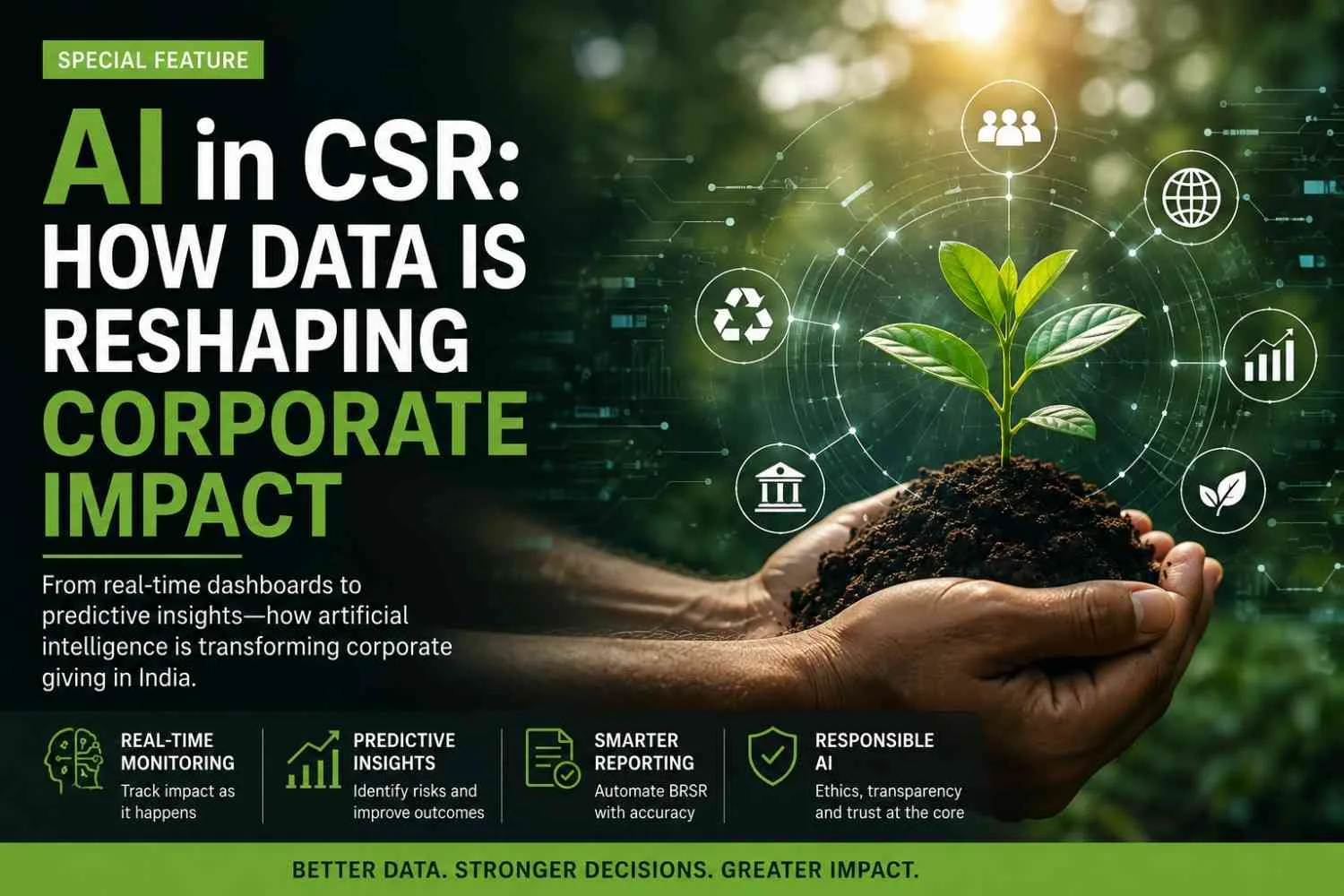
Kolkata | August 5, 2026 Artificial intelligence is rapidly transforming how companies measure, monitor and report the impact of their CSR initiatives. From predicting school dropout risks to automating sustainability disclosures, AI promises faster insights and greater accountability. Yet as algorithms begin shaping corporate giving, questions over data quality, ethical safeguards and reporting credibility are becoming impossible to ignore. Quick SummaryCorporate Social Responsibility (CSR) is entering a new phase where artificial intelligence is reshaping how social impact is measured. Companies are increasingly moving beyond annual spreadsheets and manual surveys towards real-time dashboards, predictive analytics and automated reporting systems capable of tracking beneficiaries, identifying programme risks and simplifying Business Responsibility and Sustainability Reporting (BRSR) disclosures. While these technologies promise greater efficiency and evidence-based decision-making, they also raise concerns around algorithmic bias, privacy, data manipulation and the growing gap between digital dashboards and realities on the ground. As regulators encourage greater transparency and companies invest in AI-powered impact platforms, the debate is shifting from whether AI should be used in CSR to how it can be deployed responsibly without compromising trust or accountability. KeywordsAI in CSR, CSR Impact Measurement, Artificial Intelligence, BRSR Reporting, Responsible AI, ESG Reporting, Corporate Sustainability, CSR Technology, Predictive Analytics, Real-Time Impact Monitoring   Can artificial intelligence transform corporate giving into measurable social impact- or is technology moving faster than accountability? Not long ago, assessing the success of a Corporate Social Responsibility (CSR) project was a slow and largely manual process. Field teams travelled to project locations with paper surveys, NGOs maintained handwritten records, and corporate CSR departments often spent weeks compiling data before presenting annual impact reports. By the time the data reached the decision-makers, it was too late to make timely course corrections. That approach is changing rapidly. Today, a CSR manager overseeing a digital education initiative can monitor student attendance through live dashboards, receive alerts when learning outcomes begin to decline and identify schools at risk of higher dropout rates in real time. Healthcare programmes can track patient follow-ups digitally, livelihood projects can monitor income trends through mobile applications, and sustainability teams can use automated systems to support Business Responsibility and Sustainability Report (BRSR) disclosures. This transformation reflects a broader shift in corporate India. As companies face growing expectations to demonstrate measurable social and environmental impact rather than simply report CSR spending, artificial intelligence is emerging as an important decision-support tool. Instead of relying solely on end-of-project evaluations, organisations are beginning to use AI, predictive analytics and cloud-based platforms to monitor programmes as they unfold, enabling faster and more informed interventions. The potential benefits are significant.AI can analyse large volumes of beneficiary data within seconds, identify trends that might be overlooked through manual analysis and help organisations allocate resources more efficiently. Supporters argue that this allows CSR programmes to move beyond reactive problem-solving towards proactive decision-making, addressing challenges before they affect project outcomes. Yet the growing reliance on AI also raises an important question: Can technology fully measure social impact? Community development is influenced by trust, behaviour, local realities and human relationships-factors that cannot always be captured through algorithms or dashboards. A decline in school attendance may be visible in digital data, but technology alone cannot explain whether the cause is seasonal migration, financial hardship or inadequate school infrastructure. Similarly, a healthcare platform may accurately record beneficiary numbers while failing to reflect barriers such as accessibility, awareness or social stigma. As AI becomes more deeply integrated into corporate philanthropy, the challenge is no longer collecting larger volumes of data. But to ensure that technology strengthens accountability without creating a false sense of precision. In the end, better dashboards do not automatically lead to better decisions, and measuring social impact will continue to depend as much on human judgement as on artificial intelligence. From Reporting Projects to Predicting Outcomes The evolution of CSR reporting reflects a broader shift in corporate sustainability -  from documenting activities to demonstrating measurable impact. For years, the success of CSR initiatives was largely measured through inputs such as funds spent, beneficiaries reached and projects completed during a financial year. While these indicators met statutory reporting requirements, they revealed little about whether programmes had created lasting social or environmental value. Artificial intelligence is beginning to change that approach. Rather than being used only at the end of a project for reporting, AI is becoming part of programme implementation itself. Companies are adopting cloud-based dashboards, geospatial mapping, computer vision and machine learning to monitor projects in real time, enabling CSR teams to identify risks early, compare interventions and make timely course corrections before resources are exhausted. The impact is particularly visible in education. Instead of relying solely on annual assessments, AI-enabled systems can analyse attendance, classroom engagement, learning patterns and assessment results almost in real time. Predictive models can identify students showing early signs of disengagement, allowing implementing agencies to intervene before irregular attendance leads to permanent dropout. Similar applications are being explored in skill development programmes, where algorithms help identify trainees who may need additional mentoring or financial assistance based on participation and completion trends. Healthcare initiatives are undergoing a similar transformation. Community health workers use mobile applications to upload patient data directly from the field, while AI-assisted platforms monitor vaccination coverage, treatment adherence and disease patterns across regions. Rather than measuring success only through the number of health camps organised, organisations can now track follow-up visits, treatment outcomes and areas requiring additional intervention. Livelihood programmes are also benefiting from predictive analytics. Digital platforms monitoring self-help groups, farmer producer organisations and micro-enterprises can detect changes in income, productivity and market access, enabling implementing partners to respond before financial challenges undermine programme objectives. Instead of evaluating outcomes only after a project ends, AI is helping organisations identify emerging risks while corrective action is still possible. AI is also reshaping corporate sustainability reporting. The introduction of the Business Responsibility and Sustainability Report (BRSR) by the Securities and Exchange Board of India (SEBI) has significantly increased the volume of environmental, social and governance (ESG) data that listed companies are required to disclose. Collecting, verifying and consolidating this information across multiple business units has made manual reporting more time-consuming and complex. To address this, many organisations are adopting AI-powered reporting platforms that integrate data from operational systems, identify inconsistencies, flag missing disclosures and generate draft sustainability reports. Beyond reducing administrative effort, these systems improve reporting consistency and allow management teams to focus more on analysing performance than compiling documentation. Despite these advances, however, AI remains only as reliable as the data it receives. Artificial intelligence can identify patterns, generate insights and predict future trends, but it cannot compensate for incomplete records, inaccurate field reporting or weak verification processes. Poor-quality data inevitably leads to unreliable analysis, regardless of how advanced the technology may be. For this reason, many experts view AI not as a replacement for human oversight but as a tool that strengthens decision-making when supported by credible data, robust governance and effective monitoring systems. How AI Is Changing CSR Traditional CSR MonitoringAI-Driven CSR MonitoringAnnual surveysReal-time dashboardsManual beneficiary recordsAutomated data collectionEnd-of-project evaluationContinuous performance trackingReactive interventionsPredictive analyticsSpreadsheet reportingAutomated BRSR disclosures Key takeaway: AI is shifting CSR from measuring what happened to anticipating what could happen next.  When Algorithms Meet Accountability Artificial intelligence is transforming the way CSR programmes are monitored and evaluated, but it is also introducing a new set of ethical and operational challenges. As organisations rely on algorithms to guide decisions, an important question is emerging: Can technology strengthen accountability without compromising trust? At the heart of this debate, lies the quality of data.AI systems can only produce reliable insights when the underlying data is accurate, complete and consistent. Incomplete beneficiary records, duplicate entries or reporting errors can generate misleading conclusions that appear highly credible because they are supported by sophisticated dashboards and predictive models. Unlike manual reporting, where inconsistencies are often easier to identify, algorithm-driven analysis can sometimes conceal data quality issues behind polished visualisations. This concern is particularly relevant in CSR impact assessment. Many companies and CSR consultants now use AI-enabled platforms to consolidate data from education, healthcare, livelihood and environmental programmes. While automation has significantly improved reporting efficiency, experts caution that it should complement and not replace independent field verification. Without regular validation, inaccurate beneficiary records, duplicate entries or inconsistencies across projects can find their way into impact reports and sustainability disclosures. In many cases, these errors are not intentional. Different implementing partners often use varying reporting formats, beneficiary definitions and data collection methods. A beneficiary participating in multiple programmes may be counted more than once, while attendance, outreach and engagement may be measured using different indicators across projects. AI can process these datasets rapidly, but unless the information is standardised and verified, technology may reinforce inconsistencies rather than eliminate them. Privacy and data security have also become major considerations. AI-powered CSR platforms collect personal information such as age, location, income, educational performance and health records to improve programme design and delivery. Although this enables more targeted interventions, it also raises important questions about informed consent, data ownership and cybersecurity. Many beneficiaries, particularly in rural and digitally underserved communities, may have limited awareness of how their information is collected, stored or used. To address these concerns, experts are calling for stronger ethical safeguards around the use of AI. Greater transparency in algorithms, human oversight, robust data governance, protection of sensitive information and regular third-party audits are increasingly seen as essential for ensuring that AI strengthens accountability without creating new risks. There is also a growing recognition that not every aspect of social impact can be measured through technology. AI can efficiently analyse beneficiary numbers, attendance, training hours and financial disbursements while identifying patterns that may indicate emerging programme risks.  Affected VoicesDevelopment organisations working at the grassroots say artificial intelligence is making programme monitoring faster, but not necessarily simpler.NGOs involved in education, healthcare and livelihood projects argue that digital dashboards can highlight patterns, yet they cannot replace conversations with communities. A field worker may know why a child has stopped attending school, why a family refuses a healthcare intervention or why a self-help group is struggling despite positive financial indicators- insights that rarely appear in automated reports.Consumer and civil society organisations also caution that communities should not become passive data points. They argue that beneficiaries must understand how their information is collected, stored and used, particularly as AI systems become more integrated into social programmes. For them, responsible technology is not only about better analytics but also about protecting privacy, maintaining informed consent and ensuring that people remain at the centre of every CSR intervention. However, it remains far less effective at measuring outcomes such as community trust, behavioural change, social inclusion and local ownership- factors that often determine the long-term success of CSR initiatives. For this reason, development practitioners continue to emphasise the importance of human engagement alongside technological analysis.AI can identify that attendance in a vocational training programme is declining, but conversations with beneficiaries are often needed to understand whether transport costs, household responsibilities or seasonal employment are driving that trend. Technology can reveal patterns, but people provide the context that explains them. As AI becomes more deeply embedded in corporate philanthropy, the future of CSR impact measurement is likely to depend on balancing automation with accountability. Organisations that combine advanced analytics with transparent governance, independent verification and continuous engagement with communities will not only generate more reliable evidence but also strengthen public trust in the impact they seek to create. AI Can Measure, But Can It Understand?AI Measures Well Beneficiary numbers  Attendance and participation  Learning outcomes  Health follow-ups  Resource utilisation  Reporting efficiency  Humans Still Matter For Community trust Behavioural change Inclusion and dignity Local context Cultural realities Independent verification Key takeaway: Artificial intelligence can improve measurement- but meaningful impact still requires human judgment. When Evidence Meets ScrutinyAs artificial intelligence becomes an integral part of CSR monitoring, experts argue that the technology itself must be evaluated as rigorously as the programmes it measures. A sophisticated dashboard may present real-time insights and impressive visualisations, but its credibility ultimately depends on the quality of data, the methodology behind the analysis and the transparency of the reporting process. The first challenge lies in how impact is measured. CSR programmes often use different indicators to define success. An education initiative may focus on attendance or learning outcomes, while a healthcare project may measure beneficiary reach, treatment adherence or long-term health improvements. When AI systems analyse datasets built on different definitions and reporting standards, comparing outcomes across projects becomes difficult, even if the technology functions accurately. For this reason, development economists and impact evaluation specialists continue to emphasise the importance of establishing reliable baselines before introducing AI-driven monitoring. Without a clear starting point, it is difficult to determine whether a programme has genuinely improved people's lives or simply produced more data. An algorithm may report a significant increase in school attendance, but the finding has limited value unless it is measured against credible baseline data and tracked consistently over time. Another challenge is distinguishing the impact of a single intervention from broader social change. AI platforms can efficiently capture data generated within CSR programmes, but they cannot always account for external factors that influence outcomes. Improvements in school attendance, for example, may reflect not only a company's education initiative but also better government infrastructure, scholarship schemes or wider community participation. As a result, experts caution against treating AI-generated correlations as conclusive evidence of impact. Benchmarking presents similar limitations. Many AI platforms allow organisations to compare CSR performance across projects, districts or business units. However, such comparisons are meaningful only when programmes operate under similar conditions and pursue comparable objectives. Comparing projects with different beneficiary groups, geographies or impact indicators may produce conclusions that are statistically sound but practically misleading. This is why independent assurance remains essential. AI can quickly identify anomalies, missing records and unusual reporting patterns, but it cannot replace field verification, beneficiary feedback, external audits or independent programme evaluations. Experts argue that technology is most valuable when it strengthens existing evaluation processes rather than serving as a substitute for them. The growing investment in AI also raises important questions about transparency. Companies are allocating substantial resources towards digital CSR platforms, cloud infrastructure, analytics and cybersecurity. Yet annual reports rarely distinguish expenditure on AI-enabled monitoring from broader CSR administration or programme implementation. This makes it difficult for stakeholders to assess whether these investments are improving programme delivery or primarily enhancing reporting efficiency. Ultimately, the success of AI in CSR will not be measured by the volume of data it generates, but by the quality of the decision it supports. Technology can strengthen accountability and improve impact measurement, but only when it is backed by transparent methodologies, credible data, independent verification and meaningful human oversight. Evidence Check: Questions Every AI-Powered CSR Dashboard Should Answer   Evidence TestWhy It MattersIs the methodology publicly explained?Ensures transparency and comparability.What is the baseline?Measures real change, not isolated data points.Has the data been independently verified?Reduces reporting bias and inflation.Are reporting boundaries clearly defined?Prevents misleading impact claims.Does AI support or replace field verification?Human validation remains essential.Is investment in AI transparently disclosed?Demonstrates accountability beyond technology adoption. Key takeaway: Artificial intelligence can process information at extraordinary speed, but trustworthy CSR still depends on evidence that is transparent, independently verified and grounded in reality. Beyond the Dashboard Artificial intelligence is transforming the way companies design, monitor and evaluate their CSR initiatives. What was once driven by periodic surveys and retrospective reporting is evolving into a system supported by real-time data, predictive analytics and continuous monitoring. For businesses, this means faster decision-making and more informed resource allocation. For regulators and stakeholders, it offers the potential for greater transparency, consistency and accountability in sustainability reporting. However, technology alone cannot guarantee meaningful impact. The value of AI will ultimately depend on the quality of the data it processes, the transparency of the methodologies behind it and the governance system that ensures every insight is credible and independently verifiable. While dashboards can identify patterns and emerging risks, they cannot replace human judgement, community engagement or an understanding of the local realities that shape social outcomes. As AI becomes gradually embedded in corporate philanthropy, the conversation is shifting from whether it should be adopted to how responsibly it should be used. Its long-term success will not be measured by the sophistication of its algorithms, but by its ability to strengthen decision-making, build public trust and deliver measurable improvements where they matter the most. Ultimately, no algorithm, dashboard or report can define the success of CSR. Its true measure will always be the positive and lasting change it brings to people's lives. Evidence Check ParameterStatusMethodology disclosedPartial – Varies by platformIndependent verificationEssential but inconsistentBaseline comparisonRequired for credible impact measurementAI ethics & privacyIncreasing regulatory focusHuman field validationStill indispensableAI investment disclosureLimited in public CSR reports   Key TakeawaysAI is shifting CSR from annual reporting to real-time monitoring. Predictive analytics can identify programme risks before they escalate. BRSR reporting is accelerating AI adoption across listed companies. AI cannot replace field verification or community engagement. Transparency and independent audits remain essential for credible impact reporting. Primary Sources:  Ministry of Corporate Affairs (MCA) – Corporate Social Responsibility (CSR) Framework & Companies Act, 2013https://www.mca.gov.in/ Securities and Exchange Board of India (SEBI) – Business Responsibility and Sustainability Reporting (BRSR) Frameworkhttps://www.sebi.gov.in/ NITI Aayog – Responsible AI for All: Strategy and Discussion Papershttps://www.niti.gov.in/ Ministry of Electronics and Information Technology (MeitY) – IndiaAI Mission & AI Governance Initiativeshttps://www.meity.gov.in/ CSRBOX – CSR Intelligence, Case Studies & Impact Measurement Resourceshttps://csrbox.org/ Microsoft AI for Good – AI Applications for Social Impact and Sustainable Developmenthttps://www.microsoft.com/en-us/ai/ai-for-good World Economic Forum (WEF) – Artificial Intelligence Governance & Responsible AI Reportshttps://www.weforum.org/ J-PAL South Asia – Evidence-Based Programme Evaluation and Impact Measurementhttps://www.povertyactionlab.org/south-asia ...Read more

29 Jul 2026

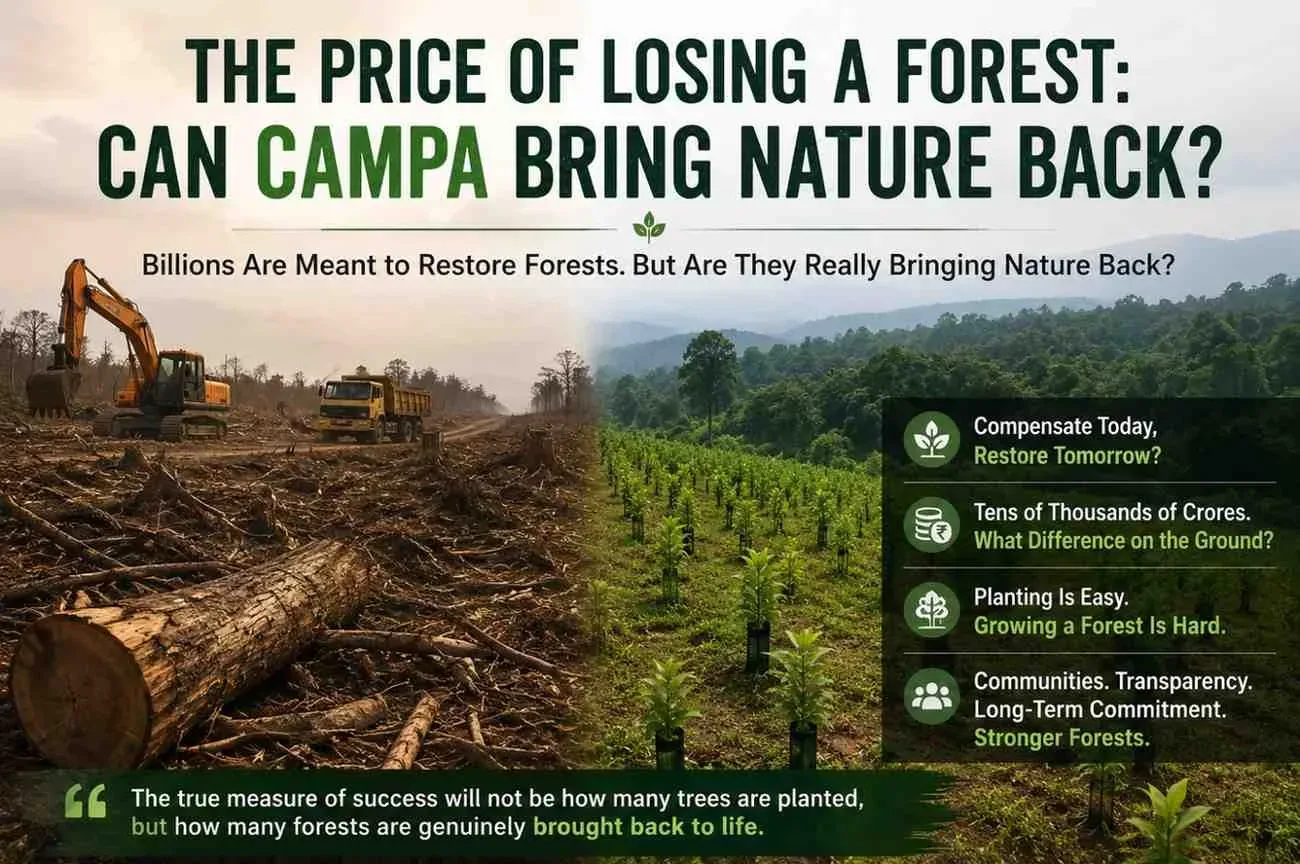
Billions Are Meant to Restore Forests. But Are They Really Bringing Nature Back?   Every time forest land is diverted for highways, railways, mines or industrial projects, developers are expected to compensate by creating forests elsewhere. On paper, the principle appears simple: replace what is lost. But the debate is no longer about whether compensation is provided- it is about whether it truly replaces what has been lost. The real test of compensatory afforestation is not the number of saplings planted, but whether lost forests are truly being restored.That question has gained renewed attention after the 10th July meeting of the National Compensatory Afforestation Fund Management and Planning Authority (CAMPA), where officials reviewed the implementation of one of India's largest ecological restoration programmes. The meeting may have focused on fund utilisation and afforestation progress, but it revived a much larger question: are CAMPA funds creating resilient forest ecosystems, or are they only measuring success through plantation numbers?  Understanding CAMPA CAMPA was created around a simple principle: when forests are lost to development, the ecological cost should be invested back into restoration. Under the mechanism, developers who divert forest land for non-forest purposes contribute funds towards rebuilding forest ecosystems elsewhere.These funds support afforestation, natural regeneration, wildlife conservation, forest protection, soil and water conservation, fire prevention and improvements in forest management infrastructure. CAMPA now represents one of India's largest environmental funding pools, with tens of thousands of crores dedicated to compensating for forest loss.The challenge, however, is not only how much money is available- it is whether that money is rebuilding forests or merely adding to plantation statistics. The Bigger Question Isn't Spending- It's Ecological Recovery Much of the attention on CAMPA revolves around fund utilisation. Rather than asking how much money has been spent, experts say the more important question is what difference those investments have made on the ground.Plantation numbers may look impressive on paper, yet forests cannot be measured by saplings alone. A healthy forest supports wildlife, stores carbon, protects water and soil, and provides livelihoods for communities that depend on it. Restoration cannot be measured by plantation numbers alone. If saplings fail to survive or diverse natural forests give way to monoculture plantations, the ecological gains may remain limited despite substantial investments. Ecologists say the conversation must move beyond how much was spent to what ecological outcomes were achieved. Planting Is Easy- Growing a Forest Is Hard One of the biggest questions surrounding compensatory afforestation is what happens after the plantation drive ends. Saplings need years of monitoring, protection and maintenance before they can grow into self-sustaining forests. Without sustained care, survival rates can fall significantly, limiting the ecological value of restoration efforts. Many environmental experts argue that public reporting should go beyond the number of saplings planted and include their survival after three, five and even ten years. Such long-term monitoring would provide a more reliable measure of whether restoration efforts are creating lasting ecological benefits. Can New Plantations Replace Natural Forests? The debate extends beyond the number of trees planted. An equally important question is whether newly created plantations can truly compensate for the loss of mature natural forests. Many researchers argue that plantation figures tell only part of the story.A natural forest is far more than a collection of trees. It develops over decades or centuries, supporting biodiversity and ecological processes that cannot be recreated overnight. Compensatory plantations, often made up of fewer species, may not fully replace these functions.That is why many conservationists argue that success should be measured by ecological restoration rather than plantation targets. Restoring degraded ecosystems, conserving existing forests and planting native species are widely considered more effective ways to rebuild resilient landscapes. Restoring Forests Requires Restoring PartnershipsForest restoration is not just an ecological exercise- it is also a community effort. Many experts argue that Indigenous communities, forest-dependent households and local residents should be treated as partners rather than participants. Their understanding of local ecosystems can improve the choice of native species, strengthen long-term management and increase plantation survival. Equally important, community involvement helps maintain accountability long after the plantation drive is over. Transparency Strengthens Accountability Many experts believe that transparency is essential to improving forest restoration. They argue that district-level information on CAMPA projects- including where funds are spent, how plantations are performing and what ecological outcomes are being achieved- should be easily accessible to the public. Greater openness would allow citizens to track progress, strengthen accountability and help governments identify restoration approaches that deliver the best results. More Than Planting TreesIndia's environmental commitments have made CAMPA a critical instrument for forest restoration. But its legacy will not be determined by financial allocations or plantation statistics alone. It will be determined by whether today's investments restore ecosystems that can withstand climate change, protect biodiversity and support future generations. In the years ahead, the true measure of success will not be how many trees are planted- it will be how many forests are genuinely brought back to life.         Sources: National Compensatory Afforestation Fund Management and Planning Authority (CAMPA) – Ministry of Environment, Forest and Climate Change (MoEFCC)https://moef.gov.in/en/division/forest-and-wildlife-division/national-campa/ Compensatory Afforestation Fund Act, 2016 (CAF Act) – Government of Indiahttps://legislative.gov.inForest Survey of India (FSI) – India State of Forest Report (ISFR)https://fsi.nic.in Down To Earth – Environment and forest restoration coverage, including CAMPA implementation and afforestation debateshttps://www.downtoearth.org ...Read more

29 Jul 2026

A deficit monsoon that is still drowning people India's monsoon crisis of 2026 appears contradictory only from a distance. The country has received below-normal rainfall overall, farmers in several regions are confronting moisture stress, reservoirs remain worryingly depleted, and kharif sowing has fallen behind last year. Yet, at the same time, Assam has suffered one of its most damaging floods in recent years, Arunachal Pradesh has seen nearly its entire district map disrupted at once, Himalayan states are reporting landslides and blocked roads, and intense rainfall episodes are inundating cities and villages from Odisha to Uttarakhand — while Mumbai and Kolkata have each been paralysed by their own floodwaters, and Karnataka has asked farmers to simply stop sowing. By July 28, the nationwide monsoon rainfall deficit had narrowed to approximately 16 percent, after reaching nearly 40 percent at the end of June. But this apparent recovery has not come through steady, farm-friendly rain. It has largely arrived through violent, concentrated downpours separated by prolonged dry spells. This is the defining feature of the Indian monsoon of 2026: rain is falling in the wrong places, at the wrong intensity, and increasingly at the wrong time. India is not merely experiencing a weak monsoon. It is experiencing a dangerously disorganised one. Late arrival, long pause, sudden violence The southwest monsoon reached Kerala around three days later than usual. It then stalled for nearly two weeks across important agricultural regions of western and central India. June ended with a severe national rainfall shortage. The monsoon subsequently accelerated, but unevenly. Low-pressure systems and depressions delivered bursts of extreme rainfall, while large areas continued to receive substantially less rain than normal. Between June 1 and July 22, India had received 19 percent less rainfall than the long-period average. The geographical imbalance was even sharper: East and Northeast India were approximately 32 percent deficient. The southern peninsula was around 26 percent deficient. Northwest India had a deficit of about 13 percent, while central India was approximately 9 percent below normal. These regional averages conceal extraordinary local variations. A district may receive almost no meaningful rain for two weeks and then receive a month's rainfall in several hours. The monthly total may eventually approach "normal," but the agricultural, hydrological and human consequences are anything but normal. A field needs moderate rain that penetrates the soil. Instead, torrential rain often rushes away as surface runoff, eroding topsoil, flooding settlements and leaving groundwater inadequately replenished. India's two monsoons are happening together The 2026 monsoon has effectively divided India into overlapping zones of emergency. In parts of Bihar, Jharkhand, eastern Uttar Pradesh and the Gangetic agricultural belt, prolonged rainfall deficits created drought-like conditions during crucial sowing weeks. By July 10, rainfall was below normal in 397 of India's 741 districts, while the area under kharif cultivation was approximately 16 percent lower than at the corresponding point in 2025. Conditions improved later in July, but the sowing deficit did not disappear. By July 24, farmers had planted approximately 78.7 million hectares, against 82.6 million hectares a year earlier. Rice cultivation was slightly behind last year, soybean acreage was down around 3 percent, cotton acreage approximately 4 percent, and maize sowing almost 10 percent lower. Sugarcane was one of the few major crops showing an increase. Karnataka has offered the sharpest illustration of this stress in the south. The state recorded a rainfall deficit of around 30 percent up to July 11 — having received only 203 mm of rain against a normal of 292 mm — prompting Chief Minister D.K. Shivakumar to write directly to the Prime Minister seeking a central assessment team. June alone was the state's fourth-worst in fifty years, with just 116 mm of rain against a 165–190 mm normal, a 42 percent shortfall. The Malnad region, the principal catchment for the Cauvery, Tunga and Bhadra systems, recorded the state's worst deficit at 34 percent, with the coastal belt close behind at 30 percent. The Tungabhadra reservoir near Hosapete held just 9.47 TMC ft of water against 61.88 TMC ft a year earlier — an 85 percent collapse in storage that has, in comparable past seasons, forced authorities to instruct farmers in the Cauvery basin to halt further sowing altogether. At the same moment, parts of Assam and Arunachal Pradesh were underwater. This coexistence is scientifically possible because flood and drought describe different dimensions of water stress. A flood is caused by excessive rainfall or river discharge over a short period and within a particular basin. Drought reflects accumulated rainfall deficiency, reduced soil moisture, poor groundwater recharge, falling reservoir storage and agricultural stress over time. India can therefore be flooded locally while remaining rainfall-deficient nationally. Assam: an upstream deluge becomes a human disaster Assam's late-July floods exposed the terrifying speed at which a localised rainfall event can become a regional humanitarian emergency. Very heavy rainfall over neighbouring Nagaland between July 18 and July 20 generated exceptionally high river flows entering Assam. By July 23, approximately 650,000 people across 11 districts had been affected and at least 36 deaths had been reported during that phase of the disaster. The crisis subsequently expanded. At its late-July peak, reports indicated that at least 50 people had died, approximately 700,000 had been displaced, nearly 300,000 people were staying in government shelters and around 900 villages were submerged. Helicopters were used for relief drops, while police, disaster-response forces, volunteers and civil administrators conducted rescues. By July 28, Assam's cumulative flood death toll had reportedly risen to 68, while more than 445,000 people remained affected across districts including Sivasagar, Charaideo, Jorhat, Golaghat, Nagaon and Kamrup Metropolitan. These changing numbers do not represent statistical confusion. They reflect the movement of water: some areas emerge from inundation as others are submerged, displaced residents begin returning, and new deaths or missing persons are recorded. The state's flood wave first hit Dhemaji, Lakhimpur and Dibrugarh, affecting over 22,000 people and nearly 100 villages, before riverbank erosion partially collapsed a railway bridge over the Simen River at Simen Chapari, cutting off train services and isolating villages overnight. On the ground, response has been substantial: 250 NDRF personnel, 36 NDRF boats, 65 SDRF and Fire Services boats, three Indian Army boats and 82 mobilised country boats have operated around Majuli and the worst-hit districts, alongside 71 relief camps and 202 relief distribution centres. The Chief Minister's Relief Fund has directed distribution of over 4 lakh bottled water units, nearly 2 lakh biscuit packets and roughly 40,000 milk packets for infants, while Cabinet ministers have been stationed in Charaideo and Sivasagar since the floods began. Prime Minister Narendra Modi has personally reviewed relief operations and ordered a full damage assessment, even as opposition leaders have pressed for faster release of PM-CARES funds. Why does Assam flood again and again? Extreme rainfall is the immediate trigger. It is not the complete explanation. The Brahmaputra is a vast, sediment-heavy and highly dynamic river system. It receives water from intense monsoon rain, Himalayan tributaries and numerous upstream catchments. Its channels naturally shift, islands erode and floodplains absorb seasonal excess water. But human interventions have progressively reduced the landscape's capacity to live with the river. Catchment degradation and deforestation accelerate erosion. Sediment raises riverbeds and reduces channel-carrying capacity. Wetlands and natural water-retention areas are encroached upon. Roads, housing projects and commercial construction block traditional drainage channels. Urban drains are undersized, poorly connected or clogged with waste. Assam's own urban-flood planning documents acknowledge that rapid development has consumed vacant land and disrupted natural drainage. In Guwahati, the obstruction and encroachment of wetlands and beels have removed natural stormwater reservoirs, allowing even moderate rainfall to produce severe waterlogging. Embankments provide essential protection, but they can also create a false sense of permanence. When inadequately maintained embankments breach, water enters settlements with extraordinary force. Embankments may also trap rainwater inside protected areas when drainage outlets are insufficient. The result is a cycle of emergency expenditure without corresponding reduction in vulnerability. Arunachal Pradesh: the upstream disaster nobody watches closely enough If Assam is the downstream casualty, Arunachal Pradesh is where the water begins its rampage — and the state has been battered on its own terms too. In mid-July, incessant rainfall triggered flash floods in Kurung Kumey district and landslides across Pakke Kessang, West Kameng and Papum Pare districts. The State Emergency Operation Centre reported seven deaths, 29 injuries, and more than 97,000 people affected across 425 villages spanning all 26 districts of the state — nearly the entire state machinery mobilised at once. The damage inventory reads like an infrastructure ledger wiped out overnight: 150 roads damaged, 19 bridges lost, 21 culverts destroyed, 221 water supply systems disrupted, 58 government buildings hit, 156 power lines and 224 electric poles down, 10 hydel projects damaged, two hospitals and three schools affected, alongside 541.75 hectares of crop area and nearly 1,010 hectares of forest land impacted. In Kurung Kumey, flash floods from the overflowing Kumey River washed away bridges connecting the villages of Huri, Damin and Pagam; a church, an inspection bungalow, and St Thomas School in Parsi-Parlo were all damaged, halting classes. A massive landslide buried a stretch of National Highway-13 near Pakro village, and a section of the road leading to the strategically vital Sela Tunnel in West Kameng — a key route toward the China border — was washed away entirely. Downstream and around, the same monsoon has scattered damage widely: a Bailey bridge over the Phee Khola at Phidang in North Sikkim's Dzongu region was simply washed away, cutting off road connectivity, while Meghalaya's hill roads suffered fresh landslide disruptions of their own. Arunachal Pradesh illustrates, in miniature, the whole country's 2026 paradox: a state that can log both flood emergencies in its river valleys and rainfall deficits in its interior districts within the same season — sometimes the same week. The drought is hiding inside the reservoirs Flood images dominate television screens because they are immediate and dramatic. Reservoir depletion receives far less attention, although it can affect drinking water, irrigation, electricity generation and food prices for months. On July 23, the country's 166 monitored major reservoirs held approximately 70.4 billion cubic metres of water, equivalent to only about 38 percent of their combined capacity. Storage was around 36 percent lower than at the same time in 2025. More than 50 reservoirs were holding water at or below 80 percent of their normal level, while 22 were at half their normal storage or lower. Conditions were especially concerning in parts of southern India — a picture Karnataka's near-empty Tungabhadra reservoir makes vivid. This is hydrological stress, even when isolated districts are reporting floods. Much of the rain produced by cloudbursts and extreme spells runs rapidly into rivers and drains. It may cause destruction without adequately restoring groundwater or maintaining reservoir inflows. The nation receives water, but cannot retain it where and when it is needed. El Niño has disturbed the monsoon's rhythm The most prominent large-scale climate influence in 2026 is El Niño — the abnormal warming of the central and eastern equatorial Pacific Ocean. The World Meteorological Organization had assessed an approximately 80 percent probability of El Niño conditions during June–August 2026, with a very high probability that the event would continue into late autumn. By July, the India Meteorological Department reported that El Niño conditions were prevailing and strengthening, while the Indian Ocean Dipole remained neutral. El Niño often weakens India's seasonal monsoon circulation. But it does not simply switch off rainfall. It can weaken the broad flow of moisture while atmospheric disturbances, Bay of Bengal depressions, western disturbances, the movement of the monsoon trough and the Madden–Julian Oscillation still generate intense local rainfall. This year, western disturbances — normally quiet during the monsoon — have remained active and interacted directly with the monsoon current over Jammu & Kashmir and the western Himalaya, intensifying rainfall precisely where slopes are least equipped to absorb it. Research examining more than a century of observations indicates that some El Niño years can simultaneously increase the probability of seasonal rainfall deficiency and short-duration extreme rainfall over particular regions. Thus, fewer rainy days do not necessarily mean fewer disasters. They may mean that a larger proportion of the season's rain falls during a smaller number of violent events. Climate warming is loading the dice El Niño is a natural climate cycle. The background against which it now operates is no longer natural. India's average temperature increased by approximately 0.7°C between 1901 and 2018. A warmer atmosphere can hold more moisture, while rising sea-surface temperatures increase the potential supply of water vapour to monsoon systems. This produces an apparent paradox: warming can intensify both drought and flooding. Higher temperatures increase evaporation from soil, plants and reservoirs during rainless periods. But when atmospheric conditions finally trigger rain, the additional moisture can produce much heavier precipitation. The Intergovernmental Panel on Climate Change has projected increasing heavy precipitation over parts of Asia and the Himalayan region, alongside declining snow and glacier volumes. Climate change does not cause every individual flood or landslide. It multiplies the probability, intensity and consequences of extreme events occurring within already vulnerable landscapes. The Himalaya: a natural hazard turned into a construction zone The Himalaya are geologically young, steep and unstable. Their rocks are fractured, their slopes are vulnerable to erosion, and intense rain can rapidly saturate thin mountain soils. Yet natural fragility is only half the story. Road widening, uncontrolled hill cutting, blasting, hotel construction, hydropower infrastructure, poorly designed retaining walls and the dumping of excavated debris have transformed many mountain slopes. Drainage channels are frequently blocked or redirected. Buildings have expanded onto unstable slopes and river terraces without adequate geological assessment. India's Supreme Court, reviewing disaster patterns in Himachal Pradesh, has explicitly named hydroelectric power projects, four-lane road expansion, deforestation and unchecked multi-storey construction as drivers of "ecological destruction," warning that revenue "cannot be earned at the cost of the environment and ecology." India's national landslide atlas has mapped around 80,000 landslides recorded between 1998 and 2022 across 17 states and two Union Territories, and ranked 147 districts by landslide exposure. Many vulnerable corridors include major pilgrimage routes, highways and densely visited tourist centres. By July 28, rain and landslides had reportedly blocked as many as 179 roads in Himachal Pradesh, while at least 15 monsoon-related deaths had been recorded in the state. Glacial retreat compounds the risk. The Hindu Kush Himalaya region has seen glacial cover shrink 12 percent between 1990 and 2020, with a 21 percent decline in the Ganga basin alone. ISRO's Glacial Lakes Atlas has identified roughly 2,400 glacial lakes, of which 601 have doubled in size and are considered at risk of catastrophic breach. The 2023 Sikkim GLOF remains the starkest warning of what this looks like in practice: permafrost erosion triggered a landslide into South Lhonak Lake, producing a 20-metre flood surge that destroyed the Teesta-III dam, killed at least 90 people, and inundated 276 square kilometres of farmland. The 2023 Joshimath subsidence crisis and the 2025 Dharali flash flood — which buried a Himalayan village under 12–18 metres of sediment — are cut from the same cloth: tectonic stress compounded by construction, tunnelling and drainage failures that turned a natural hazard into a man-made catastrophe. The Northeast faces similar risks. Recent modelling of rain-triggered landslides in Mizoram suggests that simultaneous slope failures with little or no warning could become substantially more frequent under high-emissions warming scenarios. The study remains a modelling assessment rather than a precise forecast, but its warning is unmistakable: yesterday's engineering standards cannot be assumed to protect tomorrow's mountains. Metros drowning by design: Mumbai and Kolkata While hill states battle landslides and the Northeast battles rivers, India's two biggest western and eastern metros have spent the season proving that flooding isn't only a mountain or a river problem — it is also, unmistakably, an urban planning failure. Mumbai's stormwater drainage network was designed in the early twentieth century to handle roughly 25 mm of rainfall per hour — a fraction of what the city's monsoons now regularly deliver. The 2005 catastrophe, when the city recorded 944 mm of rain in 24 hours, was supposed to be the wake-up call; the Chitale Committee that followed recommended sweeping drainage reforms and a dedicated authority for the Mithi River. Two decades on, areas like Bandra Kurla Complex and Hindmata still flood on cue every season — 2017, 2019, 2021, 2023, 2025, and again in 2026. The city's exposure is structural and largely self-inflicted: Mumbai was built by reclaiming seven islands, leaving large portions of the metropolis below high-tide level to begin with. Its drainage outfalls discharge directly into the sea, which works fine at low tide — but when heavy rain coincides with high tide, sluice gates must be shut to stop seawater backflow, trapping rainwater inside the city with nowhere to go. Layer on decades of destroyed mangroves, blocked natural nullahs, and — as the Bombay High Court itself observed this July — citizen and civic complicity in encroaching on drains, blocking gutters, and converting footpaths and open channels into shops and parking, and you get a city whose flooding the court bluntly called "our own creation." Mumbai's open-space ratio has been measured at roughly 0.012 hectares per 1,000 people, against a desired standard of 1.67 hectares — a 140-fold shortfall that leaves almost nowhere for excess water to go except the streets. Kolkata's flooding operates on an almost identical playbook. In one recent extreme event, the city logged 252 mm of rain in seven hours — arriving at the same moment as high tide on the Hooghly, forcing the Kolkata Municipal Corporation's drainage department to shut sluice gates and trap the deluge inside the city. As Mayor Firhad Hakim put it, describing the scale of the downpour: the canals and rivers were already full, so every attempt to drain the city simply invited more water back in. The deeper story is ecological. Kolkata's eastern wetlands once functioned as the city's natural stormwater sponge — but decades of illegal landfilling along the Eastern Metropolitan Bypass have destroyed much of that buffer for construction. Combined with a colonial-era sewerage network never rebuilt for today's population density, the result is a city where a few hours of intense rain can paralyse roads, rails, the Metro, hospitals, and festival infrastructure alike. The KMC's own diagnosis has been candid: erratic weather patterns are now delivering brief, torrential downpours that simply exceed what the ageing drainage network can pump into the canals in time. In response, the corporation has begun constructing rainwater-collection reservoirs at more than 50 identified "water pocket" locations, aiming to both cut waterlogging and recharge depleting groundwater — an admission, in itself, that pumping alone can no longer keep pace with the rain. Relief is necessary. Rehabilitation must not recreate risk Governments have mobilised rescue teams, opened relief camps, distributed food and drinking water, restored communications and used helicopters in inaccessible areas. The Prime Minister and Assam's Chief Minister have reviewed the flood situation, while central assessment teams and state agencies have begun examining losses and rehabilitation needs. In Himalayan states, highway authorities have identified vulnerable locations, positioned machinery and emergency teams, and undertaken slope stabilisation, retaining-wall, drainage and erosion-control work. In Arunachal Pradesh, the State Emergency Operation Centre has coordinated restoration of roads, bridges and water systems even as damage assessments continue across all 26 districts. In Mumbai and Kolkata, municipal corporations have leaned on additional pumps, desilting drives, and new underground rainwater-storage reservoirs — tactical measures that civic officials themselves concede are stopgaps against a structurally undersized system. But relief measured only by food packets, rescue boats and compensation cheques is incomplete. Relief camps need safe water, sanitation, health surveillance, menstrual hygiene facilities, child protection, disability access and arrangements for livestock. Families losing crops, shops, fishing equipment or daily-wage employment need immediate livelihood assistance, not merely compensation for damaged houses. Rehabilitation must rebuild schools, clinics, transport links and local markets — not only physical dwellings. Most importantly, homes repeatedly destroyed by erosion or landslides should not simply be reconstructed at the same location. Stop repairing disasters. Start redesigning risk Assam already has major flood-management initiatives supported by the World Bank and the Asian Development Bank. These include institutional strengthening, better flood forecasting, embankment and river-management measures, erosion control and climate-resilient infrastructure. Their success must be judged not by money spent or embankment kilometres completed, but by lives protected, warnings delivered, evacuation time gained and repeated displacement prevented. Every major flood and landslide should trigger an independent, publicly available review examining land-use violations, wetland destruction, drainage failures, embankment maintenance, road design, debris disposal, reservoir operations and administrative response. India needs legally enforceable floodplain zoning. Urban wetlands must be mapped, protected and restored — in Guwahati's beels, Kolkata's eastern marshes and Mumbai's mangroves alike. Encroachments blocking natural watercourses cannot be regularised indefinitely and then blamed on "unprecedented rain." Each embankment should have a public asset register, pre-monsoon safety certification and clearly identified maintenance responsibility. River management must incorporate sediment and erosion control, not merely build higher walls against water. The Himalaya needs a carrying-capacity test Every road, tunnel, hydropower project, hotel cluster and township in vulnerable mountain districts should be evaluated cumulatively. A project may appear manageable in isolation. Ten projects on the same unstable slope or river valley may create an entirely different hazard. High-susceptibility zones need strict no-construction rules. Road engineering must give priority to drainage, controlled excavation, slope reinforcement and scientific disposal of debris. Pilgrimage and tourism numbers should be aligned with local carrying capacity, evacuation routes and waste-management infrastructure. Development cannot be called development when each monsoon washes it away and leaves local residents to carry the debt, debris and deaths. Forecasts must reach the last household The IMD is increasingly issuing impact-based rainfall warnings, including alerts for flash flooding, landslides, crop damage and urban inundation. During the final week of July, it warned of extremely heavy rainfall across parts of Odisha, Chhattisgarh, Madhya Pradesh and Gujarat, along with very heavy rainfall over Himalayan states. But a forecast is only as useful as the action it triggers. Warnings must be converted into local languages, cell-broadcast alerts, sirens, community announcements and pre-agreed evacuation orders. Village volunteers, schools, local health workers and elected representatives must know exactly what a red or orange warning requires them to do. Forecast accuracy cannot compensate for administrative hesitation. 2026 is not an abnormal year to be forgotten The Indian monsoon of 2026 is a warning about the future of adaptation. It demonstrates that national rainfall averages are no longer enough. Policymakers must examine rainfall intensity, dry-spell duration, soil moisture, reservoir storage, district-level crop conditions and the exposure of people living along rivers, hills and urban drains. India requires an adaptation architecture capable of responding to simultaneous scarcity and excess. Farmers need drought-resistant seeds, crop insurance that pays quickly, local water harvesting and advisories based on actual soil conditions. Cities need permeable surfaces, functioning drains and restored wetlands. Floodplains need space for rivers. Himalayan districts need enforceable geological limits. Erosion-displaced families need legal recognition, secure relocation and livelihood support. The choice is no longer between development and environmental protection. The real choice is between development that survives the monsoon and development that becomes its next casualty. India is receiving less rain than normal nationally while people are dying from too much water locally. That is not a contradiction to be explained away. It is the clearest possible signal that the climate has changed faster than the country's systems of planning, construction, agriculture and disaster governance. The rain is no longer waiting for India to adapt.   Sources referred to India Meteorological Department (IMD) — seasonal and district-wise rainfall bulletins, 2026World Meteorological Organization (WMO) — El Niño probability assessments, 2026Intergovernmental Panel on Climate Change (IPCC) — regional precipitation and glacier projectionsAssam State Disaster Management Authority / Chief Secretary review bulletins, July 2026Assam Chief Minister's Office / DRIMS (Disaster Reporting and Information Management System) bulletinsANI — "NDRF, SDRF providing special support in Assam": Union Minister Sarbananda Sonowal (July 24, 2026); "Assam flood death toll rises to 68, CM Himanta Biswa Sarma directs coordinated relief operations"Assam Tribune — "Assam plans minister-led rehabilitation in flood-hit districts after Assembly"Sentinel Assam — "Assam Chief Secretary Reviews Flood Situation, Directs Faster Relief and Restoration in Worst-Hit Districts"Asian Mirror — "Assam Floods Turn Deadly: Death Toll Reaches 62, Over 7 Lakh People Affected"The Tribune — "Kharge targets BJP over Assam floods, demands immediate PM-CARES relief"State Emergency Operation Centre (SEOC), Government of Arunachal Pradesh — disaster bulletins, July 2026India TV News — "7 killed, over 97,000 affected as heavy rains trigger landslides, flash floods in Arunachal" (July 2026)Daily Pioneer — "Fresh Floods and Landslides Hit Arunachal Pradesh, Over 97,000 Affected" (2026); "Himalayan Climate Crisis: Why India Must Rethink Mountain Development Before It's Too Late"The News Minute — "Floods and landslides batter northeast India"Union Ministry of Agriculture and Farmers Welfare — kharif sowing progress data, 2026Central Water Commission — national reservoir storage bulletins, 2026News9live — "Karnataka CM writes to PM over worsening drought after 30% rainfall deficit"; "Karnataka sees 42% June rain deficit, Tungabhadra storage drops sharply"Deccan Chronicle — "Karnataka: 'Send A Central Team...' CM Tells PM"The Hans India — "Wide deficit in southwest monsoon rainfall sparks drought concerns"Tractor For Everyone — "IMD Monsoon 2026 Forecast: Below-Normal Rains & Kharif Sowing Impact"Sunday Guardian Live — "Mumbai Monsoon Arrival 2026: Is the City Ready to Tackle Waterlogging?"Free Press Journal — "Mumbai's Flooding, 'Our Own Creation,' But Not Ours Alone" (Bombay High Court observation, July 2026)Mumbai TV — "Mumbai Monsoon 2026: Heavy Rain Floods Roads, Disrupts Traffic and Tests City's Infrastructure"India.com — "Why does Mumbai continue to face severe flooding during the monsoon despite years of infrastructure upgrades?"ETV Bharat — "KMC Will Collect Excess Rainwater To Address Inundation, Replenish Depleting Groundwater"The Federal — "What caused Kolkata floods? A near-cloudburst, outdated drainage, ecological apathy"; "Flood here, drought there: A tale of two Indias in monsoon"Millennium Post — "KMC gears up for borough-level monsoon review" (2026)Down To Earth — "India's Erratic Monsoon: Floods, Dry Spells and a 16% Rain Deficit Driven by El Niño and Global Warming"Geological Survey of India — National Landslide Susceptibility AtlasInsights on India / Drishti IAS — "Himalayan Fragility: Causes, Consequences, and the Way Ahead for Sustainable Development"; "Strengthening Himalayan Disaster Preparedness"; "Building Resilience Against Landslides"Observer Research Foundation (ORF) — "Climate Extremes and the Development Dilemma in the Himalayas"ISRO Glacial Lakes Atlas; ICIMOD Hindu Kush Himalaya assessment, 2026World Bank / Asian Development Bank — Assam flood and river-management project documentation ...Read more

08 Jul 2026

Jakarta Became the World's Sustainability Classroom For four June days in 2026, Jakarta did more than host a congress. It became a live classroom for the world's sustainability conscience. The fifth Global Sustainable Development Congress, convened by Times Higher Education at the Indonesia Convention Exhibition from 22 to 25 June, brought together more than 5,000 people from higher education, government, industry and civil society. Its official post-event description spoke of "thought-provoking discussions, new partnerships and collaborative action" [1]. But the larger story was not merely the scale of attendance. It was the way the congress treated the Sustainable Development Goals as a practical architecture for institutions, rather than as ceremonial vocabulary for banners, annual reports and polite speeches. The attached pre-event report had anticipated exactly this shift. It described Jakarta as a crossroads of culture, commerce, policy and innovation, and argued that the world no longer needed sustainability as a slogan but as a system of action. The subsequent public conversation around #GSDCongress confirmed that this was not an empty line. The congress became a meeting ground where university presidents, ministers, impact-rating experts, ESG professionals, digital entrepreneurs, development practitioners, city planners, investors and students discussed how to move from climate concern to measurable institutional behaviour. That is why the phrase 'from sustainability talk to sustainability architecture' captures the spirit of Jakarta. The congress was not designed as an isolated education conference, a business forum or a climate seminar. It worked as a cross-sector operating table. Universities brought research and legitimacy. Governments brought planning authority. Companies brought capital, technology and value chains. Civil society brought moral pressure and ground truth. Media and digital platforms brought the possibility of public translation. Together, they formed the beginnings of an SDG delivery ecosystem. Why Jakarta Mattered Indonesia was not a neutral venue. It was part of the message. Southeast Asia is one of the most consequential regions for sustainability in the twenty-first century: fast urbanisation, vulnerable coasts, forest and biodiversity tensions, energy-transition dilemmas, youth-heavy demography, emerging middle classes and rapidly expanding higher education systems. Holding the congress in Jakarta placed the SDG conversation inside the development realities of the Global South. It reminded participants that sustainability cannot be shaped only in Western capitals, donor agencies or ranking offices. It has to be negotiated in cities that are growing, in economies that are industrialising, and in communities that live daily with climate risk and opportunity. The official GSDC 2026 agenda covered cities and communities; education, gender and inequality; environment; circular economy and materials; decarbonisation and energy; and supply chain and resources [2]. Those pillars gave the congress its intellectual spine. Cities were treated not only as places of consumption but as laboratories of resilience. Education was presented not only as a human-rights issue but as the platform for green skills and social mobility. Environment was not separated from livelihoods. Circularity was not reduced to recycling. Decarbonisation was not discussed only as technology but as finance, jobs, policy and justice. Supply chains were treated as systems of transparency, responsibility and competitiveness. This framing matters for Asia, South Asia and the Middle East. These regions are exposed to heat, floods, water stress, air pollution and livelihood vulnerability, but they also carry enormous demographic energy, digital capacity, entrepreneurial ambition and institutional expansion. Jakarta therefore allowed a different story to be told: the Global South is not merely a geography of risk. It is a geography of solutions. Phil Baty and the Global Pulse of #GSDCongress Public posts after the congress captured the emotional and institutional charge of the event. Phil Baty, Chief Global Affairs Officer and COO of Times Higher Education and one of the key global figures behind the congress, called it "a truly awe-inspiring event" and pointed to the commitment to "real societal impact" from changemakers across the world [3]. The official GSDC community message, which he amplified, described the week as a demonstration of global collaboration's power to "turn ambition into action" [3].   This was not only celebratory language. It pointed to the real transition that GSDC is trying to force across higher education. In another publicly indexed post connected to the congress, Baty shared the message that educational institutions must equip young people with "skills, knowledge and values" so that they can "create and seize the opportunities" before them [4]. That line matters because it moves sustainability from institutional reputation to student formation. If universities are serious about the SDGs, the proof will not be in brochures; it will be in graduates who can redesign systems, build ethical enterprises, read climate data, communicate risk, fight misinformation, understand ESG evidence, and work with communities. Another pre-congress discussion amplified by Baty carried a harder message for universities: "Excellence in itself is not enough anymore" [5]. The point was clear. Teaching excellence and research excellence remain necessary, but they are no longer sufficient markers of institutional greatness. Universities are now being asked to demonstrate how they address local and global challenges. That is a major reputational shift. It changes the definition of prestige from exclusivity to usefulness, from citation alone to contribution, from institutional image to public good. The Ratings Moment: Accountability Enters the Room The live release of Times Higher Education's Sustainability Impact Ratings 2026 gave the Jakarta congress a powerful accountability dimension. THE states that the 2026 rankings evaluated 1,646 universities from 116 countries and territories across 17 individual SDG tables and one overall ranking [6]. The ranking page also notes that the University of Manchester was number one overall, with Griffith University second [6]. A Times Higher Education LinkedIn post added that Asia had the greatest representation, with more than half of the universities in the global ranking, and that India was the second best represented country with 110 institutions [7]. These figures matter because they show that sustainability performance is no longer peripheral to higher education. It is becoming part of global institutional measurement. The old university brand was built on admissions selectivity, research citations, faculty reputation, industry salaries and alumni power. The new university brand increasingly asks additional questions. Does the campus reduce its footprint? Does the curriculum prepare students for a just transition? Does research solve public problems? Do partnerships help communities? Is equality measurable? Are water, energy, waste and health systems audited? Are students treated as co-creators of sustainable change? For Indian, Bangladeshi, Nepali, Sri Lankan, Gulf and Southeast Asian institutions, the implication is decisive. Sustainability reporting cannot remain a year-end documentation exercise. It has to become strategic planning. Every university should now think in terms of an SDG evidence office, green campus dashboard, community impact registry, sustainability curriculum map, industry partnership pipeline and annual public accountability statement. In this sense, the GSDC ratings moment converted the SDGs from moral aspiration into institutional evidence. South Asia Speaks: From Quality Education to Global Education Services The congress also made space for South Asian voices that linked sustainability with education, innovation and regional development. Dr Md Sabur Khan, representing Bangladesh's Daffodil ecosystem, wrote that he looked forward to sharing South Asia's experiences in sustainable impact through higher education, innovation and cross-sector collaboration, with special focus on "SDG 4" and "SDG 17" [8]. That framing is important. Quality education and partnerships are not two separate goals in the Global South. They are mutually reinforcing. Without partnerships, education reform lacks scale. Without education, partnerships lack human capital. Asish Thakur's publicly indexed reflections from Nepal extended this argument. He asked whether Nepal could become a global destination for education rather than simply a source of students, and pushed the conversation from "Study Abroad" to "Study in Nepal" [9]. He also described Nepal's greatest untapped resource as the "talent, ambition, and potential" of its people [9]. This is one of the most important educational-development insights emerging from Jakarta: sustainability is not only about conserving natural resources. It is also about transforming human capacity into regional value. The South Asian outcome beyond SustainVerse is therefore much larger than a media launch. It includes the possibility of a knowledge-services corridor across India, Bangladesh, Nepal, Sri Lanka and the Gulf; new transnational education models; SDG-led university partnerships; joint degrees in sustainability, development management and green entrepreneurship; and regional youth programmes that turn climate anxiety into employability. Jakarta gave South Asian institutions a global stage to say that they are not waiting to be invited into the future of higher education. They are ready to help design it. SustainVerse: The Launch as a Signal, Not the Whole Story Within this larger congress narrative, the launch of SustainVerse.org became a timely South Asian digital intervention. A public LinkedIn post by Victor Bhattacharya said SustainVerse was launched at the #GSDcongress Summit 2026 in Jakarta and described it as a comprehensive ecosystem for global sustainability, including a global media portal, an education portal and a marketplace [10]. Another post from him framed technology as having to play a deeper role in real-world challenges and called SustainVerse "not just a platform" but a commitment to digital solutions for a "greener, smarter, and more responsible future" [11]. This gives SustainVerse a clear mandate. It should not become merely another sustainability website carrying event reports and generic climate commentary. Its opportunity is to translate complex sustainability knowledge into public learning, professional skills, investment intelligence, CSR opportunities, product discovery, policy explainers, campus action models and short-form media. The SustainVerse marketplace describes the platform's purpose as making sustainability practical, accessible and actionable, exploring climate innovation "not as abstract ideas but as real-world possibilities" [12]. The portal's own blog similarly says the deeper purpose is to convert stories into models that can be studied, adopted, replicated and scaled [13]. The public posts also credited Prof Ujjwal Anu Chowdhury's role in shaping and bringing the SustainVerse vision to the global stage [10]. A publicly indexed Facebook result from his profile showed the journey beginning with the line, "On to Jakarta to attend" GSDC 2026 organised by Times Higher Education [14]. That small travel note now reads as more than a departure post. It became the beginning of a bridge between a global congress and a new South Asian sustainability communication platform. Outcomes Beyond SustainVerse: What Jakarta Actually Set in Motion The first major outcome beyond SustainVerse is the normalisation of sustainability as institutional strategy. GSDC Jakarta made it difficult for universities to treat the SDGs as optional outreach language. Institutions now have to connect sustainability to admissions, research, faculty work, campus operations, community partnerships, rankings and reputation. The second outcome is the rise of the university-industry-city triangle. The congress showed that the future of sustainability will be implemented where campuses, companies and cities work together. Universities can generate research and talent; companies can finance and execute; cities can provide the lived problem field of water, waste, transport, housing, energy, air, health and resilience. The practical next step is to build city sustainability labs anchored by universities and funded by industry. The third outcome is green skills as the new employability grammar. GSDC's audience included HR and people-development leaders, and the official page linked skills, talent and workforce transformation to progress toward a sustainable economy [1]. This is a curriculum revolution waiting to happen. Sustainability must enter engineering, business, media, law, design, architecture, health sciences, education and public administration. The green economy will need carbon accountants, climate communicators, ESG data analysts, circular designers, biodiversity auditors, renewable-energy managers, sustainable procurement professionals and community transition facilitators. The fourth outcome is the mainstreaming of sustainability finance. The attached context emphasised that capital is the missing bridge between vision and delivery. Jakarta reinforced that point by bringing chief financial officers, investors and responsible-investment leaders into the conversation. If universities and civil society want sustainability to move beyond advocacy, they must learn the language of bankable projects, blended finance, green bonds, transition finance, climate-risk disclosure and credible impact measurement. The fifth outcome is evidence-based SDG governance. The Sustainability Impact Ratings made visible the need for verifiable documentation. The danger is that institutions will chase ranking points. The opportunity is that they will build evidence systems that actually improve practice. The best universities will use the ratings not as trophies but as mirrors. The sixth outcome is regional confidence in the Global South. Jakarta affirmed that Asia, South Asia and ASEAN are not peripheral to the SDG future. The THE release showed Asia's numerical strength in sustainability rankings [7]. The congress's setting, speaker diversity and public posts by South Asian leaders created a psychological shift: emerging economies can contribute models, not merely receive advice. The seventh outcome is a new public-media task. Sustainability is still too often trapped in jargon: net zero, ESG, Scope 3, nature-positive, climate resilience, just transition, circularity, blended finance. Media platforms must translate this into everyday meaning. SustainVerse can do that, but so can university media labs, journalism schools, regional broadcasters and independent digital creators. The congress created content; the next challenge is pedagogy. The eighth outcome is youth leadership. The SDGs belong most directly to young people because they will inherit the consequences of today's decisions. GSDC's strongest legacy will emerge if students are not treated as photo-op participants but as researchers, communicators, entrepreneurs, community fellows, data collectors and policy challengers. The ninth outcome is a new model for CSR and ESG in South Asia. Instead of donation-led charity or report-led compliance, Jakarta points toward measurable partnerships: school climate literacy, community adaptation, green skilling, rural clean-energy entrepreneurship, biodiversity restoration, waste-to-value enterprises, sustainable tourism, responsible fashion and campus-community innovation. The tenth outcome is the repositioning of sustainability from fear to agency. The world is fatigued by climate panic without pathways. Jakarta's message was that the future must be built through alliances, metrics, finance, education, technology and courage. The Business and Policy Dividend For business, Jakarta's message was equally demanding. Sustainability can no longer be placed at the edge of the enterprise as CSR storytelling. It has to enter procurement, design, energy use, logistics, employee learning, investor communication and board-level risk management. The Asia-Pacific Sustainable Business Summit element in the attached context was therefore crucial because it joined the language of SDGs with the practical language of value chains. Companies that ignore climate risk, social inclusion, waste, water stress and community trust will increasingly face regulatory, reputational and market penalties. Companies that understand sustainability as innovation will find new products, new financing opportunities, new talent pipelines and new legitimacy. For governments, the policy outcome is a reminder that sustainable development cannot be delivered by ministries working in isolation. Education policy has to speak to industrial policy. Urban planning has to speak to water and health. Climate policy has to speak to employment. Digital policy has to speak to inclusion and data ethics. The Jakarta congress placed ministers, universities, business leaders and civil society in the same institutional room, which is exactly the model that national and state governments should replicate through regional SDG implementation councils. Such councils should not be ceremonial. They should publish indicators, budgets, responsibilities, timelines and citizen-facing dashboards. For philanthropic foundations and CSR leaders, the lesson is to move from activity counts to outcome architecture. Funding a seminar, distributing saplings or sponsoring a report is not enough. The new benchmark should ask: What changed in the community? What skill was acquired? What emission was reduced? What livelihood became more resilient? What policy was influenced? What student group continued the work? What data proves it? This outcome culture is where GSDC's emphasis on ratings, partnerships and evidence can reshape practice beyond higher education. The Communication Dividend: Making Sustainability Understandable One of the quiet but powerful outcomes of GSDC Jakarta is the recognition that sustainability will fail if it remains trapped in expert language. The public cannot act on acronyms alone. ESG, Scope 3, circularity, carbon markets, green taxonomy, nature-positive transition and climate adaptation all need translation into everyday choices, institutional checklists and local stories. This is where journalists, educators, creators and platforms become as important as scientists and financiers. They do not replace technical expertise; they convert expertise into public agency. The interview of Phil Baty by SustainVerse, visible through publicly indexed social posts though not fully fetchable during verification, should be seen in this light. Its value is not only that a senior THE leader spoke to a new platform. Its value is that a global higher education conversation can be carried into a South Asian digital public sphere. Every such interview should now be converted into multiple formats: a full article, a short explainer, reels for students, quote cards for universities, a policy brief for regulators and a checklist for campuses. That is how a congress conversation becomes a knowledge product. From Congress to Consequence The success of GSDC Jakarta should not be measured only by 5,000 attendees, speaker lists, social-media impressions or photo galleries. Those are important, but they are event metrics. The real measurement will come later. How many universities redesign curricula? How many cities create living labs? How many companies decarbonise supply chains? How many CSR projects become measurable? How many students gain green skills? How many impact dashboards are built? How many partnerships survive beyond the exchange of business cards? This is where the post-Jakarta responsibility begins. The official GSDC page says the congress is where strategies are set, partnerships are forged and real progress is made [1]. The challenge now is to turn that statement into a follow-up discipline. Every delegate should return home with a ninety-day action plan: one curriculum change, one partnership, one public communication product, one data dashboard, one student initiative and one measurable community outcome. For SustainVerse, the immediate mandate is to become the memory and explainer of the moment. It should track GSDC outcomes, profile change-makers, publish action toolkits, host interviews, decode sustainability finance, map green careers, build student-facing explainers and expose greenwashing with evidence. But the broader lesson of Jakarta goes far beyond SustainVerse. It is a message to universities, governments, companies, civil society and media: sustainable development has entered the age of execution. The world has spent decades speaking about the SDGs. Jakarta asked a sharper question: who will build them, fund them, teach them, measure them, communicate them and live them? If the congress succeeds in answering that question through partnerships and behaviour change, GSDC 2026 will not be remembered merely as a large event in Indonesia. It will be remembered as a moment when sustainability matured from advocacy into architecture. Research and Quote Source Notes Note: Direct quotations have been kept brief and are drawn only from publicly accessible or search-indexed source text. Public Facebook/Instagram pages connected to the SustainVerse interview with Phil Baty were visible in search results but some could not be fully fetched during verification; no unsupported interview quote has been invented or attributed. [1] Global Sustainable Development Congress 2026 official post-event page: https://www.gsdcongress.com/2026 [2] GSDC 2026 official agenda tracks on the event page: https://www.gsdcongress.com/2026 [3] Phil Baty LinkedIn post amplifying the GSDC wrap-up: https://www.linkedin.com/posts/philbaty_gsdcongress-activity-7475870230251188225-9q71 [4] Phil Baty LinkedIn post/transcript excerpt from GSDC 2026 welcome material: https://www.linkedin.com/posts/philbaty_gsdcongress-activity-7474842140850716673-WaRl [5] Phil Baty LinkedIn post quoting Andy Simmons on sustainability and reputation: https://www.linkedin.com/posts/philbaty_theimpact26-gsdcongress-activity-7469734753139785728-sfPM [6] Times Higher Education Sustainability Impact Ratings 2026: https://www.timeshighereducation.com/impactrankings [7] Times Higher Education LinkedIn post announcing Sustainability Impact Ratings 2026: https://www.linkedin.com/posts/times-higher-education_theimpact-theunirankings-timeshighereducation-activity-7475336764245852161-2Qxq [8] Dr Md Sabur Khan LinkedIn post on speaking at GSDC 2026: https://www.linkedin.com/posts/sabur-khan-2b9a364_gsdc2026-sdg4-sdg17-activity-7474406376815898624-Px86 [9] Asish Thakur LinkedIn post on Nepal as a global education services hub: https://www.linkedin.com/posts/asishthakur_can-nepal-become-a-global-destination-for-activity-7475116019494113280-0DcE [10] Victor Bhattacharya LinkedIn post on the SustainVerse launch at GSDC: https://www.linkedin.com/posts/victor-bhattacharya-682536b8_gsdcongress-sustainverse-sustainverse-activity-7476841930958626816-KSy- [11] Victor Bhattacharya LinkedIn post on technology for sustainable development at GSDC: https://www.linkedin.com/posts/victor-bhattacharya-682536b8_gsdcongress-sustainverse-gsdcongress2026-activity-7477262420068089857-7Uz0 [12] SustainVerse Marketplace About Us page: https://marketplace.sustainverse.org/about-us [13] SustainVerse blog: Where stories become solutions: https://sustainverse.org/home/blog/sustainverse-where-stories-become-solutions-and-sustainability-becomes-a-movement [14] Publicly indexed Facebook search result for Prof Ujjwal Anu Chowdhury's Jakarta/GSDC post: https://www.facebook.com/ujjwalkchowdhury/   ...Read more

13 May 2026

Compliance is a fact of business life in India. Companies must file returns, maintain registers, submit reports, and meet deadlines across multiple regulatory domains. Companies Act, 2013. Goods and Services Tax. Labour laws. Environmental regulations. Data protection. Industry specific requirements. The list is long and growing. For decades, compliance meant manual tracking. Spreadsheets, paper calendars, physical files, and the memory of a dedicated company secretary or compliance officer. But that era is ending. Technology has entered the compliance function. Software tools now automate deadline tracking, manage documentation, generate reports, and provide real time dashboards of compliance status. These tools reduce human error, save countless hours, and give management confidence that nothing has been missed. This article explores how Indian companies are using technology to transform compliance from a source of anxiety into a well managed, predictable process. It covers the types of tools available, the benefits they offer, and practical guidance for selecting and implementing the right solution for your organisation. Consider the compliance landscape for a typical mid sized Indian company. Annual general meeting within six months of the financial year end. Board meetings at least four times a year with specific notice periods and agenda requirements. Annual returns to be filed with the Registrar of Companies. Financial statements to be filed within thirty days of the annual general meeting. Income tax returns by the due date. Goods and Services Tax returns monthly and annually. TDS returns quarterly. Professional tax returns depending on the state. Labour welfare fund returns. Environmental compliance reports if applicable. And that is just a partial list. Each of these obligations has a specific deadline. Each requires specific information. Each demands specific forms and formats. Many carry penalties for late filing, ranging from modest late fees to significant fines and even potential imprisonment for persistent default. Managing this calendar manually is exhausting. A company secretary or compliance officer must maintain a master list of deadlines, track progress against each, ensure documentation is ready, coordinate with internal teams, and actually file the returns. One missed deadline can trigger penalties. One forgotten form can lead to a notice from the regulator. The pressure is constant. This is where technology enters the picture. What compliance technology actually doesCompliance technology, sometimes called regtech for regulatory technology, refers to software tools designed to help companies meet their regulatory obligations. These tools vary in scope and sophistication, but most share a common set of capabilities. ➣ Deadline tracking. The software maintains a master calendar of all compliance deadlines relevant to your company. It knows when annual returns are due, when board meetings must be held, when tax filings are required. It sends reminders days or weeks in advance. It tracks which tasks are complete and which are pending. It provides a single source of truth for the entire compliance function. ➣ Document management. Compliance generates paperwork. Board minutes, resolutions, registers, policies, filings, acknowledgements. A compliance tool stores all these documents in a central, searchable repository. No more hunting through physical files or scattered email attachments. Everything is organised, tagged, and accessible instantly. ➣ Workflow automation. Many compliance tasks follow a predictable sequence. Draft a resolution. Get it approved. Hold the meeting. Prepare the minutes. File the form. A compliance tool can guide users through these workflows, ensuring that no step is skipped and that the right people are involved at the right time. ➣ Report generation. Many compliance filings require similar information year after year. A good compliance tool pre populates repeated information, generates draft reports, and flags missing data. It reduces the manual effort of report preparation and minimises the risk of transcription errors. ➣ Dashboard visibility. A compliance dashboard shows at a glance the status of all obligations. Green for completed or on track. Yellow for approaching deadlines. Red for overdue or at risk. This dashboard gives management and board members confidence that compliance is being managed effectively. The benefits that Indian companies are experiencingCompanies that have adopted compliance technology report several consistent benefits. ✓ Reduced anxiety. When deadlines are tracked manually, there is always a nagging fear that something has been forgotten. A compliance tool with automated reminders replaces that fear with certainty. The system will not forget. The system will remind. The human can focus on completing the work, not on remembering the due date. ✓ Fewer penalties. Late filings are expensive. The late fees for missing a Companies Act filing can run into thousands or even lakhs of rupees. Compliance technology dramatically reduces the risk of missed deadlines. Companies that adopt these tools often find that the software pays for itself in avoided penalties within the first year. ✓ Time savings. A company secretary might spend hours each week manually tracking deadlines, organising documents, and preparing reports. A compliance tool automates much of this work. The time saved can be redirected to higher value activities. Strategic planning. Advisory work. Process improvement. ✓ Audit readiness. When a regulator or auditor requests documentation, a compliance tool provides instant access. No last minute scrambling. No missing files. No embarrassed explanations. The company appears professional, prepared, and credible. ✓ Scalability. A manual compliance process that works for a small company becomes unmanageable as the company grows. More regulations apply. More filings are required. More people are involved. Compliance technology scales with the business. The same tool that works for a private limited company with a few directors also works for a listed company with subsidiaries. Types of compliance tools available in IndiaThe Indian market offers several categories of compliance technology. » Integrated enterprise resource planning solutions. Large companies often use comprehensive enterprise resource planning systems like SAP, Oracle, or Microsoft Dynamics. These systems include compliance modules that track deadlines, manage documentation, and generate reports. They are powerful but expensive, typically suited for large organisations with significant budgets. » Standalone compliance management software. Several Indian and international vendors offer dedicated compliance management platforms. These tools focus specifically on regulatory compliance. They include pre configured calendars for Indian regulations, templates for common filings, and workflows for board processes. Examples include VComply, LegitDoc, and other platforms designed for the Indian market. » Secretarial software for company secretaries. Professional company secretaries often use specialised software like Secretarial Software by Masters India or similar tools. These platforms are designed for practitioners who manage compliance for multiple client companies. They include features for board management, minutes drafting, and ROC filing. » Tax and GST specific tools. For tax compliance, dedicated tools like ClearTax, H&R Block, and GST Suvidha providers offer focused solutions. These tools specialise in return preparation, filing, and reconciliation. They may not cover the full range of corporate compliance, but they excel in their specific domain. » Custom built solutions. Some large companies build their own compliance tracking systems. They may use project management software like Asana or Trello with custom fields, or they may develop proprietary databases. This approach offers flexibility but requires internal expertise to maintain and update. The right choice depends on company size, budget, complexity of compliance obligations, and internal technical capabilities. Features to look for when choosing a compliance toolFor a company evaluating compliance technology, here are the features that matter most. » Comprehensive regulatory coverage. Does the tool cover all the regulations that apply to your company? Companies Act filings? Tax deadlines? Labour law returns? Environmental compliance? Industry specific requirements? A tool that misses key obligations is worse than no tool at all, because it creates false confidence. » Automated deadline reminders. The tool should send reminders through multiple channels. Email. SMS. Dashboard notifications. Ideally, it should allow different reminder schedules for different obligations. Seven days before. Three days before. The day of. » Document repository with version control. The tool should store documents securely, allow searching, and track versions. You should be able to see when a document was uploaded, who uploaded it, and what changes were made. » Role based access. Different people need different levels of access. The board needs dashboard visibility. The company secretary needs editing rights. The finance team needs access to tax filings. An auditor might need read only access for a limited period. The tool should support these distinctions. » Integration with other systems. Does the tool integrate with your existing accounting software, enterprise resource planning system, or document management platform? Integration reduces duplicate data entry and improves accuracy. » Mobile access. Compliance does not only happen at a desk. A mobile app or mobile friendly website allows busy professionals to check deadlines, approve documents, or receive alerts from anywhere. » Audit trail. Every action in the system should be logged. Who viewed a document? Who approved a filing? Who changed a deadline? An audit trail is essential for internal controls and regulatory inspections. » Vendor reputation and support. Who makes the software? How long have they been in business? Do they understand Indian regulations? What do other customers say? What kind of training and support do they offer? These questions matter as much as the features. Implementation challenges and how to overcome themAdopting compliance technology is not always smooth. Companies face several common challenges. 1. Data migration. Existing compliance data may be scattered across spreadsheets, physical files, and email. Moving this data into a new system is time consuming. The solution is to start fresh where possible. Enter only current and forward looking data. Archive old records separately. Do not let perfect data migration delay implementation. 2. User adoption. People resist new systems. The company secretary may be comfortable with their spreadsheet. The board may not want to learn a new portal. The solution is training, communication, and leadership support. Show users how the tool makes their lives easier. Celebrate quick wins. Be patient. 3. Customisation. Every company is slightly different. A standard compliance tool may not match your exact processes. The solution is to choose a tool that allows reasonable customisation without requiring software development skills. Look for tools with configurable workflows and custom fields. 4. Cost. Compliance software ranges from a few thousand rupees per month for basic tools to lakhs per year for enterprise solutions. The solution is to calculate return on investment. Estimate the time savings and penalty avoidance. Most companies find that the software pays for itself quickly. 5. Keeping current. Regulations change. New forms are introduced. Deadlines shift. The tool must stay current. The solution is to choose a vendor that actively maintains its regulatory content. Ask about update frequency and whether updates are included in the subscription price. The human element. Technology supports, not replacesA critical point deserves emphasis. Compliance technology does not replace human judgment. It supports it. A tool can remind you of a deadline, but it cannot draft a board resolution that properly addresses the specific circumstances of your company. It can store documents, but it cannot decide whether a particular transaction requires board approval. It can generate reports, but it cannot interpret a complex regulatory provision. The best compliance technology works in partnership with knowledgeable professionals. A skilled company secretary or compliance officer uses the tool as a force multiplier. They focus their expertise on the substantive work. The tool handles the administrative burden. This partnership is the true promise of compliance technology. Not automation for its own sake. Not replacing people. Freeing people to do the work that only humans can do. The future of compliance technology in IndiaThe compliance technology market in India is evolving rapidly. Several trends are worth watching. Artificial intelligence and machine learning. Emerging tools use artificial intelligence to read regulatory updates, identify which changes affect a specific company, and suggest necessary actions. This capability will reduce the burden of regulatory monitoring. Integration with government portals. The Ministry of Corporate Affairs and the Goods and Services Tax Network already offer digital filing portals. Future compliance tools will integrate more deeply with these government systems, allowing one click filing directly from the compliance platform. Predictive analytics. By analysing patterns of compliance failures, future tools may predict where a company is most at risk and recommend preventive actions. This moves compliance from reactive to proactive. Blockchain for audit trails. Some vendors are exploring blockchain based audit trails that provide tamper proof evidence of compliance activities. This could be valuable for companies facing intense regulatory scrutiny. Affordable solutions for small companies. The market for low cost, simplified compliance tools is growing. Small companies will increasingly have access to technology that was once only affordable for large corporations. A practical path forwardFor a company ready to explore compliance technology, here is a practical path. 1. Document your current compliance obligations. Make a complete list of every regulation that applies to your company, every filing required, and every deadline. This inventory is useful regardless of whether you adopt technology. 2. Identify your pain points. Where are you currently struggling? Missed deadlines? Disorganised documents? Time consuming report preparation? Slow audit responses? Your pain points will guide your technology selection. 3. Research the market. Look at three to five compliance tools that serve Indian companies. Request demonstrations. Ask about pricing. Talk to references if possible. 4. Start with a pilot. Implement the tool for a subset of your compliance obligations, perhaps for one regulatory domain like Companies Act filings or Goods and Services Tax returns. Learn how the tool works in practice. Identify gaps and training needs. 5. Expand gradually. Once the pilot is successful, roll out the tool to additional domains. Add users. Integrate with other systems. Continuously improve your processes. 6. Measure the results. Track metrics before and after implementation. Time spent on compliance. Number of missed deadlines. Penalties paid. Audit preparation time. Use these metrics to justify the investment and identify further improvements. The closing thought. From anxiety to assuranceCompliance should not be a source of constant anxiety. It should be a predictable, manageable business function. Technology makes that possible. The right compliance tool does not eliminate the need for professional judgment. It does not replace the company secretary or the compliance team. But it does remove the burden of manual tracking, the risk of forgotten deadlines, and the chaos of disorganised documents. It transforms compliance from a reactive scramble into a proactive, well managed process. It gives management confidence that nothing has been missed. It provides auditors and regulators with clear, accessible documentation. And it frees talented professionals to focus on the strategic work that truly adds value. For Indian companies navigating an increasingly complex regulatory environment, compliance technology is not a luxury. It is becoming a necessity. The question is not whether to adopt it, but when and how. The tools are available. The benefits are proven. The path forward is clear. It is time to let technology carry the weight of the compliance calendar. ...Read more

12 May 2026

As reporting requirements become more granular and frequent, the reliance on manual spreadsheets has become a major compliance risk. In 2026, Compliance Reporting Automation is the standard for organizations aiming for high data accuracy and reduced reporting cycles. The primary goal of digital readiness is the creation of a "Single Source of Truth"—a centralized data warehouse where all compliance-related information (from carbon emissions to payroll data) is stored, tagged, and verified. By utilizing XBRL (eXtensible Business Reporting Language) and other standardized data formats, organizations can ensure their reports are machine-readable and easily digestible by regulatory bodies. The innovation driving this shift is the RegTech (Regulatory Technology) ecosystem. RegTech tools utilize AI to scan thousands of pages of new regulations daily, highlighting specific changes that apply to the company’s industry and geographic footprint. This "Horizon Scanning" allows compliance teams to adjust their systems in real-time, ensuring that they are never caught off-guard by a new law. Once the data is collected, AI algorithms perform Data Validation and Reconciliation, identifying outliers or missing information that would otherwise lead to an "Incomplete" or "Inaccurate" filing. Furthermore, the integration of Blockchain for Auditability is transforming how reports are shared with stakeholders. By recording compliance milestones on a private blockchain, companies can provide regulators with an immutable, time-stamped log of their activities. This "Permanent Audit Trail" eliminates the need for lengthy manual reviews, as the regulator can verify the integrity of the data instantly. This digital-first approach to reporting doesn't just save time; it builds radical trust with investors and stakeholders by proving that the reported figures are not just estimates, but accurate reflections of the company’s operational reality. ...Read more

12 May 2026

Compliance readiness begins long before a regulatory deadline; it is rooted in the architecture of the organization’s Governance, Risk, and Compliance (GRC) framework. True readiness is the state of being "audit-ready" at any given moment. This requires a shift from a "check-the-box" mentality to a systemic approach where compliance is integrated into every business process. The first pillar of this infrastructure is Policy Lifecycle Management. Policies must not be static documents; they must be living guidelines that are regularly updated to reflect new laws, such as the Digital Operational Resilience Act (DORA) or evolving ESG mandates. A critical component of readiness is the Internal Control Environment. This involves setting up "defense-in-depth" layers—where operational managers (first line), compliance and risk officers (second line), and internal auditors (third line) work in concert to identify and mitigate risks. Organizations must move toward Continuous Monitoring, where internal controls are tested automatically and frequently, rather than through a once-a-year manual audit. This ensures that if a control fails—such as a security patch not being applied or a mandatory safety training being missed—the organization knows immediately and can remediate before a regulatory breach occurs. Furthermore, readiness is fundamentally a human challenge. No amount of policy can protect an organization if its employees are not "compliance-aware." This requires Behavioral Compliance Training that goes beyond teaching rules to fostering an ethical culture. When employees understand the "why" behind the regulation—whether it is protecting consumer data or ensuring environmental safety—they are more likely to act as the organization’s first line of defense. By documenting these training efforts and culture-building initiatives, companies create a "Compliance Trail" that proves to regulators that the organization has taken every reasonable step to prevent misconduct. ...Read more

12 May 2026

While environmental impacts like carbon reduction are relatively easy to measure in physical units, social impacts—such as increased community resilience or improved mental well-being—are notoriously difficult to quantify. The Social Return on Investment (SROI) framework addresses this by assigning a monetary value to social and environmental outcomes. This allows organizations to speak the "language of finance" while preserving the "heart of social impact." For example, an SROI analysis might reveal that for every $1 invested in a youth mentorship program, $5 of social value is created through reduced crime rates and increased future earnings. The SROI process is deeply participatory, relying on Stakeholder Engagement to define what "value" actually means. It is not enough for an organization to decide what is important; the beneficiaries themselves must identify the changes that matter most to them. This prevents "top-down" assessments that might miss the most significant impacts of a project. The process involves identifying "proxies"—financial values that represent a non-market good. For instance, the value of improved local air quality might be proxied by a reduction in local healthcare expenditures related to respiratory illnesses. The final result is an SROI Ratio, which provides a powerful narrative for stakeholders. However, the true value of the framework lies in the "Social Impact Account"—the detailed story of how the value was created and who benefited. This level of transparency is essential for the growing "Impact Investing" market, where capital is deployed with the dual goal of financial return and measurable social good. By standardizing how social value is reported, SROI helps prevent "social washing" and ensures that organizations are held accountable for the real-world promises they make. ...Read more

12 May 2026

The foundational challenge of Impact Assessment is the "Attribution Problem"—determining whether a positive change was truly caused by the project or by external factors. To solve this, organizations utilize the Theory of Change (ToC) framework. Unlike a standard project plan, a ToC is a comprehensive description of how and why a desired change is expected to happen in a particular context. It maps the causal link between inputs (resources), activities, outputs (direct products), outcomes (short-term changes), and ultimately, the long-term impact. By establishing these indicators before a project begins, managers can design an assessment that measures the right variables at the right time. A robust Impact Assessment requires a baseline study to capture the "pre-intervention" state of the target environment or community. This allows for a Counterfactual Analysis, which asks: "What would have happened if the project had never existed?" In 2026, the use of Randomized Controlled Trials (RCTs) in social impact has become more common, where a "treatment group" receiving the intervention is compared against a "control group." This rigorous approach provides the "gold standard" of evidence, allowing organizations to prove their effectiveness to donors, investors, and regulatory bodies. However, Impact Assessment is not just about success; it is about Adaptive Management. A well-designed IA identifies where the "logic chain" has broken. If the outputs are being delivered but the outcomes are not manifesting, the assessment provides the data necessary to pivot the strategy. This prevents "impact drift," where an organization continues to fund ineffective programs simply because the activities are being completed. In this sense, IA is a governance tool that ensures resources are directed toward the most effective solutions for social and environmental challenges ...Read more

12 May 2026

ESG has become a business imperative in India. Environmental, Social, and Governance factors now influence access to capital, regulatory compliance, customer preferences, and risk management. As more companies publish ESG reports and make sustainability claims, two distinct but complementary services have emerged. ESG advisory helps companies build their strategy, collect data, and prepare reports. ESG assurance independently verifies that the reported information is accurate, complete, and credible. Many companies confuse these two services. Some seek only advisory and skip assurance, leaving their reports unverified and vulnerable to greenwashing accusations. Others seek assurance before they have built the underlying systems needed to produce reliable data. Both approaches fail. This article explains the critical difference between advisory and assurance, why both are necessary, and how Indian companies can use them effectively to build trust with investors, regulators, and the public. The two questions every ESG journey must answerEvery company that commits to ESG reporting eventually faces two fundamental questions. The first question is strategic. What should we measure, how should we measure it, and how do we present our performance credibly? The second question is verification. Can we prove that what we have reported is true? These two questions require two different kinds of expertise. The first question is the domain of ESG advisory. The second question is the domain of ESG assurance. They are related but distinct. They involve different skill sets, different methodologies, and different relationships with the company. Understanding the distinction is essential for any company serious about ESG. ESG advisory is a collaborative, forward looking service. An advisor works with the company to build systems, improve processes, and prepare reports. The advisor is a partner in the company's ESG journey. The relationship is trusting and constructive. ESG assurance is an independent, backward looking service. An assurer examines the company's reported information, tests its accuracy, and provides an independent opinion. The assurer is not a partner but an evaluator. The relationship is professional and arms length. Neither service is better than the other. They serve different purposes. A credible ESG program requires both. Advisory without assurance leaves the company with unverified claims. Assurance without advisory leaves the company with no reliable system for producing accurate data in the first place. ESG advisory. Building the foundationsLet us begin with ESG advisory. This is the service that helps companies establish the infrastructure for credible ESG reporting. An ESG advisory engagement typically begins with a gap assessment. Where is the company today relative to where it needs to be? What data is already being collected? What data is missing? What systems are in place? What systems need to be built? The advisor maps the current state and identifies the gaps. The next phase is strategy development. Which ESG topics are material to this company? Materiality means the issues that have the most significant impact on the company's business performance or on its stakeholders. For a manufacturing company, the E in ESG might be dominant. Energy efficiency, water management, and waste reduction. For a financial services company, the G in ESG might be more important. Board diversity, executive compensation, and anti corruption controls. The advisor helps the company identify its material topics and focus its efforts where they matter most. The third phase is system building. An ESG report is only as reliable as the systems that produce the underlying data. An advisor helps the company design and implement data collection processes. This might involve setting up spreadsheets, implementing software tools, training staff, and defining roles and responsibilities. The goal is to ensure that data is collected consistently, accurately, and on a regular schedule. The fourth phase is report preparation. The advisor helps the company draft its ESG report, structure its disclosures, and align with applicable frameworks. The most common frameworks in India include the Business Responsibility and Sustainability Report (BRSR) required by the Securities and Exchange Board of India, the Global Reporting Initiative standards, and the Sustainability Accounting Standards Board standards. Each framework has different requirements. The advisor helps the company navigate them. The fifth phase is continuous improvement. ESG is not a one time project. It is an ongoing process. The advisor helps the company track performance over time, benchmark against peers, and identify opportunities for improvement. This might include setting targets, developing action plans, and monitoring progress. Throughout the advisory engagement, the relationship between the advisor and the company is collaborative. The advisor is on the company's side. They share the same goal. A credible, effective ESG program. ESG assurance. Verifying the claimsNow let us turn to ESG assurance. This is the service that provides independent verification of the company's reported information. An ESG assurance engagement is structured differently from an advisory engagement. The assurer must be independent. They cannot have been involved in preparing the report or designing the data collection systems. Independence is essential for credibility. An assurer who also advises cannot provide an objective opinion. The assurance process begins with an engagement agreement. The company and the assurer agree on the scope of the assurance. Which parts of the ESG report will be verified? Which locations or business units are included? What is the period covered by the assurance? The agreement also specifies the level of assurance. Reasonable assurance or limited assurance. Reasonable assurance is the higher level. It is comparable to the assurance provided in a financial statement audit. The assurer performs detailed testing, examines evidence, and provides a high degree of confidence that the information is accurate. Reasonable assurance engagements are more rigorous, more time consuming, and more expensive. Limited assurance is a lower level. The assurer performs fewer procedures, primarily inquiries and analytical reviews, and provides less confidence. Limited assurance is often sufficient for companies that are early in their ESG journey or for information that is difficult to verify precisely. Once the scope and level are agreed, the assurer begins their work. They interview the people responsible for collecting and reporting ESG data. They inspect documentation and evidence. They test the accuracy of calculations. They assess whether the data collection systems are designed appropriately and operating effectively. They confirm that the report includes all required disclosures and that the disclosures are presented fairly. At the conclusion of the engagement, the assurer issues an opinion. The opinion states whether the information is accurate, complete, and presented fairly. The opinion is included in the company's ESG report or issued as a separate letter. It provides stakeholders with confidence that the company's claims have been independently verified. Throughout the assurance engagement, the relationship between the assurer and the company is arms length. The assurer is not the company's partner. They are an independent evaluator. This independence is what gives the assurance opinion its value.The common confusion. Why companies mix them up Despite the clear distinction between advisory and assurance, many companies confuse the two. This confusion has several causes. ➣Unfamiliarity. ESG is still new to many Indian companies. The language, the frameworks, and the services are unfamiliar. It is easy to assume that one service covers everything. It does not. ➣Similarity in names. Both advisory and assurance start with the same letter. Both are offered by consulting firms and professional services firms. A company might hire a firm to help with ESG and not realise that the same firm should not both advise and assure. ➣ Cost pressure. Advisory and assurance both cost money. A company looking to save might try to combine them or skip one. This is a false economy. Skipping advisory leads to poor data quality. Skipping assurance leads to unverified claims. Both damage credibility. ➣ Overconfidence. Some companies believe they can handle advisory internally. They design their own systems and prepare their own reports. Then they seek assurance. The assurer finds that the underlying systems are inadequate. The assurance engagement fails or produces a negative opinion. The company has wasted time and money. The correct sequence is clear. Advisory first. Build the systems. Collect the data. Prepare the report. Then assurance. Verify the accuracy. Obtain the independent opinion. Publish the verified report. This sequence works. Skipping steps does not. Why both are necessary. Three compelling reasonsA company might ask why both advisory and assurance are truly necessary. Why cannot we just do one? Here are three compelling reasons. 1. Credibility requires independent verification.An ESG report that has not been assured is just a collection of claims. The company is essentially asking stakeholders to trust it. In today's skeptical environment, trust is scarce. Independent assurance provides evidence that the claims have been tested. It converts a promise into a verified statement. For investors, regulators, and customers, that difference is decisive. 2.Data quality requires systems.Assurance cannot create good data out of bad systems. If the underlying data collection is inconsistent, incomplete, or inaccurate, the assurer will identify those problems. The best possible assurance opinion on bad data is still an opinion on bad data. The company needs advisory to build the systems that produce good data in the first place. Then assurance can verify that the good data is accurate. 3.Continuous improvement requires both working together.The best ESG programs use advisory and assurance in an ongoing cycle. Advisory helps the company improve its systems and performance. Assurance independently verifies the results. The findings from assurance inform the next round of advisory. What weaknesses were identified? Where did the data fail testing? Those become priorities for the next improvement cycle. Together, advisory and assurance drive a virtuous cycle of continuous improvement. The Indian context. BRSR and the growing demand for assuranceIndia's ESG landscape has been transformed by the introduction of the Business Responsibility and Sustainability Report, or BRSR. The Securities and Exchange Board of India now requires the top 1000 listed companies to include a BRSR in their annual reports. The BRSR covers a wide range of ESG topics. Energy consumption, water usage, waste management, greenhouse gas emissions, employee safety, human rights, community engagement, and governance practices. The reporting requirements are detailed and specific. Companies must provide quantitative data, not just qualitative descriptions. The BRSR does not currently require assurance, but the direction is clear. The Securities and Exchange Board of India has indicated that assurance will become mandatory in the future. Some leading companies are already obtaining voluntary assurance to demonstrate leadership and build investor confidence. This regulatory trajectory creates both a challenge and an opportunity for Indian companies. The challenge is to build the systems necessary to produce reliable BRSR data. The opportunity is to get ahead of the curve by engaging advisory services now and preparing for mandatory assurance later. Companies that wait will scramble. Companies that act now will be ready.Choosing an advisor. What to look for When selecting an ESG advisory firm, companies should consider several factors. ➣ Relevant experience. Does the advisor have experience in your industry? ESG priorities differ significantly between manufacturing, financial services, technology, and healthcare. An advisor who understands your specific context will provide more valuable guidance. ➣ Framework expertise. Does the advisor understand the BRSR, the Global Reporting Initiative standards, the Sustainability Accounting Standards Board standards, and other relevant frameworks? Your advisor should be able to help you navigate the framework landscape and choose the most appropriate approach for your company. ➣ Practical orientation. Is the advisor focused on building systems that work in the real world, or are they focused on producing a glossy report? A good advisor cares about data quality, not just presentation. Ask about their approach to system design and staff training. ➣ Independence from assurance. Does the advisor also offer assurance services? If so, the same firm cannot both advise and assure you. The conflict of interest would be unacceptable. It is fine to hire a firm that offers both services, but you must ensure that the advisory team and the assurance team are completely separate and that the firm has robust policies to manage independence. ➣ Cultural fit. ESG advisory involves close collaboration. You will share sensitive information and work through complex problems. Choose an advisor you trust and feel comfortable with. Choosing an assurer. What to look forWhen selecting an ESG assurance provider, the criteria are different. ➣ Independence. The assurer must be independent of the company and independent of any advisory work performed for the company. If the same firm provided advisory services, the assurance engagement must be conducted by a separate team with no involvement in the advisory work. Many companies prefer to use different firms for advisory and assurance to avoid even the appearance of a conflict. ➣ Technical competence. ESG assurance requires knowledge of assurance standards, particularly the International Standard on Assurance Engagements 3000. The assurer should be able to explain the standard, the procedures they will perform, and the level of assurance they will provide. ➣ ESG knowledge. The assurer does not need to be an ESG expert in the same way an advisor does, but they must understand the topics they are assuring. They need to know what good evidence looks like for each metric. They need to understand the common pitfalls and errors in ESG data collection. ➣ Reputation. The value of assurance depends on the credibility of the assurer. A well known, respected assurance provider adds more value than an unknown one. Look for firms with established assurance practices and a track record of quality work. ➣ Clear communication. A good assurer explains their findings clearly, including any limitations or qualifications. They do not hide behind technical language. They help the company understand what the assurance opinion means and how to improve. The path forward for Indian companiesFor companies ready to begin or strengthen their ESG journey, here is a clear path forward. ✓ Start with a diagnostic. Engage an advisor to assess your current state. What data do you already collect? What systems do you have in place? What gaps need to be filled? ✓ Build the foundations. Work with your advisor to design and implement data collection systems. Train your staff. Establish roles and responsibilities. Start collecting data consistently. ✓ Prepare a report. Draft your first ESG report. Use the BRSR framework if you are a listed company, or another appropriate framework if you are not. ✓ Commission assurance. Before you publish your report, engage an assurer to verify the information. Start with limited assurance if reasonable assurance seems too ambitious. Even limited assurance adds credibility. ✓ Publish and improve. Release your assured report. Use the findings from the assurance engagement to identify areas for improvement. Work with your advisor to address those areas. Repeat the cycle next year. This path is not quick. Building a credible ESG program takes time. But every step builds on the last. And each year, your program becomes stronger, your data becomes more reliable, and your credibility becomes more solid. Closing thoughtESG is not a trend. It is a fundamental shift in how businesses are evaluated. Access to capital, regulatory standing, customer trust, and employee engagement all depend increasingly on credible ESG performance. Advisory and assurance are the two pillars of credible ESG reporting. Advisory helps you build the systems and prepare the report. Assurance helps you verify that the report is accurate. Neither pillar can stand alone. Build then verify. That is the sequence. That is the standard. Indian companies that embrace both will lead. Those that confuse them or skip one will struggle to be believed. The choice is clear. Build the foundations. Verify the results. Earn the trust. ...Read more