

Kolkata | 27 August, 2026
| India’s higher-education campuses are becoming living laboratories for solar power, green buildings, waste reduction and water conservation, while their net-zero ambitions face a harder test from carbon-intensive grids, ageing infrastructure and rising student demand. |
Summary Indian IITs, IIMs and universities are increasingly incorporating renewable energy, green buildings, energy-efficient infrastructure, waste management and water conservation into campus planning. Rooftop solar can reduce dependence on grid electricity, while retrofits can make hostels, classrooms and laboratories more efficient. Campuses can also reduce emissions through wastewater reuse, rainwater harvesting, waste segregation and better cooling systems. But a green campus is not automatically a low-carbon campus. A university must account for electricity purchased from, the grid, construction and renovation emissions, transport, water and waste systems, and the growing energy demand of laboratories, data infrastructure and air-conditioning. Students can add another layer of accountability by independently tracking whether sustainability promises translate into measurable outcomes. The real test is therefore not how many solar panels or recycling bins a campus installs, but whether its absolute emissions fall, its energy intensity improves, its investments deliver measurable outcomes and its sustainability systems continue after the initial funding cycle ends. |
Keywords net-zero universities India, green campuses India, university decarbonisation, sustainable campuses, campus sustainability, net-zero campus, green building in universities, rooftop solar universities, IIT net-zero campus, IIM sustainability, university carbon neutrality, campus carbon footprint, renewable energy in universities, sustainable higher education, green buildings India, campus waste management, campus water management, student sustainability audits, energy-efficient campuses, higher education sustainability |
Can a university really become greener while depending on a carbon-intensive grid?
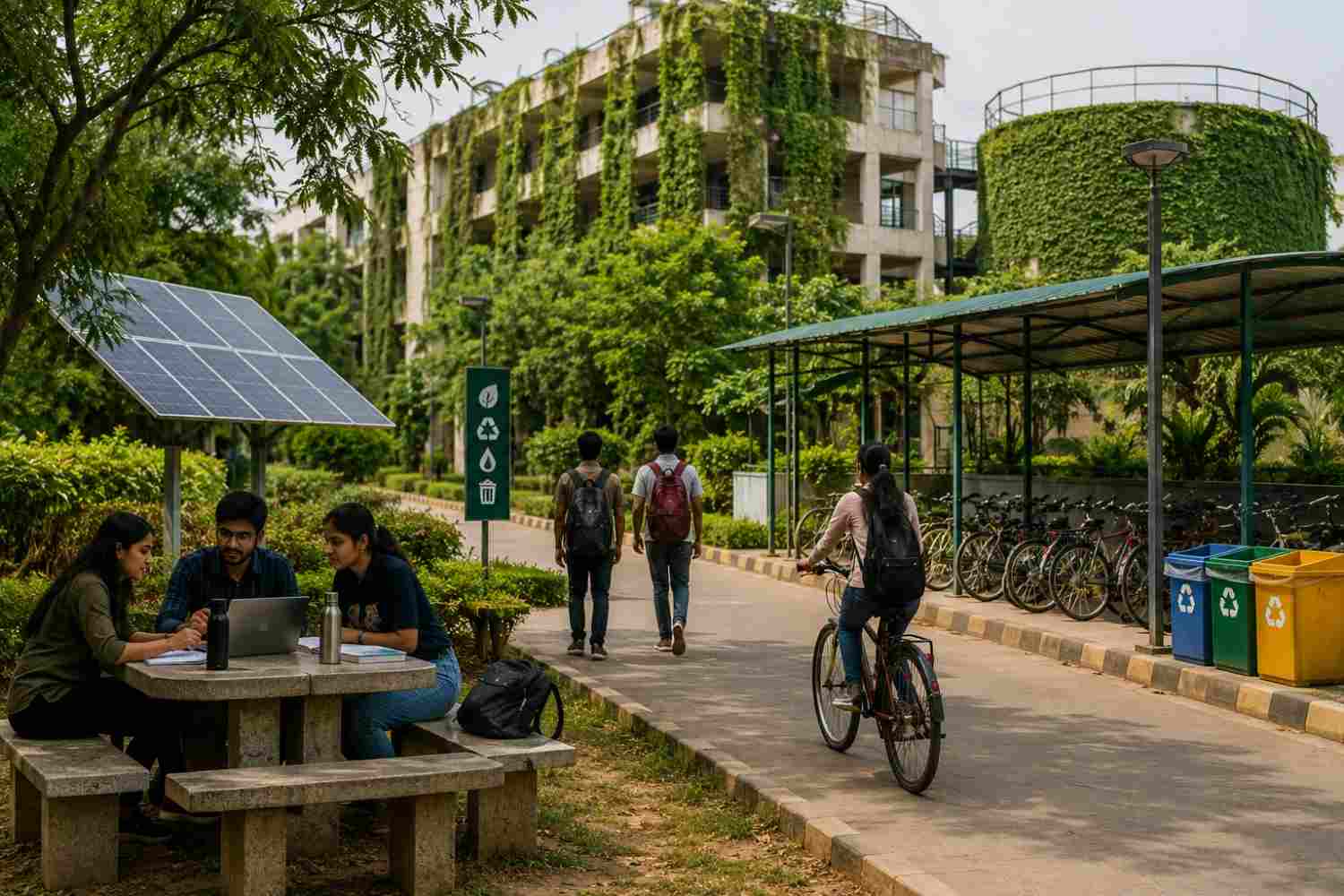
A university campus can look remarkably green from the outside. Solar panels may cover rooftops, new academic buildings may carry green-building certifications, waste may be segregated, rainwater may be harvested and students may cycle across campus instead of using cars. But these visible changes only tell part of the story.
Where does the campus actually get its electricity from?
Rooftop solar can reduce the amount of electricity a university buys from the grid, but most large campuses cannot rely entirely on solar power throughout the day or across every season. Laboratories, hostels, libraries, computer centres and air-conditioned classrooms can require a steady supply of electricity for long hours.
This creates the central challenge of the green-campus transition. A university can reduce its dependence on grid electricity without becoming independent of it.
The challenge becomes even greater as campuses expand. More cooling, digital infrastructure, research equipment and other energy-intensive facilities can push electricity demand higher, meaning that energy efficiency gains do not necessarily translate into lower overall emissions.
The real test is therefore not how green a campus looks, but whether it is reducing its carbon footprint as its energy needs continue to grow.
THE CAMPUS CARBON EQUATION
Grid Electricity
• Campus Fuel
• Buildings & Construction
• Transport
• Water & Waste
↓
TOTAL CAMPUS FOOTPRINT
Solar + Efficiency + Circular Systems
↓
EMISSIONS REDUCTION
The real test: Does the total footprint actually fall?
Are rooftop solar panels cutting emissions - or simply cutting electricity bills?
Solar panels have become one of the most visible signs of a green campus. For universities, rooftop solar can deliver two benefits at the same time: lower electricity costs and lower emissions from grid power.
But the number of panels installed does not, by itself, show environmental progress. A university can announce a large solar project and still rely heavily on grid electricity if the installed capacity is not fully operational or generation remains limited.
The more meaningful questions are: How much solar capacity is actually operational? How much electricity does it generate each year? What share of the campus’s total electricity demand does it meet? How much grid power has it replaced? How much was invested? What is the expected payback period? And what will happen to the panels when they reach the end of their useful life?
These questions become particularly important for IITs, IIMs and other institutions making carbon-neutrality or net-zero commitments.
A megawatt of installed solar capacity is an activity. The electricity actually generated and the emissions demonstrably avoided are the outcomes that matter.
Can old hostels become greener without rebuilding them?
India’s university campuses also have a major opportunity in the buildings they already have. Many hostels, lecture halls, laboratories and administrative blocks were constructed decades ago, before energy efficiency became a central part of building design.
Retrofitting these buildings can therefore deliver significant improvements without requiring complete reconstruction. Measures can include LED lighting, energy-efficient air-conditioning, building-management systems, insulation, improved windows, smart electricity controls, solar water heating, efficient pumps and better ventilation.
Organisations such as IGBC and GRIHA Council have helped establish frameworks for improving the environmental performance of buildings. But achieving a green-building certification should not become the end goal.
A building may receive a green rating because it meets specified design and construction requirements. How it actually performs once students, faculty and staff occupy it - is a separate question.
For universities, the stronger test is simple: how much energy did the building consume before the retrofit, and how much does it consume afterwards?
That comparison shows whether a green upgrade is delivering measurable energy savings rather than simply a greener label.
THE GREEN-BUILDING TEST
BEFORE RETROFIT
Energy use
Water use
Cooling demand
Maintenance cost
↓
RETROFIT
Solar
Efficient cooling
Insulation
Lighting
Smart controls
↓
AFTER RETROFIT
Energy saved?
Water saved?
Emissions reduced?
Operating cost reduced?
Certification shows design intent. Performance data shows what actually happened.
What happens to the waste and water a campus produces?
Decarbonisation does not begin and end with electricity. A university campus functions much like a small city, with thousands of students, faculty members and staff using classrooms, hostels, laboratories, kitchens, cafeterias and other facilities every day.
All of these activities create environmental pressures beyond energy use. Campuses generate solid waste, food waste, wastewater and other forms of resource demand that need to be managed alongside their carbon footprint.
A campus cannot claim to be truly sustainable simply because its rooftops carry solar panels if its waste is poorly managed or its wastewater systems are inadequate.
The green-campus question therefore extends beyond where electricity comes from to what happens to the resources and waste flowing through the campus every day.
A serious green-campus strategy therefore needs to consider:
Waste → segregation → recovery → recycling → residual disposal
and
Freshwater → consumption → wastewater → treatment → reuse
Rainwater harvesting can help reduce dependence on freshwater sources, while treated wastewater can be reused for landscaping, toilet flushing and other non-potable needs. Food waste can also be composted or sent through other recovery systems instead of being discarded.
But the presence of rainwater tanks, composting units or wastewater-treatment plants does not, by itself, demonstrate environmental progress.
Universities should report how much waste they generate, how much is recovered, how much is recycled or composted, and where the remaining waste ultimately goes.
Water reporting should be equally transparent. Campuses should disclose freshwater withdrawals, total water consumption, the volume of wastewater treated and how much treated water is actually reused.
These figures can give students, administrators and other stakeholders, a much clearer picture of how efficiently a campus uses resources - and where its environmental footprint still remains.
Can students become the campus’s sustainability auditors?
This could be one of the most valuable opportunities for higher education. Students do not have to remain passive beneficiaries of a greener campus; they can also become part of the system that monitors and questions its environmental performance.
Engineering students can track electricity use and solar generation. Management students can examine sustainability budgets and spending. Architecture students can study how buildings perform after green upgrades. Public-health students can monitor indoor temperatures and heat exposure. Environmental studies students can track waste and water use, while journalism students can investigate whether a university’s sustainability claims match what is actually happening on campus.
This approach can turn the university into a living laboratory, where sustainability is not just taught in classrooms but observed and tested in the institution itself.
However, student participation should complement - not replace - professional auditing. Students can identify gaps, collect observations, analyse data and question institutional claims, while independent technical verification should remain in place wherever specialised assessment or certification is required.
The goal is not to turn students into unpaid auditors. It is to give them a meaningful role in making the campus more transparent, measurable and accountable.
STUDENT SUSTAINABILITY AUDIT
ENERGY → Solar generation / grid dependence
BUILDINGS → Energy intensity / cooling
WATER → Freshwater / reuse
WASTE → Generation / recovery / disposal
TRANSPORT → Public transport / walking / cycling / EVs
PROCUREMENT → Sustainable materials / suppliers
↓
STUDENT AUDIT REPORT
Promise → Evidence → Gap → Recommendation
What happens when a green campus keeps expanding?
There is another contradiction that net-zero plans need to confront: universities are growing, and growth itself has an environmental cost.
New hostels, laboratories, classrooms and research facilities require concrete, steel, glass, cooling systems and other materials. A new green building may use less energy once it is occupied, but its construction still creates emissions and consumes resources.
That means campus sustainability cannot be measured only through operational electricity use. Universities need to define a clear reporting boundary that captures the wider environmental impact of their activities.
Does the footprint include new construction? Outsourced transport? Staff and student commuting? Purchased electricity? Refrigerants used in cooling systems? Or waste generated by contractors?
If these sources are left outside the calculation, a university could report a smaller carbon footprint without addressing the emissions linked to its wider operations.
A credible net-zero plan must therefore account for the emissions a university creates—not simply the emissions it chooses to count.
Can corporate green-building partnerships create lasting change?
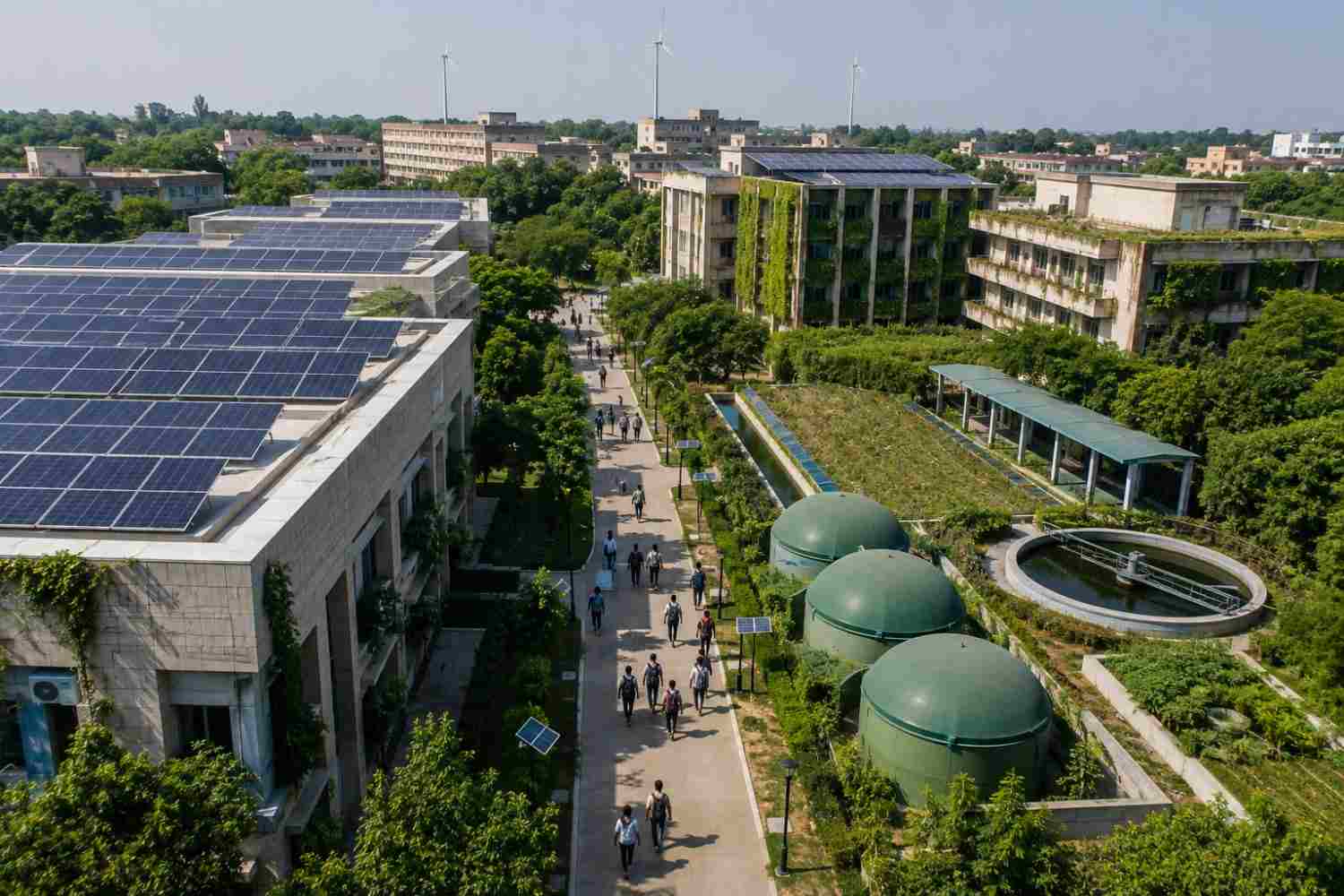
Corporate partnerships can play a useful role in campus decarbonisation. Companies such as Saint-Gobain, building-management firms, developers and other green-building partners can provide energy-efficient materials, cooling systems, building-management technology, solar solutions and retrofit expertise.
But corporate involvement also needs to pass the same evidence test as the university’s sustainability claims.
Was the intervention funded through CSR or delivered as a commercial project? Who paid for the capital investment? How much did the company contribute? What savings were expected? And who will maintain the system once the project is complete?
These distinctions matter because installing a green technology is not the same as delivering a measurable and lasting reduction in emissions.
Universities should therefore report the budget, actual expenditure, expected energy or emissions savings and the system’s actual performance after implementation.
That makes it possible to distinguish between a partnership that simply delivers new infrastructure and one that produces a measurable environmental improvement.
Can a campus measure sustainability without hiding behind percentages?
This is where the evidence test becomes crucial.
A reported “30% reduction in emissions” may sound impressive, but it does not tell the full story without context.
Thirty per cent compared with what baseline? Over which period? Across which buildings? Was campus occupancy higher or lower? Did electricity demand change? Were construction emissions included? And was the reduction measured in absolute emissions or per student?
Universities need to disclose their baseline, reporting boundary, methodology and measurement period alongside headline percentages.
Absolute figures can show the scale of emissions, while intensity measures - such as emissions per student, per square metre or per unit of electricity consumed - can help compare campuses of different sizes.
The same principle should apply to every major sustainability claim: solar generation, water savings, waste recovery, energy efficiency and carbon reductions should be backed by transparent data rather than isolated percentages.
A green campus is not defined by the size of its sustainability claims. It is defined by whether those claims can be measured, compared and independently verified.
THE GREEN CAMPUS SCORECARD
| Measure | What should be reported? |
|---|---|
| Beneficiaries | Students, faculty and staff actually covered |
| Energy | Total consumption + energy intensity |
| Solar | Installed capacity + actual generation |
| Buildings | Pre- and post-retrofit performance |
| Water | Withdrawal + consumption + reuse |
| Waste | Total generated + recovered + final destination |
| Carbon | Absolute emissions + emissions intensity |
| Investment | Budgeted vs actually spent |
| Outcome | Actual reduction achieved |
| Continuity | What remains operational after funding ends |
A 20% reduction in energy intensity may sound like significant progress. But the more important question is: what happened to the university’s total electricity consumption?
If a campus doubles its size while it’s energy use falls slightly per square metre, it’s overall electricity demand could still increase.
That is why universities need to report both absolute and intensity-based results. Absolute figures show the total amount of energy or emissions being generated, while intensity measures show how efficiently that energy is being used relative to factors such as floor area or student population.
The same principle applies to carbon emissions. Before claiming progress towards net zero, a university should clearly disclose its baseline, measurement methodology and reporting boundary.
A lower percentage does not always mean a lower footprint. The numbers need context to show what has actually changed.
So, what would a genuinely green campus actually look like?
It would not necessarily be the campus with the most solar panels, the most green-building certificates or the longest list of sustainability initiatives.
It would be a campus that can clearly account for its environmental footprint.
It would know where its energy comes from, how much electricity it consumes, how its buildings perform, how much water it uses, where its waste goes and how its emissions are changing over time.
It would consider lifecycle emissions when constructing new buildings instead of treating a green certification as the final measure of sustainability. It would also prioritise retrofitting older infrastructure where improvements can reduce energy and resource use, rather than focusing only on new construction.
Water reuse and waste recovery would be measured through actual volumes and outcomes, not simply through the number of treatment plants, collection bins or recycling facilities installed.
Students would have the opportunity to examine campus data, question sustainability claims and contribute to monitoring - while independent technical audits would provide verification where needed.
And most importantly, sustainability would not depend on one CSR partnership, one university administration or one publicity campaign.
A genuinely green campus is one where sustainable practice become part of how the institution operates - and continue to deliver measurable results even when the people, funding and projects behind them change.
FROM GREEN CAMPUS TO NET-ZERO CAMPUS
MEASURE
↓
BASELINE
↓
REDUCE DEMAND
↓
RETROFIT BUILDINGS
↓
ADD RENEWABLE ENERGY
↓
CIRCULARISE WATER & WASTE
↓
VERIFY RESULTS
↓
CONTINUE AFTER FUNDING
Can a university decarbonise faster than the grid?
Yes. A university can reduce its own emissions faster than the wider electricity system changes—but it cannot simply disconnect itself from the grid.
That is precisely where the opportunity lies.
Universities can become living laboratories for decarbonisation: campuses where students, researchers, administrators and private partners can test technologies, measure results and learn what actually works in the real world.
For CSR programmes and institutional sustainability plans, the defining question should therefore not be:
“How many solar panels did the campus install?”
It should be:
“How much energy, water, waste and carbon did the campus actually reduce? How much did it cost? And is that improvement still delivering results?”
A credible green campus should be able to show its baseline, account for its spending, disclose both absolute and intensity-based results, and explain what happens when a project or funding cycle ends.
Because sustainability cannot be measured by appearances.
A campus may have solar panels, green buildings, recycling bins and water-treatment systems and still struggle to reduce its overall footprint if its energy demand keeps rising or its wider emissions remain outside the reporting boundary.
The real test is whether the entire campus moves towards lower resource use and lower emissions - and whether the evidence proves that progress.
A university does not become sustainable simply when it looks green.
It becomes sustainable when its buildings, electricity, water, waste and people move in the same direction - and the numbers can prove it.
That is how a campus can become more than a demonstration of sustainability. It can become a model for how decarbonisation actually works.
Primary sources:
- IIT Delhi — Climate Action Plan & GHG Emission Inventory
Useful for its Net Zero 2040 target, Scope 1/2/3 framework, renewable power, rooftop solar and campus sustainability measures. (IIT Delhi)
IIT Delhi Climate Action Plan - IIT Madras — Climate Action Plan
Useful for the campus-wide climate strategy, carbon neutrality, academic buildings, hostels, laboratories, biodiversity and sustainability roadmap. (IIT Madras)
IIT Madras Climate Action Plan - IIT Madras — Carbon Footprint Report
Particularly important for your evidence-test section because it defines the campus boundary and explains Scope 1 and Scope 2 emissions, including purchased grid electricity. (sustainability.iitm.ac.in)
IIT Madras Carbon Footprint Report - IIM Calcutta — Sustainability Framework
This is one of the most important sources for your article. It documents IIM Calcutta's Net Zero Campus 2036 target, carbon assessment, renewable expansion, emission reduction, energy/water/waste management and carbon audits. (IIM Calcutta)
IIM Calcutta Sustainability Framework - IIM Calcutta — Campus Transformation / Net-Zero Campus Plan
Useful for the academic-block and hostel retrofit/construction angle, including its earlier plan for a Net Zero Energy, Net Zero Discharge and Net Zero Waste campus. (IIM Calcutta)
IIM Calcutta Campus Transformation Plan - IIT Bombay — Campus Sustainability Assessment
Useful for the campus-as-a-living-lab, sustainability assessment, resource management, student involvement and growing infrastructure-demand angle. (gesh.iitb.ac.in)
IIT Bombay Campus Sustainability Assessment - IGBC — Green Campus Rating System, Version 1.0 (January 2026)
Very important for your section questioning whether green certification equals actual performance. It explains documentation, third-party assessment, preliminary vs final submissions and implementation evidence required before certification. (IGBC)
IGBC Green Campus Rating System 2026 - GRIHA Council — GRIHA for Existing Buildings
Useful for the green-building retrofit argument. It specifically discusses reducing energy and water demand in existing buildings and the importance of continuous performance monitoring. (GRIHA)
GRIHA for Existing Buildings - GRIHA Council — Rated Projects 2025
This gives you a concrete campus example: IIT Hyderabad's AD3 project reports a 51.25% reduction in energy performance index from the GRIHA base case, 3.5 MW solar PV, 73% reduction in building water demand and campus-level sewage-treatment infrastructure. (GRIHA)
GRIHA Rated Projects 2025 - Bureau of Energy Efficiency — Energy Conservation Building Code (ECBC)
Useful for the energy-efficient building and retrofit section. BEE's material specifically includes educational buildings such as colleges and universities within the building-energy-efficiency framework. (Bee India)
BEE — Energy Conservation Building Code material - Association of Indian Universities — University News
Useful for the broader higher-education sustainability framework, including sustainable buildings, reducing energy and water consumption, waste reduction, student/faculty engagement and industry/civil-society collaboration. (Association of Indian Universities)
AIU University News — Sustainability in Higher Education






Add a Comment