Asia

Asia is the largest and most populous continent, known for its cultural diversity, economic growth, ancient civilizations, and technological advancements.

Showing 12/21

27 Aug 2026

Kolkata | 27 August, 2026  India is electrifying its railway network while metro systems are adding solar power, renewable procurement and energy-efficiency measures. But as passenger numbers rise, the next challenge is deeper: making the electricity, stations and first- and last-mile connections cleaner without confusing infrastructure announcements with actual emissions cuts. SummaryIndia's railway and metro systems are undergoing a major energy transition. Indian Railways had electrified 99.6% of its broad-gauge network by July 2026, while about 1,161 MW of solar and 103 MW of wind capacity had been commissioned by June 2026. Railway electrification has also sharply reduced diesel use for traction. Delhi Metro is increasing its renewable-energy use while passenger demand continues to grow. Kolkata Metro offers another lesson through energy-efficiency improvements alongside expanding ridership. The transition therefore cannot be judged only by kilometres electrified, solar capacity installed or green-station certifications. The stronger test is whether renewable electricity is actually being used, energy consumption per passenger falls, emissions decline within a clearly defined boundary and investments deliver measurable results. Keywordsrailway decarbonisation India, green railways India, railway electrification, Indian Railways electrification, railway renewable energy, railway solar power, railway wind energy, sustainable transport India, green transportation, railway energy efficiency, metro sustainability, railway emissions reduction, low-carbon transport, railway sustainability, railway renewable electricity, green railway stations, first and last mile connectivity, sustainable mobility, railway energy transition, clean transportation India Can India’s railway system go green as fast as it electrifies?  For decades, diesel locomotives were a visible part of India’s railway emissions story. Electrification has changed that equation dramatically. Indian Railways has pushed electrification at an exceptional pace. By July 2026, Indian Railways had electrified 99.6% of its broad-gauge network, with only a small portion yet to be electrified. Between 2014 and 2026, around 48,072 route kilometres were electrified, compared with roughly 21,801 kilometres during the six decades before 2014. The transition has also reduced diesel use for railway traction. Indian Railways reported that traction-related diesel consumption fell from 293 crore litres in 2015-16 to 108 crore litres in 2024 - 25.That represents a major operational shift. But electrification raises the next question: What powers the electricity? Switching from diesel to electric locomotives reduces direct emissions, but the overall climate benefit also depends on the source of the electricity used to power them. Electrification therefore removes one major source of direct emissions, but it does not automatically make the railway system renewable or zero-carbon.That makes renewable energy the next stage of the transition. Indian Railways reported that, as of June 2026, around 1,161 MW of solar capacity and 103 MW of wind capacity had been commissioned. The solar capacity includes both rooftop and land-based projects.The numbers show that the railway’s transition is moving beyond simply replacing diesel with electricity. The next challenge is to make more of that electricity cleaner - and to measure how much renewable power actually contributes to the railway’s overall energy demand and emissions reduction. THE ELECTRIC RAILWAY TEST  DIESEL TRACTION↓RAILWAY ELECTRIFICATION↓HIGHER ELECTRICITY DEMAND↓RENEWABLE POWER↓ACTUAL CLEAN ELECTRICITY USED↓LOWER EMISSIONS PER JOURNEY Electrification is the transition. Cleaning the electricity is the deeper decarbonisation test. Can railway stations become power producers instead of just power consumers?Railway stations offer a natural opportunity for solarisation. Their rooftops, parking areas and other available spaces can support solar installations, allowing electricity to be used at the station or integrated into wider railway operations. The scale of this effort has grown rapidly. In November 2025, Indian Railways reported 898 MW of commissioned solar capacity across 2,626 railway stations. Around 629 MW was intended for traction, while the remaining capacity supported non-traction requirements such as stations, workshops, service buildings and railway quarters.That figure, however, should now be treated as a milestone rather than the latest national total. By June 2026, Indian Railways reported around 1,161 MW of commissioned solar capacity.Installed capacity alone does not tell the full story. What matters is how much renewable electricity is actually generated and used. A stronger assessment would therefore ask:•    How much electricity is the solar capacity actually generating?•    How much is being used for railway operations?•    How much is supporting traction?•    When was each plant commissioned?•    What was the capital cost?•    What is its expected operating life?•    How is its performance being monitored?•    What happens to the equipment at the end of its useful life? A station covered in solar panels may look green. Renewable capacity is only part of the picture. A station that can demonstrate actual clean-energy generation, consumption and emissions avoided offers stronger evidence of meaningful decarbonisation. What happens when more passengers choose greener transport? This is where the story becomes more complicated. A public transport system can become more efficient even as its overall electricity consumption rises. Higher energy use does not necessarily mean that the system is becoming less efficient.If more people choose a metro instead of private vehicles, the system may consume more electricity overall while producing lower emissions per passenger journey. Delhi Metro provides a useful example. DMRC’s 2025 energy case study reported that solar power contributed 32% of its total energy consumption during the period assessed. The system has also used renewable electricity procurement to reduce its dependence on conventional power.Passenger demand has also grown, with Delhi Metro recording 235.8 crore passenger journeys in 2025 compared with 223.5 crore a year earlier. The figures highlight why electricity use needs to be assessed alongside passenger demand. If ridership grows faster than energy demand, the system may become more efficient. Even if total electricity consumption increases, a decline in energy use per passenger journey can indicate improved efficiency. But if both absolute electricity consumption and emissions continue to rise, a higher renewable-energy share alone does not tell the complete story. The real measure of a greener public transport system is therefore not simply how much renewable energy it uses, but whether it can move more people with a lower environmental cost per journey. ENERGY SAVINGS VS RIDERSHIP RENEWABLE SHARE ↑RIDERSHIP ↑ENERGY EFFICIENCY ↑↓CHECKTotal energy useEnergy per passengerCarbon per passengerAbsolute emissions A greener network should be measured against the people it moves, not only the infrastructure it installs. Can Kolkata Metro cut emissions by using less electricity in the first place?Kolkata Metro offers a different lesson in decarbonisation: sometimes the cleanest unit of electricity is the one the system does not need to consume.The transition does not always require a new renewable-energy plant. Improving the efficiency of existing infrastructure can also reduce energy use and emissions.Metro Railway Kolkata has been replacing its older steel third rail with a more conductive aluminium third-rail system. The railway has stated that the upgrade can reduce energy losses by 84% on the affected system, while also reducing voltage drops and improving operational efficiency. The project highlights a simple but important principle:Electricity generated from clean sources is still wasted if it is unnecessarily lost before reaching the system that needs it. That makes energy efficiency an important part of railway and metro decarbonisation. More efficient traction systems, regenerative braking, better station cooling, energy-efficient lighting and improved energy management can all complement renewable-energy procurement. Kolkata also demonstrates why ridership needs to be part of the climate discussion.After the Green Line became fully operational in August 2025, daily ridership rose from around 78,000 to 2.04 lakh.More passengers can naturally increase a metro system’s electricity demand. But that does not automatically mean its environmental performance is worsening. If those additional passengers are shifting from private cars, motorcycles or other more carbon-intensive modes, the wider transport system could still be reducing emissions. Can a Metro Be Truly Green If Passengers Still Depend on Cars to Reach It? A metro journey does not begin when a passenger enters the station.It begins at home.That makes first- and last-mile connectivity an important part of the decarbonisation story. A passenger who walks, cycles or uses an electric feeder to reach a metro station has a very different emissions profile from someone who drives a petrol or diesel vehicle to the station. A metro’s climate benefit does not depend only on the train journey. How passengers get to and from the station matters just as much. A low-carbon metro cannot be judged only by what happens on the tracks. The entire passenger journey has to be considered. That means the transition needs to connect: Homes → Feeder transport → Metro/Railway → Feeder transport → Destination Electric buses, e-rickshaws, shared mobility, cycling infrastructure and safe pedestrian routes can extend the climate benefits of mass transit beyond the station gates. This means metro corporations need to look beyond the electricity used to run their trains. The wider question is whether the transport network makes it easy for passengers to complete their entire journey through low-emission modes. The key question is:Are metro systems making it easier for people to reach and leave stations without having to fall back on high-emission private transport?A metro may run on clean electricity, but its full environmental benefit is limited if passengers still need petrol or diesel vehicles to complete the first and last mile. THE LOW-CARBON JOURNEY HOME↓🚶 WALK / CYCLEor⚡ ELECTRIC FEEDER↓🚇 METRO / RAILWAY↓🚶 WALK / CYCLEor⚡ ELECTRIC FEEDER↓DESTINATION The train can be green. The entire journey needs to move in the same direction. Does a green railway-station certificate prove that a station is sustainable? Not by itself.Green-building and green-station certifications can provide a useful framework for improving a station’s performance across areas such as energy efficiency, renewable energy, water conservation and waste management. The IGBC Green Railway Stations rating system, for example, covers several of these areas and can help guide stations towards more sustainable design and operations.But certification and actual environmental performance are not the same thing. A stronger evidence test should ask:What was the baseline? What did the reporting boundary include? Which measures were actually commissioned? How much energy is being saved? How much water is being conserved or reused? What was budgeted, and how much was actually spent? Are the claimed savings still being measured after implementation? These questions matter because a green rating can demonstrate that specific sustainability measures have been incorporated into a project. It does not automatically prove that the station is delivering the same level of long-term carbon reduction in its day-to-day operations. Ultimately, a certificate can show what a station was designed or assessed to achieve. Actual performance data shows what it is achieving in practice. Beyond Electrification: How Green Is the Railway? THE GREEN TRANSIT SCORECARD EvidenceWhat should be measuredElectrificationRoute kilometres + commissioning dateSolarInstalled MW + actual generationWindInstalled MW + actual generationTractionRenewable electricity actually usedStationsSolar coverage + electricity consumptionEfficiencyEnergy saved + energy intensityRidershipPassenger journeys + passenger-kmEmissionsAbsolute + intensity emissionsFirst/last mileEV and public-transport connectivityCertificationBaseline + reporting boundary + performanceInvestmentBudget/capex + money actually spentOffsetsQuantity, type and relianceLifecycleConstruction, equipment and end-of-life impacts This is where corporate and government reporting needs to become much more transparent. A company supplying renewable-energy infrastructure should clearly distinguish between capacity that has been announced, installed and actually commissioned. A railway authority should separate electricity generated from electricity actually consumed. A metro corporation should demonstrate whether renewable-energy procurement is translating into measurable changes in its emissions profile. Similarly, green-station certification should be treated as one part of the sustainability assessment, not a substitute for measuring the station’s wider emissions and resource use. The distinction may sound technical, but it determines whether sustainability claims reflect what is actually happening on the ground. Can the world’s largest passenger railway network decarbonise without compromising access? There is no single technology that can answer that question. Electrification is essential, but it is only the first layer of the transition. Solar and wind power can reduce the carbon intensity of railway electricity. More efficient traction systems can reduce energy losses. Greener stations can lower energy and water demand. Metro expansion can shift passengers away from private vehicles. Electric buses and feeders can connect neighbourhoods to mass transit while keeping the wider journey cleaner. Together, these measures can move the railway and public-transport system towards lower emissions without making access to mobility more difficult. But every layer creates a new measurement challenge.The sector needs to distinguish between announced and commissioned projects, installed capacity and actual generation, renewable-energy procurement and actual renewable-energy consumption, and energy savings and measurable emissions reductions. It also needs to account for the lifecycle footprint of new tracks, stations, trains, solar equipment and other infrastructure, rather than measuring only the emissions produced during day-to-day operations. The goal is not simply to build a railway that uses more clean technology. It is to build a transport system that can demonstrate, with evidence, that it is moving more people while reducing the environmental cost of that mobility. THE REAL DECARBONISATION TEST  ELECTRIFY↓POWER WITH RENEWABLES↓REDUCE ENERGY LOSSES↓GROW RIDERSHIP↓CONNECT FIRST & LAST MILE↓MEASURE EMISSIONS PER PASSENGER↓VERIFY SPENDING & PERFORMANCE  India’s Railways Are Going Electric. But Are They Truly Low-Carbon? The evidence points to a major transition - but not a finished one.Indian Railways has reached 99.6% broad-gauge electrification, while its latest reported renewable-energy capacity stood at 1,161 MW of solar and 103 MW of wind commissioned by June 2026. Traction-related diesel consumption has also fallen substantially over the past decade. These are significant milestones. But electrification is not the finish line. It is the foundation for the next stage of decarbonisation. The harder task now is to clean the electricity powering the network, reduce energy losses, expand public-transport use and make the entire passenger journey lower-carbon - from the first mile to the last. For Indian Railways and the country’s expanding metro systems, the strongest sustainability claim will therefore not simply be:“We electrified the railway.”It will be:“We can show how much cleaner each journey has become - where the electricity came from, how much energy and carbon were actually saved, what was spent and what changed on the ground.” That means moving beyond headline numbers and proving the difference between infrastructure installed and performance achieved. Because a railway does not become truly green simply because its locomotives run on electricity. Electrifying the railway is a major step. But it is not the finish line. The transition becomes truly green when the electricity gets cleaner, energy losses fall, more people choose mass transit, and emissions per journey show a measurable decline.That is what India’s green rail transition must ultimately prove: not simply that more tracks are electrified, but that every step is making the country’s mobility cleaner and lower-carbon.  Sources: Indian Railways / Ministry of Railways — Railway Electrification & Renewable Energy, July 2026Supports the latest 99.6% broad-gauge electrification, the 1,161 MW solar + 103 MW wind commissioned by June 2026, and the fall in traction diesel consumption from 293 crore litres in 2015-16 to 108 crore litres in 2024-25. Ministry of Railways — Railway Electrification & Renewable Energy Indian Green Building Council — Green Railway Stations Rating SystemSupports the sections on green-station certification, energy and water savings, renewable energy, waste management and first-/last-mile connectivity. It also explains the performance-improvement study and third-party assessment process. IGBC Green Railway Stations Rating System Indian Green Building Council — Green High Speed Rail Rating SystemUseful for the broader low-carbon rail infrastructure, lifecycle/site boundary and first-/last-mile connectivity discussion. IGBC Green High Speed Rail Rating System Indian Railways — Renewable Energy / Solarisation milestonesUse this for the earlier 898 MW solar capacity across 2,626 stations milestone that appears in the article as historical context. For the latest figure, use the July 2026 Ministry of Railways release above. Delhi Metro Rail Corporation — Sustainability / Energy documentationThis is the source to retain for the Delhi Metro solar contribution, renewable procurement, energy efficiency and ridership portions. The official DMRC site is also the appropriate primary source for its operational and sustainability documentation. Delhi Metro Rail Corporation ...Read more

27 Aug 2026

Kolkata | 27 August, 2026   India’s higher-education campuses are becoming living laboratories for solar power, green buildings, waste reduction and water conservation, while their net-zero ambitions face a harder test from carbon-intensive grids, ageing infrastructure and rising student demand. SummaryIndian IITs, IIMs and universities are increasingly incorporating renewable energy, green buildings, energy-efficient infrastructure, waste management and water conservation into campus planning. Rooftop solar can reduce dependence on grid electricity, while retrofits can make hostels, classrooms and laboratories more efficient. Campuses can also reduce emissions through wastewater reuse, rainwater harvesting, waste segregation and better cooling systems. But a green campus is not automatically a low-carbon campus. A university must account for electricity purchased from, the grid, construction and renovation emissions, transport, water and waste systems, and the growing energy demand of laboratories, data infrastructure and air-conditioning. Students can add another layer of accountability by independently tracking whether sustainability promises translate into measurable outcomes. The real test is therefore not how many solar panels or recycling bins a campus installs, but whether its absolute emissions fall, its energy intensity improves, its investments deliver measurable outcomes and its sustainability systems continue after the initial funding cycle ends. Keywordsnet-zero universities India, green campuses India, university decarbonisation, sustainable campuses, campus sustainability, net-zero campus, green building in universities, rooftop solar universities, IIT net-zero campus, IIM sustainability, university carbon neutrality, campus carbon footprint, renewable energy in universities, sustainable higher education, green buildings India, campus waste management, campus water management, student sustainability audits, energy-efficient campuses, higher education sustainability Can a university really become greener while depending on a carbon-intensive grid?A university campus can look remarkably green from the outside. Solar panels may cover rooftops, new academic buildings may carry green-building certifications, waste may be segregated, rainwater may be harvested and students may cycle across campus instead of using cars. But these visible changes only tell part of the story.Where does the campus actually get its electricity from?Rooftop solar can reduce the amount of electricity a university buys from the grid, but most large campuses cannot rely entirely on solar power throughout the day or across every season. Laboratories, hostels, libraries, computer centres and air-conditioned classrooms can require a steady supply of electricity for long hours. This creates the central challenge of the green-campus transition. A university can reduce its dependence on grid electricity without becoming independent of it. The challenge becomes even greater as campuses expand. More cooling, digital infrastructure, research equipment and other energy-intensive facilities can push electricity demand higher, meaning that energy efficiency gains do not necessarily translate into lower overall emissions. The real test is therefore not how green a campus looks, but whether it is reducing its carbon footprint as its energy needs continue to grow. THE CAMPUS CARBON EQUATION Grid Electricity•    Campus Fuel•    Buildings & Construction•    Transport•    Water & Waste         ↓TOTAL CAMPUS FOOTPRINTSolar + Efficiency + Circular Systems          ↓EMISSIONS REDUCTION  The real test: Does the total footprint actually fall?   Are rooftop solar panels cutting emissions - or simply cutting electricity bills?Solar panels have become one of the most visible signs of a green campus. For universities, rooftop solar can deliver two benefits at the same time: lower electricity costs and lower emissions from grid power. But the number of panels installed does not, by itself, show environmental progress. A university can announce a large solar project and still rely heavily on grid electricity if the installed capacity is not fully operational or generation remains limited. The more meaningful questions are: How much solar capacity is actually operational? How much electricity does it generate each year? What share of the campus’s total electricity demand does it meet? How much grid power has it replaced? How much was invested? What is the expected payback period? And what will happen to the panels when they reach the end of their useful life? These questions become particularly important for IITs, IIMs and other institutions making carbon-neutrality or net-zero commitments. A megawatt of installed solar capacity is an activity. The electricity actually generated and the emissions demonstrably avoided are the outcomes that matter.Can old hostels become greener without rebuilding them? India’s university campuses also have a major opportunity in the buildings they already have. Many hostels, lecture halls, laboratories and administrative blocks were constructed decades ago, before energy efficiency became a central part of building design. Retrofitting these buildings can therefore deliver significant improvements without requiring complete reconstruction. Measures can include LED lighting, energy-efficient air-conditioning, building-management systems, insulation, improved windows, smart electricity controls, solar water heating, efficient pumps and better ventilation. Organisations such as IGBC and GRIHA Council have helped establish frameworks for improving the environmental performance of buildings. But achieving a green-building certification should not become the end goal. A building may receive a green rating because it meets specified design and construction requirements. How it actually performs once students, faculty and staff occupy it - is a separate question. For universities, the stronger test is simple: how much energy did the building consume before the retrofit, and how much does it consume afterwards? That comparison shows whether a green upgrade is delivering measurable energy savings rather than simply a greener label. THE GREEN-BUILDING TESTBEFORE RETROFIT Energy useWater useCooling demandMaintenance cost ↓ RETROFIT SolarEfficient coolingInsulationLightingSmart controls ↓ AFTER RETROFITEnergy saved?Water saved?Emissions reduced?Operating cost reduced? Certification shows design intent. Performance data shows what actually happened.   What happens to the waste and water a campus produces?Decarbonisation does not begin and end with electricity. A university campus functions much like a small city, with thousands of students, faculty members and staff using classrooms, hostels, laboratories, kitchens, cafeterias and other facilities every day. All of these activities create environmental pressures beyond energy use. Campuses generate solid waste, food waste, wastewater and other forms of resource demand that need to be managed alongside their carbon footprint. A campus cannot claim to be truly sustainable simply because its rooftops carry solar panels if its waste is poorly managed or its wastewater systems are inadequate. The green-campus question therefore extends beyond where electricity comes from to what happens to the resources and waste flowing through the campus every day. A serious green-campus strategy therefore needs to consider: Waste → segregation → recovery → recycling → residual disposal and Freshwater → consumption → wastewater → treatment → reuseRainwater harvesting can help reduce dependence on freshwater sources, while treated wastewater can be reused for landscaping, toilet flushing and other non-potable needs. Food waste can also be composted or sent through other recovery systems instead of being discarded. But the presence of rainwater tanks, composting units or wastewater-treatment plants does not, by itself, demonstrate environmental progress. Universities should report how much waste they generate, how much is recovered, how much is recycled or composted, and where the remaining waste ultimately goes. Water reporting should be equally transparent. Campuses should disclose freshwater withdrawals, total water consumption, the volume of wastewater treated and how much treated water is actually reused. These figures can give students, administrators and other stakeholders, a much clearer picture of how efficiently a campus uses resources - and where its environmental footprint still remains. Can students become the campus’s sustainability auditors?This could be one of the most valuable opportunities for higher education. Students do not have to remain passive beneficiaries of a greener campus; they can also become part of the system that monitors and questions its environmental performance. Engineering students can track electricity use and solar generation. Management students can examine sustainability budgets and spending. Architecture students can study how buildings perform after green upgrades. Public-health students can monitor indoor temperatures and heat exposure. Environmental studies students can track waste and water use, while journalism students can investigate whether a university’s sustainability claims match what is actually happening on campus. This approach can turn the university into a living laboratory, where sustainability is not just taught in classrooms but observed and tested in the institution itself. However, student participation should complement - not replace - professional auditing. Students can identify gaps, collect observations, analyse data and question institutional claims, while independent technical verification should remain in place wherever specialised assessment or certification is required. The goal is not to turn students into unpaid auditors. It is to give them a meaningful role in making the campus more transparent, measurable and accountable.  STUDENT SUSTAINABILITY AUDIT  ENERGY → Solar generation / grid dependence BUILDINGS → Energy intensity / cooling WATER → Freshwater / reuse WASTE → Generation / recovery / disposal TRANSPORT → Public transport / walking / cycling / EVs PROCUREMENT → Sustainable materials / suppliers ↓ STUDENT AUDIT REPORT Promise → Evidence → Gap → Recommendation   What happens when a green campus keeps expanding?There is another contradiction that net-zero plans need to confront: universities are growing, and growth itself has an environmental cost. New hostels, laboratories, classrooms and research facilities require concrete, steel, glass, cooling systems and other materials. A new green building may use less energy once it is occupied, but its construction still creates emissions and consumes resources. That means campus sustainability cannot be measured only through operational electricity use. Universities need to define a clear reporting boundary that captures the wider environmental impact of their activities. Does the footprint include new construction? Outsourced transport? Staff and student commuting? Purchased electricity? Refrigerants used in cooling systems? Or waste generated by contractors? If these sources are left outside the calculation, a university could report a smaller carbon footprint without addressing the emissions linked to its wider operations. A credible net-zero plan must therefore account for the emissions a university creates—not simply the emissions it chooses to count.Can corporate green-building partnerships create lasting change?  Corporate partnerships can play a useful role in campus decarbonisation. Companies such as Saint-Gobain, building-management firms, developers and other green-building partners can provide energy-efficient materials, cooling systems, building-management technology, solar solutions and retrofit expertise. But corporate involvement also needs to pass the same evidence test as the university’s sustainability claims. Was the intervention funded through CSR or delivered as a commercial project? Who paid for the capital investment? How much did the company contribute? What savings were expected? And who will maintain the system once the project is complete? These distinctions matter because installing a green technology is not the same as delivering a measurable and lasting reduction in emissions. Universities should therefore report the budget, actual expenditure, expected energy or emissions savings and the system’s actual performance after implementation. That makes it possible to distinguish between a partnership that simply delivers new infrastructure and one that produces a measurable environmental improvement.Can a campus measure sustainability without hiding behind percentages?This is where the evidence test becomes crucial. A reported “30% reduction in emissions” may sound impressive, but it does not tell the full story without context. Thirty per cent compared with what baseline? Over which period? Across which buildings? Was campus occupancy higher or lower? Did electricity demand change? Were construction emissions included? And was the reduction measured in absolute emissions or per student? Universities need to disclose their baseline, reporting boundary, methodology and measurement period alongside headline percentages. Absolute figures can show the scale of emissions, while intensity measures - such as emissions per student, per square metre or per unit of electricity consumed - can help compare campuses of different sizes. The same principle should apply to every major sustainability claim: solar generation, water savings, waste recovery, energy efficiency and carbon reductions should be backed by transparent data rather than isolated percentages. A green campus is not defined by the size of its sustainability claims. It is defined by whether those claims can be measured, compared and independently verified. THE GREEN CAMPUS SCORECARD  MeasureWhat should be reported?BeneficiariesStudents, faculty and staff actually coveredEnergyTotal consumption + energy intensitySolarInstalled capacity + actual generationBuildingsPre- and post-retrofit performanceWaterWithdrawal + consumption + reuseWasteTotal generated + recovered + final destinationCarbonAbsolute emissions + emissions intensityInvestmentBudgeted vs actually spentOutcomeActual reduction achievedContinuityWhat remains operational after funding ends A 20% reduction in energy intensity may sound like significant progress. But the more important question is: what happened to the university’s total electricity consumption? If a campus doubles its size while it’s energy use falls slightly per square metre, it’s overall electricity demand could still increase. That is why universities need to report both absolute and intensity-based results. Absolute figures show the total amount of energy or emissions being generated, while intensity measures show how efficiently that energy is being used relative to factors such as floor area or student population. The same principle applies to carbon emissions. Before claiming progress towards net zero, a university should clearly disclose its baseline, measurement methodology and reporting boundary. A lower percentage does not always mean a lower footprint. The numbers need context to show what has actually changed. So, what would a genuinely green campus actually look like?It would not necessarily be the campus with the most solar panels, the most green-building certificates or the longest list of sustainability initiatives. It would be a campus that can clearly account for its environmental footprint. It would know where its energy comes from, how much electricity it consumes, how its buildings perform, how much water it uses, where its waste goes and how its emissions are changing over time. It would consider lifecycle emissions when constructing new buildings instead of treating a green certification as the final measure of sustainability. It would also prioritise retrofitting older infrastructure where improvements can reduce energy and resource use, rather than focusing only on new construction. Water reuse and waste recovery would be measured through actual volumes and outcomes, not simply through the number of treatment plants, collection bins or recycling facilities installed. Students would have the opportunity to examine campus data, question sustainability claims and contribute to monitoring - while independent technical audits would provide verification where needed. And most importantly, sustainability would not depend on one CSR partnership, one university administration or one publicity campaign. A genuinely green campus is one where sustainable practice become part of how the institution operates - and continue to deliver measurable results even when the people, funding and projects behind them change. FROM GREEN CAMPUS TO NET-ZERO CAMPUS  MEASURE↓BASELINE↓REDUCE DEMAND↓RETROFIT BUILDINGS↓ADD RENEWABLE ENERGY↓CIRCULARISE WATER & WASTE↓VERIFY RESULTS↓ CONTINUE AFTER FUNDING   Can a university decarbonise faster than the grid?Yes. A university can reduce its own emissions faster than the wider electricity system changes—but it cannot simply disconnect itself from the grid. That is precisely where the opportunity lies. Universities can become living laboratories for decarbonisation: campuses where students, researchers, administrators and private partners can test technologies, measure results and learn what actually works in the real world. For CSR programmes and institutional sustainability plans, the defining question should therefore not be: “How many solar panels did the campus install?” It should be: “How much energy, water, waste and carbon did the campus actually reduce? How much did it cost? And is that improvement still delivering results?” A credible green campus should be able to show its baseline, account for its spending, disclose both absolute and intensity-based results, and explain what happens when a project or funding cycle ends. Because sustainability cannot be measured by appearances. A campus may have solar panels, green buildings, recycling bins and water-treatment systems and still struggle to reduce its overall footprint if its energy demand keeps rising or its wider emissions remain outside the reporting boundary. The real test is whether the entire campus moves towards lower resource use and lower emissions - and whether the evidence proves that progress. A university does not become sustainable simply when it looks green. It becomes sustainable when its buildings, electricity, water, waste and people move in the same direction - and the numbers can prove it. That is how a campus can become more than a demonstration of sustainability. It can become a model for how decarbonisation actually works.   Primary sources: IIT Delhi — Climate Action Plan & GHG Emission InventoryUseful for its Net Zero 2040 target, Scope 1/2/3 framework, renewable power, rooftop solar and campus sustainability measures. (IIT Delhi)IIT Delhi Climate Action PlanIIT Madras — Climate Action PlanUseful for the campus-wide climate strategy, carbon neutrality, academic buildings, hostels, laboratories, biodiversity and sustainability roadmap. (IIT Madras)IIT Madras Climate Action PlanIIT Madras — Carbon Footprint ReportParticularly important for your evidence-test section because it defines the campus boundary and explains Scope 1 and Scope 2 emissions, including purchased grid electricity. (sustainability.iitm.ac.in)IIT Madras Carbon Footprint ReportIIM Calcutta — Sustainability FrameworkThis is one of the most important sources for your article. It documents IIM Calcutta's Net Zero Campus 2036 target, carbon assessment, renewable expansion, emission reduction, energy/water/waste management and carbon audits. (IIM Calcutta)IIM Calcutta Sustainability FrameworkIIM Calcutta — Campus Transformation / Net-Zero Campus PlanUseful for the academic-block and hostel retrofit/construction angle, including its earlier plan for a Net Zero Energy, Net Zero Discharge and Net Zero Waste campus. (IIM Calcutta)IIM Calcutta Campus Transformation PlanIIT Bombay — Campus Sustainability AssessmentUseful for the campus-as-a-living-lab, sustainability assessment, resource management, student involvement and growing infrastructure-demand angle. (gesh.iitb.ac.in)IIT Bombay Campus Sustainability AssessmentIGBC — Green Campus Rating System, Version 1.0 (January 2026)Very important for your section questioning whether green certification equals actual performance. It explains documentation, third-party assessment, preliminary vs final submissions and implementation evidence required before certification. (IGBC)IGBC Green Campus Rating System 2026GRIHA Council — GRIHA for Existing BuildingsUseful for the green-building retrofit argument. It specifically discusses reducing energy and water demand in existing buildings and the importance of continuous performance monitoring. (GRIHA)GRIHA for Existing BuildingsGRIHA Council — Rated Projects 2025This gives you a concrete campus example: IIT Hyderabad's AD3 project reports a 51.25% reduction in energy performance index from the GRIHA base case, 3.5 MW solar PV, 73% reduction in building water demand and campus-level sewage-treatment infrastructure. (GRIHA)GRIHA Rated Projects 2025Bureau of Energy Efficiency — Energy Conservation Building Code (ECBC)Useful for the energy-efficient building and retrofit section. BEE's material specifically includes educational buildings such as colleges and universities within the building-energy-efficiency framework. (Bee India)BEE — Energy Conservation Building Code materialAssociation of Indian Universities — University NewsUseful for the broader higher-education sustainability framework, including sustainable buildings, reducing energy and water consumption, waste reduction, student/faculty engagement and industry/civil-society collaboration. (Association of Indian Universities)AIU University News — Sustainability in Higher Education ...Read more

24 Aug 2026

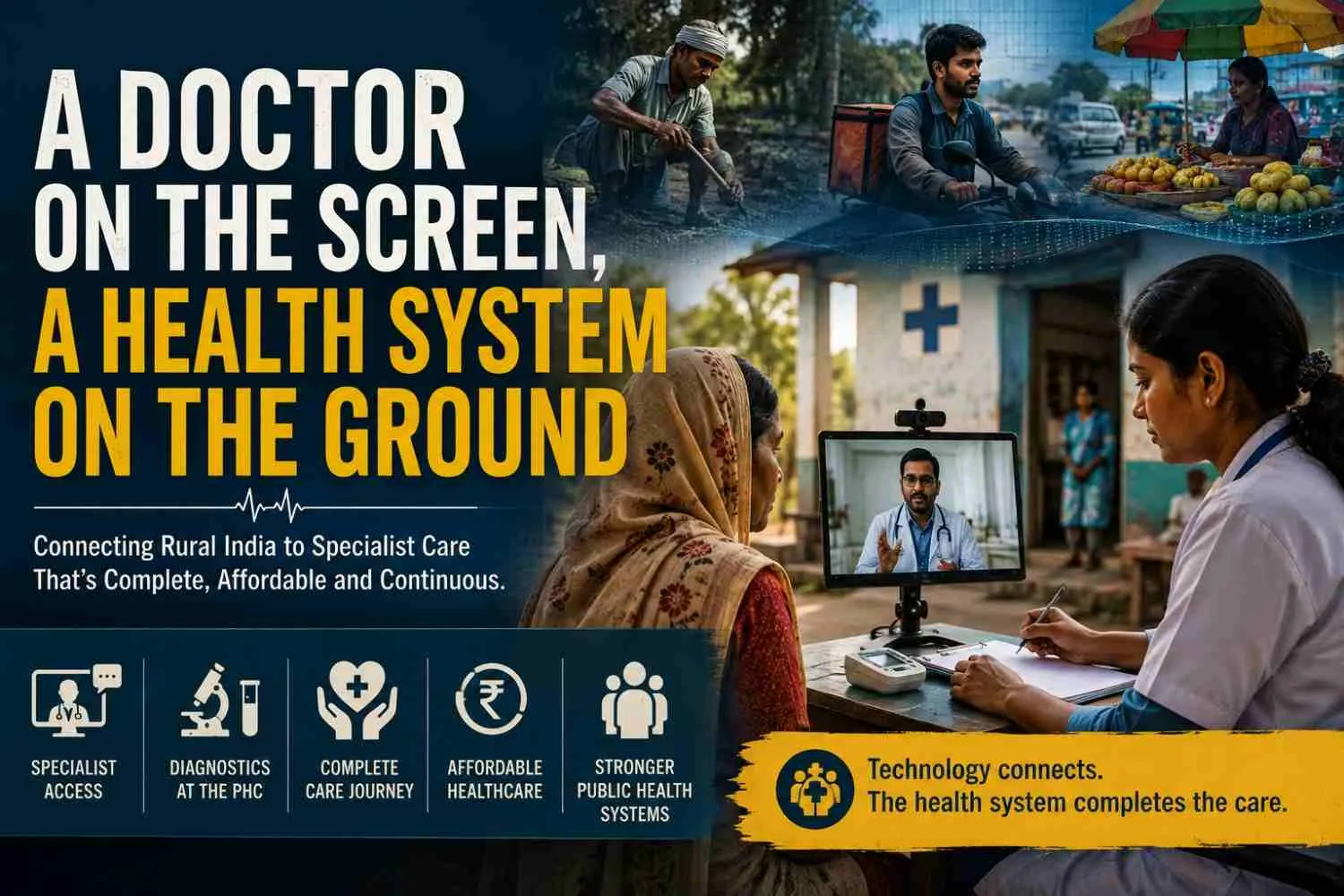
Kolkata |24 August, 2026  India’s telemedicine network is bringing specialist care closer to rural patients, but the real challenge is ensuring that a consultation leads to care that is complete, affordable and continuous. SummaryFor rural patients, seeing a specialist can mean a long journey, lost wages and repeated visits to a distant hospital. India’s telemedicine network is changing that equation by bringing specialist expertise closer to rural communities, while corporate partnerships are adding diagnostics, technology, mobile healthcare and specialist access to the mix. But a teleconsultation is only one part of the care journey. The real test is whether patients are diagnosed, treated and followed up without having to bear the same travel and financial burden. For CSR programmes, success also depends on whether public health facilities are strengthened, outcomes are measured against a clear baseline, money is actually spent as reported and systems continue functioning after corporate funding ends. KeywordsPhygital Healthcare, Rural Telemedicine, Digital Health India, eSanjeevani, Healthcare Access, Rural Healthcare, Primary Health Centres, Ayushman Arogya Mandirs, Digital Health Infrastructure, Teleconsultation, Diagnostics, Continuity of Care   Can a PHC become the gateway to a specialist hundreds of kilometres away? For many rural patients, the challenge is not simply finding healthcare. But is reaching the right doctor without travelling hundreds of kilometres, losing a day’s wages or making repeated trips to a distant hospital. India continues to face shortages and an uneven distribution of health professionals, particularly in rural and underserved areas, making specialist access a bigger challenge than simply counting the number of doctors available. Telemedicine can help change this equation by bringing specialist expertise closer to patients instead of requiring them to travel long distances for every consultation. India’s eSanjeevani platform has demonstrated the scale of this approach by connecting patients and health workers with doctors and specialists, including in rural and remote communities.But phygital healthcare cannot depend on a screen alone.The physical Primary Health Centre remains an important part of the care journey. A nurse or community health worker can examine the patient, record vital signs, conduct basic diagnostic tests, explain the specialist’s advice and help ensure that medicines, referrals and follow-up care are available. The technology can bring the specialist closer. But it is the local health system that turns a remote consultation into actual care. PHYGITAL CARE JOURNEY Village patient → Local PHC → Physical examination → Point-of-care diagnostics → Remote specialist → Treatment → Follow-up The screen connects the specialist. The PHC completes the care journey. What happens when telemedicine meets diagnostics? A specialist cannot always make a reliable diagnosis through a conversation alone. Basic diagnostic tests can provide the information needed to understand a patient’s condition and decide what treatment or referral is required. A blood-sugar or blood-pressure reading, pregnancy test, haemoglobin level or another point-of-care test can significantly change what happens after a teleconsultation. This makes diagnostics an important part of the phygital healthcare model, where digital specialist access is combined with physical healthcare services at the local level. NITI Aayog’s work across Aspirational Districts and Blocks includes healthcare interventions that bring together community outreach, frontline health workers, diagnostics and digital monitoring. The broader lesson is clear: technology works best when it is connected to the basic healthcare infrastructure patients can access locally. That means a teleconsultation should not end with a video call. It should connect to examination, diagnosis, medicines, referrals and follow-up care.Otherwise, a programme may be able to report thousands of consultations while leaving the more important question unanswered: Did those consultations actually lead to better care for patients? THE SCREEN IS ONLY ONE PART REMOTE SPECIALIST↓DIGITAL PLATFORM↓PHC / HEALTH WORKER↓DIAGNOSTICS + PHYSICAL EXAMINATION↓MEDICINES + REFERRAL↓FOLLOW-UP Technology connects the patient to expertise. Infrastructure turns that expertise into care. Can corporate partnerships strengthen the public health system? This is where corporate participation can become more than a funding exercise. Companies can bring technology, specialist networks, diagnostics, equipment, training and logistics that may help extend healthcare to communities that public facilities struggle to reach on their own.There are already examples of different approaches. Tata Trusts has worked with state governments on telehealth and mobile healthcare initiatives aimed at connecting underserved communities with doctors and specialist services. Apollo’s remote healthcare network offers another hybrid model. Its 2024–25 ESG report states that the network has delivered more than 16.5 million teleconsultations across 95 specialties, combining digital consultations with physical healthcare services. Meanwhile, Smile Foundation’s Smile on Wheels takes doctors, nurses, laboratory services and medicines directly to villages and other hard-to-reach communities through mobile medical units.These models also raise a bigger question for CSR: Should companies create separate healthcare systems of their own, or use their resources to strengthen the government facilities already serving these communities? The second approach could offer greater long-term value. Instead of creating parallel systems that may struggle to continue once funding ends, corporate partners can support existing PHCs with digital infrastructure, diagnostic equipment, specialist access, staff training and logistics, while keeping the public health system at the centre of care. The goal should not simply be to bring corporate healthcare to rural India. It should be to leave the rural healthcare system stronger than it was before the partnership began.WHO DOES WHAT? GOVERNMENT• PHCs• Health workers• Public health infrastructure• Referrals CORPORATES• Technology• Equipment• Diagnostics• Funding• Specialist networks NGOs / COMMUNITY GROUPS• Outreach• Awareness• Inclusion• Local access PATIENTS / COMMUNITIES• Care-seeking• Treatment• Follow-up• Feedback Can preventive healthcare produce a measurable social return? For CSR programmes, the focus needs to move beyond how many services were delivered to what actually changed for patients. Screening 10,000 people is an activity. Identifying patients with hypertension or diabetes, ensuring they begin treatment and helping them complete follow-up is an outcome. This distinction is particularly important when companies use technology to expand preventive healthcare. J-PAL South Asia has evaluated preventive-health interventions in India, including research on demand for hypertension screening and the impact of health camps on preventive-care investment. Its research also highlights an important limitation: technology and better monitoring systems do not automatically lead to better healthcare delivery. In Karnataka, for example, a biometric system successfully tracked the attendance of doctors at Primary Health Centres, but it did not improve attendance because the government struggled to enforce the incentives and penalties linked to the system.The lesson is relevant for corporate healthcare programmes too.A better dashboard does not automatically mean better healthcare.What matters is whether patients are being diagnosed earlier, starting treatment, completing follow-up and ultimately experiencing better health outcomes. The real measure of CSR is not the number of beneficiaries on a report, but the difference the programme makes to their lives. ACTIVITY VS OUTCOME 10,000 people reached↓7,500 screened↓2,100 diagnosed / referred↓1,600 started treatment↓1,200 completed follow-up Measure the care journey, not just the first contact. What do rural workers and migrant families need from these systems? Rural healthcare cannot be separated from the realities of work and income. For many people, accessing specialist care can mean more than a long journey. It can mean lost wages, travel costs, childcare difficulties and time away from work. A worker who has to travel to another town for a specialist consultation may lose a day’s earnings. Migrant workers may face additional barriers when their workplace and place of residence keep changing. Women may delay seeking medical care when travel, childcare responsibilities or the cost of treatment become difficult to manage. The Aajeevika Bureau’s work with migrant workers highlights how informal workers can face gaps in healthcare and social-security access, particularly when migration, low incomes and hazardous working conditions overlap. SEWA Bharat has similarly worked to improve women’s access to healthcare and social-security entitlements through community-based approaches. These experiences point to a simple principle:Healthcare technology should fit into people’s lives, rather than expect people to reorganise their lives around technology.That means rural healthcare systems also need to consider accessibility, language, affordability, mobility and physical access. These are particularly important for persons with disabilities, older people and workers who cannot easily travel. What should companies actually measure? This is where the evidence test becomes critical.Companies should report the full number of people covered, rather than using a single “beneficiaries reached” figure.If 10,000 people were enrolled, how many completed screening? How many were diagnosed? How many started treatments? And how many completed follow-ups? The baseline should be equally clear. If a programme claims that it reduced patients’ travel costs, companies should show what patients were spending before the intervention. If it claims to have improved access to specialist care, it should show how far patients previously had to travel and how that changed.The same applies to consultations. Reporting one lakh consultations does not show how many patients actually received the treatment, medicines or referrals they needed. Money also needs to be accounted for.How much was budgeted? How much was actually spent? How much went towards equipment, technology, staffing, diagnostics, training and maintenance? Companies should also report cost per outcome, rather than stopping at cost per consultation. For example, they could track the cost per completed treatment, cost per successfully screened patient or number of patients served per 1,000 people in the target population. Both absolute and intensity measures can provide a clearer picture. Absolute numbers show the scale of a programme, while intensity measures help show how efficiently resources are being used. Most importantly, the reporting boundary must remain clear.A consultation is not automatically a treated patient. A screening is not automatically a diagnosis. And a person reached by a programme cannot automatically be counted as someone whose health improved. The real evidence lies in what happened after the healthcare service was delivered. THE CORPORATE HEALTHCARE EVIDENCE SCORECARD MeasureWhat to askBeneficiary denominatorHow many people were actually covered?CompletionHow many completed screening, treatment or follow-up?OutcomeWhat changed for patients?BaselineWhat was the situation before the programme?CostHow much was actually spent?Cost per outcomeWhat did each successful outcome cost?IntensityWhat was achieved per 1,000 people or per ₹1 lakh?ContinuityWhat continued after CSR funding ended? Measure outcomes, not just activities. What happens when the CSR funding ends? This may be the most important test of any corporate healthcare partnership. A company can install telemedicine equipment, bring specialists into the system and fund diagnostics for three years. But rural healthcare needs to function long after a CSR funding cycle ends. If a programme cannot continue without corporate support, its long-term impact remains limited. So, who maintains the equipment once the funding ends? Who pays for internet connectivity? Who trains new health workers when trained staff leave? Who ensures medicines and diagnostic supplies remain available? Who manages patient referrals and follow-up? And who is responsible for the infrastructure and patient data? ESIC’s teleconsultation model offers a useful public-sector example. Its hub-and-spoke approach connects dispensaries with hospitals that act as specialist hubs, helping reduce patient travel while keeping local doctors involved in treatment and follow-up.The broader lesson is clear:Telemedicine creates lasting value when it becomes part of the regular healthcare system - not when it remains a temporary CSR project. For companies, that means the success of a partnership should be judged not only by what it delivers during the funding period, but also by what the health system is still able to deliver after the funding ends. WHAT SURVIVES AFTER CSR? DURING CSR FUNDING• Equipment purchased• Specialists connected• Staff trained• Patients reached ↓ FUNDING ENDS WHAT REMAINS?• Equipment maintained?• PHC staff still trained?• Specialist network still available?• Diagnostics still functioning?• Connectivity still paid for?• Patient follow-up still happening? CONTINUITY = REAL SYSTEM STRENGTH So, can corporate partnerships really bridge India’s rural specialist-care gap? Yes - but only if corporate healthcare moves beyond delivering services and starts strengthening the system that delivers them. India already has a network of Primary Health Centres, frontline health workers, digital platforms and an expanding telemedicine system. Corporate partnerships can add what many rural facilities struggle to access: specialists, diagnostics, technology, training, logistics and investment. But the real value of these partnerships will not be measured by how many teleconsultations were delivered or how many devices were installed. Nor should success be defined by the size of a CSR announcement.The stronger model is one in which corporate support makes the existing public health system more capable, more accessible and more sustainable. That means the evidence test has to go much further:Who was actually reached? Who completed care? How many patients received the treatment or referral they needed? What changed compared with the baseline? How much did patients save in travel, time or lost wages? What did the PHC gain? What did each successful outcome cost? And, most importantly, what continued after the corporate funding ended? These questions determine whether phygital healthcare is creating a lasting healthcare solution or simply another successful CSR activity on paper. For rural patients, however, the measure of success is much simpler.It means not having to travel hundreds of kilometres just to see the right specialist. It means being able to get basic diagnostics close to home, receive treatment without unnecessary delays and know that follow-up care will still be available.That is the real promise of phygital healthcare: bringing specialist expertise closer without leaving rural patients dependent on a screen - or on a company’s funding. The real CSR test is not whether a company can bring a doctor to a village once. It is whether its partnership can help build a rural healthcare system that continues to deliver care long after the company steps away. THE REAL TEST ACCESSCan patients reach specialist care?→ OUTCOMEDid their health actually improve?→ VALUEWas the intervention worth the cost?→ CONTINUITYDid the system survive after CSR funding? A consultation is an activity.Completed, affordable and continuous care is the outcome. The promise of phygital healthcare is not to replace the rural doctor with a screen. It is to bring specialist expertise, diagnostics and continuity of care closer to patients through the health system already in place. And ultimately, the strongest corporate partnership will not be the one that creates the biggest programme. It will be the one that leaves the rural health system more accessible, more capable and more sustainable - and less dependent on the corporate partner than it was before. Sources: Ministry of Health & Family Welfare — eSanjeevani National Telemedicine Service SourceMinistry of Health & Family Welfare — Telemedicine Services Guidelines SourceNational Health Authority — Ayushman Bharat Digital Mission (ABDM) SourceNational Health Authority — ABDM and Telemedicine FAQs SourceMinistry of Health & Family Welfare — Ayushman Arogya Mandirs, diagnostics and teleconsultation SourceMinistry of Health & Family Welfare — Annual Report 2024–25: eSanjeevani and digital health SourceMinistry of Health & Family Welfare / ABDM — eSanjeevani’s scale and assisted teleconsultation model Source Press Information Bureau — eSanjeevani integration with ABDM and continuity of care Source ...Read more

21 Aug 2026

Kolkata | 21 August, 2026  As extreme heat reshapes Indian cities, delivery riders, construction workers and street vendors are being asked to keep working through conditions that can threaten both health and income. The real test is whether Heat Action Plans and corporate commitments can protect workers without making them pay the cost of adaptation. SummaryExtreme heat is becoming a workplace issue as much as a weather emergency. India now has Heat Action Plans across 23 states, 195 districts and 64 cities, while the National Disaster Management Authority has specifically advised cities to include street vendors and other informal workers through shaded vending areas, hydration facilities, cooling centres and flexible working hours. Yet the people most exposed to heat are often those who cannot simply stop working. Delivery riders lose income when they take breaks, construction workers spend hours outdoors, and street vendors depend on remaining at their locations through the hottest parts of the day. A 2026 nationwide advisory from the Ministry of Labour and Employment has urged employers and construction companies to provide drinking water, rest areas and cooling measures. Meanwhile, a proposed parametric-insurance pilot for delivery workers in Delhi-NCR is testing whether heat-triggered payouts can protect income when workers reduce labour during extreme temperatures. The larger question is whether India's heat-response system can move from warnings and advisories to enforceable protection for the workforce that keeps cities moving. Keywordsextreme heat in India, outdoor workers India, heat stress workers, heatwave workers India, workers and extreme heat, Heat Action Plans India, heat safety at workplace, worker protection from heat, heatwave labour protection, delivery riders heat, construction workers heat, street vendors heat, informal workers India, heat and labour rights, heat stress at workplace, worker income protection, climate adaptation workers, heat insurance India, parametric insurance workers, heatwave income protection, cooling centres India, workplace cooling, CSR and climate adaptation, CSR worker protection, corporate heat safety, climate resilience India, urban heat India, extreme heat and livelihoods, heat action plans and workers, labour protection climate change   Who Bears the Cost of Extreme Heat? For many city residents, extreme heat may mean discomfort or changes in their daily routine. For outdoor workers, however, cutting back on work because of the heat can directly affect their earnings. A delivery rider who delays an order may lose part of the day’s income. A street vendor who closes their stall may lose an entire day’s earnings. A construction worker may take longer breaks to cope with the heat, yet still be expected to meet daily targets.The choice is rarely simple. For many outdoor workers, protecting themselves from extreme heat can also mean risking their livelihood. India’s Heat Action Plans gradually recognise this vulnerability. The National Disaster Management Authority (NDMA) framework calls for early warnings, health preparedness and targeted protection for vulnerable groups. Recent government guidance has also identified informal workers and recommended measures such as shaded vending areas, drinking-water facilities, cooling centres and flexible working hours. The framework is in place. But the real question is whether these protections reach workers on the ground, where they face the greatest heat exposure.  Is a Heat Action Plan Enough to Protect Workers?  India’s heat-response system has expanded significantly. As of 2026, Heat Action Plans have been prepared across 23 states, 195 districts and 64 cities. These plans are intended to establish when authorities should act, identify vulnerable populations and assign responsibilities across government departments.But a plan on paper does not necessarily translate into action on the ground. CEEW’s 2026 analysis has highlighted that many urban local bodies still lack Heat Action Plans tailored to local conditions. It recommends city-specific heat thresholds, ward-level risk assessments, clearly assigned responsibilities and stronger monitoring. Heat warnings may cover an entire city, but the risks are not the same everywhere. A construction site, delivery depot and street market can expose workers to different levels of heat. The real test, therefore, is not simply whether a city has a Heat Action Plan. But it is whether that plan changes working conditions when temperatures cross dangerous levels.  What Does Extreme Heat Mean for the People Who Keep Cities Running? Heat exposure is not distributed equally across a city. An office worker may be able to respond to a heat warning by staying indoors. A delivery rider still has to travel through traffic. A construction worker cannot move a building site into the shade. A street vendor cannot simply walk away from the heat when leaving the market or roadside stall could mean losing the day’s income. The danger is not determined by temperature alone. Long hours of exposure, combined with humidity, direct sunlight, physical exertion and inadequate rest, can increase the risk of heat-related illness. Warmer nights add another layer of problem. When temperatures remain high after sunset, workers get less time to recover before another physically demanding day begins. CEEW’s recent analysis has also highlighted the growing role of humidity and warmer nights in India’s heat risk. Protecting workers from extreme heat requires more than monitoring the temperature at midday. It also means considering how long they work, how physically demanding the work is, whether they get enough breaks and water, and whether they have enough time to recover between shifts. Can Employers Be Held Accountable for Heat Safety?  Government measures are placing greater responsibility on employers to protect workers from extreme heat. In April 2026, the Ministry of Labour and Employment issued a nationwide advisory asking states to direct employers, industries and construction companies to take measures to protect workers during heatwaves. These included drinking water, rest areas and workplace cooling, with particular attention to construction workers, brick-kiln workers, daily-wage earners and casual labourers.The advisory also called on ESIC facilities and labour-welfare authorities to establish support mechanisms for heatstroke cases and maintain supplies such as ORS and ice packs. But an advisory alone does not answer a crucial workplace question:What happens when heat protection comes into conflict with productivity targets? A delivery platform may expect riders to complete a certain number of orders. A construction contractor may have a fixed daily target. In such situations, simply recommending more breaks may not protect workers if taking those breaks means losing wages, incentives or facing penalties. That makes employer responsibility closely linked to income protection. A heat-safety measure works only when workers can actually use it without being financially punished for doing so. Could Changing Work Hours Make Outdoor Work Safer? One of the simplest ways to reduce heat exposure is also one of the hardest to implement: changing when people work. NDMA guidance has recommended flexible working hours and other measures for outdoor workers during heatwaves. Earlier heatwave guidelines have also supported rescheduling working hours and providing drinking-water points and shaded areas. For construction workers, this could mean moving physically demanding tasks away from the hottest part of the day. For delivery workers, it could mean reducing pressure during peak-heat hours. For street vendors, it could involve shaded vending spaces and easy access to water and cooling facilities rather than simply advising workers to stay indoors.But changing working hours can also reduce earnings. If a worker is paid according to hours worked or deliveries completed, reducing heat exposure without compensating for lost income can simply shift the financial cost of climate adaptation from the employer to the worker.That is why heat adaptation is not only a public-health issue. It is also a labour and income-protection issue. Can Cooling Centres Reach the Workers Who Need Them? Cooling centres are becoming part of heat-response planning, but their usefulness depends on whether workers can actually access them during the working day. A delivery rider may not be able to leave a delivery route for 30 minutes. A street vendor may not be able to leave a stall unattended. A construction worker may be working far from any public cooling facility.This means cooling infrastructure should be planned around where workers live, work and move, rather than simply measured by the number of centres established. In some locations, shaded bus stops, drinking-water points, rest areas, shaded markets, construction-site cooling zones and accessible public facilities may provide more practical protection than a small number of centralised cooling centres. The more useful measure, therefore, is not simply how many cooling facilities exist, but how many vulnerable workers can actually access them when they need them. Can Heat Insurance Protect Workers’ Income? Another emerging approach is parametric insurance, which can provide a predetermined payout when specific temperature thresholds are reached.J-PAL South Asia is studying a proposed pilot for outdoor delivery workers in Delhi-NCR. Under the model, payouts would be triggered when temperatures cross defined thresholds, helping workers reduce their exposure to extreme heat without losing as much income. The research also proposes examining the effects on worker health, labour supply and platform businesses. The idea is important because it addresses a basic problem: workers should not have to choose between protecting their health and earning their income during extreme heat.But any such model needs to be tested carefully. How many workers are covered? How often are payouts triggered? How much does each worker receive? Does the payment actually compensate for lost income? And does it help reduce heat exposure?The timing of the support matters too. A payout that arrives only after a worker has already suffered serious health consequences cannot be considered an adequate heat-protection system. What should companies actually measure? THE HEAT-PROTECTION EVIDENCE TEST  Workers Exposed↓Heat Threshold Crossed↓Protection Activated↓Break / Shift Adjustment↓Income Protected↓Health & Grievance Outcome↓Protection Continues Beyond the Heatwave  Companies need to look beyond the number of worksites covered and report how many workers are actually protected.They should track whether heat-related measures affect workers’ wages, job retention, access to benefits and ability to raise complaints. Worker feedback should also be collected independently, without management present, so employees can speak honestly about whether they were allowed to take breaks, whether supervisors followed heat-safety measures and whether taking precautions affected their earnings. Transparency also matters in reporting. If a company protects its permanent employees but leaves contract workers outside its heat-safety measures, that gap should be clearly reported. The same scrutiny should apply to CSR spending. How much was promised? How much was actually spent? Where did the money go? And did it fund cooling infrastructure, worker support, insurance, training or other forms of protection?Most importantly, did these interventions actually reduce workers’ exposure to extreme heat, or did they simply add more activities and numbers to a CSR report?The responsibility for protecting workers cannot rest with one department alone. Municipal corporations manage much of the response in public spaces. Disaster-management authorities coordinate heat preparedness. Health departments respond to heat-related illness. Labour authorities oversee workplace protections. Employers determine working conditions, while delivery platforms can influence schedules, workloads and incentives. Workers experience the combined impact of all these decisions.That is why Heat Action Plans need clear responsibilities that extend beyond issuing warnings. A city can issue a heat alert, but that warning must lead to action at construction sites, markets, delivery depots and on the streets.An employer can provide drinking water, but workers must also be able to take necessary breaks without putting their income at risk. A city can build cooling centres, but the workers most exposed to heat must be able to reach and use them. And a company can fund a heat-adaptation programme, but the money should result in measurable protection - not just a list of activities completed.  Who Protects the People Who Keep Our Cities Running?  India’s urban economy relies heavily on people who work outside offices, malls and air-conditioned buildings. They deliver food and medicines, build homes and roads, sell goods, transport materials and keep neighbourhoods running.As extreme heat becomes a more persistent threat, protecting this workforce cannot remain limited to seasonal warnings and awareness campaigns. The response needs to connect heat alerts with workplace protections, income security, accessible cooling spaces and clear employer accountability.For CSR programmes, success should not be measured by how many water bottles were distributed or how many awareness sessions were conducted. The more important question is whether workers were safer, able to protect their income, able to access essential benefits and able to raise concerns when protections failed. The workers most exposed to India’s rising heat are also among those keeping its cities running.The real test is whether India can turn heat warnings into meaningful protection for the workers who keep its cities moving.WHAT TO CHECK BEFORE CALLING A HEAT CSR PROGRAMME A SUCCESS  MeasureWhat to askDenominatorHow many workers were actually covered?ExposureHow many workers face outdoor/heat-intensive work?IncomeDid workers lose wages when taking heat breaks?ProtectionWere water, shade, cooling and adjusted shifts actually available?BenefitsCould workers access medical/social-security support?GrievancesHow many complaints were raised and resolved?BaselineWhat was the situation before the intervention?OutcomeDid heat exposure or illness actually decline?SpendingWhat was budgeted versus actually spent?ContinuityDoes protection continue after CSR funding ends? Primary sources: NDMA — Guidelines for Preparation of Action Plan: Prevention and Management of Heat Wave (2019)Official national framework for Heat Action Plans, heat preparedness and response. NDMA Heat Wave GuidelinesNDMA — Heat Wave portalOfficial government guidance and heat-wave information. NDMA Heat WaveMinistry of Labour & Employment / PIB — Nationwide Heatwave Advisory (28 April 2026)This is the key primary source for your claims about employers, rescheduling working hours, drinking water, rest areas, workplace cooling, construction workers, daily-wage workers, ORS/ice packs and compliance monitoring. Ministry of Labour & Employment Heatwave Advisory, 2026CEEW — How We Build Scientific Heat Action Plans with Indian Cities (23 June 2026)Supports your points about locally calibrated HAPs, ward-level risk assessments, heat thresholds, outdoor workers, revised work schedules, rest-water-shade measures and monitoring/evaluation. CEEW: Scientific Heat Action PlansCEEW — How Extreme Heat is Impacting India: Assessing District-level Heat Risk (2025)Useful for the claims about humidity, warmer nights, heat risk and the limitations of existing HAPs. CEEW: Extreme Heat Risk in IndiaNDMA — National Guidelines for Cooling Centers (November 2025)This is the strongest primary source for the cooling-centre/infrastructure section. NDMA lists the guideline officially. NDMA: National Guidelines for Cooling CentersJ-PAL South Asia — Take-up and Impacts of Parametric Insurance for Labor Supply under Climate ChangeThis is the primary research source for your section on parametric heat insurance for outdoor delivery workers in Delhi-NCR, including predetermined temperature triggers and income protection. J-PAL: Parametric Insurance for Outdoor Delivery Workers ...Read more

19 Aug 2026

Kolkata|19 August, 2026 India’s tourism economy is expanding across its mountains, coasts and biodiversity-rich landscapes, but fragile destinations are reaching the limits of what they can absorb. The next test for responsible tourism is whether growth can protect the ecosystems and communities that make these places worth visiting. SummaryTourism is creating valuable economic opportunities for communities across India’s Himalayan and coastal regions. But the rapid rise in visitors is also putting growing pressure on water, waste management, natural habitats and local infrastructure. A recent carrying-capacity study of Uttarakhand’s Char Dham shows why setting clear limits on tourist numbers is becoming important. At the same time, government policy is gradually promoting carrying-capacity assessments, responsible tourism and community-based models such as homestays. Waste-management partnerships and village-led tourism offer possible alternatives to high-volume tourism, but their success depends on what happens after the initial intervention. For CSR and private tourism investment, the real test is whether ecosystems remain protected, communities retain a meaningful share of the benefits and projects continue to work after the funding cycle ends. KeywordsSustainable Tourism, Responsible Tourism, India Tourism, Fragile Ecosystems, Tourism Carrying Capacity, Himalayan Tourism, Rural Tourism, Community-Based Tourism, Eco-Tourism, Sustainable Travel How Much Tourism Is Too Much for a Fragile Destination?For popular destinations, more tourists mean more hotels, restaurants, transport services, jobs and income for local communities. But fragile destinations cannot absorb unlimited growth. Mountain region often has limited land, vulnerable water sources, difficult terrain, waste-management challenges and sensitive ecosystems. Coastal areas face their own pressures, including erosion, cyclones, mangroves, wetlands, nesting sites and changing water conditions. The growing pressure is already visible in the Himalayas. A recent study found that visitor numbers to Uttarakhand’s Char Dham reached a record 5 million in 2023.Using geoscientific, biological, socioeconomic and cultural indicators, the study estimated sustainable daily visitor limits of 15,778 for Badrinath, 13,111 for Kedarnath, 8,178 for Gangotri and 6,160 for Yamunotri. These figures are more than tourism statistics. They represent an effort to understand how much pressure a destination can take before tourism begins to damage the natural resources and local communities that support it. The ability to accommodate more visitors is not simply a question of physical space. Water resources, waste systems, forests and local communities may be under significant pressure. Can Tourism Limits Work on the Ground?India is gradually recognising that tourism growth needs to be planned at the destination level, rather than simply focusing on attracting more visitors. The Ministry of Tourism’s National Strategy for Sustainable Tourism calls for better visitor management, physical site planning and greater community participation in tourism decisions. The government is also encouraging states and Union Territories to assess carrying capacity when planning new tourism projects. But the real challenge begins once these assessments are completed. A carrying-capacity report has little value if visitor numbers continue to exceed the limits it identifies. At the same time, restricting tourist numbers is not a simple solution. Fewer visitors may reduce pressure on water, waste systems and fragile habitats, but it can also affect hotels, transport operators, guides, vendors and other local businesses that depend on tourism income. This creates an important policy challenge: how can destinations protect their environment without cutting local communities out of the tourism economy? The answer could lie in better demand management. Timed entry, seasonal visitor limits, promoting less-crowded destinations and strengthening local businesses can help spread tourism more evenly. Instead of concentrating visitors and income in a few high-footfall locations, destinations can create opportunities for more communities to benefit while reducing pressure on fragile hotspots. Absolutely. The ideas are strong, but the language can be made more reader-friendly, smoother and less repetitive, while still keeping the article professional. I’d also simplify the headers so they feel more natural and engaging. Managing Tourism’s Waste, Not Just Measuring ItWaste is often one of the most visible signs of tourism pressure. In mountain regions, poorly managed waste can find its way into water sources, attract animals and affect both wildlife and local residents. In coastal areas, plastic and other waste can pile up along beaches, wetlands and marine ecosystems. This makes waste management an important area for collaboration between travel companies, local authorities and community organisations. But simply collecting waste is not enough. If a tourism company reports collecting hundreds of tonnes of waste, it is important to ask: How much was segregated? How much was recycled or composted? How much ended up in landfills? Who managed the system? And what happened after the CSR funding ended? A more meaningful approach would also measure waste per visitor. This helps destinations understand whether their environmental impact is actually decreasing as tourist numbers increase. The numbers need to be viewed in context. Higher waste collection may simply reflect a rise in tourist arrivals, rather than an improvement in waste management.  Can Communities Lead Tourism?One way to make tourism more inclusive is to spread its economic benefits beyond large hotels and commercial operators. Homestays and community-based tourism allow local households to earn directly from visitors while keeping accommodation smaller and closer to existing communities. Government policy is supporting this model. A 2026 rural-homestay initiative under Swadesh Darshan includes plans for 1,000 homestays in tribal areas, along with financial support for village-level needs, construction and renovation, as well as technical training for homestay owners. Ladakh also launched a Holistic Homestay Support Framework in March 2026, aimed at developing village-led tourism enterprises with a focus on quality, preparedness and sustainability. These efforts point to a broader idea: tourism growth does not always have to depend on large-scale infrastructure. A well-managed homestay can turn an existing household asset into a source of income while giving visitors a more direct experience of local culture. But homestays are not automatically sustainable. A 2026 study of Himalayan homestays in Kalimpong found that their sustainability depends on factors such as infrastructure, accessibility, social conditions and environmental performance. It also highlighted how poorly planned tourism can lead to waste accumulation, environmental damage and greater pressure on local resources. Community-based tourism, too, must operate within the limits of what a destination can sustainably support.   Who Really Benefits When Tourism Grows?For local communities, the real question is not how many tourists a destination attracts, but whether tourism creates stable local incomes without making everyday life more difficult for residents. In Himalayan villages, residents can earn through homestays, guiding, transport and food services. But alongside these economic benefits, communities may also face more waste, greater demands on local water resources and changes to land use.That is why community participation cannot stop at creating jobs. Who owns the land? Who controls tourism development? Who receives and shares the revenue? Who has the authority to decide where infrastructure is built? And do local communities have a meaningful voice when development puts their resources at risk? These questions are particularly relevant in regions where forests, grazing lands and other natural resources are managed through customary systems and community institutions. A stronger community-based tourism model therefore gives residents a meaningful role in decision-making, ownership and sharing of benefits, rather than treating them only as service providers. Recent policy thinking on Himalayan tourism has also emphasised community participation, local workforce development and stronger connections between tourism, conservation and local businesses. What Does Real Community Consent Look Like? Community consent should mean more than simply holding a consultation meeting. When a project affects forests, coastal areas or resources used by local communities, companies should clearly record who was consulted, what concerns were raised and whether those concerns influenced the final plans. For example, if a proposed resort is moved away from a sensitive forest after residents and environmental assessments identify the area as important, that shows avoidance. If local residents receive a share of tourism revenue or own a stake in the business, that is benefit sharing. But if a project moves ahead despite community objections, without showing how environmental and livelihood concerns were addressed, it becomes difficult to call the project genuinely “community-based.” That is why independent community interviews are important. The people living in the destination should be able to speak freely about both the benefits and the costs of tourism, without their responses being shaped by project management.  How Green Is an “Eco-Resort” Really? Certification can help set common standards for sustainable tourism. But having a certificate should not be treated as proof that a project is environmentally responsible. India’s tourism sector is promoting sustainable practices through initiatives such as Travel for LiFE and sustainability criteria for tourism businesses gradually. However, a resort can install solar panels, reduce plastic use and market itself as “eco-friendly” while still consuming large amounts of groundwater, being built on sensitive land or producing more waste than the local system can manage. The real test lies in the evidence. Ask: Was the local ecosystem assessed before construction began? Were sensitive habitats identified and avoided? How much water does the property use per guest? How much waste does it generate per guest? Were local communities meaningfully consulted? How many employees and suppliers are from the local area? And perhaps most importantly: Are these indicators being tracked year after year? A certification may confirm that a resort meets sustainability standards when it is awarded, but long-term environmental performance requires continued monitoring.   What Makes Tourism Regenerative?  THE RESPONSIBLE TOURISM EVIDENCE TEST  Ecological Baseline↓Avoid Sensitive Habitat↓Community Consent & Tenure↓Benefit Sharing↓Waste & Water Performance↓Multi-Year Habitat Monitoring↓Actual CSR Spend & Long-Term Continuity  CSR-funded projects should be judged by more than the numbers announced. Companies should disclose the original budget, actual expenditure and scope of their reporting. If ₹5 crore is announced but only ₹2 crore is spent, the gap deserves explanation. Likewise, a waste-management initiative cannot be considered a lasting success if it works only while CSR funding is available and disappears once the funding ends. For habitat restoration, the number of saplings planted is only a starting point. What matters more is how many survive and continue to grow three or five years later. The same principle applies to community tourism. Counting homestays is useful, but tracking how many remain active, how much income they generate and how much of that income reaches local households gives a far better measure of impact. Can Tourism Grow Without Consuming the Destination Itself? India does not have to choose between tourism and conservation. But it does have to decide what kind of tourism it wants to build and what it is willing to protect along the way. Tourism can create jobs, support local businesses and bring valuable income to communities. But when growth comes without limits, the same industry can put pressure on water resources, waste systems, habitats, infrastructure and the people who call these destinations home. A more responsible approach begins by recognising that growth cannot be measured by visitor numbers alone. It means managing tourist flows, spreading demand beyond overcrowded hotspots, strengthening local businesses, involving communities in decisions and building infrastructure that reflects the ecological limits of each destination. Homestays can help keep tourism income within communities. Waste-management partnerships can reduce the environmental burden of visitors. Carrying-capacity assessments can help establish clear limits. Certification can set standards for more responsible operations. But none of these measures is a guarantee of sustainability on its own. The real test comes years later. Is the destination healthier? Are its natural resources better protected? Are local communities earning more without bearing a greater burden? And are the systems created through tourism still working after the initial funding, publicity or project period has ended? For companies, this means measuring not just what was built, funded or promised, but what continues to deliver results. For communities, it means having a genuine voice in decisions, a meaningful share of the benefits and a say in how their resources are used. For governments, it means turning carrying-capacity assessments into clear and enforceable limits, rather than leaving them as recommendations on paper. A fragile mountain, forest or coastline cannot be treated as an endlessly expandable tourism asset. Its natural resources are not infinite, and neither is its ability to absorb the pressure of visitors. The destination is the asset. And if tourism damages the ecosystem, exhausts the resources and weakens the livelihoods that make a place worth visiting in the first place, the industry is not simply harming the destination - it is undermining its own future. That is why regenerative tourism must ask a different question. Not how many more tourists can this destination accommodate? but: What will still be here, thriving and protected, long after the tourists have gone?   Sources:  Ministry of Tourism, Government of India — National Strategy for Sustainable Tourism (https://tourism.gov.in/index.php/whats-new/national-strategy-sustainable-tourism) (Tourism India)Ministry of Tourism, Government of India — National Strategy and Roadmap for Development of Rural Tourism (https://tourism.gov.in/sites/default/files/2026-02/National%20Strategy%20and%20Roadmap%20for%20Development%20of%20Rural%20Tourism.pdf) (Tourism India)PIB / Ministry of Tourism — Development of 1,000 Tribal Homestays under PM-JUGA (https://www.pib.gov.in/PressReleasePage.aspx?PRID=2212575) (Press Information Bureau)UT Ladakh Administration — Holistic Homestay Support Framework, March 2026 (https://ladakh.gov.in/secretary-tourism-launches-holistic-homestay-support-framework/) (Ladakh Government)Scientific study — Carrying capacity and strategic planning for sustainable tourism practices in the Char Dham, Uttarakhand (https://pmc.ncbi.nlm.nih.gov/articles/PMC12534453/) (PubMed Central (PMC))PubMed — Char Dham carrying-capacity study (https://pubmed.ncbi.nlm.nih.gov/41107367/) (PubMed)Scientific study — Sustainable homestay tourism in the Himalayas: A multicriteria evaluation approach (Kalimpong) (https://www.sciencedirect.com/science/article/abs/pii/S2211464525002568) (ScienceDirect)Ministry of Tourism — Travel for LiFE (https://nidhi.tourism.gov.in/home/page/travel-for-life) (NIDHI) ...Read more

18 Aug 2026

SPECIAL INVESTIGATION  ·  CORPORATE GOVERNANCE & PHILANTHROPY   How India Inc Is Walling Off Its Own Charity — and What It Means for the Grassroots By Professor Ujjwal K. Chowdhury Behind India's ₹40,000-crore CSR economy lies a quiet institutional coup. A tightened Ministry of Corporate Affairs registration regime, a boardroom terrified of personal director liability, and SEBI's data-hungry ESG assurance machinery are together pushing corporate India to build its own foundations — and, in the process, are starving the small, community-rooted non-profits the law was written to reach. SUMMARYSince Form CSR-1 became mandatory on 1 April 2021, and more sharply since the Companies (CSR Policy) Amendment Rules, 2025 came into force on 14 July 2025, the Ministry of Corporate Affairs has converted CSR implementation into a licensed activity. The new web-based, CA/CS/CMA-certified CSR-1 form — demanding 12A/80G proof, NGO Darpan IDs, a three-year track record and digitally signed disclosures — now gates roughly ₹35,000-40,000 crore of annual statutory CSR spend. Boards newly exposed to personal liability for unspent funds under Section 135(5), (6) and (7) are responding by internalising social spending inside wholly owned Section 8 foundations: Tata Steel Foundation, JSW Foundation, Infosys Foundation, Wipro Foundation, SBI Foundation and dozens more. This feature traces the regulatory chain from 2014 to 2026, the cost-benefit and tax arithmetic of building versus outsourcing, hard data on where the money actually lands, and mounting evidence that grassroots NGOs — 84% of India's non-profits, most running on budgets under ₹3 crore — are being pushed out of a philanthropic economy their own advocacy helped build. KEYWORDS: CSR-1 registration, Section 8 foundations, Companies Act Section 135, corporate CSR India, Ministry of Corporate Affairs, BRSR Core, grassroots NGOs, CSR compliance, 12A and 80G registration, Tata Steel Foundation, Infosys Foundation, Social Stock Exchange, CSR governance, corporate philanthropy India HASHTAGS: #CSRIndia  #Section8Foundations  #CSR1Registration  #CorporateGovernance  #MCA  #BRSRCore  #GrassrootsNGOs  #CSRCompliance  #IndiaInc  #SocialStockExchange  #NonProfitIndia  #ESGIndia THE BOARDROOM THAT BROKE WITH CIVIL SOCIETY In a wood-panelled boardroom overlooking Mumbai's Bandra-Kurla Complex late last winter, the CSR committee of a top-tier industrial conglomerate faced an existential briefing. For nearly a decade the company had dispersed its mandatory 2% statutory spend — roughly ₹140 crore a year — across a decentralised constellation of 45 grassroots NGOs working the rural hinterlands from Kalahandi to Bastar. Then came the regulatory audit. A routine notice from the Registrar of Companies, coupled with statutory-auditor queries over third-party utilisation certificates, Form CSR-1 validations and unspent-escrow allocations under Section 135(6), pushed boardroom anxiety to a fever pitch. By the time legal counsel finished briefing directors on personal liability under the amended penalty provisions, the decision was unanimous: terminate 38 external partner contracts and incorporate a wholly owned, captive Section 8 not-for-profit. “Within eighteen months, our entire social budget was internalised. It wasn't philanthropic philosophy — it was regulatory survival.” — Chief Sustainability Officer, industrial conglomerate This boardroom pivot is neither isolated nor accidental. Across corporate India a seismic restructuring of statutory philanthropy is under way. What began in 2014 as a broad legislative mandate under Section 135 of the Companies Act has hardened into a tightly policed, data-audited compliance machinery — and in its place has arisen a sprawling new institutional class: the captive corporate foundation. FROM ‘COMPLY OR EXPLAIN’ TO A COMPLIANCE MACHINE Section 135 was notified in 2014 as a soft ‘comply or explain’ regime — a company could simply justify a shortfall in its board report. That leniency did not survive long. A High-Level Committee on CSR (2019-20) recommended tightening; the escrow mechanisms of Section 135(5) and (6) followed; then, in 2021, came Form CSR-1 and the decriminalisation-cum-mandatory-impact-assessment amendments. By 2023-26, SEBI's BRSR Core reasonable-assurance regime and the Social Stock Exchange had pulled CSR into the wider architecture of ESG disclosure. 20142019‑2020212023‑26Section 135 notified — the ‘comply or explain’ era begins.High-Level Committee on CSR; Section 135(5)/(6) escrow mechanisms introduced.MCA Form CSR-1 mandatory; decriminalisation amendments; mandatory third-party impact assessments.SEBI BRSR Core reasonable assurance rolls out; Social Stock Exchange goes live; CSR-1 re-engineered (July 2025). FORM CSR-1: THE FORM THAT REWROTE THE RULES The decisive shift began on 1 April 2021, when it became illegal for any company to route CSR capital to an implementing agency lacking an MCA-issued, eleven-digit unique CSR Registration Number. To secure that number, a Section 8 company, registered public trust or registered society had to demonstrate valid Section 12A/12AB and 80G registrations, a verified three-year operational track record in comparable development work (waived only for Section 8 entities established by the funding company itself), and Digital Signature Certificate verification certified by a practising Chartered Accountant, Company Secretary or Cost and Management Accountant. The ground shifted again on 14 July 2025, when the Companies (CSR Policy) Amendment Rules, 2025 replaced the old PDF-based process with a fully web-based e-form on the MCA21 V3 portal — now demanding an NGO Darpan ID as a compulsory field, governing-body member details with DIN/PAN, audited financials, and OTP-verified, digitally signed submission. MCA subsequently clarified that entities already holding valid CSR registration numbers need not register afresh merely because the form changed. Running in parallel, the Ministry of Home Affairs tightened the Foreign Contribution (Regulation) Act, cancelling the licences of over 6,000 civil society organisations and banning sub-granting between NGOs. CSR funds are technically domestic capital, but the institutional fallout — lost accounting staff, deep regulatory scrutiny, sudden instability — hit thousands of multi-funded grassroots entities regardless. THE ESCROW TRAP: WHEN NON-COMPLIANCE BECOMES PERSONAL For corporate legal teams, the cost of an implementing partner's compliance lapse has become intolerable. Under Section 135(5) and (6), unspent capital tied to an ‘ongoing project’ must move within 30 days of fiscal close into a designated Unspent CSR Account at a scheduled bank, to be utilised within three fiscal years — or, for one-off projects, surrendered within six months to a Schedule VII fund such as PM CARES or Clean Ganga. Section 135(7) penalises failure with fines running up to twice the unspent amount for the company, plus personal financial liability for every defaulting officer. Recent RoC adjudication orders — some now under appeal — show that enforcement is real, not theoretical. A further procedural tightening in 2025 requires companies to file Form AOC-4 (audited financial statements) before filing Form CSR-2, the annual CSR report; the CSR-2 web form must now carry the AOC-4 Service Request Number to link it algorithmically to audited accounts. Regulators can now cross-reference CSR spend against financials in real time, closing off the discretion companies once used to smooth over reporting gaps. THE GREAT SPIN-OFF: MAPPING INDIA INC’S CAPTIVE FOUNDATIONS The stampede toward captive vehicles has reshaped the institutional map of Indian philanthropy. Data compiled from the MCA portal, the Registrar of Companies and analytics platform CSRBOX show that over 65% of the NIFTY 100 now execute the majority of their social spend through promoter-backed Section 8 companies, captive trusts or dedicated operating foundations — and, since the 2025 CSR-1 overhaul, more than 60% of large corporate CSR budgets are routed through company-owned implementation arms. Yet corporate India is not converging on one model. In heavy industry, Tata Steel Foundation — a Section 8 company and wholly owned subsidiary of Tata Steel — has saturated 81 blocks and 4,500 villages across Jharkhand and Odisha, spending roughly ₹473 crore in FY2024-25, reaching between 5.77 million and 6.9 million lives across different reporting cycles and unlocking over ₹5,300 crore of public entitlements through grassroots mobilisers. Under its MANSI maternal-health programme, 93% of high-risk pregnancies now culminate in institutional deliveries; through Masti Ki Pathshala, 73% of 5,406 highly vulnerable children in Jamshedpur's urban slums have entered mainstream schooling. JSW Foundation scaled from ₹63 crore in FY2018-19 to ₹235 crore in FY2023-24 and ₹363 crore in FY2024-25, touching 30 lakh lives across Maharashtra, Karnataka and Odisha. In technology, Infosys Foundation — three decades old in FY2026 — has deployed cumulative spending above ₹4,800 crore, with FY2024-25 alone seeing ₹545 crore across healthcare, education and environment, and FY2025-26 global CSR of about ₹666 crore reaching more than seven million people across 200-plus projects; its annual report won a Gold Stevie in 2025, even as a 2026 fraud case — a former contractor who posed as a regional head to defraud the foundation of ₹6 crore — exposed governance vulnerabilities that scale alone cannot fix. TCS reported FY2024-25 CSR of ₹960 crore, rising to a global figure of about ₹1,153 crore in FY2025-26 with more than 18 million beneficiaries and over nine million volunteering hours, through flagship programmes such as goIT, Ignite My Future and BridgeIT reaching 7.1 million people worldwide. Wipro runs a deliberate dual-engine architecture: the endowment-backed Azim Premji Foundation, which holds an economic interest in Wipro and preserves pure civil-society funding, alongside Wipro Foundation and Wipro Cares, which executed statutory CSR of ₹259.4 crore in FY2024-25 and ₹227.4 crore in FY2025-26 against an adjusted obligation of ₹130.4 crore — a zero-shortfall result. Among banks, HDFC Bank's Parivartan posted a record ₹1,068 crore in FY2024-25 across seven focus areas — including a newly added natural-resource-management vertical — reaching over 100 million beneficiaries through 214 implementation partners. SBI institutionalised its CSR inside SBI Foundation, a Section 8 company, spending ₹610.77 crore. ICICI Bank earmarked ₹801 crore but spent only ₹527 crore, citing delays in statutory approvals — a reminder that even large, well-resourced banks face implementation lag. Axis Bank Foundation, notably, is a registered trust rather than a Section 8 company and openly runs a partnership model with multiple development-sector organisations, showing that the captive-foundation trend is not universal even among peer institutions. In agribusiness, ITC's Mission Sunehra Kal spent ₹325 crore in FY2023-24, embedding climate-smart agriculture and e-Choupal watershed development directly into its sourcing catchments, creating a circular loop in which agroforestry CSR supplies pulpwood for its paperboard business. Reliance Industries, largely through Reliance Foundation, led all spenders at ₹2,156 crore in FY2024-25. THE HIDDEN P&L: WHY BUILD BEATS BUY Running an in-house foundation is not cheap. Registering a Section 8 company — the preferred structure — costs roughly ₹18,000-35,000 in government and professional fees, with annual compliance of ₹15,000-40,000 covering statutory audits, RoC filings (MGT-7, AOC-4), income-tax returns and 12A/80G maintenance. That is markedly steeper than a trust (₹500-3,000 to register; ₹5,000-15,000 a year) — yet for companies with large, recurring CSR budgets the arithmetic still tilts toward internalisation. The decisive lever is Rule 7(1) of the CSR Rules, which caps administrative overheads at 5% of total CSR spend for the company itself — but explicitly excludes the administrative expenses of implementing agencies, including a company's own Section 8 foundation, from that cap. Grassroots NGOs typically need 15-20% institutional overhead to cover compliance, monitoring, senior management and rent; bound by the 5% ceiling, corporates routinely disallow these core costs when funding external partners, forcing NGOs into project-restricted budgets that erode their long-term health. A captive foundation, by contrast, allows structural reclassification: salaries of social workers, agronomists, project directors and field-monitoring teams are booked not as ‘administrative overhead’ but as direct programmatic implementation expense — full operational capacity, while the general-administration line on paper stays comfortably under 5%.  Outsourced NGO Model (₹100 Cr Spend)Captive Section 8 Model (₹100 Cr Spend)External grant / direct programme₹95 Cr grant, capped at 5% overhead (Rule 7(1))₹96 Cr — field salaries booked as direct delivery cost, not overheadOverhead / admin₹5 Cr — partner NGO's core costs largely disallowed₹4 Cr head-office admin, technically within the 5% capNet effectOperational friction for the NGO partnerFull in-house operational capacity retained inside the group Tax structuring compounds the advantage. A Section 8 foundation without 12A registration is taxed at the ordinary corporate rate — an effective 29-33% including surcharge and cess — which is why 12A is treated as non-negotiable; newly registered entities get a provisional 12A (Form 10A, valid three years) before moving to regular 12AB (Form 10AB, valid five years, extendable to ten years for foundations with annual income under ₹5 crore). Once secured, foundation income is 100% tax-exempt if applied to charitable objects. Section 80G then lets the donor — typically the parent company — claim a deduction of 50% on the donated sum, subject to a ceiling of 10% of Adjusted Gross Total Income (cash donations above ₹2,000 do not qualify; the foundation must file Form 10BD and issue Form 10BE to preserve the donor's claim). On a ₹10 crore contribution, that works out to a ₹5 crore deduction and, at a 30% marginal rate, roughly ₹1.5 crore of tax saved by the parent — while the foundation itself receives the full ₹10 crore tax-free. There is a catch worth flagging for the balance sheet: when a 12A-registered foundation passes money onward to other NGOs, 15% of that onward transfer is disallowed from tax exemption, creating an effective 30% tax cost on unstructured pass-through grants — one more reason captive foundations prefer to spend directly rather than sub-grant. And Mumbai ITAT rulings through 2025-26 have clarified that CSR donations to 80G-approved entities can claim the 80G deduction even though CSR itself is disallowed as business expenditure under Section 37(1) — clearly so for voluntary spending above the mandatory 2%, more contestably so for the mandatory 2% itself. FOLLOW THE ₹40,000 CRORE: WHERE THE MONEY ACTUALLY GOES Reported national CSR expenditure rose from ₹24,965.82 crore in FY2019-20 to ₹34,908.75 crore in FY2023-24 — more than ₹1.44 lakh crore across those five years, and over ₹2.17 lakh crore cumulatively since 2014. A July 2026 private analysis by Fulcrum, based on corporate filings, estimates FY2024-25 spending at about ₹40,794 crore across 29,546 companies and 72,233 projects — a research estimate, not yet the government's own consolidated figure, but directionally consistent with NSE data showing listed companies alone spent ₹22,212 crore in FY2025, up 23% year-on-year, with the top 10 companies contributing 34% of that total. Thematically, the captive model has produced herd behaviour. According to CSRBOX analytics, Education and Skill Development absorbs roughly 38% of national CSR capital and Healthcare and Sanitation another 27% — together nearly two-thirds of all corporate spending — while Rural Infrastructure takes 12%, Environmental Sustainability just 6%, and Gender and Vulnerable Groups only 4%.   ThemeShare of National CSR SpendEducation & Skill Development38%Healthcare & Sanitation27%Rural Infrastructure12%Other Schedule VII heads13%Environmental Sustainability6%Gender & Vulnerable Groups4% Environmental CSR, while the fastest-growing category — up 54% year-on-year in FY2023-24 to roughly ₹3,500 crore, per CEEW — remains a rounding error against India's climate-finance need: the Climate Policy Initiative India estimates ₹162.5 trillion (about $2.5 trillion) is required by 2030 to meet the country's Nationally Determined Contributions, of which current tracked green finance for mitigation covers only about 30%. CEEW argues CSR could become a major financing source for clean air — clean mobility, waste management, crop-residue solutions, construction-dust reduction — but notes that such programmes cluster around existing corporate locations and frequently lack measurable outcomes. WRI India separately flags biodiversity's marginal CSR share. Geography compounds the theme problem. Despite statutory language urging companies to prioritise their local operating areas, Maharashtra, Gujarat, Karnataka, Tamil Nadu and Andhra Pradesh — the states with the highest concentration of corporate headquarters — together absorb over 45% of all national CSR outlays. NITI Aayog's 112 Aspirational Districts and 500 Aspirational Blocks, precisely the geographies where marginal investment could generate the most disproportionate impact, receive only 2-4.5% of total CSR funds between them. And headline compliance conceals an implementation gap: NIFTY 500 annual reports show that even as reported compliance sits above 95%, 8-12% of committed capital is parked in Unspent CSR Accounts under Section 135(6); over ₹1,000 crore went unspent in FY2021-22 alone and had to be transferred to government Schedule VII funds. THE GRASSROOTS SQUEEZE The most consequential casualty of this restructuring is India's smallest, most rooted non-profits. Roughly 84% of Indian NGOs run on annual budgets under ₹3 crore — yet only 71% of CSR-1-registered NGOs actually accessed corporate funding in FY2023-24, leaving nearly three in ten locked out despite having cleared the registration bar. A 2025 Fulcrum survey of 325 NGOs across more than 20 states found that 89% held valid CSR-1 registration, but only 71% received any CSR money; about 80% reported inadequate opportunities to network with corporates; nearly half faced project-documentation difficulties; 40% experienced delayed fund disbursement; and 61% lacked the technical MIS expertise corporate due-diligence teams now expect. Small NGOs saw proposal-acceptance rates of roughly 50%, against about 73% for larger organisations. “A small organisation working on forest rights in Bastar cannot afford the compliance overhead that a corporate foundation's legal department takes for granted.” — Senior researcher, Centre for Science and Environment The barriers compound. Hiring a CA, CS or CMA solely to certify a CSR-1 filing adds ₹15,000-25,000 in professional fees — a material sum against a ₹20-30 lakh annual budget. The three-year track-record rule excludes newer or informally structured community organisations by design. The ban on sub-granting has eliminated the traditional intermediary model, through which large aggregator grantmakers once dispersed micro-grants to unheralded community groups; capital must now flow directly from company or foundation to final implementer, cutting hyper-local groups out of the pipeline entirely. Surviving small NGOs are increasingly demoted from co-equal strategic partners to third-tier field contractors — conducting surveys or distributing materials on razor-thin management fees, without budget for staff healthcare or institutional capacity-building. An ₹800 crore CSR-diversion racket uncovered across six states in 2025-26 has only sharpened corporate caution, disproportionately penalising honest but less-polished grassroots groups. And a May 2026 MCA notification recognising Zero Coupon Zero Principal (ZCZP) instruments on the Social Stock Exchange as a valid CSR channel — while officially framed as widening CSR's ambit — has been described by critics as tilting the playing field further toward large, listing-ready organisations, at the expense of community-based groups too small to meet SSE disclosure norms. THE GOVERNANCE MIRAGE: IS BIGGER ACTUALLY BETTER? Is the captive corporate foundation a genuinely superior vehicle for social transformation, or a tax-exempt marketing division wearing a Section 8 registration? Proxy-advisory and governance researchers urge scrutiny of the premise itself. “When a company routes its entire CSR allocation through an in-house Section 8 entity, board oversight must be twice as vigilant. Is the foundation's board genuinely independent? Are procurement contracts subject to arm's-length competitive bidding — or is the foundation a soft-money vehicle for the parent's brand and executive pet projects?” — Amit Tandon, Institutional Investor Advisory Services (IiAS) IiAS's 2024 Corporate Governance Scorecard found that 94 of the BSE 100 now meet the 2% spend threshold, up from 74 the previous year — but only 54 of the BSE 100 conducted impact assessments in FY2024, unchanged from FY2023, suggesting that measurement remains driven by legal mandate rather than mission. InGovern's Shriram Subramanian points to the underlying logic: once personal penalties for board directors and statutory escrow timelines entered the picture, boards concluded that reliance on third-party non-profits carried unacceptable legal risk, and that a captive vehicle offered what no external NGO could guarantee — absolute operational line-of-sight, brand control and an unassailable audit trail. The pros are real: continuity across CSR-head turnover, comparable multi-year data, the ability to hire genuine sector specialists, replicable multi-state programme design, and clearer board-level accountability than a scattershot grants portfolio ever offered. The cons are equally real: concentration risk, potential self-dealing between parent and foundation, thematic herd behaviour toward ‘safe’ brand-accretive causes, and — as Infosys Foundation's own 2026 fraud episode showed, in which a former contractor posed as a regional head to defraud the foundation of ₹6 crore — the loss of the deep, hyperlocal community trust that independent NGOs spend decades building and that no ERP dashboard can substitute for. SEBI, BRSR CORE AND THE SOCIAL STOCK EXCHANGE The foundation boom is accelerating under market-driven sustainability regulation running in parallel to CSR law. SEBI's BRSR Core framework requires the top 1,000 listed companies to disclose roughly 30 designated environmental and social KPIs, with independent reasonable assurance phased in from the top 150 companies to all top 1,000 by FY2026-27; non-compliance can draw penalties of ₹2,000 a day under the LODR framework, with SEBI enforcement penalties running up to ₹1 crore. The Reserve Bank of India has entered from the banking side, through its 2023 Green Deposits Framework and a 2024 draft climate-risk disclosure framework aligned with TCFD standards — pulling bank CSR into climate-risk management rather than treating it as siloed philanthropy. “If ESG data comes from dozens of dispersed, un-audited NGOs, the assurance provider will qualify their opinion. If it flows from a captive Section 8 company with ERP tracking, the process is smooth. Corporates are building foundations because foundations are data pipelines.” — ESG Director, Big Four audit firm The Social Stock Exchange, launched by SEBI with the BSE and NSE, was designed to let non-profits raise capital through Zero Coupon Zero Principal instruments and democratise social finance; companies can now allocate up to 10% of CSR expenditure this way. In practice, the SSE demands the same sophisticated disclosure norms and social-audit verification that have already strained grassroots non-profits — so early issuances have been dominated by well-funded, professionally managed and corporate-backed entities, reproducing at market scale the same exclusion visible in CSR-1 registration. THE SEVEN-QUESTION EVIDENCE TEST Every large CSR claim — corporate or foundation-issued — should now survive seven tests before it is taken at face value: Methodology: was there an explicit theory of change and an independent evaluator, or simply a beneficiary head-count?Baseline: what were incomes, water use, school enrolment or health indicators before the intervention began?Comparison group: measured against the previous year, a non-programme geography, industry peers, or a genuine control group?Implementation gap: did a board-approved allocation actually become a signed contract, deployed capital and completed field expenditure — or only the first of those?Reporting boundary: when a foundation funds three NGOs, who counts the beneficiaries, and are repeat beneficiaries double-counted?Absolute versus intensity: does ‘one billion litres conserved’ also tell us conservation per hectare, per beneficiary, or against baseline?Money trail: what is the gap between the statutory 2% obligation, the approved programme budget, cash actually spent, unspent balances, and asset ownership? Platforms such as India CSR and CSRBOX track corporate foundations and spending at scale, and MCA's own CSR-2 annual filing offers a layer of transparency — but without mandatory third-party impact audits, the quality of self-reported outcomes still varies enormously across the ecosystem. THE POLICY CROSSROADS: FIVE PILLARS FOR REFORM India's CSR experiment has already answered its first-generation question — social spending can be mandated at national scale. The harder, second-generation question is whether ₹35,000-40,000 crore of annual corporate capital can be made more accountable without becoming more distant from the people it is meant to serve. Policy thinkers converge on five interventions: MCA reform: carve out a mandatory 20-25% grassroots allocation quota, directed to independent, community-rooted non-profits operating in NITI Aayog's Aspirational Districts and Blocks.SEBI mandate: incentivise listed companies on the Social Stock Exchange to back independent, non-captive NPOs rather than only large, listing-ready organisations.RBI incentives: link Priority Sector Lending benefits to demonstrated corporate backing of rural micro-NGOs.Overhead relief: modernise the Rule 7(1) admin cap into a tiered structure — 5% for captive foundations, but 12-15% for grants to independent grassroots partners, so they can invest in compliance, technology and fair staff wages.Regional equalisation: create a pooled national fund, or tax and ESG credits, to channel CSR capital toward historically underfunded regions, alongside a single-window CSR-1/12AB/80G/Darpan compliance pathway for NGOs with budgets under ₹1 crore.   CONCLUSION: CONTROL VERSUS COMMUNITY The corporatisation of CSR has professionalised social spending: it has curtailed fraudulent balance sheets, built modern community infrastructure, brought enterprise-grade technology to the development sector, and mobilised tens of thousands of crores with genuine audit precision. Section 8 foundations bring governance discipline, institutional continuity and scale that the early, freewheeling years of mandatory CSR often lacked. But that efficiency has arrived alongside a quieter cost — the marginalisation of a pluralistic, independent civil society. Section 135 was conceived as a bridge between corporate success and societal well-being. If that bridge hardens into a closed loop of captive corporate vehicles feeding data pipelines rather than communities, the letter of the law will have triumphed over its spirit. The evidence test remains open: until independent, standardised impact assessments compare foundation-led projects with NGO-implemented ones on the same terms, the true cost — and the true benefit — of India's captive-foundation era will stay only partially visible. What is no longer in doubt is that India's CSR story has stopped being a story about compliance. It is now a story about power, control, and who gets to decide what ‘impact’ means for the country's poorest and most remote communities. SOURCES: The writer compiled this feature from Ministry of Corporate Affairs and Registrar of Companies filings, SEBI and RBI circulars, corporate annual reports and BRSR disclosures, the MCA CSR-1/CSR-2 portals, CSRBOX and India CSR analytics, Fulcrum's 2025 NGO survey, and assessments by IiAS, InGovern, CSE, WRI India and Climate Policy Initiative India. ...Read more

18 Aug 2026

Kolkata| 18 August, 2026  As renewable energy, electric mobility and sustainable agriculture create new livelihood opportunities, the real test for CSR is whether women gain lasting access to skills, decent wages, finance and leadership - not just training certificates. SummaryIndia’s green transition is opening opportunities across solar energy, electric mobility, sustainable agriculture and other emerging sectors. Yet women remain underrepresented in many technical clean-energy jobs. A 2026 CEEW-NRDC analysis found that women account for only 11% of the workforce in India’s solar and wind deployment and manufacturing sectors, while more than half of the women working in these sectors are in non-technical roles. At the same time, India’s clean-energy ambitions could create more than 44 lakh full-time-equivalent jobs. The opportunity is therefore significant, but access remains uneven. CSR can help women enter technical occupations and build green enterprises by combining training with employment, finance, market access, safety and social protection. Its success, however, should be measured by wages, retention, benefits and income growth rather than the number of women trained alone. Keywords: Women in Green Economy, Green Jobs, Women in Renewable Energy, Green Skills, Women’s Employment, CSR, Clean Energy, Women Entrepreneurs, Sustainable Agriculture, EV Jobs, Gender Equality Can Women Become a Key Workforce in India’s Green Transition?India’s green economy is opening up job opportunities in areas that were once seen as highly technical or largely male-dominated. Solar installation and maintenance, electric-vehicle servicing, battery management, climate-resilient agriculture, waste management and energy-efficient construction are creating new career possibilities for women, including jobs with potential for long-term income and growth. But women are still significantly underrepresented in these roles. The latest CEEW-NRDC analysis shows that women account for only 11% of the workforce across solar and wind deployment and manufacturing. Their representation is highest in rooftop solar, at 15%, while wind manufacturing has only around 6% women workers. More than half of the women employed across the clean-energy sectors studied are still working in non-technical roles such as administration, accounting and human resources. This raises an important question for companies supporting green CSR and skilling programmes: Are they actually preparing women for technical careers, or are they mainly directing them towards support roles? India’s clean-energy targets could generate more than 44 lakh full-time-equivalent jobs. If women remain largely excluded from technical positions, a significant share of this employment opportunity could remain out of reach for them. Where Is the Missing Link?India already has programmes aimed at building a skilled renewable-energy workforce. The government’s Suryamitra programme, for instance, trains solar photovoltaic technicians in installation, operation and maintenance, with more than 51,000 Suryamitras trained by the end of 2022. But completing a training programme does not mean automatically securing a job. A woman may earn a technical certificate and still struggle to find employment because of limited transport to project sites, lack of equipment, workplace barriers or the challenge of balancing paid work with unpaid care responsibilities. This is where CSR programmes need to rethink how they measure success. Reporting that 1,000 women completed a training course shows the reach of a programme, but it does not show whether the training improved their livelihoods or not. The more meaningful questions are: How many women found jobs? How much did they earn? How many remained employed after six or 12 months? How many moved into technical roles? How many received social-security benefits? And how many were able to progress in their careers? The focus therefore needs to shift from how many women were trained to how many women are earning, staying employed and moving forward in the green economy.Can Women Turn Green Skills into Real Jobs? Women are already entering technical and clean-energy roles, showing that green-skills training can create real employment opportunities when it is linked to actual jobs and local demand. Government programmes have documented women receiving training in solar installation and maintenance, while other clean-energy initiatives are helping women from communities whose traditional livelihoods are changing to access new opportunities in the renewable-energy sector.The key lesson is clear: training creates greater impact when it is designed around the skills and jobs that are actually in demand in the local economy. For example, A CSR programme in a region experiencing rapid growth in solar installations could equip women with skills in installation, maintenance and after-sales services, helping them access emerging employment opportunities in the sector. Near an electric-mobility hub, training could focus on EV diagnostics, battery maintenance and charging infrastructure. The same approach can work in agriculture. Women farmers could be trained in climate-resilient farming, efficient irrigation, solar-powered agricultural equipment, soil management, livestock services and value-chain activities. The goal should not be to simply add more people to the list of training certificate holders. Instead, it should be to create sustainable local green livelihoods that provide a steady source of income and remain viable even after CSR funding ends. Can Green Skills Help Women Build Their Own Businesses? A job is not the only way women can participate in the green economy. For many, entrepreneurship could offer a more flexible and sustainable route to earning a livelihood. A woman trained in solar maintenance could become a local service provider. A group of women could run a farm-equipment service centre. An EV-trained technician could start a small repair business. A farmer could adopt climate-smart practices and better equipment to improve productivity and access higher-value markets. But training alone is not enough to turn these skills into viable businesses. Women also need working capital, equipment, access to credit, digital payment systems and reliable market connections. India already has a strong institutional network that can support this transition. By February 2026, DAY-NRLM had mobilised more than 10.05 crore rural women into over 90.90 lakh self-help groups, while cumulative bank credit to women’s SHGs had crossed ₹11.10 lakh crore. This creates an opportunity for CSR programmes to connect green skilling with existing women-led financial and community networks, instead of creating separate systems from scratch.The government’s SVEP model similarly supports rural entrepreneurs in setting up businesses and provides assistance until they become more stable. CSR can strengthen these existing systems by providing targeted support for green enterprises, helping women turn their skills into viable businesses, reliable incomes and long-term economic opportunities. Could Financial Inclusion Decide Whether Women Stay in the Green Economy?Access to finance can determine whether green-skills training leads to real economic independence. A woman may have the technical skills to provide solar maintenance or run a green enterprise, but without the money to purchase tools, equipment or basic business inputs, she may remain dependent on an employer. Access to small-business finance, on the other hand, can give her the opportunity to build and manage her own livelihood. But finance alone is not enough. Women also need access to markets. Providing loans without ensuring access to customers, procurement opportunities or business support can leave women with financial obligations but without a stable and sustainable source of income. This is where companies can use their own supply chains to create stronger opportunities. Large businesses in sectors such as construction, logistics, healthcare and education could create procurement opportunities for women-led enterprises providing solar maintenance, waste-management services, sustainable food supplies or energy-related solutions. Such an approach can move CSR from simply training women for employment to helping them build sustainable sources of income and participate in the wider green economy. Are Green Jobs Creating Better Work for Women?The quality of employment matters just as much as the number of women entering the green workforce. Green jobs are often presented as automatically better opportunities, but a job does not become a decent job simply because it is linked to renewable energy or sustainability. Women entering these sectors still need fair wages, safe workplaces, reasonable working conditions, effective grievance mechanisms and access to social protection. These factors also influence whether women remain in technical roles over the long term. If women leave their jobs within a few months because of low wages, unsafe working conditions or limited opportunities for career growth, a programme may appear successful on paper while failing to create lasting employment opportunities. Companies therefore need to look beyond job placements and understand what happens after women enter the workforce. Regular feedback and worker interviews, conducted independently and without management present, can help identify issues that may not appear in official programme reports - such as harassment, wage disputes, unsafe conditions, inadequate transport or difficulties accessing workplace benefits. The real measure of success is not simply whether women get green jobs, but whether those jobs provide the security, dignity and opportunity needed to build lasting livelihoods. What Should Companies Actually Measure? For women-focused green CSR programmes, measuring activities alone is not enough. The real test is whether those activities lead to meaningful and lasting improvements in women’s employment, income and economic opportunities. FROM TRAINING TO GREEN LIVELIHOOD  Women Enrolled↓Training Completed↓Job / Enterprise Started↓Wage or Business Income↓6–12 Month Retention↓Benefits + Grievance Access↓Career / Business GrowthCompanies should also report the starting point or baseline against which changes in income or employment are measured. If a programme reports an increase in women’s earnings, it should clearly establish their income levels before the intervention to demonstrate the actual change achieved. The same clarity is needed when reporting beneficiaries. For example, if an NGO trained 1,000 women, but only 400 completed the course and 180 found employment, these figures should be reported separately rather than combined into one broad “beneficiaries reached” number. Financial reporting should follow the same approach. Companies should clearly state: How much was budgeted? How much was actually spent? How much went towards training, equipment, job placement and support for women-led enterprises? Clear reporting of these numbers helps show the difference between a CSR announcement and a programme that is actually being implemented and creating results.So, Can Women Actually Lead India’s Green Economy?India’s green economy is opening up new opportunities for women, but participation alone will not be enough. The real opportunity lies in ensuring that women can enter the sector, build stable livelihoods and progress into roles with greater skills, responsibility and decision-making power. The clean-energy transition is creating a new employment landscape in India, but women are still underrepresented in the technical roles that will shape its future. CSR can help close this gap by connecting women with opportunities in renewable-energy technology, EV maintenance, sustainable agriculture and green enterprises. But the strongest programmes will not end when the training period does. Training must be the starting point - not the finish line. Its impact should continue through employment, fair wages, access to finance and markets, safe working conditions, social protection and opportunities for career progression. For companies, the real measure of success goes beyond training numbers.They need to ask whether women are earning more, staying employed, receiving workplace benefits and moving into higher-skilled and better-paid roles. For women, being part of the green workforce should only be the beginning. They should have opportunities to grow into technicians, entrepreneurs, supervisors and decision-makers who help shape India’s green future.India is preparing for a greener economy. The real CSR test is whether women are being given the skills, opportunities and support to lead it.Sources: CEEW–NRDC — Driving Energy Transition: Workforce, Skills, and Gender in India’s Renewable Energy Sector (https://www.ceew.in/publications/driving-energy-transition-workforce-skills-and-gender-in-indias-renewable-energy-sector) (CEEW)CEEW–NRDC — India’s clean energy targets could create over 44 lakh jobs by 2030 (https://www.ceew.in/press-releases/india%E2%80%99s-clean-energy-targets-could-create-over-44-lakh-jobs-2030-rooftop-solar) (CEEW)Ministry of New and Renewable Energy (MNRE) — Suryamitra Skill Development Programme (https://mnre.gov.in/en/skill-development-programme/) (Ministry of New and Renewable Energy)Ministry of Rural Development / PIB — DAY-NRLM and Self-Help Groups (https://www.pib.gov.in/PressReleasePage.aspx?PRID=2224571) (Press Information Bureau)Ministry of Rural Development / PIB — DAY-NRLM financial inclusion and SHG credit (https://www.pib.gov.in/PressReleasePage.aspx?PRID=2222697) (Press Information Bureau)Ministry of Rural Development / PIB — Start-up Village Entrepreneurship Programme (SVEP) (https://www.pib.gov.in/PressReleasePage.aspx?PRID=2205172) (Press Information Bureau)Ministry of Rural Development / PIB — Women-led enterprises and public procurement under DAY-NRLM (https://www.pib.gov.in/PressReleasePage.aspx?PRID=2229449) (Press Information Bureau)Ministry of Rural Development / PIB — DAY-NRLM outcomes and financial inclusion, 2026 (https://www.pib.gov.in/PressReleasePage.aspx?PRID=2287316) (Press Information Bureau) ...Read more

17 Aug 2026

Kolkata | 17 August 2026  As e-commerce and logistics companies electrify delivery fleets, the next challenge is building enough charging, battery-swapping and power infrastructure to keep the transition moving. SummaryIndia’s e-commerce and logistics sector is steadily shifting towards electric delivery vehicles as companies seek to reduce fuel costs and transport emissions. Amazon has already crossed its target of 10,000 electric delivery vehicles in India, while Flipkart has reported more than 13,000 EVs in its delivery ecosystem and is working towards a fully electric fleet by 2030. However, the transition involves more than replacing conventional vehicles with EVs. Commercial fleets also require dependable charging and battery-swapping infrastructure, adequate grid connections and careful management of electricity demand. As electric fleets expand across delivery hubs and logistics networks, the availability and capacity of supporting power infrastructure will become central to the success of India’s commercial e-mobility transition. Is India’s E-commerce Sector Ready to Electrify the Last Mile?  Every day, thousands of delivery vehicles carry parcels across Indian cities. These vehicles often follow fixed routes, return to warehouses or delivery hubs and operate for long hours, making last-mile logistics one of the areas where electric vehicles can be adopted at scale. The transition is already underway. Amazon India set a target of deploying 10,000 electric delivery vehicles by 2025 and reached that goal ahead of schedule. Flipkart has set a longer-term target of making its last-mile delivery fleet fully electric by 2030. The shift is also spreading beyond the country’s largest e-commerce companies. Electric mobility firms are supplying vehicles to quick-commerce platforms, food-delivery companies and logistics operators, expanding the market for electric two-wheelers, three-wheelers, vans and other commercial vehicles. But the size of an electric fleet alone does not show whether the transition is working or not. For an EV to be useful in commercial delivery, it must be able to complete its route, recharge within the required time and return to service without disrupting operations. That makes charging infrastructure one of the biggest challenges in India’s move towards electric last-mile delivery. What Happens When the Vehicle Is Ready but the Charger Isn’t? For a private EV owner, charging can usually be planned around personal schedules. For a commercial delivery fleet, however, charging directly affects business operations. Every hour a delivery vehicle spends waiting for a recharge is an hour it is not on the road making deliveries. The challenge becomes even greater when several vehicles return to the same warehouse or delivery hub around the same time, creating a sudden increase in electricity demand. This is why companies are gradually exploring dedicated fleet-charging hubs instead of relying entirely on public charging stations. Tata Power has been expanding its charging network across public, semi-public and fleet locations, while oil and energy companies are also becoming part of the growing EV-charging ecosystem. The wider transition involves companies such as NTPC, NTPC Green, Tata Power, Reliance New Energy, ReNew, Adani Green, Indian Oil and GAIL. Their roles vary from renewable power generation and electricity supply to charging infrastructure, energy storage and existing fuel-station networks - but they are connected to the same shift towards electric mobility. The last-mile EV transition, therefore, is no longer just about replacing petrol and diesel vehicles with electric ones. But also, about building the energy and charging infrastructure needed to keep those vehicles moving.Could Battery Swapping Help Delivery Fleets Stay on the Move?  Charging time matters even more for electric two- and three-wheelers that spend most of the day making deliveries. For these high-use vehicles, battery swapping can offer an alternative to conventional charging. Instead of waiting for a depleted battery to recharge, a delivery vehicle can exchange it for a fully charged one and get back on the road. Reliance’s Jio-bp has explored battery-swapping and Battery-as-a-Service models for electric mobility, while India’s policy framework has also started recognising battery swapping as part of the broader EV-charging ecosystem. For delivery companies, the benefit is clear: less time spent charging can mean more time making deliveries. However, battery swapping also creates new challenges. Companies will also need to address key questions around battery ownership and maintenance, compatibility across different vehicle models, the location of swapping stations and who will bear the cost of setting up and operating the network.  Without common standards and enough vehicles using the network, swapping stations may struggle to reach the scale needed to remain commercially viable. Battery swapping can help reduce charging downtime, but it does not remove the need for a strong and reliable infrastructure network. Instead, it shifts the focus from charging stations to a wider network of batteries, swapping points and supporting systems.  Could Faster Charging Put More Pressure on India’s Power Grid?  One of the less visible challenges of the EV transition is its growing impact on India’s electricity network. Electric vehicles reduce dependence on petrol and diesel, but they also shift transport energy demand from fuel stations to the power grid. For commercial delivery fleets, this shift can be particularly significant because vehicles often operate for long hours and need to recharge within tight schedules. A large delivery depot could have dozens or even hundreds of vehicles requiring power within a limited period. If several vehicles charge at the same time, the local distribution network could face a significant increase in demand. This does not necessarily mean that India’s power grid cannot support the growth of electric vehicles. The bigger issue is where, when and how that electricity is consumed. Smart-charging systems can shift charging to periods of lower electricity demand. Battery storage can help manage peak loads, while renewable energy can reduce the emissions associated with charging. Careful planning can also help companies avoid placing large charging facilities in locations where the local power network is already under pressure. The move towards electric delivery, therefore, cannot be managed by fleet operators alone. Companies and electricity providers will need to plan charging capacity together so that the growth of electric fleets does not create unnecessary pressure on the power system. Can India’s Commercial Freight Sector Make the Bigger Shift to Zero Emissions? Electrifying two- and three-wheelers may be relatively easier, but heavy commercial vehicles present a much bigger challenge. Electric trucks require larger batteries, higher-capacity charging systems and careful route planning to ensure they can cover long distances without disrupting delivery schedules. India is beginning to identify priority freight corridors for zero-emission trucking, with charging infrastructure being planned along major routes. Over time, this could help connect warehouses, logistics hubs and cities through dedicated electric freight networks. However, the financial and operational challenges of this transition cannot be overlooked. Companies will need to account for vehicle purchase costs, battery replacement, charging infrastructure, land requirements, grid connections, electricity tariffs and ongoing maintenance. For investors and corporate sustainability teams, therefore, the important question is not simply whether a company has announced a target for electric trucks. The real test is whether the company has the business model, infrastructure and financial capacity to achieve that target at scale. Could Renewable Energy Make Commercial EVs Even Cleaner?  The environmental benefits of commercial electric vehicles become stronger when the electricity used to charge them comes from renewable sources. In other words, the transition is not only about replacing petrol and diesel vehicles with EVs, but also about ensuring that the electricity powering those vehicles comes from cleaner sources.This is where India’s renewable-energy and power-sector companies have an important role to play. Companies such as NTPC Green, ReNew and Adani Green can contribute to the broader clean-energy ecosystem supporting electric transport, while Tata Power can help connect electricity supply with the charging infrastructure needed by commercial fleets.   The future may therefore involve a much more integrated system:   THE LAST-MILE ELECTRIFICATION CHAIN  Renewable electricity↓Grid & energy storage↓Charging / battery swapping↓Electric delivery fleet↓Zero-emission last-mile deliveries  The success of the transition depends on how well these different parts work together. A growing EV fleet needs sufficient charging capacity to operate smoothly, while charging infrastructure must be supported by proper grid planning to avoid new pressure on the electricity network. At the same time, powering electric vehicles with cleaner electricity can further increase their overall emissions benefits.  The EV Is Only the Beginning   The real test of India’s commercial EV transition will not be the number of targets companies announce. It will be the evidence they provide on what has actually changed.  A company promising a 100% electric fleet by 2030 has set a target. It has not yet achieved an outcome.   To show real progress, companies should disclose how many electric vehicles are currently in operation, what share of deliveries they handle, how many kilometres they travel and how much petrol or diesel use they have replaced. Charging infrastructure also needs to be measured by what it can actually deliver, rather than simply the number of stations announced or installed. Similarly, battery-swapping investments should be assessed through their actual use and operational performance. The financial picture matters too. Companies should clearly report the amount they committed to the transition, the amount actually spent, the number of EVs deployed, the charging capacity brought into operation, the baseline from which progress was measured and the changes achieved as a result.This evidence can help investors assess whether electrification is becoming an integral part of a company’s operations or remains largely a sustainability commitment on paper. The bigger question, then, is whether India can electrify its last-mile delivery network without creating new pressure on the systems that support it. The answer will depend not simply on how quickly companies purchase EVs, but on how effectively the wider ecosystem develops. India needs more electric vehicles, but it also needs well-planned charging hubs, reliable electricity connections, battery-swapping networks where they make economic sense and smart-charging systems that can manage peak demand. Most importantly, companies need to report what happened after the announcement. The case for electrifying commercial delivery is strong. These vehicles operate frequently, travel extensively through cities and account for significant fuel costs. Switching to EVs can help businesses reduce operating costs while also cutting local air pollution and transport-related emissions. But replacing a petrol or diesel vehicle with an electric one is only the beginning. The vehicle may be the most visible part of the transition, but it is supported by a much larger system of batteries, chargers, electricity networks, distribution infrastructure, renewable energy and investment. India’s e-commerce boom has already created the demand for this transition. Now the energy system has to build the capacity to support it. And that is the real story of India’s electric last mile: the shift may begin with an EV, but achieving genuinely lower emissions will depend on the entire system behind it - from batteries and charging infrastructure to the power grid and clean energy.   Primary sources  Amazon India — 10,000 EV milestoneSupports Amazon’s 10,000-EV target, its achievement ahead of schedule, deployment across 500 cities and its continuing work on electric heavy goods vehicles. Amazon India — 10,000 electric vehicles milestone Flipkart — Sustainability JourneySupports Flipkart’s 13,300 EVs and its commitment to 100% electric mobility by 2030. Flipkart — Building for tomorrow: sustainability journey Flipkart — EV Assist, June 2026Supports the current figure on delivery-partner adoption, including the 6,000+ delivery-partner study and 46% willingness to transition to EVs, as well as the 2030 ambition. Flipkart — EV Assist Tata Power — Integrated Annual Report 2025–26Supports the article’s discussion of commercial/fleet charging infrastructure, with 5,800+ public, semi-public and fleet charging points and 1,200+ e-bus charging points reported as operationalised. Tata Power — Integrated Annual Report 2025–26 Reliance Industries / Jio-bp — EV and battery-swapping initiativesSupports the claims about Jio-bp exploring battery swapping, Battery-as-a-Service and charging/swapping points, including applications for three-wheelers and commercial/last-mile mobility. Reliance — Jio-bp and Mahindra EV partnership Central Electricity Authority — EV Charging Station / Power Consumption ReportsThis is the key government source for the article’s grid and electricity-demand section. CEA maintains dedicated EV Charging Station/Power Consumption Reports as part of its energy-transition work. CEA — EV Charging Station / Power Consumption Reports Ministry of Power — EV Charging Infrastructure GuidelinesSupports the article’s discussion of charging infrastructure, grid-support requirements and fast charging for long-range/heavy-duty EVs. The guidelines specify fast-charging stations for heavy-duty vehicles at 100-km intervals on designated highways and call for supporting infrastructure such as transformers and feeders. Ministry of Power — EV Charging Infrastructure Guidelines WRI India — Electrifying India’s HighwaysSupports the section on electric freight and explains why e-truck charging requires high-capacity grid connections, larger sites and carefully planned electrical systems. WRI India — Electrifying India’s Highways WRI India — Accelerating India’s Freight DecarbonizationSupports the article’s discussion of electric freight, charging constraints, corporate adoption and the structural challenges facing zero-emission trucking. It currently reports 869 electric medium- and heavy-duty freight vehicles and identifies charging infrastructure and upfront costs as major barriers. WRI India — Accelerating India’s Freight Decarbonization WRI India — Fi-ZET: Financial Impact Assessment for Zero-Emission TrucksSupports the article’s discussion of the financial and operational feasibility of electric trucks, including vehicle costs, financing and route-specific economics. WRI India — Fi-ZET           ...Read more

11 Aug 2026

August 11, 2026 | Kolkata Bangladesh has launched three villages as SDG Villages, bringing sustainable development goals closer to everyday rural life. The experiment offers India a possible blueprint - but an Indian model would need to add climate resilience, local livelihoods, digital access and community- led planning to suit the country's diverse villages. SummaryBangladesh has launched an SDG Village pilot across three villages, bringing poverty reduction, healthcare, education, water, sanitation, livelihoods, women's empowerment, environmental protection and infrastructure together under a single local development plan. For India, the initiative highlights the possibility of developing SDG Villages across states, each designed around its own geographical and social challenges while using existing Panchayat-level systems to track and measure progress. KeywordsSDG Villages, Sustainable Development Goals, Bangladesh, India, Rural Development, Panchayati Raj, Sustainable Rural Development, Climate Resilience, Community Development, SDG Localization Can Bangladesh’s SDG Village experiment offer India a blueprint for turning global goals into local action? Bangladesh has taken the Sustainable Development Goals from national policy to the village level through its first SDG Village pilot. On August 10, Prime Minister Tarique Rahman inaugurated three villages under the initiative: Mitingachhari in Rangamati, Pankhali in Khulna and Nafanagar in Dinajpur. The villages were selected to represent different geographical and socioeconomic conditions. The idea is to bring several development priorities together instead of addressing them through separate programmes. Health, education, clean water, sanitation, livelihoods, women's empowerment, renewable energy, environmental protection and digital access are all part of the approach. This matters because rural challenges rarely exist in isolation. Poor connectivity can affect education, healthcare and employment at the same time, while water shortages can influence health, farming and household incomes. The pilot is therefore testing a simple but important idea: Can the SDGs become a local development plan rather than remain mainly national targets?  Why should India pay attention to three Bangladeshi villages? The question is not whether India should copy Bangladesh. India's villages are far more diverse in terms of geography, population and economic conditions. But the broader lesson is relevant: development works better when national goals are connected to local needs. India already has systems that could support such an approach. The SDGs have been localised through Panchayati Raj Institutions, while the Panchayat Advancement Index assesses Gram Panchayats across areas linked to sustainable development. This means India may not need another standalone scheme. Instead, existing systems could be used to identify demonstration villages across states and build development plans around their most urgent needs. The process could begin with a village-level baseline covering health, education, poverty, water, sanitation, livelihoods, energy, environment, digital access and climate risks.   What Would an SDG Village Change on the Ground? For ordinary residents, the SDGs matter only when they improve everyday life. Can families access safe drinking water? Can children receive better education? Can farmers increase their incomes without damaging natural resources? Can women access healthcare and livelihood opportunities more easily? Can villages prepare for floods, droughts, cyclones or extreme heat? An Indian SDG Village should be built around these practical questions. However, every village should not receive the same development package.  A coastal village may need to prioritise cyclone preparedness, mangrove restoration, safe drinking water, fisheries and saline-water management. A drought-prone village may focus on rainwater harvesting, groundwater recharge, efficient irrigation and climate-resilient farming. Himalayan villages could prioritise landslide preparedness, spring-water conservation, resilient infrastructure and responsible tourism. Agricultural regions could focus on soil health, crop diversification, storage, food processing and farmer-led enterprises. The Northeast could place greater emphasis on connectivity, healthcare, biodiversity, digital services and locally owned businesses. Tribal and forest-dependent communities may need stronger support for nutrition, healthcare, forest-based livelihoods and biodiversity protection. The principle should remain simple: one national framework, different local priorities. But who decides what a village needs? This is where community participation becomes essential. An SDG Village cannot be planned entirely from government offices. The Gram Sabha should play a central role in identifying the problems residents consider most urgent. A farmer may prioritise irrigation. Women may identify healthcare, water access or employment as bigger concerns. Young people may want better digital connectivity, skills and local job opportunities. These priorities should directly shape the village development plan. Government departments can then bring existing schemes together around those needs instead of making residents navigate multiple programmes separately. The result could be a more coordinated system: one village plan, multiple government programmes and one set of measurable outcomes. How can India make sure it is more than a label?This may be the biggest challenge. India already has numerous rural development schemes. The problem is often not a lack of programmes, but weak coordination, uneven implementation and limited measurement. An SDG Village should therefore be judged by outcomes, not announcements. If a water project is completed, officials should measure whether households actually receive reliable, safe water. If a skill-development programme is introduced, its success should be reflected in employment or income. If healthcare facilities improve, residents should be able to access services more easily. \Each village could publish an annual SDG scorecard covering a focused set of indicators such as water, health, education, livelihoods, gender, environment and resilience. Funding should follow the village plan. Existing government schemes can form the foundation, while state and local resources fill gaps. Businesses, universities and civil society organisations can provide valuable expertise where needed, but the needs and priorities of local communities should remain at the heart of the model. Most importantly, the approach should allow programmes to be reviewed and improved along the way. If an intervention does not deliver the expected results, it should be changed and strengthened rather than simply marked as successful. Could Bangladesh’s Village Experiment Work for India? Bangladesh's initiative is still a pilot, so its long-term success will depend on implementation and whether the approach can be replicated effectively. But its central idea is worth watching. India already has the policy architecture needed to localise the SDGs. What it can strengthen is the connection between village-level data, community priorities, government schemes and measurable outcomes. A national SDG Village programme could begin with demonstration villages across every state and Union Territory. Each village could follow common national indicators while adding priorities based on its geography, economy and climate risks. The goal should not be to make every village follow the same development model. Instead, each village should receive the resources and support needed to address its own local challenges. As Bangladesh tests whether sustainable development can begin at the village level, India has an opportunity to build on the idea by turning SDG Villages into real-world models for water security, climate resilience, livelihoods, healthcare, education and inclusive rural development.   The true measure of success will not be the signboard at the village entrance, but the difference people can actually see and feel in their everyday lives.  Sources: United Nations in Bangladesh – Sustainable Development Goals (https://bangladesh.un.org/en/sdgs) Bangladesh Planning Commission / Social Security Policy Support – Local Collective Action for Accelerating SDGs (https://socialprotection.gov.bd/2026/01/local-collective-action-for-accelerating-sdgs/) United Nations Statistics Division – Bangladesh SDG Localization (https://unstats.un.org/capacity-development/UNSD-FCDO/bangladesh/) United Nations University – Localisation of Sustainable Development Goals in Bangladesh (https://collections.unu.edu/view/UNU:8935) Sustainability – Localisation of Sustainable Development Goals (SDGs) in Bangladesh: An Inclusive Framework under Local Governments (https://www.mdpi.com/2071-1050/14/17/10817) United Nations in Bangladesh – SDG Localization & Gender-Disaggregated Data (https://bangladesh.un.org/en/316977-advocacy-session-gender-disaggregated-data-collection-advance-sdg-localization-bangladesh) Ministry of Panchayati Raj, Government of India – Panchayat-level SDG Localization (https://panchayat.gov.in/) NITI Aayog – Sustainable Development Goals India (https://sdgindiaindex.niti.gov.in/) UNDP – Sustainable Development Goals (https://www.undp.org/sustainable-development-goals) ...Read more

10 Aug 2026

Kolkata | August 10, 2026 Employee mental health is moving beyond the HR department as companies, regulators and investors look at wellbeing as part of the “S” in ESG. The real test, however, is whether such programmes create measurable improvements in workers’ well-being- not merely whether an activity was organised. Quick SummaryWorkplace mental health is becoming harder for companies to treat it as a private HR matter. Employee-assistance programmes, counselling access and wellbeing initiatives are gradually appearing alongside broader workforce and social disclosures, while burnout, absenteeism and attrition are gaining attention as potential business risks. But measuring workplace wellbeing remains difficult. A company can report how many employees had access to a programme without showing how many actually used it, completed it or benefited from it. The gap becomes even wider for blue-collar, contract and gig workers, who may have fewer avenues to access mental-health support. As investors pay greater attention to the social side of ESG, the question is shifting from whether a company has a wellness programme to whether it can demonstrate a meaningful outcome from it. Can Employee Wellbeing Become an ESG Metric Investors Can Trust? For years, workplace mental health was largely treated as an HR responsibility. Companies organised counselling sessions, wellness workshops and employee-assistance programmes, often presenting them as workplace benefits aimed at improving employee morale. That approach is now changing. Mental health is gradually being linked to wider business concerns such as employee retention, absenteeism, productivity, workplace safety and governance risks. For investors examining the “S” in ESG, employee wellbeing can offer valuable insight into how responsibly a company manages one of its most important assets- its people. This shift comes at a time when corporate sustainability reporting is also becoming more structured. Under India's Business Responsibility and Sustainability Reporting (BRSR) framework, workforce-related information has become part of the broader discussion on responsible business practices. This creates an opportunity for employee wellbeing to move beyond general promises and become an area that can be assessed through clear evidence. But an important question remains: What should companies actually measure? Reporting that an employee-assistance programme exists only shows that support is available. It does not reveal how many employees used the service, whether they received continued support or whether the programme led to meaningful improvements. The gap between providing access and demonstrating results could become one of the biggest tests of credibility in workplace wellbeing reporting. The same applies to spending. A large budget for wellness programmes may look impressive in a sustainability report, but the amount spent alone cannot show whether the investment reached employees who needed support or whether it produced meaningful results. The challenge becomes even greater when looking beyond corporate offices. A wellbeing programme designed for salaried employees with access to private healthcare may not work in the same way for blue-collar, contract or gig workers, who may face different working conditions, financial pressures and barriers to accessing support. The real question, therefore, is no longer simply whether Indian companies are paying greater attention to workplace mental health. But whether their ESG reporting can provide credible evidence that these efforts are actually improving employees' wellbeing and working lives. Are Companies Measuring Wellbeing or Just Counting Participation? One of the biggest challenges in bringing workplace mental health into ESG reporting is measurement.  Companies can easily count the number of wellness programmes conducted, workshops organised or employees covered by an assistance programme. But these figures do not necessarily show whether employees are actually benefiting from them or not. This distinction is important because a programme can reach thousands of employees on paper while having very little real impact. A counselling service may be available across an organisation, for example, but only a small number of employees may use it. Others may hesitate because of stigma, concerns about confidentiality or simply a lack of awareness about the support available. This makes utilisation, completion and outcomes more meaningful indicators than programme availability alone. For investors, the difference can provide a much clearer picture of a company's social performance. Saying that 90% of employees have access to mental-health support shows the scale of the programme. Reporting how many employees actually used the service, completed the intervention and continued receiving support provides a better indication of whether that investment is making a difference. The same caution applies to employee burnout and turnover. High attrition may signal problems within the workplace, but it cannot automatically be linked to mental health. Factors such as salary, workload, management practices, career growth and job security can also influence an employee's decision to leave. This is where stronger ESG reporting can provide greater insight. Companies should also establish a clear baseline before measuring change, otherwise improvements in employee wellbeing cannot be meaningfully compared over time. Rather than relying on a single indicator, companies can look at employee turnover, absenteeism, engagement, workplace safety and access to wellbeing support together. Examining these factors side by side can help identify whether workforce wellbeing is becoming a broader business risk. Another important issue is who is actually covered by the data. A company may report strong wellbeing support for its permanent employees while excluding contract workers, outsourced staff or gig workers from the same programmes and disclosures. For businesses that rely heavily on such workers, this can create a significant gap between reported performance and the reality of the workforce. The expectation, therefore, is shifting from simply counting programmes to measuring the people they actually reach and the difference they make. A credible wellbeing metric should provide a clearer picture of who received support, who used it, what outcomes followed and whether support continued when required or not. Without such evidence, workplace mental-health reporting risks becomes another list of ESG activities rather than a meaningful measure of how a company is supporting its people. Wellbeing Beyond the PayrollThe corporate conversation around mental health often focuses on employees who are easiest to reach: permanent, office-based staff with access to HR teams, digital platforms and private healthcare. But India's workforce is much more diverse, and workers facing the toughest conditions may have the least access to mental-health support. For blue-collar workers, long hours, physically demanding jobs, safety concerns and limited flexibility can add to everyday pressures. Yet counselling and employee-assistance programmes may not be as accessible to them as they are to office employees. Shift workers may struggle to attend sessions during regular hours, while language barriers, limited awareness and concerns about confidentiality can discourage them from seeking support. The challenge can be even greater for contract and gig workers. Their relationship with a company often runs through contractors, vendors or digital platforms, creating uncertainty about who is responsible for providing mental-health support. As a result, a company may report strong employee-wellbeing figures while a significant part of its workforce remains outside formal support systems. This raises an important ESG question: Who is included when companies measure employee wellbeing? A narrow reporting boundary can make a company's social performance appear stronger than the experience of its wider workforce. For businesses that depend heavily on contract or outsourced labour, credible reporting should clearly state whether these workers are included, excluded or covered through separate arrangements. There is also a barrier that participation figures cannot fully capture: stigma. Employees may avoid counselling because they fear being judged, labelled as unable to cope or treated differently by managers and colleagues. Simply providing a helpline or counselling service, therefore, does not guarantee that employees will feel comfortable using it. Closing this gap requires more than an annual wellness campaign. Support must be accessible, confidential and trusted, and it needs to reach workers across different locations, shifts and employment arrangements. This is where the difference between wellness programming and a genuine wellbeing strategy becomes important. A wellness week may create awareness for a few days, but a meaningful ESG approach asks a deeper question: can workers access support when they actually need it, and is the company also addressing the workplace conditions that contributes to stress in the first place? Absolutely. I’d make this one tighter, more analytical and mass-friendly, while keeping the ESG and impact-measurement angle clear. I’d also avoid making it sound like a conclusion. When Wellness Becomes a Box-Ticking Exercise As workplace wellbeing gains importance in corporate ESG discussions, a new concern is emerging: are companies improving employee wellbeing, or simply adding mental-health initiatives to their ESG checklist?  A wellness week, meditation session or counselling app may show that a company is taking action, but it does not necessarily prove that employees are benefiting. This is where the difference between activity and outcome becomes important. An activity-based approach records what a company has done, while an outcome-based approach looks at what has changed as a result. For investors and other stakeholders, the second measure offers a much clearer picture of social performance. A more meaningful assessment could therefore consider indicators such as participation, programme completion, repeat use of support services, absenteeism trends, employee feedback and continuity of care. None of these measures can establish a direct cause-and-effect relationship on their own, but together they can show whether wellbeing initiatives are reaching the people they are intended to support. Investment also needs closer attention. If a company spends significantly on employee wellbeing, stakeholders should be able to understand how spending relates to the number of workers covered and the support provided. Budget allocation does not necessarily mean the money was spent, and spending alone does not demonstrate impact. Stronger reporting would connect financial investment with measurable reach and longer-term outcomes. Privacy is another critical concern. Mental-health information is highly sensitive, and employees may avoid seeking help if they fear that their participation could become known to managers or affect their careers. Companies therefore need clear rules on confidentiality, data collection, storage and access to employee information. This makes governance an important part of the “S” in ESG. A wellbeing programme cannot be considered effective simply because it exists. Employees must also feel safe, respected and confident enough to use the support available to them. The wider ecosystem is also expanding beyond corporate HR teams. NIMHANS-affiliated workplace-health initiatives, mental-health organisations such as the Live Love Laugh Foundation and worker-health institutions such as ESIC are part of a broader push towards improving access to mental-health support. Their relevance to ESG, however, should be assessed through measurable reach, outcomes and continuity rather than the visibility of individual programmes. Large employers such as Infosys, TCS, Wipro, ITC, Tata Steel and JSW Steel, along with major banks and other listed companies, offer useful examples of how workplace wellbeing is being incorporated into employee policies and sustainability reporting.  However, the real comparison should not be based on who has the most visible wellness programme. It should focus on who provides wider access, protects employee privacy, measures outcomes and maintains support over time. From Wellness Activity to ESG Outcome What companies reportWhat investors should askEAP availableHow many employees actually used it?Wellness sessions conductedWhat changed afterwards?Employees coveredWho is excluded from the denominator?Counselling accessIs it confidential and accessible?Programme spendingWhat was the cost per beneficiary/outcome?Annual campaignDid support continue beyond the campaign? The credibility of workplace wellbeing reporting depends on moving beyond programme availability to measurable and sustained outcomes. What Would Make Workplace Wellbeing Credible to Investors?If mental health is becoming an important part of the “S” in ESG, companies will need to show more than the existence of a counselling service or employee-assistance programme. Investors want to know who is covered, whether employees can actually access and use the support, and what evidence shows that it is making a difference. The first requirement is clear coverage. Companies should state how many workers are included in their wellbeing programmes and whether this covers only permanent employees or also contract, outsourced and gig workers. Reporting both total figures and workforce-adjusted measures can provide a clearer picture of the programme’s actual reach. Without a defined reporting boundary, percentages can create a misleading impression of scale. The second is accessibility. A programme may be officially available but difficult to use because of working hours, location, language, limited awareness or concerns about confidentiality. For blue-collar, shift and contract workers, removing these barriers can be just as important as offering the programme itself. Then comes evidence of outcomes. Companies do not need to reduce mental health to a single score, but they can track indicators such as programme use, completion, employee feedback, absenteeism and retention trends. These measures can help show whether support is reaching employees and whether workforce wellbeing is changing over time, without claiming that one programme alone caused a particular business outcome. Continuity is another important test. Mental-health support should not disappear once a wellness campaign ends or an annual budget cycle close. Credible wellbeing strategies require sustained access, regular evaluation and safe channels through which employees can share feedback. Investors and ESG-data providers can also influence this shift. Rather than rewarding companies simply for reporting that a wellbeing programme exists, they can place greater emphasis on coverage, accessibility, outcomes and transparency. The Wellbeing Measurement ChainAccess → Participation → Completion → Outcome → Continuity Credible workplace wellbeing reporting requires companies to move from simply offering support to demonstrating sustained outcomes. For companies, the message is straightforward: strong wellbeing performance is not about having the most visible wellness programme. It is about creating a workplace where employees can seek support without stigma, access it without unnecessary barriers and trust that their personal information will remain protected. The conversation is therefore moving from “We have a wellness programme” to “Here is the evidence that our workforce is better supported.” That distinction could determine whether workplace wellbeing remains another activity listed in an ESG report or becomes a meaningful indicator of how responsibly a company manages its people. Ultimately, the wellbeing section of an ESG report should measure more than the number of workshops or campaigns conducted. It should show who is covered, who receives support, what changes and whether that support lasts or not!   Evidence Check: What Should Investors Look For?  Coverage: What percentage of the total workforce is included? Utilisation: How many employees actually used the support? Outcome: What changed after the intervention? Worker mix: Are contract, blue-collar and gig workers included? Cost: How much was actually spent per beneficiary/outcome? Continuity: Did support continue beyond the campaign or funding period? Baseline: Is there a starting point against which improvement is measured? Reporting boundary: Does the data cover the whole workforce or only selected employees?      Primary sources  SEBI — BRSR Core & ESG disclosure frameworkThis is your most important source. SEBI’s BRSR Core specifically includes employee/worker wellbeing spending and says mental-health access can be part of the reported wellbeing measures. SEBI — BRSR Core framework SEBI — Updated BRSR formatUseful for your coverage/denominator argument because the framework asks companies to report employee wellbeing benefits separately for permanent and non-permanent employees. SEBI — Updated BRSR format SEBI — BRSR Core industry reporting standardsUse this when discussing how ESG disclosures are becoming more standardised and comparable. SEBI — Industry Standards on Reporting of BRSR Core Live Love Laugh Foundation — Corporate Mental Health & Well-being ProgrammeVery useful for your wellness vs measurable outcome argument. Its programme uses employee assessments, stigma-reduction measures and utilisation of existing EAPs rather than relying only on awareness events. Live Love Laugh — Corporate Mental Health & Well-being Programme Live Love Laugh Foundation — Corporate India roadmapUse its Transforming Mental Health in Corporate India: A Roadmap for Action as a sector-specific source for burnout, workplace stress and the argument that mental health should move beyond one-off initiatives. Live Love Laugh — Corporate India Roadmap NIMHANS — Centre for Well BeingGood primary institutional source for the availability of professional mental-health support and NIMHANS' broader role in mental-health services. NIMHANS Centre for Well Being NIMHANS — Institutional informationUseful for establishing NIMHANS' role in mental-health research, care, policy and national programmes. NIMHANS ...Read more

10 Aug 2026

Kolkata | August 7, 2026 As India strengthens its position in global supply chains, responsible sourcing has become just as important as sustainable production. While companies increasingly promote ESG commitments and ethical procurement, concerns over bonded labour, migrant-worker exploitation and weak rehabilitation continue to challenge the credibility of these claims. The real question is no longer whether businesses have policies- but whether those policies protect workers on the ground. Quick SummaryIndia's ambition to become a global manufacturing and sourcing hub is placing greater attention on labour rights across supply chains. International buyers, particularly in Europe, now expect companies to prove that products are made without forced or bonded labour, making human-rights due diligence a critical part of ESG reporting. While governments have intensified anti-bonded labour campaigns and many large companies have strengthened supplier monitoring, challenges remain in sectors such as brick kilns, quarrying, textiles and construction, where migrant workers often face debt, poor working conditions and limited access to legal protections. Experts argue that rescue operations alone are insufficient unless rehabilitation, fair wages and long-term livelihood support are ensured. As global regulations become stricter, India's competitiveness will increasingly depend not only on environmental sustainability but also on how effectively it safeguards the rights and dignity of workers throughout its supply chains. Keywords Bonded Labour, Forced Labour, Human Rights, ESG, Supply Chains, Human Rights Due Diligence, Responsible Sourcing, Migrant Workers, Labour Rights, Ethical Supply Chains, Corporate ESG, India ESG, Worker Welfare, Sustainable Business, Social Sustainability, Global Trade, EU Due Diligence, ESG Compliance, Responsible Procurement, India Labour Can India Build Global Supply Chains Without Leaving Workers Behind? India's ESG journey is no longer judged only by carbon emissions, renewable energy targets or environmental commitments. Gradually, investors, regulators and consumers around the world are asking a more fundamental question: Who made the product, and under what conditions? As global supply chains become more transparent, labour rights have emerged as one of the strongest indicators of corporate sustainability. This shift comes at a critical moment for India. As the country strengthens its position as a global manufacturing hub through initiatives such as Make in India and the Production-Linked Incentive (PLI) schemes, it is attracting companies looking to diversify their supply chains. But with this opportunity comes greater scrutiny. International buyers now expect more than quality products and competitive prices- they also want assurance that goods are produced without forced labour, child labour or exploitative working conditions. At the heart of this challenge is bonded labour, one of India's oldest and most persistent labour-rights issues. Although the practice was abolished under the Bonded Labour System (Abolition) Act, 1976, cases continue to emerge across several industries. Workers caught in cycles of debt, informal employment and labour contracting arrangements often remain trapped in exploitative conditions despite legal protections. The issue goes far beyond legal compliance. Labour rights have become a key part of ESG performance. A company may reduce emissions, invest in clean energy and publish detailed sustainability reports, but if exploitation exists anywhere within its supply chain, those achievements are seen as incomplete. For global investors and responsible businesses, environmental responsibility and human rights are now inseparable. This changing landscape is also reshaping corporate practices. Large listed companies, exporters and multinational buyers are strengthening supplier checks, conducting labour audits and integrating human-rights due diligence into their procurement processes. These measures are aimed not only at meeting international expectations but also at reducing the legal, financial and reputational risks associated with unethical supply chains. However, experts caution that stronger corporate policies alone will not eliminate the problem. A large share of India's workforce remains employed in the informal sector, where monitoring is limited and many workers have little awareness of their rights or access to effective grievance mechanisms. As India seeks to expand its role in global manufacturing and trade, ensuring that economic growth is matched by stronger labour protections has become one of the country's most pressing sustainability priorities.The Hidden Reality of Bonded Labour Despite stronger laws and growing corporate commitments, bonded labour continues to exist across parts of India. Rather than disappearing, it has become less visible, often hidden within informal employment, labour contracting systems and migrant-worker networks that receive limited oversight.Some of the highest risks of bonded labour continue to be reported in sectors such as brick kilns, stone quarries, textiles, construction and small manufacturing units. In many cases, workers are recruited through middlemen who offer advance payments or small loans. What begins as financial support can soon turn into a cycle of debt, leaving workers unable to leave their jobs until the amount is repaid- a practice widely recognised as debt bondage. Migrant workers are particularly at risk. Many travel long distances in search of work without formal contracts, proper documentation or access to social security. Language barriers, dependence on labour contractors and limited awareness of their legal rights often make it difficult for them to report exploitation or seek help. According to labour experts, these conditions can lead to unpaid wages, excessive working hours and restrictions on workers' freedom, especially in labour-intensive sectors. In response, government agencies have stepped up efforts to identify and rescue bonded labourers through district administrations and Bonded Labour Vigilance Committees. States such as Telangana have expanded inspections and rescue operations, while the National Human Rights Commission (NHRC) and organisations such as International Justice Mission India (IJM India) continue to support rescue, legal action and rehabilitation. However, experts stress that rescue is only the beginning of the process. The bigger challenge is helping survivors rebuild their lives. Under the Central Sector Scheme for Rehabilitation of Bonded Labourers, rescued workers are entitled to financial assistance, skill development and livelihood support. However, implementation remains uneven across states. Delays in issuing Release Certificates, slow disbursal of rehabilitation funds and limited follow-up support often leave survivors vulnerable to returning to the same exploitative conditions. Organisations such as Aajeevika Bureau and SEWA Bharat have repeatedly pointed out that financial insecurity remains one of the biggest reasons many rescued workers return to informal employment. Without stable livelihoods, social protection and long-term support, breaking the cycle of bonded labour becomes extremely difficult. Businesses, too, are facing growing pressure to strengthen labour oversight throughout their supply chains. Companies are now expected to look beyond their immediate suppliers by scrutinising labour contractors, monitoring subcontractors and ensuring that temporary and migrant workers receive the same protections and rights as permanent employees.For many organisations, protecting labour rights is no longer just about regulatory compliance, it has become a key part of responsible business practices and long-term ESG performance. Where Labour-Risk Vulnerabilities Are Highest  Brick kilns Quarrying Textiles Construction Small Manufacturing When Human Rights Become a Trade Requirement The discussion around bonded labour is no longer confined to human rights- it has become a business priority. As global markets place greater emphasis on responsible sourcing, Indian companies are finding that labour practices now influence market access, investor confidence and brand reputation as much as product quality or pricing.A major reason for this shift is the European Union's Corporate Sustainability Due Diligence Directive (CSDDD) and other emerging international regulations. These require companies to identify, prevent and address human-rights risks across their supply chains. Global buyers are no longer satisfied with just supplier declarations. They expect evidence that workers are recruited fairly, paid properly and employed under safe and ethical conditions, particularly in sectors that have historically been linked to labour exploitation. In response, many Indian exporters and large listed companies are strengthening their human-rights due diligence processes. Supplier agreements are gradually incorporating labour-rights clauses, mandatory compliance requirements and independent audits. Businesses are also looking beyond their direct suppliers to examine labour contractors and subcontractors, where informal employment practices are often more difficult to monitor. Many companies in sectors such as manufacturing, construction, logistics and platform-based services are investing in digital worker registration, attendance systems and grievance mechanisms to improve transparency. Others are working with independent auditors and civil society organisations to assess labour conditions instead of relying solely on internal reports. These efforts are aimed not only at meeting international regulations but also at reducing legal, operational and reputational risks in an ESG-focused business environment. However, experts caution that due diligence should go beyond paperwork. Audits conducted in the presence of management, pre-announced inspections or supplier self-declarations often fail to reflect the actual conditions faced by workers. Labour-rights organisations argue that meaningful due diligence requires confidential worker interviews, regular field visits and independent grievance mechanisms that allow workers to raise concerns without fear of retaliation. The situation is particularly challenging for migrant workers employed through third-party contractors. While many companies have adopted strong ESG policies, they often have limited visibility into the working conditions of people employed beyond their direct workforce. Bridging this gap between corporate commitments and on-ground realities remains one of the biggest challenges in building truly responsible supply chains. As India strengthens its position as a global manufacturing hub, businesses are realising that long-term competitiveness will depend not only on production capacity and product quality but also on their ability to uphold human rights throughout the supply chain. For global buyers, a sustainable product begins with fair treatment of the worker long before it reaches the consumer. Progress Is Visible, But Challenges Persist Government agencies say India has made significant progress in tackling bonded labour over the past decade. Several states have stepped up rescue operations; labour inspections have become more focused and rehabilitation programmes continue to receive policy support. Authorities also point to stronger coordination between government departments, district-level vigilance committees and awareness campaigns as important steps towards identifying and protecting vulnerable workers. Businesses also highlight improvements in their labour practices. Many large listed companies now require suppliers to follow human-rights standards, conduct regular labour audits and provide grievance mechanisms for workers. ESG reporting has also broadened the focus from workplace safety to issues such as ethical recruitment, fair wages and responsible sourcing.For companies serving international markets, these measures have become essential for maintaining investor confidence and meeting global buyer expectations. However, organisations working closely with affected communities present a more cautious assessment. Groups such as Aajeevika Bureau, SEWA Bharat and International Justice Mission India (IJM India) argue that while rescue operations have improved, long-term rehabilitation remains a major challenge. Many rescued workers continue to face financial hardship, while delays in rehabilitation support, limited livelihood opportunities and difficulties in accessing government benefits often leave them vulnerable to exploitation again. Labour-rights organisations also point out that migrant workers frequently remain outside formal monitoring systems, making it difficult to identify abuse until it becomes severe. Experts also caution that corporate compliance reports do not always reflect the realities of the entire supply chain. Most audits focus on direct suppliers, while smaller subcontractors and labour contractors- where the risk of exploitation is often highest receive much less attention. Without independent worker interviews, confidential grievance mechanisms and regular field verification, important labour issues can remain hidden despite positive ESG disclosures. For this reason, many experts believe that the next stage of India's ESG journey should focus less on expanding policies and more on measuring real outcomes. The true test of progress is not the number of audits conducted or policies announced, but whether workers receive fair wages, safe working conditions, access to benefits and effective protection when their rights are violated.   Closing this gap between policy and implementation will be crucial if India has to build supply chains that meet both national labour standards and rising global expectations. From Compliance to Competitiveness Worker Rights → Responsible Supply Chains → Stronger ESG → Investor Confidence → Export Competitiveness   Why Protecting Workers Is Good for Business Labour rights are no longer seen as just a legal requirement. They have become an important measure of how companies are judged by investors, regulators and global buyers. Today, a strong ESG profile is not defined only by lower emissions or renewable energy investments- it is also shaped by how businesses treat the people working across their supply chains. This shift is changing the way companies operate. Investors are paying greater attention to labour-related risks, while international buyers expect businesses to prove that their products are made under fair and ethical working conditions. Companies that cannot demonstrate responsible recruitment, safe workplaces and effective grievance mechanisms risk damaging their reputation, losing investor confidence and facing challenges in global markets. At the same time, organisations that invest in better labour practices are discovering clear business benefits. Fair wages, transparent supply chains and safe working conditions can improve employee morale, reduce operational disruptions and build stronger relationships with customers and investors. Protecting workers is no longer just about meeting regulations- but becoming a competitive advantage. For India, this shift carries particular significance. As the country strengthen its position as a global manufacturing hub, the credibility of its supply chains will depend not only on production capacity but also on the confidence that goods are produced under fair and lawful conditions. Sustainable economic growth cannot be achieved without protecting the people who drives it. Ultimately, India's ESG journey will be judged not only by how successfully it cuts emissions or expands clean industries, but also by how effectively it safeguards the rights and dignity of its workforce. Ending bonded labour requires much more than rescue operations or compliance reports.   It demands fair wages, timely rehabilitation, secure livelihoods and supply chains where every worker is visible, protected and treated with dignity. As global markets continue to demand greater transparency, businesses that place human rights at the centre of their ESG strategies will be better positioned to earn trust, attract investment and compete internationally. In the end, India's success as a global manufacturing and sourcing destination will depend not only on what it produces, but on how well it protects the people who produce it.    Sources:  Ministry of Labour & Employment, Government of India – Bonded Labour System (Abolition) Act, labour welfare schemes and rehabilitation policies.https://labour.gov.in/ National Human Rights Commission (NHRC) – Reports and advisories on bonded labour, migrant workers and human-rights protection.https://nhrc.nic.in/ International Justice Mission (IJM) India – Bonded labour rescue, rehabilitation and survivor case studies.https://www.ijm.org/india Aajeevika Bureau – Research and policy work on migrant labour, safe migration and labour rights.https://www.aajeevika.org/ SEWA Bharat – Informal workers, women's livelihoods and labour rights.https://www.sewabharat.org/ J-PAL South Asia – Evidence-based research on labour markets, migration and public policy.https://www.povertyactionlab.org/south-asia Telangana Labour Department – State-level bonded labour rescue initiatives, inspections and rehabilitation measures.https://labour.telangana.gov.in/ Central Consumer Protection Authority (CCPA) (for broader ethical business and consumer accountability where relevant)https://consumeraffairs.nic.in/ ESIC (Employees' State Insurance Corporation) – Worker welfare, social security and benefit access.https://www.esic.gov.in/  International Labour Organization (ILO) – Global standards on forced labour, decent work and supply-chain due diligence.https://www.ilo.org/                   ...Read more

10 Aug 2026

Kolkata | August 6, 2026 Climate-tech companies are beginning to deliver the kind of investor returns once reserved for mainstream technology start-ups. High-value private equity exits, founder wealth creation and employee stock payouts suggest India's green economy is entering a more mature phase. Yet behind the headline deals lies a more complex reality, although sustainability attracts unprecedented investment globally, many early-stage climate innovators still struggle to secure the capital they need. Quick SummaryIndia's climate-tech ecosystem is reaching an important milestone as sustainability-focused start-ups begin generating meaningful financial returns for investors, founders and employees. Successful private equity exits, strategic acquisitions and expanding ESOP wealth creation indicate that green businesses are gradually moving from experimental ventures to commercially viable enterprises capable of attracting institutional capital. These developments could strengthen investor confidence and encourage greater participation from banks, infrastructure funds, venture capital firms and green-bond issuers. However, beneath these success stories, early-stage climate-tech companies continue to face tightening funding conditions, higher investor expectations and longer fundraising cycles. As India's clean economy expands, the real challenge is ensuring that capital supports not only established winners but also the next generation of innovators developing technologies needed for the country's long-term climate transition. KeywordsClimate Tech, Green Investment, PE/VC, Sustainable Finance, Green Startups, Climate Innovation, ESG Investment, Clean Technology, Startup Funding, India Sustainability Are Climate-Tech Exits Creating a Stronger Green Investment Cycle? For years, climate-tech entrepreneurs faced a familiar question: Can sustainability generate attractive financial returns? Although investors recognised the long-term potential of sectors such as clean energy, battery recycling, carbon capture, green materials and circular manufacturing, many remained cautious about investing. Climate-tech businesses often require years of research, large upfront investments and supportive government policies before they become profitable, making them a riskier bet than many conventional technology start-ups.That perception is gradually changing.Across India, a growing number of climate-tech companies are moving beyond the experimental stage and proving that environmental innovation can also be commercially successful. High-value acquisitions, private equity exits and strategic investments are giving investors the returns they have been waiting for while rewarding founders who have spent years building businesses around the low-carbon economy. For venture capital and private equity firms, these deals represent far more than isolated success stories. Every successful exit strengthens confidence that climate-tech can become a profitable business. It shows that companies in the sector can grow, attract institutional buyers and generate competitive returns, encouraging more investors to back climate-focused innovation.The benefits are also reaching employees.Many professionals who joined climate-tech start-ups in their early years are now benefiting through Employee Stock Ownership Plans (ESOPs), turning years of equity ownership into real financial gains. In a sector long driven by purpose as much as profit, wealth creation is becoming an important sign of maturity. These success stories are also helping attract experienced professionals who may once have viewed climate-tech as a risky career choice. However, the headlines tell only part of the story. While a handful of established climate-tech companies are securing impressive valuations and rewarding investors, many younger start-ups continue to struggle to raise funding. Investors have become far more selective, preferring businesses that already have clear revenue streams, strong financial performance and a realistic path to profitability. As a result, many promising early-stage innovators are finding it difficult to secure the capital needed to grow. This reflects one of the biggest challenges facing India's green economy. If the wealth created through successful exits is reinvested across the broader climate-tech ecosystem, it could encourage new ideas, support emerging businesses and accelerate India's transition to a low-carbon economy. But if investment remains concentrated in a small number of mature companies, many promising innovators may never receive the support needed to develop the technologies that will drive India's future in clean energy, resource efficiency and net-zero development. The debate is therefore no longer about whether climate-tech can create economic value. The real question is whether today's success stories will generate enough fresh investment to support tomorrow's innovators and strengthen the ecosystem that made those achievements possible. From Climate Ambition to Commercial Returns India's climate-tech sector has changed dramatically over the past decade. What was once a niche investment space focused mainly on renewable energy has grown into a broad ecosystem of businesses working on electric mobility, battery technologies, sustainable materials, carbon management, resource efficiency and circular economy solutions. This growth has been fuelled by a combination of government support, rising investor confidence and increasing demand from businesses for low-carbon technologies. Policies promoting clean energy, electric vehicles and green manufacturing, together with India's net-zero commitment and growing ESG expectations, have encouraged companies to develop solutions that not only reduce environmental impact but also create long-term commercial value. As the sector has matured, the pattern of investment also evolved.In the early years, most climate-tech start-ups depended on angel investors, incubators and venture capital firms willing to back high-risk ideas. Today, many successful companies are attracting larger investors, including private equity firms, infrastructure funds, strategic corporate buyers and institutional investors. This shift reflects growing confidence that climate-tech can deliver strong and sustainable financial returns.For investors, a successful exit represents far more than the success of a single company. When a company is acquired or investors sell their stake, they recover their investment, demonstrate returns to their backers and free up capital to invest in the next generation of start-ups.  This recycling of capital is essential for keeping the innovation ecosystem healthy. Without successful exits, investors become more cautious, fundraising slows and fewer new businesses receive the support they need to grow.India is beginning to see the benefits of this cycle.Large infrastructure investors, climate-focused funds and financial institutions are treating green businesses as long-term investment opportunities rather than experimental ventures. Organisations such as IREDA continue to expand financing for renewable energy and clean technology projects, while SIDBI Venture Capital is strengthening support for innovation-driven enterprises. Alongside them, specialised climate funds and impact investors are broadening the range of financing available for businesses working on decarbonisation, sustainable manufacturing and resource efficiency.The country's expanding green finance market is also playing an important role. Green bonds, sustainability-linked loans and ESG-focused investment products are opening new funding channels and attracting larger pools of institutional capital. Banks, non-banking financial companies (NBFCs) and infrastructure funds are gradually evaluating climate-tech businesses not only for their environmental benefits but also for their commercial potential and long-term resilience. While the sector has made significant progress, important hurdles remain.  While established climate-tech companies are attracting larger investments and delivering successful exits, many younger start-ups continue to struggle to raise funding. Investors have become more selective, favouring businesses with proven revenues, efficient operations and a clear path to profitability. As a result, many promising start-ups are finding it difficult to secure the funding needed to develop and expand their technologies. This growing gap raises an important question. If successful exits are creating wealth and attracting new investors, how can India ensure that enough of this capital reaches the next generation of climate innovators who will drive the country's future green economy?   The Climate-Tech Capital Cycle Innovation → Seed Funding → Series A/B Growth Capital → Scale-Up → Private Equity / Strategic Investment → Exit → Capital Reinvested into New Climate Start-ups Key takeaway: Successful exits do more than reward investors- they recycle capital back into the innovation ecosystem. The Exit Economy: When Green Innovation Starts Delivering Returns For venture capital and private equity investors, a successful exit is more than a profitable deal- it is a sign that an industry has reached a new level of maturity. Climate-tech companies have traditionally taken longer to grow than conventional technology start-ups. Many require significant investment, years of research and supportive regulations before becoming commercially successful. Because of this, investors often had to wait much longer to see returns. Today, however, successful acquisitions, private equity exits and secondary sales are changing that picture, showing that businesses built around sustainability can generate strong financial returns alongside environmental impact. These success stories are boosting investor confidence. Institutional investors are viewing climate-tech as a promising long-term investment rather than a niche sustainability sector. Large transactions in renewable energy, electric mobility, battery technology, climate software and sustainable materials are encouraging infrastructure funds, pension-backed investors and growth capital firms to increase their exposure to India's green economy. The gains are not limited to investors and founders. Employees who joined climate-tech companies in their early years are also beginning to benefit through Employee Stock Ownership Plans (ESOPs), turning years of equity ownership into significant financial rewards. These outcomes are helping attract experienced engineers, scientists, sustainability professionals and business leaders who may once have considered climate-tech too risky as a long-term career choice. For entrepreneurs, successful exits carry equal importance. They validate years of innovation, business development and investor confidence, proving that sustainability-focused businesses can scale successfully while delivering meaningful environmental solutions.  Many founders who achieve successful exits also go on to become angel investors or mentors, using their experience and capital to support the next generation of climate-tech start-ups. However, these encouraging developments reveal only one side of the story. While established climate-tech companies are attracting larger investments and delivering strong investor returns, many younger start-ups continue to face a difficult fundraising environment. Investors are becoming selective, favouring businesses with stronger revenues, clear business models and a faster path to profitability. As a result, many early-stage companies developing new technologies are finding it harder to secure the funding needed to grow. This has created an uneven investment landscape. A small number of mature companies are generating impressive returns, while many promising start-ups continue to struggle for early-stage funding. Industry experts warn that if investment remains concentrated only in established businesses, India could slow the development of the next generation of technologies needed to support its long-term decarbonisation and sustainability goals. Successful exits, therefore, are only part of the story. They prove that climate-tech can create both environmental impact and financial value. But the long-term strength of the sector will depend on whether today's returns are reinvested in the innovators building tomorrow's clean technologies. Where the Returns Go Successful Climate-Tech Exit ⬇ ✔ Investors recover capital ✔ Employees benefit through ESOPs ✔ Founders gain liquidity ✔ Confidence in climate-tech grows ✔ Fresh capital flows into future ventures Key takeaway: Every successful exit has the potential to finance the next generation of climate innovation- but only if capital continues moving downstream.  Beyond the Headlines: Are Green Returns Reaching the Next Generation of Innovators? The recent wave of climate-tech exits has strengthened confidence in India's green economy. However, experts caution that headline valuations and high-profile deals alone do not reflect the true health of the sector.Every successful acquisition or investor exit marks the end of one investment journey. The bigger question is whether the money generated from these deals is being reinvested in the next generation of climate-tech start-ups or remaining concentrated in a small number of established companies. Research organisations such as the Council on Energy, Environment and Water (CEEW), Climate Policy Initiative India (CPI India) and WRI India have consistently pointed out that achieving India's climate and net-zero goals will require steady investment at every stage of innovation. This includes everything from early research and product development to large-scale commercial deployment. In other words, a strong climate-tech ecosystem depends not only on successful exits but also on a continuous flow of funding for new ideas and emerging businesses. This is where the funding gap becomes more visible. While investors continue to announce ambitious climate commitments, much of the available capital is flowing towards companies with proven business models and stable revenues. Early-stage start-ups working on technologies such as green materials, carbon removal, industrial decarbonisation and advanced battery solutions often face longer fundraising periods and greater difficulty attracting investment, despite their long-term importance. For policymakers, the challenge is not simply attracting more investment but ensuring that it reaches the right parts of the ecosystem. Institutions such as the Reserve Bank of India (RBI), SEBI, IREDA, SIDBI and the Ministry of Finance are gradually strengthening India's sustainable finance ecosystem through green bonds, climate-focused lending and improved disclosure frameworks. However, experts argue that financing must support innovation as much as infrastructure if India hopes to remain a leader in climate technology. Looking beyond headline numbers is therefore essential. A large investor exit may signal growing confidence in the sector, but it does not tell the complete story. Analysts believe that market performance should also be assessed through transparent reporting, realistic valuations and clear distinctions between announced investments and capital that has actually been deployed. Such disclosures provide a more accurate picture of the sector's long-term growth. Transparency is equally important. Large funding announcements often make headlines, but less attention is given to how that capital is used, how projects perform over time or whether they deliver meaningful environmental outcomes. Experts believe that stronger disclosure around investment deployment, technology adoption and measurable impact would help investors identify businesses creating lasting value rather than short-term optimism. Ultimately, the future of India's climate-tech sector will not be defined by the size of a few high-profile exits alone. Its long-term success will depend on whether today's financial gains help fund tomorrow's innovators, ensuring that investment continues to support not only companies already delivering returns but also those developing the technologies that will power India's low-carbon future.   Evidence Check Evidence TestWhat Investors Should AskMethodologyHow was the valuation calculated?Peer BenchmarkHow does the company compare with similar climate-tech firms?Implementation GapWas announced investment fully deployed?BaselineWhat was the company's starting scale before investment?Reporting BoundaryAre only financial returns measured, or environmental impact too?Capital DeploymentHow much funding actually reached projects?Long-Term ValueDoes the exit strengthen future climate innovation? Key takeaway: A successful exit proves commercial viability-but a healthy climate-tech ecosystem is measured by how effectively capital is reinvested into future innovation. The Road AheadClimate-tech has reached an important turning point.Not long ago, many green start-ups depended on bold ideas, supportive policies and investors willing to wait years for returns. Today, that picture is changing. A growing number of successful exits show that businesses built around sustainability can create real financial value while helping address environmental challenges. They also reflect a more mature ecosystem where climate-focused companies are attracting institutional investors, rewarding founders and creating wealth for employees through ESOPs. But a few high-profile success stories alone cannot define the future of the sector. For India's climate-tech ecosystem to remain strong, investment must continue across the entire innovation journey- from research labs and early-stage start-ups to companies ready for large-scale commercial growth. If funding keeps flowing only to businesses that have already proven themselves, many promising ideas may never reach the market. The real success of climate-tech will not be measured only by billion-dollar exits or investor returns. It will depend on whether today's gains help build tomorrow's innovators. If the capital generated through successful exits is reinvested into the next wave of entrepreneurs, India will not only strengthen its green economy but also accelerate the development of technologies needed for a cleaner and, a more sustainable future. Evidence Check Evidence TestStatusMethodology disclosedVaries across transactionsExit completed or announcedMust be independently verifiedPeer benchmark availableEssential for valuation comparisonCapital actually deployedMore important than commitments announcedESOP wealth disclosedLimited public reportingLong-term reinvestmentKey indicator of ecosystem maturity Key Takeaways:Climate-tech exits are validating India's green innovation ecosystem.  Private equity returns can attract the next wave of sustainable investment.  ESOP payouts are creating wealth and attracting talent to climate ventures.  Early-stage funding remains significantly tighter than growth-stage capital.  Long-term ecosystem strength depends on reinvesting today's returns into tomorrow's climate innovators.  Expert SnapshotCEEW: Climate innovation requires sustained investment across the entire technology lifecycle.  Climate Policy Initiative India: Long-term climate finance must support both infrastructure and innovation.  IEEFA South Asia: Strong capital flows are essential, but funding must remain diversified across emerging technologies.   Sources: Securities and Exchange Board of India (SEBI) – ESG disclosures, sustainable finance and capital marketshttps://www.sebi.gov.in/ Reserve Bank of India (RBI) – Climate risk, sustainable finance and financial stability reportshttps://www.rbi.org.in/ Ministry of Finance, Government of India – Green finance and economic policy updateshttps://finmin.gov.in/ Indian Renewable Energy Development Agency (IREDA) – Annual Reports, project financing and renewable energy lendinghttps://www.ireda.in/ Small Industries Development Bank of India (SIDBI) – Venture Capital and MSME innovation financinghttps://www.sidbi.in/ Council on Energy, Environment and Water (CEEW) – Climate-tech investment, energy transition and clean economy researchhttps://www.ceew.in/ Climate Policy Initiative (CPI) India – Climate finance reports and investment analysishttps://www.climatepolicyinitiative.org/ WRI India – Climate innovation, sustainable finance and energy transition researchhttps://wri-india.org/ IEEFA South Asia (Institute for Energy Economics and Financial Analysis) – Clean energy investment and financial market analysishttps://ieefa.org/ Rainmatter Foundation – Climate innovation grants and ecosystem supporthttps://rainmatter.org/ Climate Collective Foundation – Indian climate-tech ecosystem and start-up support initiativeshttps://climatecollective.net/ Baring Private Equity Partners India (now part of EQT) – Private equity investment insights and portfolio informationhttps://eqtgroup.com/     ...Read more