

August 11, 2026 | Kolkata
| Bangladesh has launched three villages as SDG Villages, bringing sustainable development goals closer to everyday rural life. The experiment offers India a possible blueprint - but an Indian model would need to add climate resilience, local livelihoods, digital access and community- led planning to suit the country's diverse villages. |
| Summary Bangladesh has launched an SDG Village pilot across three villages, bringing poverty reduction, healthcare, education, water, sanitation, livelihoods, women's empowerment, environmental protection and infrastructure together under a single local development plan. For India, the initiative highlights the possibility of developing SDG Villages across states, each designed around its own geographical and social challenges while using existing Panchayat-level systems to track and measure progress. |
| Keywords SDG Villages, Sustainable Development Goals, Bangladesh, India, Rural Development, Panchayati Raj, Sustainable Rural Development, Climate Resilience, Community Development, SDG Localization |
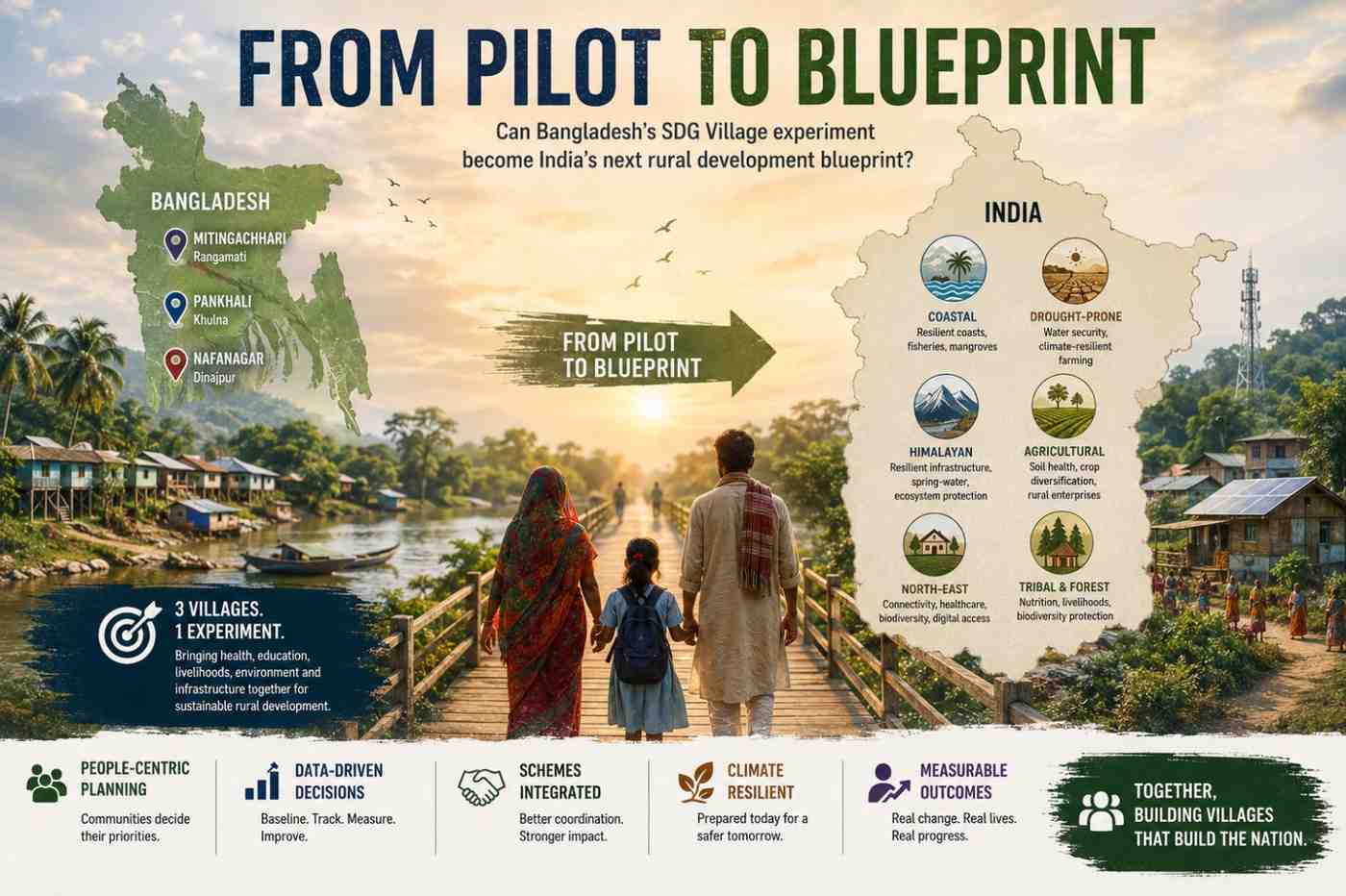
Can Bangladesh’s SDG Village experiment offer India a blueprint for turning global goals into local action?
Bangladesh has taken the Sustainable Development Goals from national policy to the village level through its first SDG Village pilot.
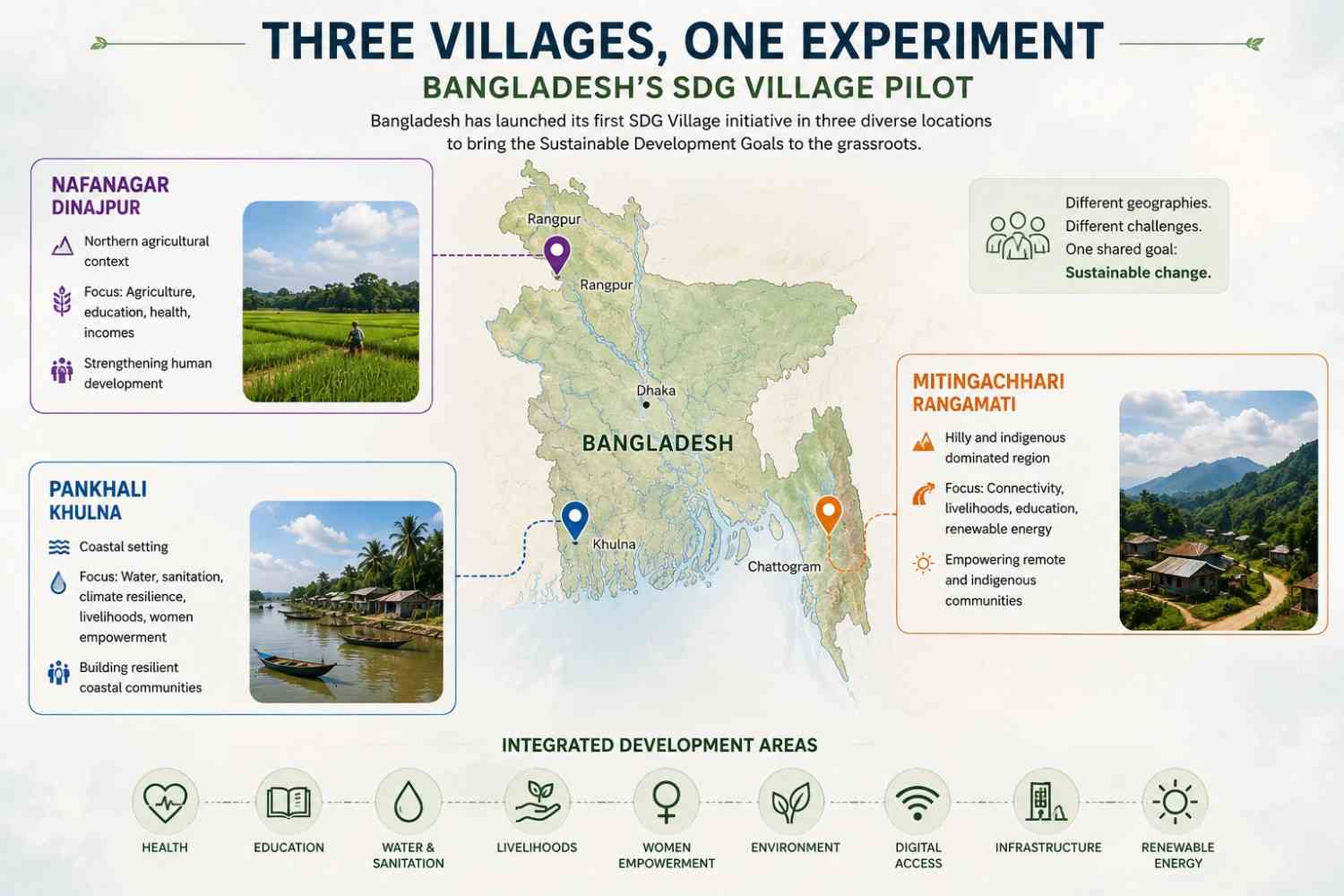
On August 10, Prime Minister Tarique Rahman inaugurated three villages under the initiative: Mitingachhari in Rangamati, Pankhali in Khulna and Nafanagar in Dinajpur.
The villages were selected to represent different geographical and socioeconomic conditions.
The idea is to bring several development priorities together instead of addressing them through separate programmes.
Health, education, clean water, sanitation, livelihoods, women's empowerment, renewable energy, environmental protection and digital access are all part of the approach.
This matters because rural challenges rarely exist in isolation.
Poor connectivity can affect education, healthcare and employment at the same time, while water shortages can influence health, farming and household incomes.
The pilot is therefore testing a simple but important idea: Can the SDGs become a local development plan rather than remain mainly national targets?
Why should India pay attention to three Bangladeshi villages?
The question is not whether India should copy Bangladesh. India's villages are far more diverse in terms of geography, population and economic conditions. But the broader lesson is relevant: development works better when national goals are connected to local needs.
India already has systems that could support such an approach.
The SDGs have been localised through Panchayati Raj Institutions, while the Panchayat Advancement Index assesses Gram Panchayats across areas linked to sustainable development.
This means India may not need another standalone scheme. Instead, existing systems could be used to identify demonstration villages across states and build development plans around their most urgent needs.
The process could begin with a village-level baseline covering health, education, poverty, water, sanitation, livelihoods, energy, environment, digital access and climate risks.
What Would an SDG Village Change on the Ground?
For ordinary residents, the SDGs matter only when they improve everyday life.
Can families access safe drinking water? Can children receive better education? Can farmers increase their incomes without damaging natural resources? Can women access healthcare and livelihood opportunities more easily? Can villages prepare for floods, droughts, cyclones or extreme heat?
An Indian SDG Village should be built around these practical questions.
However, every village should not receive the same development package.
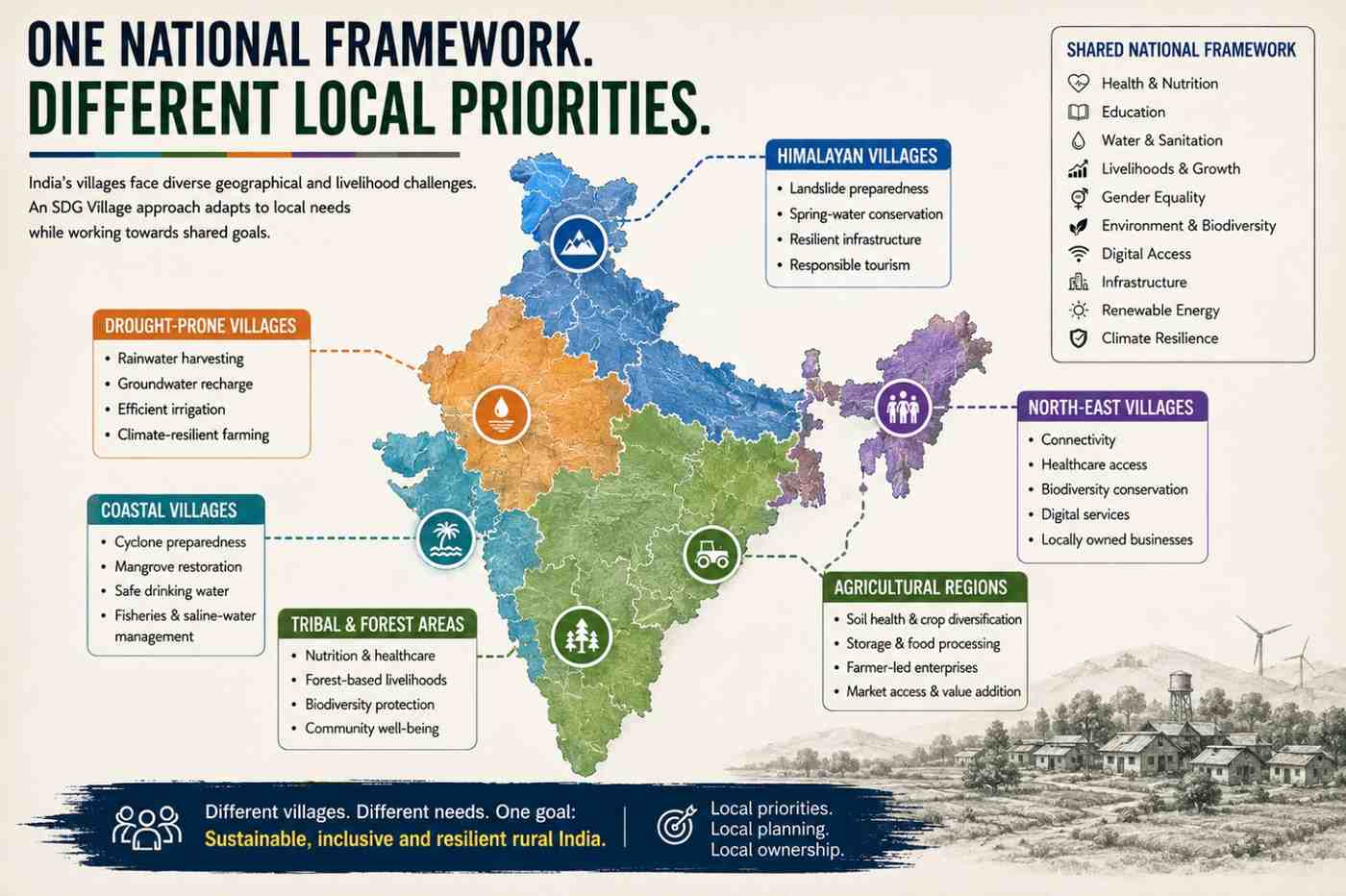
A coastal village may need to prioritise cyclone preparedness, mangrove restoration, safe drinking water, fisheries and saline-water management.
A drought-prone village may focus on rainwater harvesting, groundwater recharge, efficient irrigation and climate-resilient farming.
Himalayan villages could prioritise landslide preparedness, spring-water conservation, resilient infrastructure and responsible tourism. Agricultural regions could focus on soil health, crop diversification, storage, food processing and farmer-led enterprises.
The Northeast could place greater emphasis on connectivity, healthcare, biodiversity, digital services and locally owned businesses. Tribal and forest-dependent communities may need stronger support for nutrition, healthcare, forest-based livelihoods and biodiversity protection.
The principle should remain simple: one national framework, different local priorities.
But who decides what a village needs?
This is where community participation becomes essential.
An SDG Village cannot be planned entirely from government offices. The Gram Sabha should play a central role in identifying the problems residents consider most urgent.
A farmer may prioritise irrigation. Women may identify healthcare, water access or employment as bigger concerns. Young people may want better digital connectivity, skills and local job opportunities.
These priorities should directly shape the village development plan. Government departments can then bring existing schemes together around those needs instead of making residents navigate multiple programmes separately.
The result could be a more coordinated system: one village plan, multiple government programmes and one set of measurable outcomes.
How can India make sure it is more than a label?
This may be the biggest challenge. India already has numerous rural development schemes. The problem is often not a lack of programmes, but weak coordination, uneven implementation and limited measurement.
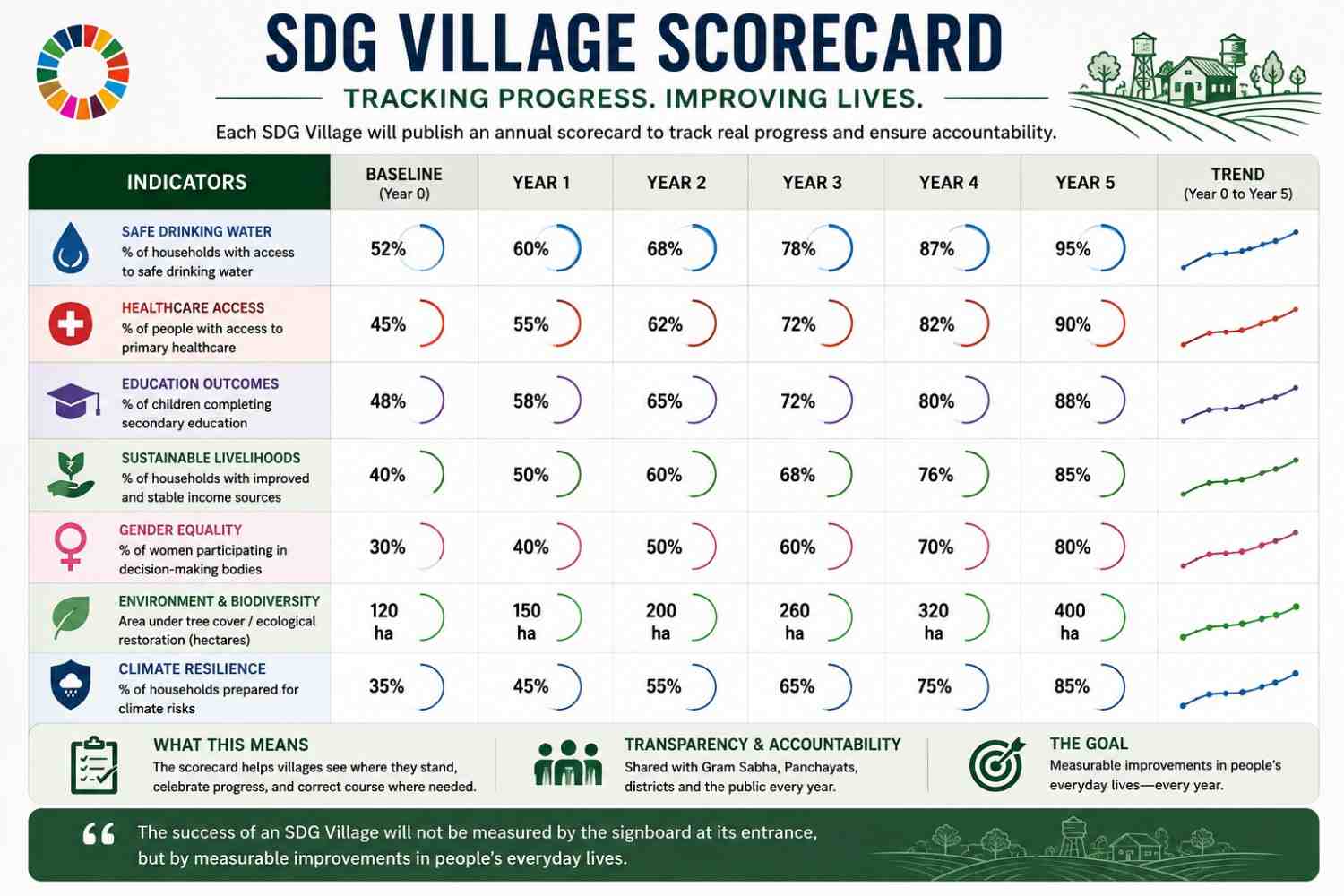
An SDG Village should therefore be judged by outcomes, not announcements.
If a water project is completed, officials should measure whether households actually receive reliable, safe water.
If a skill-development programme is introduced, its success should be reflected in employment or income. If healthcare facilities improve, residents should be able to access services more easily.
\Each village could publish an annual SDG scorecard covering a focused set of indicators such as water, health, education, livelihoods, gender, environment and resilience.
Funding should follow the village plan. Existing government schemes can form the foundation, while state and local resources fill gaps.
Businesses, universities and civil society organisations can provide valuable expertise where needed, but the needs and priorities of local communities should remain at the heart of the model.
Most importantly, the approach should allow programmes to be reviewed and improved along the way. If an intervention does not deliver the expected results, it should be changed and strengthened rather than simply marked as successful.
Could Bangladesh’s Village Experiment Work for India?
Bangladesh's initiative is still a pilot, so its long-term success will depend on implementation and whether the approach can be replicated effectively.
But its central idea is worth watching.
India already has the policy architecture needed to localise the SDGs. What it can strengthen is the connection between village-level data, community priorities, government schemes and measurable outcomes.
A national SDG Village programme could begin with demonstration villages across every state and Union Territory. Each village could follow common national indicators while adding priorities based on its geography, economy and climate risks.
The goal should not be to make every village follow the same development model. Instead, each village should receive the resources and support needed to address its own local challenges.
As Bangladesh tests whether sustainable development can begin at the village level, India has an opportunity to build on the idea by turning SDG Villages into real-world models for water security, climate resilience, livelihoods, healthcare, education and inclusive rural development.
The true measure of success will not be the signboard at the village entrance, but the difference people can actually see and feel in their everyday lives.
Sources:
- United Nations in Bangladesh – Sustainable Development Goals (https://bangladesh.un.org/en/sdgs)
- Bangladesh Planning Commission / Social Security Policy Support – Local Collective Action for Accelerating SDGs (https://socialprotection.gov.bd/2026/01/local-collective-action-for-accelerating-sdgs/)
- United Nations Statistics Division – Bangladesh SDG Localization (https://unstats.un.org/capacity-development/UNSD-FCDO/bangladesh/)
- United Nations University – Localisation of Sustainable Development Goals in Bangladesh (https://collections.unu.edu/view/UNU:8935)
- Sustainability – Localisation of Sustainable Development Goals (SDGs) in Bangladesh: An Inclusive Framework under Local Governments (https://www.mdpi.com/2071-1050/14/17/10817)
- United Nations in Bangladesh – SDG Localization & Gender-Disaggregated Data (https://bangladesh.un.org/en/316977-advocacy-session-gender-disaggregated-data-collection-advance-sdg-localization-bangladesh)
- Ministry of Panchayati Raj, Government of India – Panchayat-level SDG Localization (https://panchayat.gov.in/)
- NITI Aayog – Sustainable Development Goals India (https://sdgindiaindex.niti.gov.in/)
- UNDP – Sustainable Development Goals (https://www.undp.org/sustainable-development-goals)




Add a Comment