Reporting & Management

A strategic approach to tracking, analyzing, and improving organizational performance through structured reporting and effective management practices.

Showing 12/14

10 Aug 2026

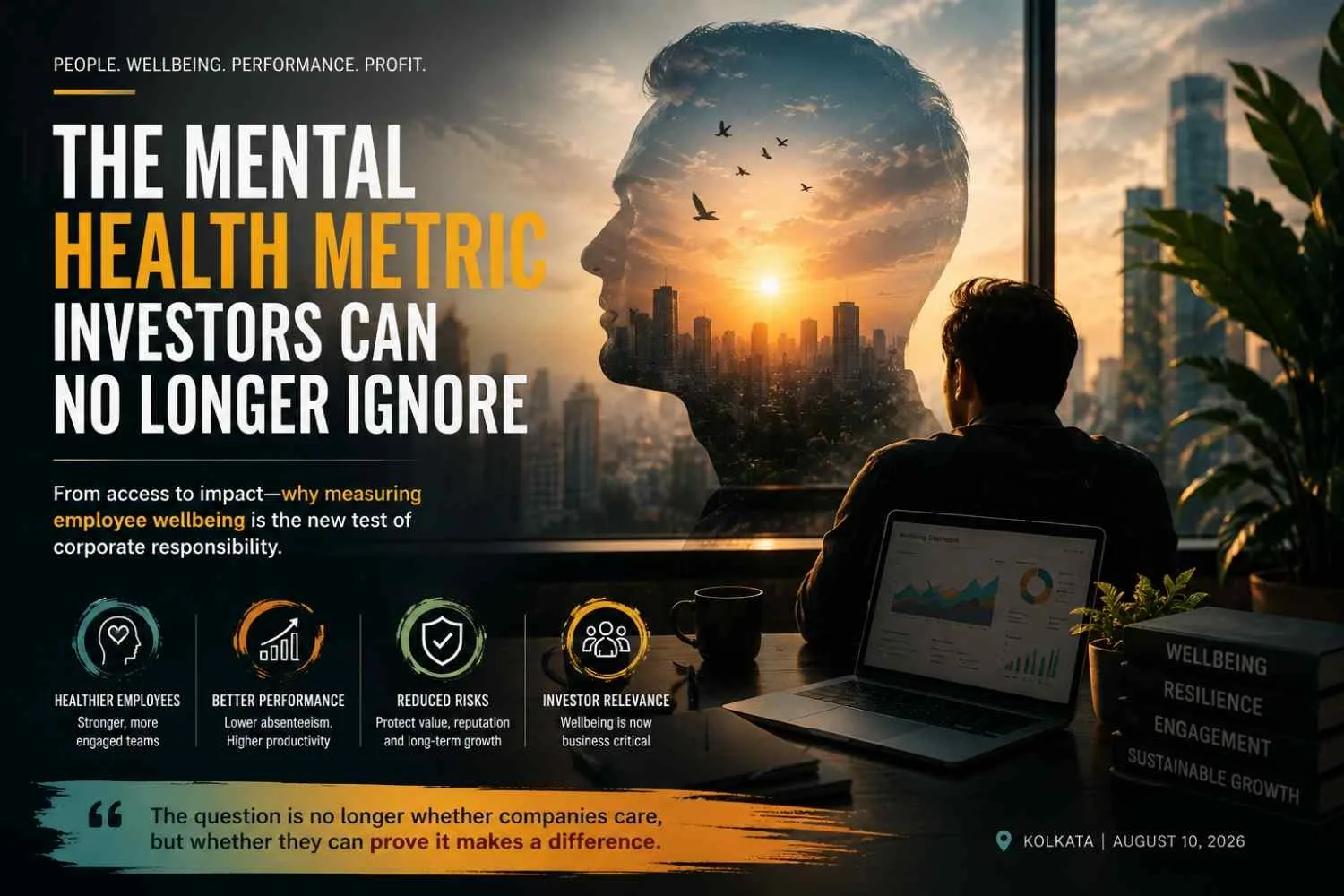
Kolkata | August 10, 2026 Employee mental health is moving beyond the HR department as companies, regulators and investors look at wellbeing as part of the “S” in ESG. The real test, however, is whether such programmes create measurable improvements in workers’ well-being- not merely whether an activity was organised. Quick SummaryWorkplace mental health is becoming harder for companies to treat it as a private HR matter. Employee-assistance programmes, counselling access and wellbeing initiatives are gradually appearing alongside broader workforce and social disclosures, while burnout, absenteeism and attrition are gaining attention as potential business risks. But measuring workplace wellbeing remains difficult. A company can report how many employees had access to a programme without showing how many actually used it, completed it or benefited from it. The gap becomes even wider for blue-collar, contract and gig workers, who may have fewer avenues to access mental-health support. As investors pay greater attention to the social side of ESG, the question is shifting from whether a company has a wellness programme to whether it can demonstrate a meaningful outcome from it. Can Employee Wellbeing Become an ESG Metric Investors Can Trust? For years, workplace mental health was largely treated as an HR responsibility. Companies organised counselling sessions, wellness workshops and employee-assistance programmes, often presenting them as workplace benefits aimed at improving employee morale. That approach is now changing. Mental health is gradually being linked to wider business concerns such as employee retention, absenteeism, productivity, workplace safety and governance risks. For investors examining the “S” in ESG, employee wellbeing can offer valuable insight into how responsibly a company manages one of its most important assets- its people. This shift comes at a time when corporate sustainability reporting is also becoming more structured. Under India's Business Responsibility and Sustainability Reporting (BRSR) framework, workforce-related information has become part of the broader discussion on responsible business practices. This creates an opportunity for employee wellbeing to move beyond general promises and become an area that can be assessed through clear evidence. But an important question remains: What should companies actually measure? Reporting that an employee-assistance programme exists only shows that support is available. It does not reveal how many employees used the service, whether they received continued support or whether the programme led to meaningful improvements. The gap between providing access and demonstrating results could become one of the biggest tests of credibility in workplace wellbeing reporting. The same applies to spending. A large budget for wellness programmes may look impressive in a sustainability report, but the amount spent alone cannot show whether the investment reached employees who needed support or whether it produced meaningful results. The challenge becomes even greater when looking beyond corporate offices. A wellbeing programme designed for salaried employees with access to private healthcare may not work in the same way for blue-collar, contract or gig workers, who may face different working conditions, financial pressures and barriers to accessing support. The real question, therefore, is no longer simply whether Indian companies are paying greater attention to workplace mental health. But whether their ESG reporting can provide credible evidence that these efforts are actually improving employees' wellbeing and working lives. Are Companies Measuring Wellbeing or Just Counting Participation? One of the biggest challenges in bringing workplace mental health into ESG reporting is measurement.  Companies can easily count the number of wellness programmes conducted, workshops organised or employees covered by an assistance programme. But these figures do not necessarily show whether employees are actually benefiting from them or not. This distinction is important because a programme can reach thousands of employees on paper while having very little real impact. A counselling service may be available across an organisation, for example, but only a small number of employees may use it. Others may hesitate because of stigma, concerns about confidentiality or simply a lack of awareness about the support available. This makes utilisation, completion and outcomes more meaningful indicators than programme availability alone. For investors, the difference can provide a much clearer picture of a company's social performance. Saying that 90% of employees have access to mental-health support shows the scale of the programme. Reporting how many employees actually used the service, completed the intervention and continued receiving support provides a better indication of whether that investment is making a difference. The same caution applies to employee burnout and turnover. High attrition may signal problems within the workplace, but it cannot automatically be linked to mental health. Factors such as salary, workload, management practices, career growth and job security can also influence an employee's decision to leave. This is where stronger ESG reporting can provide greater insight. Companies should also establish a clear baseline before measuring change, otherwise improvements in employee wellbeing cannot be meaningfully compared over time. Rather than relying on a single indicator, companies can look at employee turnover, absenteeism, engagement, workplace safety and access to wellbeing support together. Examining these factors side by side can help identify whether workforce wellbeing is becoming a broader business risk. Another important issue is who is actually covered by the data. A company may report strong wellbeing support for its permanent employees while excluding contract workers, outsourced staff or gig workers from the same programmes and disclosures. For businesses that rely heavily on such workers, this can create a significant gap between reported performance and the reality of the workforce. The expectation, therefore, is shifting from simply counting programmes to measuring the people they actually reach and the difference they make. A credible wellbeing metric should provide a clearer picture of who received support, who used it, what outcomes followed and whether support continued when required or not. Without such evidence, workplace mental-health reporting risks becomes another list of ESG activities rather than a meaningful measure of how a company is supporting its people. Wellbeing Beyond the PayrollThe corporate conversation around mental health often focuses on employees who are easiest to reach: permanent, office-based staff with access to HR teams, digital platforms and private healthcare. But India's workforce is much more diverse, and workers facing the toughest conditions may have the least access to mental-health support. For blue-collar workers, long hours, physically demanding jobs, safety concerns and limited flexibility can add to everyday pressures. Yet counselling and employee-assistance programmes may not be as accessible to them as they are to office employees. Shift workers may struggle to attend sessions during regular hours, while language barriers, limited awareness and concerns about confidentiality can discourage them from seeking support. The challenge can be even greater for contract and gig workers. Their relationship with a company often runs through contractors, vendors or digital platforms, creating uncertainty about who is responsible for providing mental-health support. As a result, a company may report strong employee-wellbeing figures while a significant part of its workforce remains outside formal support systems. This raises an important ESG question: Who is included when companies measure employee wellbeing? A narrow reporting boundary can make a company's social performance appear stronger than the experience of its wider workforce. For businesses that depend heavily on contract or outsourced labour, credible reporting should clearly state whether these workers are included, excluded or covered through separate arrangements. There is also a barrier that participation figures cannot fully capture: stigma. Employees may avoid counselling because they fear being judged, labelled as unable to cope or treated differently by managers and colleagues. Simply providing a helpline or counselling service, therefore, does not guarantee that employees will feel comfortable using it. Closing this gap requires more than an annual wellness campaign. Support must be accessible, confidential and trusted, and it needs to reach workers across different locations, shifts and employment arrangements. This is where the difference between wellness programming and a genuine wellbeing strategy becomes important. A wellness week may create awareness for a few days, but a meaningful ESG approach asks a deeper question: can workers access support when they actually need it, and is the company also addressing the workplace conditions that contributes to stress in the first place? Absolutely. I’d make this one tighter, more analytical and mass-friendly, while keeping the ESG and impact-measurement angle clear. I’d also avoid making it sound like a conclusion. When Wellness Becomes a Box-Ticking Exercise As workplace wellbeing gains importance in corporate ESG discussions, a new concern is emerging: are companies improving employee wellbeing, or simply adding mental-health initiatives to their ESG checklist?  A wellness week, meditation session or counselling app may show that a company is taking action, but it does not necessarily prove that employees are benefiting. This is where the difference between activity and outcome becomes important. An activity-based approach records what a company has done, while an outcome-based approach looks at what has changed as a result. For investors and other stakeholders, the second measure offers a much clearer picture of social performance. A more meaningful assessment could therefore consider indicators such as participation, programme completion, repeat use of support services, absenteeism trends, employee feedback and continuity of care. None of these measures can establish a direct cause-and-effect relationship on their own, but together they can show whether wellbeing initiatives are reaching the people they are intended to support. Investment also needs closer attention. If a company spends significantly on employee wellbeing, stakeholders should be able to understand how spending relates to the number of workers covered and the support provided. Budget allocation does not necessarily mean the money was spent, and spending alone does not demonstrate impact. Stronger reporting would connect financial investment with measurable reach and longer-term outcomes. Privacy is another critical concern. Mental-health information is highly sensitive, and employees may avoid seeking help if they fear that their participation could become known to managers or affect their careers. Companies therefore need clear rules on confidentiality, data collection, storage and access to employee information. This makes governance an important part of the “S” in ESG. A wellbeing programme cannot be considered effective simply because it exists. Employees must also feel safe, respected and confident enough to use the support available to them. The wider ecosystem is also expanding beyond corporate HR teams. NIMHANS-affiliated workplace-health initiatives, mental-health organisations such as the Live Love Laugh Foundation and worker-health institutions such as ESIC are part of a broader push towards improving access to mental-health support. Their relevance to ESG, however, should be assessed through measurable reach, outcomes and continuity rather than the visibility of individual programmes. Large employers such as Infosys, TCS, Wipro, ITC, Tata Steel and JSW Steel, along with major banks and other listed companies, offer useful examples of how workplace wellbeing is being incorporated into employee policies and sustainability reporting.  However, the real comparison should not be based on who has the most visible wellness programme. It should focus on who provides wider access, protects employee privacy, measures outcomes and maintains support over time. From Wellness Activity to ESG Outcome What companies reportWhat investors should askEAP availableHow many employees actually used it?Wellness sessions conductedWhat changed afterwards?Employees coveredWho is excluded from the denominator?Counselling accessIs it confidential and accessible?Programme spendingWhat was the cost per beneficiary/outcome?Annual campaignDid support continue beyond the campaign? The credibility of workplace wellbeing reporting depends on moving beyond programme availability to measurable and sustained outcomes. What Would Make Workplace Wellbeing Credible to Investors?If mental health is becoming an important part of the “S” in ESG, companies will need to show more than the existence of a counselling service or employee-assistance programme. Investors want to know who is covered, whether employees can actually access and use the support, and what evidence shows that it is making a difference. The first requirement is clear coverage. Companies should state how many workers are included in their wellbeing programmes and whether this covers only permanent employees or also contract, outsourced and gig workers. Reporting both total figures and workforce-adjusted measures can provide a clearer picture of the programme’s actual reach. Without a defined reporting boundary, percentages can create a misleading impression of scale. The second is accessibility. A programme may be officially available but difficult to use because of working hours, location, language, limited awareness or concerns about confidentiality. For blue-collar, shift and contract workers, removing these barriers can be just as important as offering the programme itself. Then comes evidence of outcomes. Companies do not need to reduce mental health to a single score, but they can track indicators such as programme use, completion, employee feedback, absenteeism and retention trends. These measures can help show whether support is reaching employees and whether workforce wellbeing is changing over time, without claiming that one programme alone caused a particular business outcome. Continuity is another important test. Mental-health support should not disappear once a wellness campaign ends or an annual budget cycle close. Credible wellbeing strategies require sustained access, regular evaluation and safe channels through which employees can share feedback. Investors and ESG-data providers can also influence this shift. Rather than rewarding companies simply for reporting that a wellbeing programme exists, they can place greater emphasis on coverage, accessibility, outcomes and transparency. The Wellbeing Measurement ChainAccess → Participation → Completion → Outcome → Continuity Credible workplace wellbeing reporting requires companies to move from simply offering support to demonstrating sustained outcomes. For companies, the message is straightforward: strong wellbeing performance is not about having the most visible wellness programme. It is about creating a workplace where employees can seek support without stigma, access it without unnecessary barriers and trust that their personal information will remain protected. The conversation is therefore moving from “We have a wellness programme” to “Here is the evidence that our workforce is better supported.” That distinction could determine whether workplace wellbeing remains another activity listed in an ESG report or becomes a meaningful indicator of how responsibly a company manages its people. Ultimately, the wellbeing section of an ESG report should measure more than the number of workshops or campaigns conducted. It should show who is covered, who receives support, what changes and whether that support lasts or not!   Evidence Check: What Should Investors Look For?  Coverage: What percentage of the total workforce is included? Utilisation: How many employees actually used the support? Outcome: What changed after the intervention? Worker mix: Are contract, blue-collar and gig workers included? Cost: How much was actually spent per beneficiary/outcome? Continuity: Did support continue beyond the campaign or funding period? Baseline: Is there a starting point against which improvement is measured? Reporting boundary: Does the data cover the whole workforce or only selected employees?      Primary sources  SEBI — BRSR Core & ESG disclosure frameworkThis is your most important source. SEBI’s BRSR Core specifically includes employee/worker wellbeing spending and says mental-health access can be part of the reported wellbeing measures. SEBI — BRSR Core framework SEBI — Updated BRSR formatUseful for your coverage/denominator argument because the framework asks companies to report employee wellbeing benefits separately for permanent and non-permanent employees. SEBI — Updated BRSR format SEBI — BRSR Core industry reporting standardsUse this when discussing how ESG disclosures are becoming more standardised and comparable. SEBI — Industry Standards on Reporting of BRSR Core Live Love Laugh Foundation — Corporate Mental Health & Well-being ProgrammeVery useful for your wellness vs measurable outcome argument. Its programme uses employee assessments, stigma-reduction measures and utilisation of existing EAPs rather than relying only on awareness events. Live Love Laugh — Corporate Mental Health & Well-being Programme Live Love Laugh Foundation — Corporate India roadmapUse its Transforming Mental Health in Corporate India: A Roadmap for Action as a sector-specific source for burnout, workplace stress and the argument that mental health should move beyond one-off initiatives. Live Love Laugh — Corporate India Roadmap NIMHANS — Centre for Well BeingGood primary institutional source for the availability of professional mental-health support and NIMHANS' broader role in mental-health services. NIMHANS Centre for Well Being NIMHANS — Institutional informationUseful for establishing NIMHANS' role in mental-health research, care, policy and national programmes. NIMHANS ...Read more
05 Aug 2026

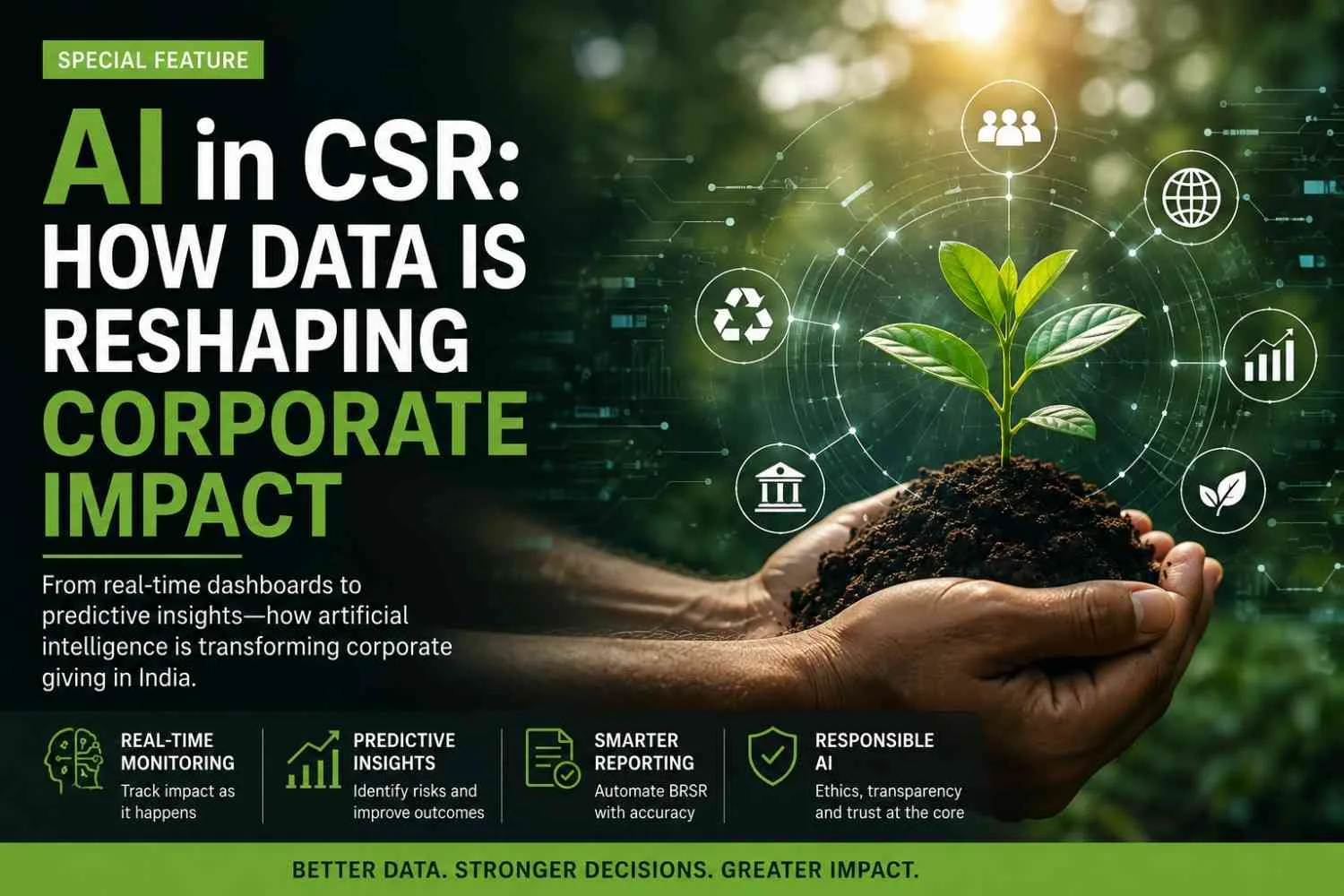
Kolkata | August 5, 2026 Artificial intelligence is rapidly transforming how companies measure, monitor and report the impact of their CSR initiatives. From predicting school dropout risks to automating sustainability disclosures, AI promises faster insights and greater accountability. Yet as algorithms begin shaping corporate giving, questions over data quality, ethical safeguards and reporting credibility are becoming impossible to ignore. Quick SummaryCorporate Social Responsibility (CSR) is entering a new phase where artificial intelligence is reshaping how social impact is measured. Companies are increasingly moving beyond annual spreadsheets and manual surveys towards real-time dashboards, predictive analytics and automated reporting systems capable of tracking beneficiaries, identifying programme risks and simplifying Business Responsibility and Sustainability Reporting (BRSR) disclosures. While these technologies promise greater efficiency and evidence-based decision-making, they also raise concerns around algorithmic bias, privacy, data manipulation and the growing gap between digital dashboards and realities on the ground. As regulators encourage greater transparency and companies invest in AI-powered impact platforms, the debate is shifting from whether AI should be used in CSR to how it can be deployed responsibly without compromising trust or accountability. KeywordsAI in CSR, CSR Impact Measurement, Artificial Intelligence, BRSR Reporting, Responsible AI, ESG Reporting, Corporate Sustainability, CSR Technology, Predictive Analytics, Real-Time Impact Monitoring   Can artificial intelligence transform corporate giving into measurable social impact- or is technology moving faster than accountability? Not long ago, assessing the success of a Corporate Social Responsibility (CSR) project was a slow and largely manual process. Field teams travelled to project locations with paper surveys, NGOs maintained handwritten records, and corporate CSR departments often spent weeks compiling data before presenting annual impact reports. By the time the data reached the decision-makers, it was too late to make timely course corrections. That approach is changing rapidly. Today, a CSR manager overseeing a digital education initiative can monitor student attendance through live dashboards, receive alerts when learning outcomes begin to decline and identify schools at risk of higher dropout rates in real time. Healthcare programmes can track patient follow-ups digitally, livelihood projects can monitor income trends through mobile applications, and sustainability teams can use automated systems to support Business Responsibility and Sustainability Report (BRSR) disclosures. This transformation reflects a broader shift in corporate India. As companies face growing expectations to demonstrate measurable social and environmental impact rather than simply report CSR spending, artificial intelligence is emerging as an important decision-support tool. Instead of relying solely on end-of-project evaluations, organisations are beginning to use AI, predictive analytics and cloud-based platforms to monitor programmes as they unfold, enabling faster and more informed interventions. The potential benefits are significant.AI can analyse large volumes of beneficiary data within seconds, identify trends that might be overlooked through manual analysis and help organisations allocate resources more efficiently. Supporters argue that this allows CSR programmes to move beyond reactive problem-solving towards proactive decision-making, addressing challenges before they affect project outcomes. Yet the growing reliance on AI also raises an important question: Can technology fully measure social impact? Community development is influenced by trust, behaviour, local realities and human relationships-factors that cannot always be captured through algorithms or dashboards. A decline in school attendance may be visible in digital data, but technology alone cannot explain whether the cause is seasonal migration, financial hardship or inadequate school infrastructure. Similarly, a healthcare platform may accurately record beneficiary numbers while failing to reflect barriers such as accessibility, awareness or social stigma. As AI becomes more deeply integrated into corporate philanthropy, the challenge is no longer collecting larger volumes of data. But to ensure that technology strengthens accountability without creating a false sense of precision. In the end, better dashboards do not automatically lead to better decisions, and measuring social impact will continue to depend as much on human judgement as on artificial intelligence. From Reporting Projects to Predicting Outcomes The evolution of CSR reporting reflects a broader shift in corporate sustainability -  from documenting activities to demonstrating measurable impact. For years, the success of CSR initiatives was largely measured through inputs such as funds spent, beneficiaries reached and projects completed during a financial year. While these indicators met statutory reporting requirements, they revealed little about whether programmes had created lasting social or environmental value. Artificial intelligence is beginning to change that approach. Rather than being used only at the end of a project for reporting, AI is becoming part of programme implementation itself. Companies are adopting cloud-based dashboards, geospatial mapping, computer vision and machine learning to monitor projects in real time, enabling CSR teams to identify risks early, compare interventions and make timely course corrections before resources are exhausted. The impact is particularly visible in education. Instead of relying solely on annual assessments, AI-enabled systems can analyse attendance, classroom engagement, learning patterns and assessment results almost in real time. Predictive models can identify students showing early signs of disengagement, allowing implementing agencies to intervene before irregular attendance leads to permanent dropout. Similar applications are being explored in skill development programmes, where algorithms help identify trainees who may need additional mentoring or financial assistance based on participation and completion trends. Healthcare initiatives are undergoing a similar transformation. Community health workers use mobile applications to upload patient data directly from the field, while AI-assisted platforms monitor vaccination coverage, treatment adherence and disease patterns across regions. Rather than measuring success only through the number of health camps organised, organisations can now track follow-up visits, treatment outcomes and areas requiring additional intervention. Livelihood programmes are also benefiting from predictive analytics. Digital platforms monitoring self-help groups, farmer producer organisations and micro-enterprises can detect changes in income, productivity and market access, enabling implementing partners to respond before financial challenges undermine programme objectives. Instead of evaluating outcomes only after a project ends, AI is helping organisations identify emerging risks while corrective action is still possible. AI is also reshaping corporate sustainability reporting. The introduction of the Business Responsibility and Sustainability Report (BRSR) by the Securities and Exchange Board of India (SEBI) has significantly increased the volume of environmental, social and governance (ESG) data that listed companies are required to disclose. Collecting, verifying and consolidating this information across multiple business units has made manual reporting more time-consuming and complex. To address this, many organisations are adopting AI-powered reporting platforms that integrate data from operational systems, identify inconsistencies, flag missing disclosures and generate draft sustainability reports. Beyond reducing administrative effort, these systems improve reporting consistency and allow management teams to focus more on analysing performance than compiling documentation. Despite these advances, however, AI remains only as reliable as the data it receives. Artificial intelligence can identify patterns, generate insights and predict future trends, but it cannot compensate for incomplete records, inaccurate field reporting or weak verification processes. Poor-quality data inevitably leads to unreliable analysis, regardless of how advanced the technology may be. For this reason, many experts view AI not as a replacement for human oversight but as a tool that strengthens decision-making when supported by credible data, robust governance and effective monitoring systems. How AI Is Changing CSR Traditional CSR MonitoringAI-Driven CSR MonitoringAnnual surveysReal-time dashboardsManual beneficiary recordsAutomated data collectionEnd-of-project evaluationContinuous performance trackingReactive interventionsPredictive analyticsSpreadsheet reportingAutomated BRSR disclosures Key takeaway: AI is shifting CSR from measuring what happened to anticipating what could happen next.  When Algorithms Meet Accountability Artificial intelligence is transforming the way CSR programmes are monitored and evaluated, but it is also introducing a new set of ethical and operational challenges. As organisations rely on algorithms to guide decisions, an important question is emerging: Can technology strengthen accountability without compromising trust? At the heart of this debate, lies the quality of data.AI systems can only produce reliable insights when the underlying data is accurate, complete and consistent. Incomplete beneficiary records, duplicate entries or reporting errors can generate misleading conclusions that appear highly credible because they are supported by sophisticated dashboards and predictive models. Unlike manual reporting, where inconsistencies are often easier to identify, algorithm-driven analysis can sometimes conceal data quality issues behind polished visualisations. This concern is particularly relevant in CSR impact assessment. Many companies and CSR consultants now use AI-enabled platforms to consolidate data from education, healthcare, livelihood and environmental programmes. While automation has significantly improved reporting efficiency, experts caution that it should complement and not replace independent field verification. Without regular validation, inaccurate beneficiary records, duplicate entries or inconsistencies across projects can find their way into impact reports and sustainability disclosures. In many cases, these errors are not intentional. Different implementing partners often use varying reporting formats, beneficiary definitions and data collection methods. A beneficiary participating in multiple programmes may be counted more than once, while attendance, outreach and engagement may be measured using different indicators across projects. AI can process these datasets rapidly, but unless the information is standardised and verified, technology may reinforce inconsistencies rather than eliminate them. Privacy and data security have also become major considerations. AI-powered CSR platforms collect personal information such as age, location, income, educational performance and health records to improve programme design and delivery. Although this enables more targeted interventions, it also raises important questions about informed consent, data ownership and cybersecurity. Many beneficiaries, particularly in rural and digitally underserved communities, may have limited awareness of how their information is collected, stored or used. To address these concerns, experts are calling for stronger ethical safeguards around the use of AI. Greater transparency in algorithms, human oversight, robust data governance, protection of sensitive information and regular third-party audits are increasingly seen as essential for ensuring that AI strengthens accountability without creating new risks. There is also a growing recognition that not every aspect of social impact can be measured through technology. AI can efficiently analyse beneficiary numbers, attendance, training hours and financial disbursements while identifying patterns that may indicate emerging programme risks.  Affected VoicesDevelopment organisations working at the grassroots say artificial intelligence is making programme monitoring faster, but not necessarily simpler.NGOs involved in education, healthcare and livelihood projects argue that digital dashboards can highlight patterns, yet they cannot replace conversations with communities. A field worker may know why a child has stopped attending school, why a family refuses a healthcare intervention or why a self-help group is struggling despite positive financial indicators- insights that rarely appear in automated reports.Consumer and civil society organisations also caution that communities should not become passive data points. They argue that beneficiaries must understand how their information is collected, stored and used, particularly as AI systems become more integrated into social programmes. For them, responsible technology is not only about better analytics but also about protecting privacy, maintaining informed consent and ensuring that people remain at the centre of every CSR intervention. However, it remains far less effective at measuring outcomes such as community trust, behavioural change, social inclusion and local ownership- factors that often determine the long-term success of CSR initiatives. For this reason, development practitioners continue to emphasise the importance of human engagement alongside technological analysis.AI can identify that attendance in a vocational training programme is declining, but conversations with beneficiaries are often needed to understand whether transport costs, household responsibilities or seasonal employment are driving that trend. Technology can reveal patterns, but people provide the context that explains them. As AI becomes more deeply embedded in corporate philanthropy, the future of CSR impact measurement is likely to depend on balancing automation with accountability. Organisations that combine advanced analytics with transparent governance, independent verification and continuous engagement with communities will not only generate more reliable evidence but also strengthen public trust in the impact they seek to create. AI Can Measure, But Can It Understand?AI Measures Well Beneficiary numbers  Attendance and participation  Learning outcomes  Health follow-ups  Resource utilisation  Reporting efficiency  Humans Still Matter For Community trust Behavioural change Inclusion and dignity Local context Cultural realities Independent verification Key takeaway: Artificial intelligence can improve measurement- but meaningful impact still requires human judgment. When Evidence Meets ScrutinyAs artificial intelligence becomes an integral part of CSR monitoring, experts argue that the technology itself must be evaluated as rigorously as the programmes it measures. A sophisticated dashboard may present real-time insights and impressive visualisations, but its credibility ultimately depends on the quality of data, the methodology behind the analysis and the transparency of the reporting process. The first challenge lies in how impact is measured. CSR programmes often use different indicators to define success. An education initiative may focus on attendance or learning outcomes, while a healthcare project may measure beneficiary reach, treatment adherence or long-term health improvements. When AI systems analyse datasets built on different definitions and reporting standards, comparing outcomes across projects becomes difficult, even if the technology functions accurately. For this reason, development economists and impact evaluation specialists continue to emphasise the importance of establishing reliable baselines before introducing AI-driven monitoring. Without a clear starting point, it is difficult to determine whether a programme has genuinely improved people's lives or simply produced more data. An algorithm may report a significant increase in school attendance, but the finding has limited value unless it is measured against credible baseline data and tracked consistently over time. Another challenge is distinguishing the impact of a single intervention from broader social change. AI platforms can efficiently capture data generated within CSR programmes, but they cannot always account for external factors that influence outcomes. Improvements in school attendance, for example, may reflect not only a company's education initiative but also better government infrastructure, scholarship schemes or wider community participation. As a result, experts caution against treating AI-generated correlations as conclusive evidence of impact. Benchmarking presents similar limitations. Many AI platforms allow organisations to compare CSR performance across projects, districts or business units. However, such comparisons are meaningful only when programmes operate under similar conditions and pursue comparable objectives. Comparing projects with different beneficiary groups, geographies or impact indicators may produce conclusions that are statistically sound but practically misleading. This is why independent assurance remains essential. AI can quickly identify anomalies, missing records and unusual reporting patterns, but it cannot replace field verification, beneficiary feedback, external audits or independent programme evaluations. Experts argue that technology is most valuable when it strengthens existing evaluation processes rather than serving as a substitute for them. The growing investment in AI also raises important questions about transparency. Companies are allocating substantial resources towards digital CSR platforms, cloud infrastructure, analytics and cybersecurity. Yet annual reports rarely distinguish expenditure on AI-enabled monitoring from broader CSR administration or programme implementation. This makes it difficult for stakeholders to assess whether these investments are improving programme delivery or primarily enhancing reporting efficiency. Ultimately, the success of AI in CSR will not be measured by the volume of data it generates, but by the quality of the decision it supports. Technology can strengthen accountability and improve impact measurement, but only when it is backed by transparent methodologies, credible data, independent verification and meaningful human oversight. Evidence Check: Questions Every AI-Powered CSR Dashboard Should Answer   Evidence TestWhy It MattersIs the methodology publicly explained?Ensures transparency and comparability.What is the baseline?Measures real change, not isolated data points.Has the data been independently verified?Reduces reporting bias and inflation.Are reporting boundaries clearly defined?Prevents misleading impact claims.Does AI support or replace field verification?Human validation remains essential.Is investment in AI transparently disclosed?Demonstrates accountability beyond technology adoption. Key takeaway: Artificial intelligence can process information at extraordinary speed, but trustworthy CSR still depends on evidence that is transparent, independently verified and grounded in reality. Beyond the Dashboard Artificial intelligence is transforming the way companies design, monitor and evaluate their CSR initiatives. What was once driven by periodic surveys and retrospective reporting is evolving into a system supported by real-time data, predictive analytics and continuous monitoring. For businesses, this means faster decision-making and more informed resource allocation. For regulators and stakeholders, it offers the potential for greater transparency, consistency and accountability in sustainability reporting. However, technology alone cannot guarantee meaningful impact. The value of AI will ultimately depend on the quality of the data it processes, the transparency of the methodologies behind it and the governance system that ensures every insight is credible and independently verifiable. While dashboards can identify patterns and emerging risks, they cannot replace human judgement, community engagement or an understanding of the local realities that shape social outcomes. As AI becomes gradually embedded in corporate philanthropy, the conversation is shifting from whether it should be adopted to how responsibly it should be used. Its long-term success will not be measured by the sophistication of its algorithms, but by its ability to strengthen decision-making, build public trust and deliver measurable improvements where they matter the most. Ultimately, no algorithm, dashboard or report can define the success of CSR. Its true measure will always be the positive and lasting change it brings to people's lives. Evidence Check ParameterStatusMethodology disclosedPartial – Varies by platformIndependent verificationEssential but inconsistentBaseline comparisonRequired for credible impact measurementAI ethics & privacyIncreasing regulatory focusHuman field validationStill indispensableAI investment disclosureLimited in public CSR reports   Key TakeawaysAI is shifting CSR from annual reporting to real-time monitoring. Predictive analytics can identify programme risks before they escalate. BRSR reporting is accelerating AI adoption across listed companies. AI cannot replace field verification or community engagement. Transparency and independent audits remain essential for credible impact reporting. Primary Sources:  Ministry of Corporate Affairs (MCA) – Corporate Social Responsibility (CSR) Framework & Companies Act, 2013https://www.mca.gov.in/ Securities and Exchange Board of India (SEBI) – Business Responsibility and Sustainability Reporting (BRSR) Frameworkhttps://www.sebi.gov.in/ NITI Aayog – Responsible AI for All: Strategy and Discussion Papershttps://www.niti.gov.in/ Ministry of Electronics and Information Technology (MeitY) – IndiaAI Mission & AI Governance Initiativeshttps://www.meity.gov.in/ CSRBOX – CSR Intelligence, Case Studies & Impact Measurement Resourceshttps://csrbox.org/ Microsoft AI for Good – AI Applications for Social Impact and Sustainable Developmenthttps://www.microsoft.com/en-us/ai/ai-for-good World Economic Forum (WEF) – Artificial Intelligence Governance & Responsible AI Reportshttps://www.weforum.org/ J-PAL South Asia – Evidence-Based Programme Evaluation and Impact Measurementhttps://www.povertyactionlab.org/south-asia ...Read more

30 Jul 2026

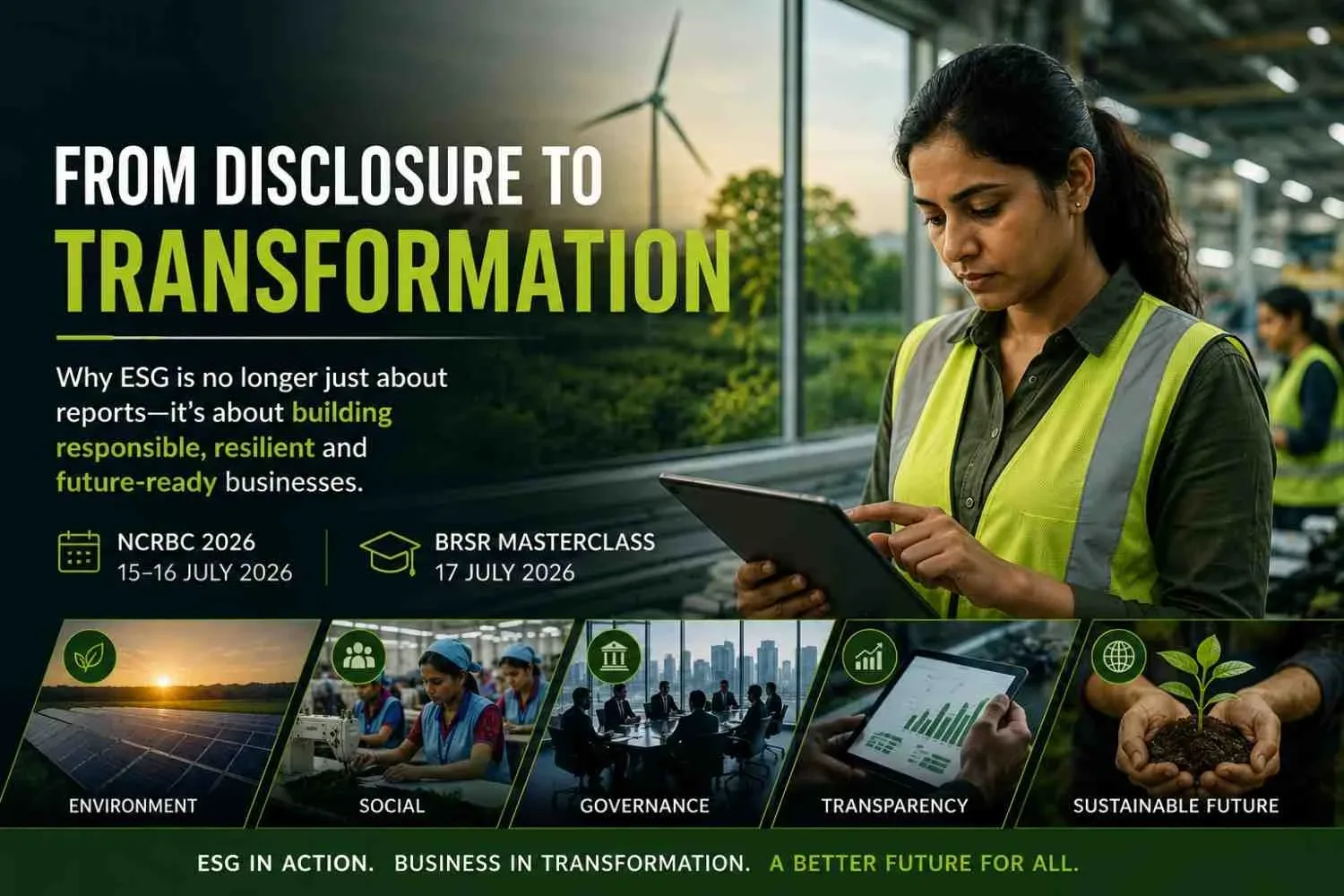
As NCRBC 2026 approaches, the conversation is shifting from sustainability reporting to building businesses that are resilient, responsible and future-ready What if the real value of sustainability is no longer measured by the report a company publishes once a year, but by the decisions it makes every day?From managing risks and attracting investment to building customer trust and securing long-term growth, sustainability is increasingly becoming part of how businesses operate.That transformation is expected to drive discussions at the National Conference on Responsible Business Conduct (NCRBC) 2026, organised by the Indian Institute of Corporate Affairs (IICA) on 15–16 July, followed by the Business Responsibility and Sustainability Reporting (BRSR) Masterclass on 17 July.The conference comes at a time when businesses across India are under growing pressure to demonstrate that sustainability is more than a corporate commitment. Gradually, Environmental, Social and Governance (ESG) practices are moving beyond annual disclosures and becoming a core element of business strategy. Why ESG Matters Beyond BusinessESG may sound like a term reserved for corporate boardrooms, but its impact reaches far beyond them. It shapes the products people buy, the conditions in which employees work and the way businesses affect the environment and local communities. Cleaner production, ethical sourcing, responsible waste management and transparent governance, influence everyday life. Public expectations are changing as well. Consumers and investors want businesses to prove that sustainability is reflected in their actions, not just their reports. In a marketplace built on trust, companies that fail to do so risk falling behind. Why Reporting Alone Is No Longer Enough For many businesses, sustainability reporting was once viewed as a way to meet regulatory requirements. Today, it is becoming a starting point rather than the final objective. India's Business Responsibility and Sustainability Reporting (BRSR) framework has strengthened ESG disclosures, but stakeholders now expect more than transparency. Investors compare ESG performance before allocating capital, banks are incorporating sustainability risks into lending decisions, global buyers are demanding responsible sourcing, and customers are rewarding businesses that demonstrate genuine environmental and social responsibility. The result is a fundamental shift: ESG is moving from an annual reporting exercise to an integral part of business strategy, financial planning and long-term growth. What Will NCRBC 2026 Focus On? The conference is expected to bring together policymakers, corporate leaders, regulators, researchers, sustainability professionals and industry experts to discuss the future of responsible business in India. The discussions are expected to cover several key areas, including Integrating ESG into core business strategy.Strengthening Business Responsibility and Sustainability Reporting (BRSR) and its implementation.Building resilient and responsible supply chains.Advancing climate action, corporate governance and ethical leadership.Preparing businesses to adapt to evolving global sustainability standards.The Business Responsibility and Sustainability Reporting (BRSR) Masterclass, scheduled for 17 July, is also expected to help organisations strengthen their sustainability reporting while encouraging companies to use ESG information as a business planning tool rather than treating it solely as a compliance requirement. The Bigger ChallengePublishing a sustainability report may mark an important milestone, but it does not guarantee meaningful change. The real challenge lies in translating commitments into everyday business practices. Many organisations continue to struggle with collecting reliable ESG data, measuring environmental impacts, engaging suppliers and embedding sustainability across their operations. Small and medium-sized enterprises (SMEs) often face additional barriers because of limited financial resources, technical expertise and dedicated sustainability teams. Experts say that achieving broader ESG adoption will require stronger policy support, capacity-building initiatives and practical guidance, particularly for smaller businesses. They also believe that continuous monitoring will become increasingly important. Businesses will need to demonstrate measurable improvements in emissions reduction, resource efficiency, employee well-being and governance practices- not just publish sustainability reports each year. Looking AheadAs India strengthens its sustainability ambitions and keeps pace with evolving global responsible business standards, platforms like NCRBC are becoming more than places for discussion. They are helping shape a future where sustainability is no longer viewed as a corporate obligation, but as a driver of innovation, resilience and long-term growth. The true success of ESG will not be measured by the number of reports released each year. It will be measured by businesses that reduce their environmental impact, strengthen governance, build resilient supply chains and earn the trust of the communities they serve. Because the future of responsible business will not be defined by what companies say in their disclosures- it will be defined by what they change in their decisions, their operations and their culture. That is the transformation ESG is ultimately expected to deliver. Sources:Indian Institute of Corporate Affairs (IICA) – NCRBC 2026 (https://iica.nic.in/esgconference/)   NCRBC 2026 Official Conference Website (https://esgconference.iica.in/)   Press Information Bureau (PIB) – NCRBC 2026 Inaugural Press Release (https://www.pib.gov.in/PressReleasePage.aspx?PRID=2285687&lang=2&reg=48)  Press Information Bureau (PIB) – NCRBC 2026 Closing Press Release (https://www.pib.gov.in/PressReleasePage.aspx?PRID=2286148&lang=2&reg=48)   Indian Institute of Corporate Affairs (IICA) – Certified ESG Professional Programme (https://iica.nic.in/esgcsr/)   Institute of Chartered Accountants of India (ICAI) – Sustainability Reporting Standards Board (https://www.icai.org/post/sustainability-reporting-standards-board) ...Read more

29 Jul 2026

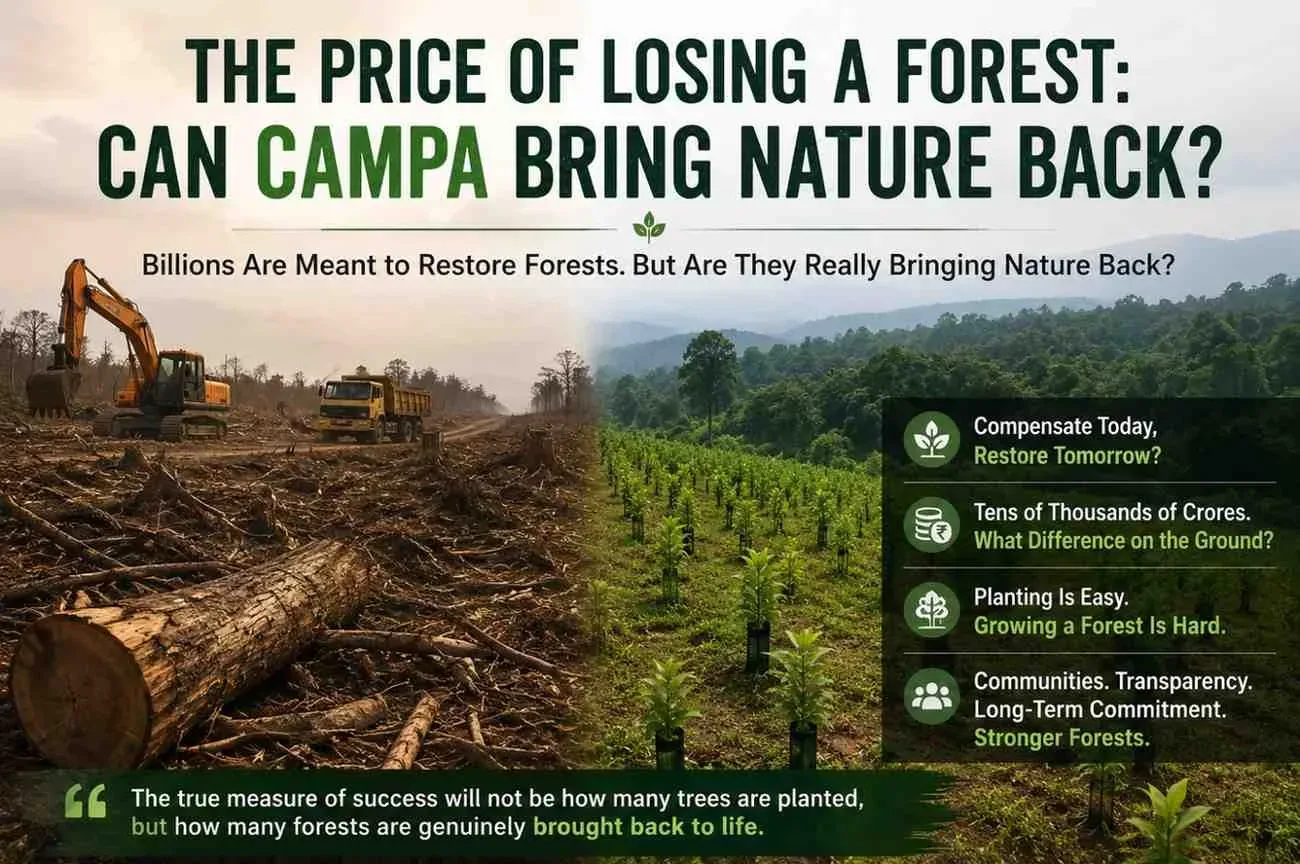
Billions Are Meant to Restore Forests. But Are They Really Bringing Nature Back?   Every time forest land is diverted for highways, railways, mines or industrial projects, developers are expected to compensate by creating forests elsewhere. On paper, the principle appears simple: replace what is lost. But the debate is no longer about whether compensation is provided- it is about whether it truly replaces what has been lost. The real test of compensatory afforestation is not the number of saplings planted, but whether lost forests are truly being restored.That question has gained renewed attention after the 10th July meeting of the National Compensatory Afforestation Fund Management and Planning Authority (CAMPA), where officials reviewed the implementation of one of India's largest ecological restoration programmes. The meeting may have focused on fund utilisation and afforestation progress, but it revived a much larger question: are CAMPA funds creating resilient forest ecosystems, or are they only measuring success through plantation numbers?  Understanding CAMPA CAMPA was created around a simple principle: when forests are lost to development, the ecological cost should be invested back into restoration. Under the mechanism, developers who divert forest land for non-forest purposes contribute funds towards rebuilding forest ecosystems elsewhere.These funds support afforestation, natural regeneration, wildlife conservation, forest protection, soil and water conservation, fire prevention and improvements in forest management infrastructure. CAMPA now represents one of India's largest environmental funding pools, with tens of thousands of crores dedicated to compensating for forest loss.The challenge, however, is not only how much money is available- it is whether that money is rebuilding forests or merely adding to plantation statistics. The Bigger Question Isn't Spending- It's Ecological Recovery Much of the attention on CAMPA revolves around fund utilisation. Rather than asking how much money has been spent, experts say the more important question is what difference those investments have made on the ground.Plantation numbers may look impressive on paper, yet forests cannot be measured by saplings alone. A healthy forest supports wildlife, stores carbon, protects water and soil, and provides livelihoods for communities that depend on it. Restoration cannot be measured by plantation numbers alone. If saplings fail to survive or diverse natural forests give way to monoculture plantations, the ecological gains may remain limited despite substantial investments. Ecologists say the conversation must move beyond how much was spent to what ecological outcomes were achieved. Planting Is Easy- Growing a Forest Is Hard One of the biggest questions surrounding compensatory afforestation is what happens after the plantation drive ends. Saplings need years of monitoring, protection and maintenance before they can grow into self-sustaining forests. Without sustained care, survival rates can fall significantly, limiting the ecological value of restoration efforts. Many environmental experts argue that public reporting should go beyond the number of saplings planted and include their survival after three, five and even ten years. Such long-term monitoring would provide a more reliable measure of whether restoration efforts are creating lasting ecological benefits. Can New Plantations Replace Natural Forests? The debate extends beyond the number of trees planted. An equally important question is whether newly created plantations can truly compensate for the loss of mature natural forests. Many researchers argue that plantation figures tell only part of the story.A natural forest is far more than a collection of trees. It develops over decades or centuries, supporting biodiversity and ecological processes that cannot be recreated overnight. Compensatory plantations, often made up of fewer species, may not fully replace these functions.That is why many conservationists argue that success should be measured by ecological restoration rather than plantation targets. Restoring degraded ecosystems, conserving existing forests and planting native species are widely considered more effective ways to rebuild resilient landscapes. Restoring Forests Requires Restoring PartnershipsForest restoration is not just an ecological exercise- it is also a community effort. Many experts argue that Indigenous communities, forest-dependent households and local residents should be treated as partners rather than participants. Their understanding of local ecosystems can improve the choice of native species, strengthen long-term management and increase plantation survival. Equally important, community involvement helps maintain accountability long after the plantation drive is over. Transparency Strengthens Accountability Many experts believe that transparency is essential to improving forest restoration. They argue that district-level information on CAMPA projects- including where funds are spent, how plantations are performing and what ecological outcomes are being achieved- should be easily accessible to the public. Greater openness would allow citizens to track progress, strengthen accountability and help governments identify restoration approaches that deliver the best results. More Than Planting TreesIndia's environmental commitments have made CAMPA a critical instrument for forest restoration. But its legacy will not be determined by financial allocations or plantation statistics alone. It will be determined by whether today's investments restore ecosystems that can withstand climate change, protect biodiversity and support future generations. In the years ahead, the true measure of success will not be how many trees are planted- it will be how many forests are genuinely brought back to life.         Sources: National Compensatory Afforestation Fund Management and Planning Authority (CAMPA) – Ministry of Environment, Forest and Climate Change (MoEFCC)https://moef.gov.in/en/division/forest-and-wildlife-division/national-campa/ Compensatory Afforestation Fund Act, 2016 (CAF Act) – Government of Indiahttps://legislative.gov.inForest Survey of India (FSI) – India State of Forest Report (ISFR)https://fsi.nic.in Down To Earth – Environment and forest restoration coverage, including CAMPA implementation and afforestation debateshttps://www.downtoearth.org ...Read more

29 Jul 2026

China's climate emergencies highlight a bigger question: Are Asian cities prepared for multiple disasters at once?  When a typhoon approaches, cities usually prepare for strong winds and heavy rain. But what happens when rivers are already overflowing before the storm even arrives? Experts say this is becoming the new reality. Instead of facing isolated disasters, countries are increasingly confronting compound events- multiple climate hazards unfolding together or in rapid succession, making their impacts far more severe and recovery more complex. China's recent climate emergencies offer a clear example of this growing challenge. Over a short span of time, several regions have experienced heavy rainfall, widespread flooding and the looming threat of typhoons. Together, these overlapping events have tested emergency response systems, disrupted transport networks, increased pressure on dams and forced thousands of people to evacuate. China's response may dominate the immediate headlines, but the larger concern reaches beyond its borders. If one of Asia's largest economies can face multiple climate disasters simultaneously, how resilient are other countries when confronted with the same threat? Across Asia, rapid urbanisation is unfolding alongside frequent climate hazards. Rising temperatures are intensifying heavy rainfall, while sea-level rise and changing weather patterns are making floods more destructive in densely populated cities.Experts say this new reality demands a shift in disaster planning- from preparing for single events to managing multiple climate risks at the same time.The challenge is no longer preparing for a single disaster in isolation. Cities are now being forced to plan for multiple hazards that can occur at the same time or trigger one another. This shift is making compound-event planning a key priority for disaster preparedness. The focus is shifting from isolated disasters to understanding how multiple hazards interact. Heavy rainfall can overwhelm drainage systems, flood roads, trigger landslides, and strain dams and reservoirs- leaving communities more vulnerable if another hazard, such as a cyclone, follows soon after. Disasters can no longer be viewed as separate emergencies, as one event often magnifies the impact of another. China's recent climate emergencies demonstrate why preparing for interconnected risks is becoming an essential part of disaster planning. Another issue moving to the forefront is dam safety.Reservoirs across Asia are vital for water storage, irrigation, hydropower and flood management.  But during extreme rainfall, operators face a difficult choice: retain more water and increase pressure on the dam, or release it quickly and risk worsening floods downstream.Experts say climate change is making these decisions more difficult, turning dam management into more than just a technical challenge.Modern dam management depends on accurate weather forecasts, river monitoring, real-time data and close coordination between multiple agencies. Strengthening these systems can help authorities act before risks escalate.The same principle applies to cities.Urban flooding is no longer caused by heavy rainfall alone. Rapid urbanisation, shrinking wetlands, expanding paved surfaces and inadequate drainage often prevent water from draining naturally, allowing intense rainfall to quickly develop into a major urban emergency. Many cities across Asia are now confronting the same challenge. Whether in China, India, Bangladesh or Southeast Asia, growing populations and expanding infrastructure are increasing exposure to climate-related risks. Experts argue that adaptation must therefore become part of everyday urban planning rather than an emergency response after disasters occur. This requires stronger drainage systems, the protection of natural flood buffers like wetlands and floodplains, more effective early-warning systems, and resilient infrastructure that can continue operating during extreme weather. Technology is becoming a powerful ally in climate adaptation. From satellite monitoring and artificial intelligence to advanced forecasting and digital flood mapping, new tools are helping authorities detect risks earlier and give communities more time to prepare. But technology cannot prevent disasters on its own. Experts say real preparedness depends on how effectively governments, engineers, emergency responders and local communities work together long before a crisis begins. For India, the lessons are particularly relevant. Recurring urban floods, powerful cyclones and rapid infrastructure expansion are increasing the country's exposure to multiple climate hazards. Experts argue that future disaster preparedness will depend not only on responding effectively to individual events but also on planning for the ways different hazards can interact. China's recent floods and typhoon threats are therefore more than a national emergency. They highlight a broader reality: climate disasters are becoming more interconnected, more complex and increasingly difficult to anticipate. China's floods and typhoon threats are more than a reminder of a changing climate- they are a reminder that the nature of disasters is changing as well. The real test of resilience will not be how well countries respond to the next disaster, but how effectively they prepare for a future where climate risks no longer arrive alone. Sources: World Meteorological Organization (WMO) – Multi-Hazard Early Warning Systems & Climate Reportshttps://wmo.intUnited Nations Office for Disaster Risk Reduction (UNDRR) – Compound Disaster Risk & Disaster Resiliencehttps://www.undrr.orgChina Meteorological Administration (CMA) – Typhoon Monitoring, Rainfall & Weather Warningshttps://www.cma.gov.cn/enReuters – Coverage of China's floods, typhoons and emergency responsehttps://www.reuters.com/world/china/ReliefWeb (OCHA) – Floods, Humanitarian Updates & Disaster Situation Reportshttps://reliefweb.int ...Read more

28 Jul 2026

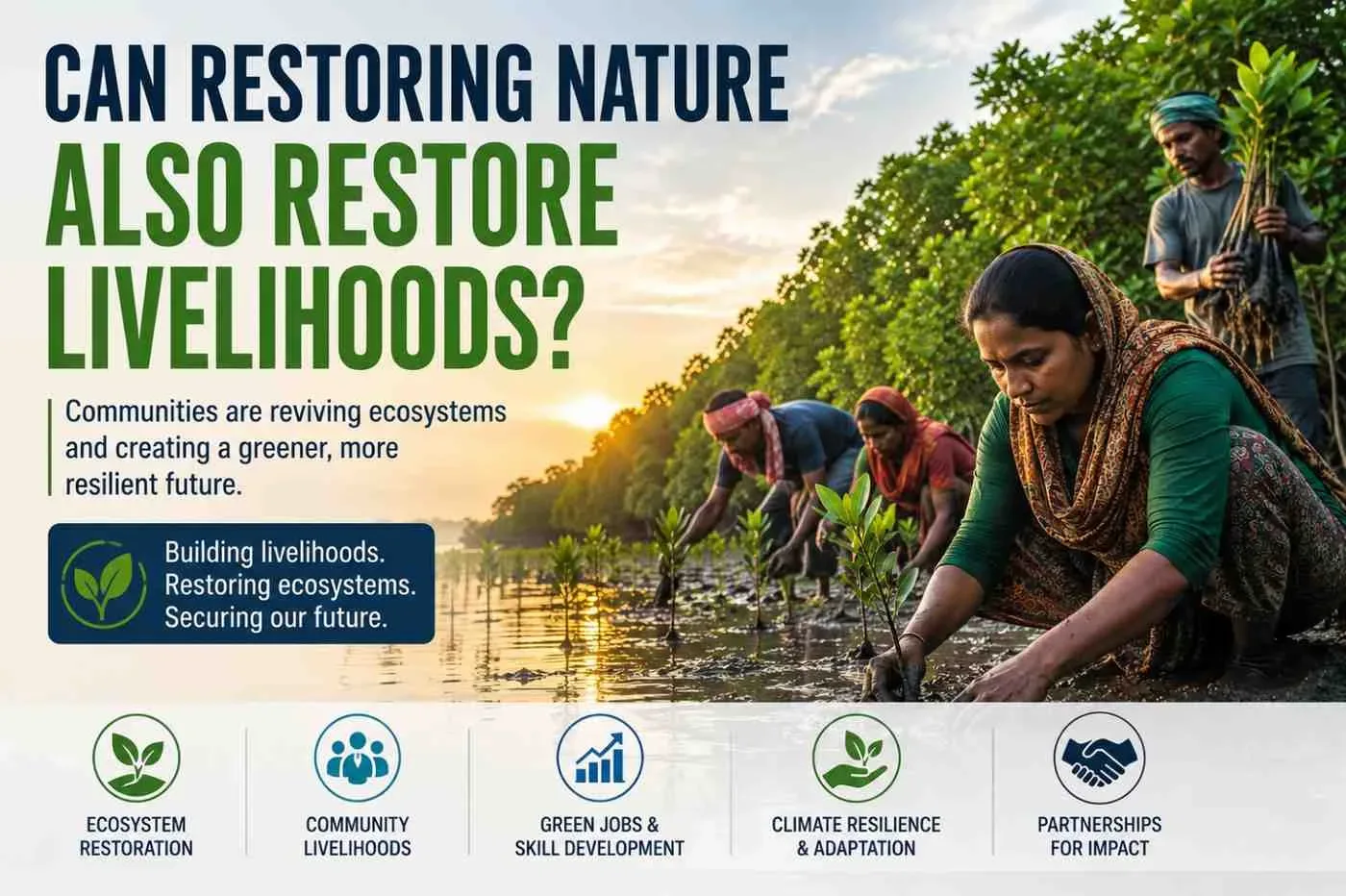
A workshop in Kolkata has sparked a larger conversation about whether restoring ecosystems can also restore livelihoods, especially for communities that have protected nature for generations. Can restoring nature also restore livelihoods? As communities revive forests, wetlands and mangroves, a new conversation is emerging around climate action, employment and long-term resilience. The discussion gained momentum following a recent climate workshop in Kolkata, where experts, researchers, community leaders and environmental practitioners explored how community-led climate action can create meaningful jobs while restoring ecosystems. While the conversations began at the local level, the ideas resonate far beyond the city.As countries invest more in climate action, a bigger opportunity is beginning to emerge. Experts believe community-led restoration can not only revive ecosystems but also create inclusive, long-term livelihoods for the people who depend on them.But an equally important question remains.Can green jobs evolve into stable, long-term careers, or will they continue to depend on short-lived projects and temporary funding? Around the world, climate action is being backed by investments in restoring nature. Whether it involves bringing forests back to life, reviving wetlands, rejuvenating urban lakes or protecting vulnerable coastlines, these efforts require skilled hands and local knowledge. Experts argue that the communities protecting these ecosystems ought to be the primary beneficiaries of the opportunities they generate.For India, this conversation is especially significant. As the country works towards expanding forest cover, restoring degraded landscapes and building climate resilience, the need for a skilled green workforce is becoming important. Experts say achieving these ambitions will depend on professionals trained in ecological restoration, biodiversity monitoring, sustainable agriculture, waste management and other nature-based solutions.Yet the workshop made one point particularly clear- green jobs cannot succeed on numbers alone. Their future will depend on skilled training, reliable career pathways and valuing the traditional knowledge that communities have passed down for generations. This made traditional ecological knowledge one of the defining themes of the discussions. For centuries, communities living closest to nature have learned how to work with it. Across India, Indigenous groups, fisherfolk, farmers and forest-dependent households have built a deep understanding of forests, wetlands, mangroves, biodiversity and changing weather through lived experience. Experts believe this traditional knowledge should play a central role in shaping restoration efforts rather than simply supporting them.Several restoration initiatives have already demonstrated the value of community participation. From mangrove conservation along India's coastlines to watershed restoration in drought-prone regions and community-managed forests across different states, these efforts show that restoration is more likely to succeed when local people are involved in planning, implementation and long-term monitoring. But training people is only the beginning! The real challenge is ensuring that green skills open the door to credible, long-term careers rather than remaining part of short-lived training programmes. Experts say the real opportunity lies in creating skills that remain valuable long after individual restoration projects are completed. Whether it is nursery management, biodiversity surveys, GIS mapping, climate-risk assessment or environmental monitoring, specialised training can help build a workforce prepared for the demands of a greener economy.They also believe stronger collaboration between governments, educational institutions, businesses and civil society organisations will be key to improving certification, creating employment opportunities and supporting continuous learning. In this transition, the private sector is expected to emerge as an equally important partner. As sustainability becomes a bigger priority for businesses, the demand for professionals who understand ecological restoration, climate resilience and environmental reporting is expected to rise. Experts believe this could create meaningful career opportunities for young people while helping India build a greener and more resilient economy.One message echoed throughout the workshop: green jobs should be valued not just for the number of people they employ, but for the livelihoods they sustain. Fair wages, long-term income security, safe working conditions and genuine community participation will decide whether restoration efforts create lasting change or simply fade with project funding. Ultimately, the discussions in Kolkata pointed to a much larger truth- building a greener future does not require choosing between climate action and economic development. A greener future will require both to move forward as one.Every restored forest, wetland, river and coastline represents more than an environmental success- it is an investment in the future of both people and nature. The real task now is ensuring that the opportunities created are inclusive, credible and long-lasting. As countries invest more in climate solutions, the focus must shift from counting projects to creating lasting opportunities for the people leading them. Building a resilient economy will require communities to be recognised not just as participants, but as long-term partners in the journey. Because if restoring nature is about protecting tomorrow, it should also help secure the livelihoods of those shaping that future today!   Sources:International Labour Organization (ILO) – Green Jobs Programme   United Nations Environment Programme (UNEP)   United Nations Development Programme (UNDP)  UN Decade on Ecosystem Restoration (2021–2030)  Ministry of Environment, Forest and Climate Change (MoEFCC), Government of India  Ministry of Skill Development and Entrepreneurship (MSDE), Government of India  National Skill Development Corporation (NSDC)  Green Skill Development Programme (GSDP), MoEFCC   National Mission for Green India   National Biodiversity Authority (NBA)   Wildlife Institute of India (WII) ...Read more

28 Jul 2026

The UN's latest global review isn't just measuring progress- it is testing whether countries can still deliver on the promises they made a decade ago   With only five years remaining to meet the United Nations' Sustainable Development Goals (SDGs), global attention has once again turned to the pace of progress. The High-Level Political Forum (HLPF), taking place at UN Headquarters in New York from 7 to 15 July, is assessing how countries are advancing on five key goals that directly affect billions of people. This year's forum is reviewing progress on five Sustainable Development Goals: SDG 3 (Good Health and Well-being), SDG 5 (Gender Equality), SDG 6 (Clean Water and Sanitation), SDG 9 (Industry, Innovation and Infrastructure), and SDG 17 (Partnerships for the Goals). Together, these goals shape many aspects of sustainable development, from healthcare and clean water to resilient infrastructure and global cooperation.But the discussions also raise a critical question.The final five years of the 2030 Agenda have begun, bringing renewed focus on whether countries can turn a decade of commitments into measurable results. The latest UN assessments paint a mixed picture. Progress in healthcare, clean water and digital infrastructure has been encouraging in several countries, but it has been uneven. Climate change, economic instability, conflicts and widening inequalities continue to hamper development, leaving many of the Sustainable Development Goals off track. For India, the forum serves as an opportunity to assess both achievements and unfinished priorities.The country has made steady progress by expanding access to drinking water through the Jal Jeevan Mission, strengthening digital public infrastructure, increasing renewable energy capacity and extending healthcare coverage under Ayushman Bharat. Despite these gains, India continues to face hurdles in expanding equitable healthcare, improving sanitation, increasing women's participation in the workforce and developing infrastructure that can withstand climate-related risks. Experts say the HLPF is more than just an annual review of global commitments. It provides a platform for governments to showcase national progress, share successful policies and identify areas where greater international cooperation is needed. Among the key issues expected to dominate discussions is water security. Erratic rainfall, shrinking groundwater reserves and growing urban demand are intensifying pressure on freshwater resources in many parts of the world. Experts say governments must invest not only in expanding water supplies but also in wastewater treatment, river conservation and water-use efficiency. Another key issue before the forum is gender equality. Despite gains in girls' education and women's leadership, significant inequalities persist in employment, equal pay, unpaid care work and personal safety.Experts say achieving the remaining Sustainable Development Goals will depend on ensuring that women and girls have equal access to education, healthcare, financial resources and decision-making opportunities. Health systems are another major focus. The COVID-19 pandemic exposed vulnerabilities in healthcare systems around the world, highlighting the need for stronger public health infrastructure, better disease surveillance, increased local production of medical supplies and universal health coverage.  Delegates are expected to explore ways to build more resilient health systems that are better prepared for future health emergencies. Infrastructure and innovation are also expected to feature prominently in the discussions as countries work towards cleaner and more inclusive economic growth. Investments in sustainable transport, climate-resilient cities, digital connectivity and low-carbon industries are gradually increasing as immediate priorities rather than long-term goals. Experts also stress that innovation must reach underserved communities to ensure the benefits of development are shared more equitably. Despite the diversity of issues on the agenda, one message continues to stand out: achieving the Sustainable Development Goals will require collective action, as no country can accomplish them alone.Partnerships between governments, businesses, financial institutions, researchers, civil society organisations and local communities are expected to play a critical role during the final years of the 2030 Agenda. Whether it’s through technology transfer, climate finance, knowledge exchange, or capacity building, stronger global cooperation will largely determine how well countries fill the remaining development gaps.As the forum progresses, the focus is shifting from setting ambitious targets to delivering measurable results. The next five years will be crucial in determining whether global commitments can translate into real improvements in people's lives. For countries like India, the challenge now is to build on recent gains while ensuring that future development is inclusive, climate-resilient and environmentally sustainable. The countdown to 2030 has entered its final stretch. The future of the Sustainable Development Goals will be shaped not by the commitments made at international forums, but by how effectively countries turn those commitments into lasting action.   Sources: United Nations – High-Level Political Forum on Sustainable Development (HLPF) 2026 United Nations Department of Economic and Social Affairs (UN DESA) United Nations Sustainable Development Goals (SDGs) Knowledge Platform UN Sustainable Development Report 2025/2026 UN Secretary-General's SDG Progress Report NITI Aayog – SDG India Index Ministry of Statistics and Programme Implementation (MoSPI), Government of India Jal Jeevan Mission, Ministry of Jal Shakti Ayushman Bharat, Ministry of Health and Family Welfare Open-source reports and official UN HLPF session documents (7–15 July 2026) ...Read more

19 Jul 2026

Two philosophies are fighting over how artificial intelligence should be built — one chases scale at any cost, the other asks what that cost actually is Ujjwal K Chowdhury Strapline: For a decade, AI research had one scoreboard: accuracy. A new one is forcing its way onto the field — energy, water, carbon and hardware. The contest between “Red AI” and “Green AI” is no longer academic; it is shaping how the world’s most powerful technology gets built. The paper that named the problem In 2020, a small group of computer scientists — Roy Schwartz, Jesse Dodge, Noah A. Smith and Oren Etzioni — published a short, blunt paper in the Communications of the ACM with a title that stuck: “Green AI.” It drew a line through the field. On one side sat what the authors called Red AI: research that chases state-of-the-art results by throwing ever more computation at a problem, treating accuracy as the only currency that matters. On the other side stood Green AI: research that treats efficiency — the resources spent per unit of result — as a first-class scientific goal, not an afterthought. The label was provocative on purpose. Red AI was not, the authors were careful to say, morally wrong. It had produced genuine breakthroughs. But it had also quietly normalised an arms race in which each new record-setting model consumed dramatically more compute than the last, with the environmental bill rarely itemised in the paper’s appendix, let alone its abstract. Six years on, that argument reads less like a provocation and more like a prophecy. Generative and agentic AI systems now sit inside search engines, office software, customer service lines and increasingly autonomous workflows that plan, browse, code and retry without a human in the loop. The scoreboard Schwartz and colleagues warned about has expanded from leaderboard rankings to gigawatts, litres and tonnes of carbon dioxide. Two philosophies, one industry Red AI, at its core, is a bet that more computation reliably buys more capability — bigger models, longer training runs, wider search over architectures, more parameters, more data, more reasoning steps at inference time. It is the logic behind scaling laws, and it has worked spectacularly well as a research strategy. But it has a hidden accounting problem: the “winning” run reported in a paper or press release is usually just the tip of an iceberg of failed experiments, architecture searches, ablations and evaluation runs that never make it into the final number. Recent lifecycle research — including a 2025 study led by Jacob Morrison that traced the full environmental cost of building a language-model family — found that model development contributed roughly half of the total training-related impact, not the celebrated final run alone. Green AI, by contrast, asks a different question of every architectural choice, every training run and every product feature: what is the smallest, most efficient way to achieve an acceptable outcome? It treats efficiency — measured in floating-point operations, energy, water and, increasingly, successful outcomes per unit of resource — as an evaluation criterion sitting alongside accuracy, not subordinate to it. Crucially, Green AI has matured past its original, somewhat narrow framing. In 2020 it was largely about training compute. Today, researchers describe it as the quality- and outcome-constrained minimisation of lifecycle environmental impact — a formulation that captures something Red-versus-Green rhetoric can miss: a computationally hungry model is not automatically the villain, and a lean one is not automatically virtuous. A large model solving a genuinely high-value problem in a handful of steps can outperform, environmentally, a small model that fails repeatedly and triggers costly retries. The real dividing line is not model size; it is whether computation is productive. Why the contest matters now The urgency comes from scale. According to the International Energy Agency’s most recent assessment, global data-centre electricity demand rose roughly 17% in 2025 alone — more than five times faster than overall global electricity growth — while electricity consumption specifically tied to AI-focused facilities surged around 50% in the same year. The IEA’s satellite-tracking programme, which watches construction of dedicated “AI factories” from orbit, found that their combined capacity has more than tripled in eighteen months. Data-centre electricity use worldwide, which stood at roughly 415–485 TWh depending on the estimate and year, is on a trajectory toward roughly 950 TWh to beyond 1,000 TWh by 2030 — comparable to the entire annual electricity consumption of Japan.   FAST FACTS > - Global data-centre electricity demand: ~485 TWh in 2025, heading toward ~950 TWh by 2030 (IEA) > - AI-focused data-centre demand: up ~50% in 2025 alone > - US data-centre share of national electricity: 4.4% in 2023, projected 6.7–12% by 2028 (LBNL) > - AI-rack power density: up roughly elevenfold, 2020–2025 (IEA) > - Ireland’s data centres already draw over a fifth of national electricity; Dublin’s local share runs close to 80% This is precisely the terrain Red AI was warned about: growth compounding on growth, with local grids in Ireland, Northern Virginia and parts of the Netherlands already straining, and utilities in the United States requesting billions of dollars in rate increases partly attributable to data-centre load growth. Energy-policy academics have begun asking, pointedly, whether ordinary electricity customers should effectively subsidise the power appetite of trillion-dollar technology companies — a question with no comfortable answer for regulators. Where the two camps actually clash The Red AI/Green AI split is not simply “big model bad, small model good.” It shows up in concrete engineering and business decisions: 1. Model selection. Red-style practice defaults to the most capable, largest available model for every task, regardless of whether the task warrants it. Green practice builds a portfolio: small or domain-specific models for routine work, escalating to frontier models only when complexity demands it. Systems such as FrugalGPT, which learned to route easy queries to cheaper models and reserve expensive ones for hard cases, demonstrated cost reductions of up to 98% on selected benchmarks without materially sacrificing quality. 2. Reporting practice. Red AI habitually reports only the final training run’s cost. Green AI insists on lifecycle transparency — development experimentation, fine-tuning, evaluation, and the electricity, water and embodied-hardware cost of years of subsequent inference, which can dwarf the original training bill many times over. 3. Agentic design. This is the newest and sharpest fault line. An autonomous agent can quietly multiply a single user request into dozens or hundreds of model calls, tool invocations, retries and multi-agent “debates.” Early benchmark research has found up to a 9.4-fold energy difference between agent-framework designs solving the same software-engineering tasks, driven mostly by wasted loops and redundant verification. A 2026 preprint proposing a metric called Energy per Successful Goal (EpG) found that agentic workflows consumed, on average, 4.33 times more energy per completed goal than equivalent linear, non-agentic approaches. Red AI treats agent autonomy as an unqualified upgrade; Green AI treats it as a resource-management problem requiring budgets, loop detection and outcome-based evaluation. 4. The rebound trap. Perhaps the most uncomfortable insight from Green AI research is that efficiency gains alone do not guarantee lower total impact. If a model becomes twice as cheap to run, organisations often respond by running it far more than twice as often — generating more content, running more experiments, automating tasks nobody previously bothered to automate. This is a version of the century-old Jevons paradox, in which efficiency improvements in coal-fired steam engines led, historically, to more coal consumption, not less, because cheaper power expanded its uses. Green AI researchers now argue that intensity metrics (energy per task) must be paired with absolute-impact accounting (total annual energy, water and carbon) precisely to catch this rebound before it erases hard-won efficiency gains. The measurement mess neither side can ignore Part of what makes the Red/Green debate so combustible is that reliable, comparable numbers are still scarce. A landmark 2025 measurement of Google’s production systems found a median energy cost of just 0.24 watt-hours and 0.26 millilitres of water per text prompt — a strikingly small figure. Around the same time, a separate academic benchmark estimated that complex, long-context reasoning queries on certain models could consume more than 33 watt-hours — over a hundred times more. Both figures are credible within their own scope; they simply describe different systems, different tasks and different accounting boundaries. A 2025 peer-reviewed review of data-centre water use went further, finding that water consumption per workload can vary by more than 10,000-fold depending on cooling technology, grid water intensity, climate and utilisation. This is why serious Green AI researchers are wary of single, universal “footprint per query” numbers circulating in the media — they tend to flatten an extraordinarily heterogeneous reality into a misleadingly precise soundbite. The more defensible approach, gaining traction in both research and emerging regulation such as the European Union’s data-centre reporting rules, is a layered hierarchy: from raw activity counts (tokens, model calls), up through compute energy, facility-adjusted energy, environmental impact (carbon and water, adjusted for time and place), full lifecycle impact including embodied hardware emissions, and finally outcome-normalised impact — energy and water per successfully completed task, not per token generated. Not a morality play — a design discipline It would be easy, and wrong, to read Red AI and Green AI as heroes and villains. Some of the most consequential AI applications — climate modelling, grid forecasting, drug discovery, materials science for batteries and solar cells — are legitimately compute-intensive, and restricting them to “small and frugal” would forfeit real value. The IEA itself estimates that mature AI applications could trim energy costs across several industries by 3 to 10 percentage points, and Google has reported enabling tens of millions of tonnes of avoided CO2-equivalent emissions through AI-optimised products in a single year. Green AI’s actual claim is narrower and more rigorous: that value should be measured against lifecycle cost, that claims of benefit require credible counterfactual evidence, and that scale should be earned by demonstrated necessity rather than assumed by default. HIGHLIGHT > “A Green AI system is not simply smaller or faster. It is appropriately capable, transparently measured, powered and cooled responsibly, designed to avoid waste, and deployed where its verified value exceeds its environmental cost.” What comes next Expect the Red/Green fault line to move from academic papers into contracts and regulation. Procurement teams are beginning to demand model-level energy and water disclosures before signing cloud contracts. The EU’s AI Act ecosystem is developing standards for reporting the resource performance of general-purpose AI systems. Enterprises are experimenting with model-routing rules that default to the smallest sufficient model rather than the flashiest one. And a growing chorus of researchers argues that the next frontier metric will not be accuracy, or even energy per token, but energy per successful goal — a number that punishes both wasteful agents and models that fail so often they need constant escalation. The Red AI era was not a mistake; it built the models the world now depends on. But the bill for that approach is now visible in gigawatts, litres and rising electricity tariffs, and it is arriving at a moment when climate constraints leave little room for waste. Green AI’s proposition is simple, if not easy: intelligence, at any scale, should have to justify its keep. Reading the two camps side by side  Red AIGreen AICore metricAccuracy / benchmark scoreQuality-adjusted efficiency (energy, water, carbon per successful task)Model choiceBiggest available, by defaultSmallest sufficient model, escalate only when neededReportingFinal training run onlyFull lifecycle: development, training, inference, hardwareAgentsAutonomy as unqualified upgradeAutonomy as a budgeted, monitored resourceRiskRebound erases efficiency gainsAbsolute-impact caps alongside intensity targets Framed this way, the contest is less a war between two tribes of researchers than a description of a choice every AI-building organisation now has to make, explicitly or by default, every time it ships a feature. The instinctive path — reach for the largest available model, let an agent iterate until it seems to have solved the problem, publish the headline benchmark and move on — is Red AI, whether or not anyone in the room uses the term. The alternative requires more upfront engineering discipline: measuring what a task actually needs, instrumenting the full resource cost, and being willing to report a less flattering number if that is the honest one. Neither side of the debate disputes that AI can create enormous value. The disagreement is about method — whether that value is pursued by default at maximum scale, or earned deliberately at the scale a task actually requires. As electricity bills, water permits and carbon disclosures increasingly follow AI systems out of the lab and into public scrutiny, that distinction is starting to carry real financial and regulatory weight, not just scientific interest. ...Read more

17 Jul 2026

It is not one invention but a discipline — spanning smarter models, honest measurement and hard limits on waste Prof Ujjwal K Chowdhury Strapline: Green AI will not arrive as a single breakthrough. It is being assembled, piece by piece, out of smarter algorithms, redesigned data centres, new accounting rules and a willingness to ask whether a task needed a supercomputer in the first place. Defining the term properly “Green AI” is often used loosely, as a synonym for “AI that feels less wasteful.” Researchers who work in the field define it more precisely: the quality- and outcome-constrained minimisation of the lifecycle environmental impact of an AI system. Every word in that definition is doing work. “Lifecycle” means the accounting cannot stop at a single training run — it must include research and experimentation, data preparation, fine-tuning, round-the-clock inference, agent orchestration, data-centre construction and cooling, electricity generation, and the mining, fabrication and eventual disposal of hardware. “Quality- and outcome-constrained” means Green AI is not simply “use less compute” — a model that saves energy but fails at its task, or that needs constant human correction, has not achieved anything green at all. The term traces to a 2020 paper by Roy Schwartz and colleagues that contrasted this approach with “Red AI” — the pursuit of state-of-the-art accuracy through ever-larger computation, with efficiency treated as an afterthought. Since then the field has broadened well beyond machine-learning theory into data-centre engineering, materials science, distributed systems, water science, economics and public policy. How Green AI actually reduces impact — the toolkit Researchers and engineers now have a genuine, tested toolkit for cutting AI’s resource footprint, operating at every layer of the stack. At the model level. Not every task needs a frontier-scale model. Task-specific and domain models can match performance on narrow jobs at a fraction of the memory and compute cost, and can often run on local devices rather than cloud data centres. Model cascades — systems that route easy requests to small, cheap models and escalate only genuinely difficult ones to larger models — have demonstrated dramatic savings; the research system FrugalGPT showed cost reductions of up to 98% on selected tasks while preserving output quality. Quantisation (reducing the numerical precision of a model’s internal weights) and distillation (training a smaller “student” model from a larger “teacher”) both cut deployment energy substantially, at the cost of some upfront retraining effort. Sparse or mixture-of-experts architectures activate only a fraction of a model’s total parameters for any given input, expanding capacity without proportionally expanding energy use per request. At the inference level. Because generating output token-by-token is often the most expensive part of serving a model, techniques such as speculative decoding (a small draft model proposes text that a larger model merely verifies, rather than generating from scratch), key-value caching (reusing previously computed information instead of recalculating it), and adaptive or “early-exit” reasoning (stopping once a model is confident enough, rather than always running the maximum computation) can cut energy per request without changing the underlying answer. A large 2025 study measuring more than 32,000 configurations across models and GPU hardware found that matching architecture to hardware, and tuning batching and utilisation, mattered as much as model choice itself. At the infrastructure level. Data-centre engineering has moved from generic efficiency metrics toward site-specific redesign: direct-to-chip and immersion liquid cooling, which can cut water use dramatically compared with evaporative systems in the right climate; heat-reuse schemes that feed data-centre waste heat into district heating or industrial processes; battery storage and demand-response systems that let facilities absorb the rapid power swings AI workloads create; and a shift from annual renewable-energy accounting toward genuine hour-by-hour carbon-free electricity matching, which prevents companies from claiming a “clean” annual average while still drawing fossil-heavy power at peak evening hours. At the agent level — the newest frontier. Because autonomous, tool-using agents can silently balloon a single request into dozens of model calls, Green AI research has begun proposing agent-specific controls: hard budgets on the number of steps, tokens and tool calls a workflow may use; automatic loop detection to catch agents stuck repeating unproductive cycles; routing that assigns the smallest capable model to each sub-task, escalating only when genuinely necessary; and outcome-based evaluation using a proposed metric called Energy per Successful Goal, which penalises agent designs that waste computation on retries, redundant multi-agent debate or failed verification.   Selected Efficiency Results FrugalGPT model-cascade routingUp to 98% cost reduction on selected tasksAgent-framework redesignUp to 9.4× difference in energy use for the same completed task (2025 benchmark)Direct chip-level closed-loop coolingOne major operator claims more than 125 million litres of water saved per data centre annually GoogleReports 12 GW of clean energy contracted in 2025 and 78% of freshwater consumption replenished (company-reported)   Measuring what matters — and admitting what we don’t know yet A recurring theme among Green AI researchers is that measurement itself remains immature, and that this is not a minor technical gap but a governance problem. A landmark 2025 study of Google’s production systems reported a median cost of just 0.24 watt-hours and 0.26 millilitres of water per typical text prompt, alongside large year-on-year efficiency gains. A separate academic benchmark, using different models and a different methodology, estimated more than 33 watt-hours for complex, long-context reasoning queries — over one hundred times higher. Both numbers are legitimate; they simply describe different systems and different task complexity, which is exactly the problem: without a shared functional unit and quality threshold, headline “AI footprint” figures cannot be meaningfully compared, and companies can select whichever framing flatters them. In response, researchers have proposed a seven-level hierarchy of Green AI metrics, moving from crude activity counts (tokens, model calls) through compute energy, facility-adjusted energy (including cooling and idle capacity), full environmental accounting (carbon and water adjusted for time, place and water-basin stress), lifecycle impact (including embodied hardware emissions), outcome-normalised impact (per successfully completed task), and finally absolute organisational impact — the only level capable of catching rebound effects that intensity metrics alone miss. Open measurement tools such as CodeCarbon, Carbontracker and the industry-standard MLPerf Power benchmark are improving reproducibility, but researchers caution that no measurement tool can fix a poorly defined functional unit or a missing supply-chain boundary.   The next phase of research should make energy, carbon, water and materials first-class optimisation variables. The next phase of policy should make claims auditable and local impacts visible.   The current state of progress: real, but partial How far has Green AI actually come? The honest answer is: further than five years ago, but nowhere near far enough to offset AI’s raw growth in scale. On the positive side of the ledger: efficiency per individual task is, by most credible measures, improving faster than at almost any point in computing history, driven by better model architectures, smarter serving systems and the techniques described above. Major cloud operators report substantial renewable-energy procurement and water-replenishment programmes, alongside progress on closed-loop and liquid cooling that can cut onsite water use sharply where deployed. Regulatory frameworks are catching up: the European Union now requires structured energy and water reporting from data centres, and the EU AI Act ecosystem is developing standardised resource-reporting rules for general-purpose AI models. Independent benchmarking initiatives, including the AI Energy Score project, are beginning to let outside researchers compare model efficiency on defined tasks rather than relying solely on company claims. On the other side of the ledger: global data-centre electricity demand is still climbing steeply — up roughly 17% in 2025 alone, with AI-specific facilities growing around 50% in the same year — showing that efficiency gains are, so far, being outpaced by sheer volume growth exactly as the rebound-effect research predicted. Agentic AI is expanding faster than the tools built to measure or govern its resource use, and remains, by most researchers’ assessment, in an “early-stage, high research priority” state rather than a solved problem. Water accounting remains inconsistent enough that credible studies report more than a 10,000-fold variation across otherwise comparable workloads — a sign that the industry still lacks agreed, auditable standards. And embodied hardware impact — the minerals, fabrication water and manufacturing emissions locked into every accelerator before it processes a single request — remains the least developed area of lifecycle assessment, largely because supply-chain data is scarce and closely guarded. What a genuinely green deployment looks like Researchers increasingly converge on a simple decision rule for organisations deciding whether to deploy AI at scale: proceed only when four conditions are jointly met. Necessity — the application creates material, demonstrable value. Proportionality — the model and any autonomous agent built around it are no larger or more independent than the task actually requires. Transparency — energy, carbon, water and lifecycle impacts can be measured or credibly estimated, not merely asserted. Net benefit — the quality-adjusted value delivered, socially, economically or environmentally, exceeds the lifecycle cost, with rebound effects actively monitored rather than assumed away. The opportunity for fast-growing, water-stressed economies For countries such as India — with rapid digital growth, hot climates, constrained grids and water-stressed cities — Green AI is not only a defensive necessity but an industrial opening. Policy researchers argue that fast-growing digital economies should avoid simply importing data-centre designs optimised for cooler, water-abundant regions, and instead map proposed AI capacity against transmission constraints, renewable supply and urban water plans from the outset — favouring non-potable cooling sources, dry or hybrid cooling systems and seasonal operating limits rather than defaulting to the energy- and water-intensive designs common in temperate markets. That same constraint creates a market. Efficient small models tuned for Indian languages, energy-aware edge AI that keeps processing on-device rather than in the cloud, low-water cooling technology, power electronics, and auditable sustainability software are all areas where necessity could plausibly drive genuine innovation rather than imitation. Public procurement has real leverage here: governments that require energy and water reporting as a condition of AI contracts can create demand for exactly the transparent, efficient systems Green AI research is trying to build — turning a regulatory requirement into a home-grown industry. The bottom line That rule captures what Green AI has become, seven years after the phrase was coined: not a call to make AI smaller for its own sake, but a discipline for making sure every unit of computation has to earn its keep — a shift from celebrating efficiency in isolation to managing absolute impact in full view. The technology is not yet there. But for the first time, the tools, the metrics and the regulatory appetite to get there all exist simultaneously — which is more than could be said even three years ago. ...Read more

12 May 2026

The ultimate testing ground for sustainable project management is the megaproject—large-scale infrastructure developments that have historically had massive carbon footprints and social displacement issues. Today, the focus has shifted from merely "minimizing damage" to creating Regenerative Infrastructure, where projects are designed to give back more to the environment and society than they take. A prime example of this shift is the development of energy-neutral tunnels and roadways that generate their own power through integrated renewable energy systems. These projects utilize innovative materials like "photovoltaic asphalt" and kinetic floor tiles that harvest energy from passing vehicles. By turning a passive piece of infrastructure into an active energy producer, project managers are transforming the very definition of a "public utility," moving toward a future where our built environment assists in the global transition to renewable energy rather than hindering it. Executing these projects requires a radical shift in Supply Chain Stewardship and construction techniques. Project managers are increasingly utilizing "Modular and Prefabricated Construction," where components are built in controlled factory environments to minimize on-site waste, noise pollution, and local traffic disruption. Furthermore, the use of Low-Carbon and Bio-based Materials, such as "green concrete" infused with recycled plastic or carbon-sequestering mass timber, has become the standard for high-performance infrastructure. These megaprojects also prioritize "Social License to Operate" by involving local communities in the design phase through augmented reality (AR) and virtual reality (VR) visualizations, ensuring that the infrastructure serves the people as much as it does the economy. By successfully delivering these complex, multi-billion-dollar sustainable projects, the industry is proving that the scale of a project is no longer an excuse for environmental degradation, but rather an opportunity for large-scale ecological and social restoration. This "Restorative" approach ensures that projects create a legacy of health and prosperity for future generations. ...Read more

12 May 2026

 The second great challenge of corporate sustainability lies in the physical reality of production. For a century, industrial success was measured by throughput—the speed at which raw materials could be converted into products and sold. The barrier here is the Linear Infrastructure Lock-in. Billions of dollars are invested in factories, power plants, and logistics networks designed for a one-way flow of resources. Transitioning to a sustainable model requires more than just "doing less harm"; it requires a move toward Regenerative Business Models that actively contribute to the restoration of the ecosystems they draw from. One of the most significant barriers to this pivot is the Resource Scarcity-Complexity Trap. As companies try to move away from fossil fuels, they encounter a massive surge in demand for "transition minerals" like lithium, cobalt, and rare earth elements. This creates a new set of ethical and environmental dilemmas. The innovation solving this is the Circular Design Paradigm. Instead of simply looking for "better" materials to extract, innovative firms are designing products for "Disassembly." By using modular components and avoiding toxic glues or complex alloys, companies like those in the electronics and appliance sectors are ensuring that today’s products become the "urban mines" of tomorrow. This "Closed-Loop" manufacturing eliminates the need for virgin extraction and insulates companies from the volatility of global commodity markets. Another major hurdle is Energy Intermittency and Industrial Heat. While many corporations have successfully transitioned their offices to renewable electricity, the "Hard-to-Abate" sectors—such as steel, cement, and chemical production—require intense heat that solar and wind struggle to provide. Here, innovation is taking the form of Industrial Symbiosis. In "Eco-Industrial Parks," the waste heat or byproduct of one company becomes the fuel or raw material for its neighbor. For example, a data center’s excess heat can be piped into a nearby greenhouse, or a steel mill’s carbon emissions can be captured and converted into aviation fuel. This mimics natural ecosystems where "waste" does not exist, and every output is a useful input for another organism. The barrier of Consumer Inertia also plagues corporate progress. Even when a company develops a truly sustainable product, consumers are often reluctant to change their habits or pay a premium. To counter this, businesses are innovating through Behavioral Economics and Choice Architecture. Instead of making the "green" option a specialized luxury item, companies are making it the "default" setting. Whether it’s a logistics company defaulting to carbon-neutral shipping or a food giant reformulating its core products to be plant-forward, these subtle shifts utilize human psychology to drive mass-scale sustainability without requiring constant, conscious effort from the end-user.Finally, the evolution of Corporate Governance is providing the ultimate solution to the barrier of accountability. We are seeing the rise of "Benefit Corporations" (B-Corps) and legal frameworks that mandate directors to consider the interests of all stakeholders—employees, communities, and the environment—rather than just shareholders. This legal "hard-coding" of sustainability ensures that the mission survives leadership changes and economic downturns. As AI and machine learning begin to optimize supply chains for "minimum carbon" rather than just "minimum cost," the corporation is being redefined. It is moving from being a mere profit-extraction machine to becoming a sophisticated engine of social and ecological value, capable of thriving within the boundaries of a finite planet. ...Read more

11 May 2026

Bio-based polymers, regenerative textiles, and the chemistry of green materials. The foundation of a sustainable supply chain is the material itself. For over a century, the global economy has been built on "vignette" materials—plastics, alloys, and chemicals designed for performance and cost, with zero regard for their "end-of-life" reality. The first pillar of greening the supply chain is a fundamental shift toward Material Science Innovation.1. The Rise of Bio-Polymers and Mycelium.We are moving away from petroleum-based plastics toward PHAs (Polyhydroxyalkanoates) and PLA (Polylactic Acid). However, the true innovation lies in Mycelium-based packaging. Companies are now "growing" packaging using fungal root structures. This material is not just biodegradable; it is home-compostable and requires a fraction of the energy used to produce Expanded Polystyrene (EPS).2. Regenerative Textiles: Beyond Organic Cotton While organic cotton was a step forward, the future lies in Regenerative Agriculture. This involves sourcing materials from farms that prioritize soil health, carbon sequestration, and biodiversity. We are seeing the emergence of "Carbon-Negative" fibers—materials like hemp and seaweed-based lyocell—which actually pull more carbon from the atmosphere during their growth cycle than is emitted during their processing.3. High-Performance Green AlloysIn the industrial sector, the focus is on "Green Steel" and low-carbon aluminum. Traditional steel production is one of the largest emitters of $CO_2$. Innovation here involves switching from coal-fired blast furnaces to Green Hydrogen-based Direct Reduced Iron (DRI). This allows manufacturers to source metals that carry a near-zero carbon debt, fundamentally altering the "Scope 3" profile of automotive and construction companies. ...Read more