India

India is a diverse and culturally rich country located in South Asia, known for its ancient history, vibrant traditions, and rapidly growing economy. This category covers everything related to India, including its geography, culture, heritage, politics, technology, lifestyle, and current developments.

Showing 12/39

27 Aug 2026

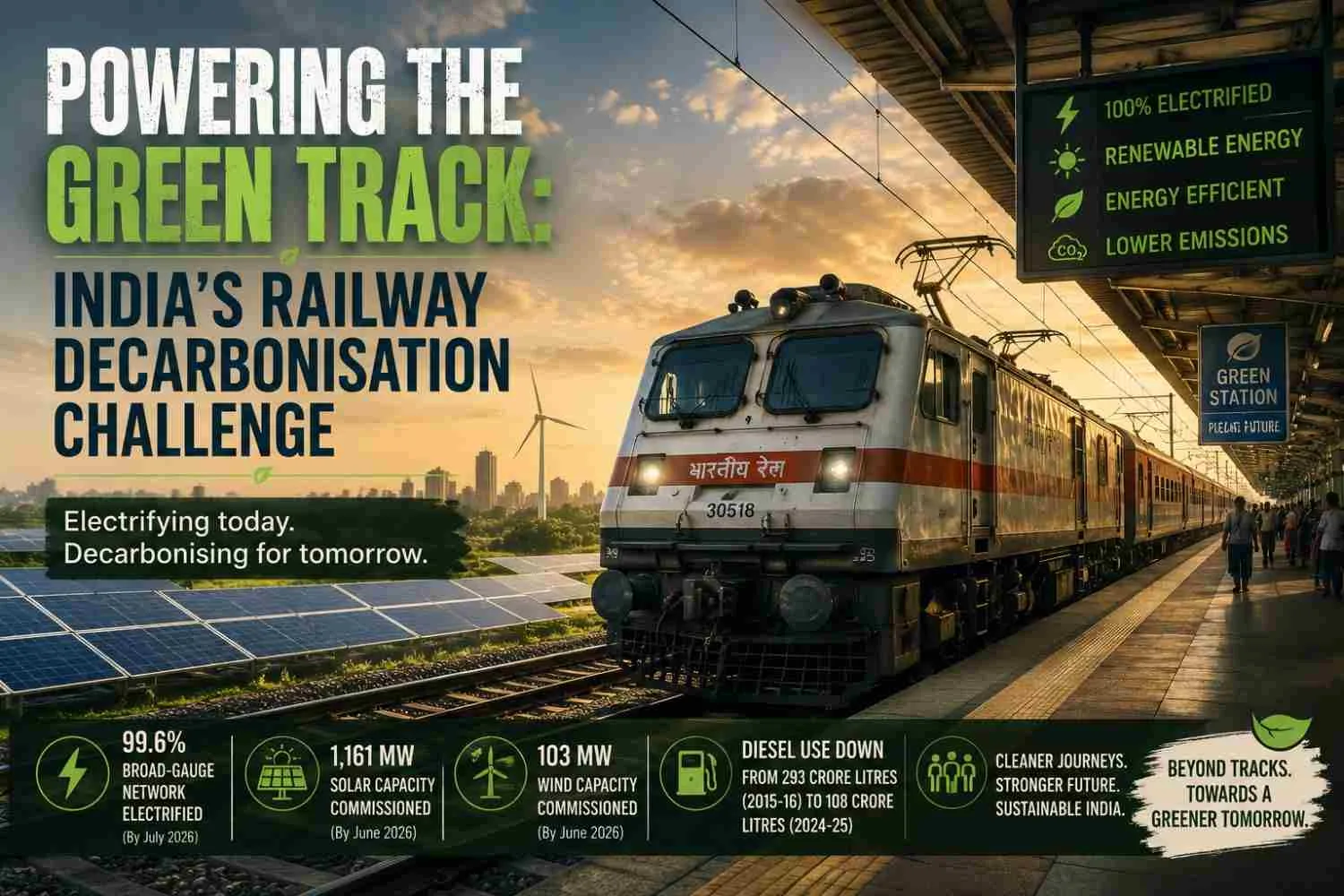
Kolkata | 27 August, 2026  India is electrifying its railway network while metro systems are adding solar power, renewable procurement and energy-efficiency measures. But as passenger numbers rise, the next challenge is deeper: making the electricity, stations and first- and last-mile connections cleaner without confusing infrastructure announcements with actual emissions cuts. SummaryIndia's railway and metro systems are undergoing a major energy transition. Indian Railways had electrified 99.6% of its broad-gauge network by July 2026, while about 1,161 MW of solar and 103 MW of wind capacity had been commissioned by June 2026. Railway electrification has also sharply reduced diesel use for traction. Delhi Metro is increasing its renewable-energy use while passenger demand continues to grow. Kolkata Metro offers another lesson through energy-efficiency improvements alongside expanding ridership. The transition therefore cannot be judged only by kilometres electrified, solar capacity installed or green-station certifications. The stronger test is whether renewable electricity is actually being used, energy consumption per passenger falls, emissions decline within a clearly defined boundary and investments deliver measurable results. Keywordsrailway decarbonisation India, green railways India, railway electrification, Indian Railways electrification, railway renewable energy, railway solar power, railway wind energy, sustainable transport India, green transportation, railway energy efficiency, metro sustainability, railway emissions reduction, low-carbon transport, railway sustainability, railway renewable electricity, green railway stations, first and last mile connectivity, sustainable mobility, railway energy transition, clean transportation India Can India’s railway system go green as fast as it electrifies?  For decades, diesel locomotives were a visible part of India’s railway emissions story. Electrification has changed that equation dramatically. Indian Railways has pushed electrification at an exceptional pace. By July 2026, Indian Railways had electrified 99.6% of its broad-gauge network, with only a small portion yet to be electrified. Between 2014 and 2026, around 48,072 route kilometres were electrified, compared with roughly 21,801 kilometres during the six decades before 2014. The transition has also reduced diesel use for railway traction. Indian Railways reported that traction-related diesel consumption fell from 293 crore litres in 2015-16 to 108 crore litres in 2024 - 25.That represents a major operational shift. But electrification raises the next question: What powers the electricity? Switching from diesel to electric locomotives reduces direct emissions, but the overall climate benefit also depends on the source of the electricity used to power them. Electrification therefore removes one major source of direct emissions, but it does not automatically make the railway system renewable or zero-carbon.That makes renewable energy the next stage of the transition. Indian Railways reported that, as of June 2026, around 1,161 MW of solar capacity and 103 MW of wind capacity had been commissioned. The solar capacity includes both rooftop and land-based projects.The numbers show that the railway’s transition is moving beyond simply replacing diesel with electricity. The next challenge is to make more of that electricity cleaner - and to measure how much renewable power actually contributes to the railway’s overall energy demand and emissions reduction. THE ELECTRIC RAILWAY TEST  DIESEL TRACTION↓RAILWAY ELECTRIFICATION↓HIGHER ELECTRICITY DEMAND↓RENEWABLE POWER↓ACTUAL CLEAN ELECTRICITY USED↓LOWER EMISSIONS PER JOURNEY Electrification is the transition. Cleaning the electricity is the deeper decarbonisation test. Can railway stations become power producers instead of just power consumers?Railway stations offer a natural opportunity for solarisation. Their rooftops, parking areas and other available spaces can support solar installations, allowing electricity to be used at the station or integrated into wider railway operations. The scale of this effort has grown rapidly. In November 2025, Indian Railways reported 898 MW of commissioned solar capacity across 2,626 railway stations. Around 629 MW was intended for traction, while the remaining capacity supported non-traction requirements such as stations, workshops, service buildings and railway quarters.That figure, however, should now be treated as a milestone rather than the latest national total. By June 2026, Indian Railways reported around 1,161 MW of commissioned solar capacity.Installed capacity alone does not tell the full story. What matters is how much renewable electricity is actually generated and used. A stronger assessment would therefore ask:•    How much electricity is the solar capacity actually generating?•    How much is being used for railway operations?•    How much is supporting traction?•    When was each plant commissioned?•    What was the capital cost?•    What is its expected operating life?•    How is its performance being monitored?•    What happens to the equipment at the end of its useful life? A station covered in solar panels may look green. Renewable capacity is only part of the picture. A station that can demonstrate actual clean-energy generation, consumption and emissions avoided offers stronger evidence of meaningful decarbonisation. What happens when more passengers choose greener transport? This is where the story becomes more complicated. A public transport system can become more efficient even as its overall electricity consumption rises. Higher energy use does not necessarily mean that the system is becoming less efficient.If more people choose a metro instead of private vehicles, the system may consume more electricity overall while producing lower emissions per passenger journey. Delhi Metro provides a useful example. DMRC’s 2025 energy case study reported that solar power contributed 32% of its total energy consumption during the period assessed. The system has also used renewable electricity procurement to reduce its dependence on conventional power.Passenger demand has also grown, with Delhi Metro recording 235.8 crore passenger journeys in 2025 compared with 223.5 crore a year earlier. The figures highlight why electricity use needs to be assessed alongside passenger demand. If ridership grows faster than energy demand, the system may become more efficient. Even if total electricity consumption increases, a decline in energy use per passenger journey can indicate improved efficiency. But if both absolute electricity consumption and emissions continue to rise, a higher renewable-energy share alone does not tell the complete story. The real measure of a greener public transport system is therefore not simply how much renewable energy it uses, but whether it can move more people with a lower environmental cost per journey. ENERGY SAVINGS VS RIDERSHIP RENEWABLE SHARE ↑RIDERSHIP ↑ENERGY EFFICIENCY ↑↓CHECKTotal energy useEnergy per passengerCarbon per passengerAbsolute emissions A greener network should be measured against the people it moves, not only the infrastructure it installs. Can Kolkata Metro cut emissions by using less electricity in the first place?Kolkata Metro offers a different lesson in decarbonisation: sometimes the cleanest unit of electricity is the one the system does not need to consume.The transition does not always require a new renewable-energy plant. Improving the efficiency of existing infrastructure can also reduce energy use and emissions.Metro Railway Kolkata has been replacing its older steel third rail with a more conductive aluminium third-rail system. The railway has stated that the upgrade can reduce energy losses by 84% on the affected system, while also reducing voltage drops and improving operational efficiency. The project highlights a simple but important principle:Electricity generated from clean sources is still wasted if it is unnecessarily lost before reaching the system that needs it. That makes energy efficiency an important part of railway and metro decarbonisation. More efficient traction systems, regenerative braking, better station cooling, energy-efficient lighting and improved energy management can all complement renewable-energy procurement. Kolkata also demonstrates why ridership needs to be part of the climate discussion.After the Green Line became fully operational in August 2025, daily ridership rose from around 78,000 to 2.04 lakh.More passengers can naturally increase a metro system’s electricity demand. But that does not automatically mean its environmental performance is worsening. If those additional passengers are shifting from private cars, motorcycles or other more carbon-intensive modes, the wider transport system could still be reducing emissions. Can a Metro Be Truly Green If Passengers Still Depend on Cars to Reach It? A metro journey does not begin when a passenger enters the station.It begins at home.That makes first- and last-mile connectivity an important part of the decarbonisation story. A passenger who walks, cycles or uses an electric feeder to reach a metro station has a very different emissions profile from someone who drives a petrol or diesel vehicle to the station. A metro’s climate benefit does not depend only on the train journey. How passengers get to and from the station matters just as much. A low-carbon metro cannot be judged only by what happens on the tracks. The entire passenger journey has to be considered. That means the transition needs to connect: Homes → Feeder transport → Metro/Railway → Feeder transport → Destination Electric buses, e-rickshaws, shared mobility, cycling infrastructure and safe pedestrian routes can extend the climate benefits of mass transit beyond the station gates. This means metro corporations need to look beyond the electricity used to run their trains. The wider question is whether the transport network makes it easy for passengers to complete their entire journey through low-emission modes. The key question is:Are metro systems making it easier for people to reach and leave stations without having to fall back on high-emission private transport?A metro may run on clean electricity, but its full environmental benefit is limited if passengers still need petrol or diesel vehicles to complete the first and last mile. THE LOW-CARBON JOURNEY HOME↓🚶 WALK / CYCLEor⚡ ELECTRIC FEEDER↓🚇 METRO / RAILWAY↓🚶 WALK / CYCLEor⚡ ELECTRIC FEEDER↓DESTINATION The train can be green. The entire journey needs to move in the same direction. Does a green railway-station certificate prove that a station is sustainable? Not by itself.Green-building and green-station certifications can provide a useful framework for improving a station’s performance across areas such as energy efficiency, renewable energy, water conservation and waste management. The IGBC Green Railway Stations rating system, for example, covers several of these areas and can help guide stations towards more sustainable design and operations.But certification and actual environmental performance are not the same thing. A stronger evidence test should ask:What was the baseline? What did the reporting boundary include? Which measures were actually commissioned? How much energy is being saved? How much water is being conserved or reused? What was budgeted, and how much was actually spent? Are the claimed savings still being measured after implementation? These questions matter because a green rating can demonstrate that specific sustainability measures have been incorporated into a project. It does not automatically prove that the station is delivering the same level of long-term carbon reduction in its day-to-day operations. Ultimately, a certificate can show what a station was designed or assessed to achieve. Actual performance data shows what it is achieving in practice. Beyond Electrification: How Green Is the Railway? THE GREEN TRANSIT SCORECARD EvidenceWhat should be measuredElectrificationRoute kilometres + commissioning dateSolarInstalled MW + actual generationWindInstalled MW + actual generationTractionRenewable electricity actually usedStationsSolar coverage + electricity consumptionEfficiencyEnergy saved + energy intensityRidershipPassenger journeys + passenger-kmEmissionsAbsolute + intensity emissionsFirst/last mileEV and public-transport connectivityCertificationBaseline + reporting boundary + performanceInvestmentBudget/capex + money actually spentOffsetsQuantity, type and relianceLifecycleConstruction, equipment and end-of-life impacts This is where corporate and government reporting needs to become much more transparent. A company supplying renewable-energy infrastructure should clearly distinguish between capacity that has been announced, installed and actually commissioned. A railway authority should separate electricity generated from electricity actually consumed. A metro corporation should demonstrate whether renewable-energy procurement is translating into measurable changes in its emissions profile. Similarly, green-station certification should be treated as one part of the sustainability assessment, not a substitute for measuring the station’s wider emissions and resource use. The distinction may sound technical, but it determines whether sustainability claims reflect what is actually happening on the ground. Can the world’s largest passenger railway network decarbonise without compromising access? There is no single technology that can answer that question. Electrification is essential, but it is only the first layer of the transition. Solar and wind power can reduce the carbon intensity of railway electricity. More efficient traction systems can reduce energy losses. Greener stations can lower energy and water demand. Metro expansion can shift passengers away from private vehicles. Electric buses and feeders can connect neighbourhoods to mass transit while keeping the wider journey cleaner. Together, these measures can move the railway and public-transport system towards lower emissions without making access to mobility more difficult. But every layer creates a new measurement challenge.The sector needs to distinguish between announced and commissioned projects, installed capacity and actual generation, renewable-energy procurement and actual renewable-energy consumption, and energy savings and measurable emissions reductions. It also needs to account for the lifecycle footprint of new tracks, stations, trains, solar equipment and other infrastructure, rather than measuring only the emissions produced during day-to-day operations. The goal is not simply to build a railway that uses more clean technology. It is to build a transport system that can demonstrate, with evidence, that it is moving more people while reducing the environmental cost of that mobility. THE REAL DECARBONISATION TEST  ELECTRIFY↓POWER WITH RENEWABLES↓REDUCE ENERGY LOSSES↓GROW RIDERSHIP↓CONNECT FIRST & LAST MILE↓MEASURE EMISSIONS PER PASSENGER↓VERIFY SPENDING & PERFORMANCE  India’s Railways Are Going Electric. But Are They Truly Low-Carbon? The evidence points to a major transition - but not a finished one.Indian Railways has reached 99.6% broad-gauge electrification, while its latest reported renewable-energy capacity stood at 1,161 MW of solar and 103 MW of wind commissioned by June 2026. Traction-related diesel consumption has also fallen substantially over the past decade. These are significant milestones. But electrification is not the finish line. It is the foundation for the next stage of decarbonisation. The harder task now is to clean the electricity powering the network, reduce energy losses, expand public-transport use and make the entire passenger journey lower-carbon - from the first mile to the last. For Indian Railways and the country’s expanding metro systems, the strongest sustainability claim will therefore not simply be:“We electrified the railway.”It will be:“We can show how much cleaner each journey has become - where the electricity came from, how much energy and carbon were actually saved, what was spent and what changed on the ground.” That means moving beyond headline numbers and proving the difference between infrastructure installed and performance achieved. Because a railway does not become truly green simply because its locomotives run on electricity. Electrifying the railway is a major step. But it is not the finish line. The transition becomes truly green when the electricity gets cleaner, energy losses fall, more people choose mass transit, and emissions per journey show a measurable decline.That is what India’s green rail transition must ultimately prove: not simply that more tracks are electrified, but that every step is making the country’s mobility cleaner and lower-carbon.  Sources: Indian Railways / Ministry of Railways — Railway Electrification & Renewable Energy, July 2026Supports the latest 99.6% broad-gauge electrification, the 1,161 MW solar + 103 MW wind commissioned by June 2026, and the fall in traction diesel consumption from 293 crore litres in 2015-16 to 108 crore litres in 2024-25. Ministry of Railways — Railway Electrification & Renewable Energy Indian Green Building Council — Green Railway Stations Rating SystemSupports the sections on green-station certification, energy and water savings, renewable energy, waste management and first-/last-mile connectivity. It also explains the performance-improvement study and third-party assessment process. IGBC Green Railway Stations Rating System Indian Green Building Council — Green High Speed Rail Rating SystemUseful for the broader low-carbon rail infrastructure, lifecycle/site boundary and first-/last-mile connectivity discussion. IGBC Green High Speed Rail Rating System Indian Railways — Renewable Energy / Solarisation milestonesUse this for the earlier 898 MW solar capacity across 2,626 stations milestone that appears in the article as historical context. For the latest figure, use the July 2026 Ministry of Railways release above. Delhi Metro Rail Corporation — Sustainability / Energy documentationThis is the source to retain for the Delhi Metro solar contribution, renewable procurement, energy efficiency and ridership portions. The official DMRC site is also the appropriate primary source for its operational and sustainability documentation. Delhi Metro Rail Corporation ...Read more
25 Aug 2026

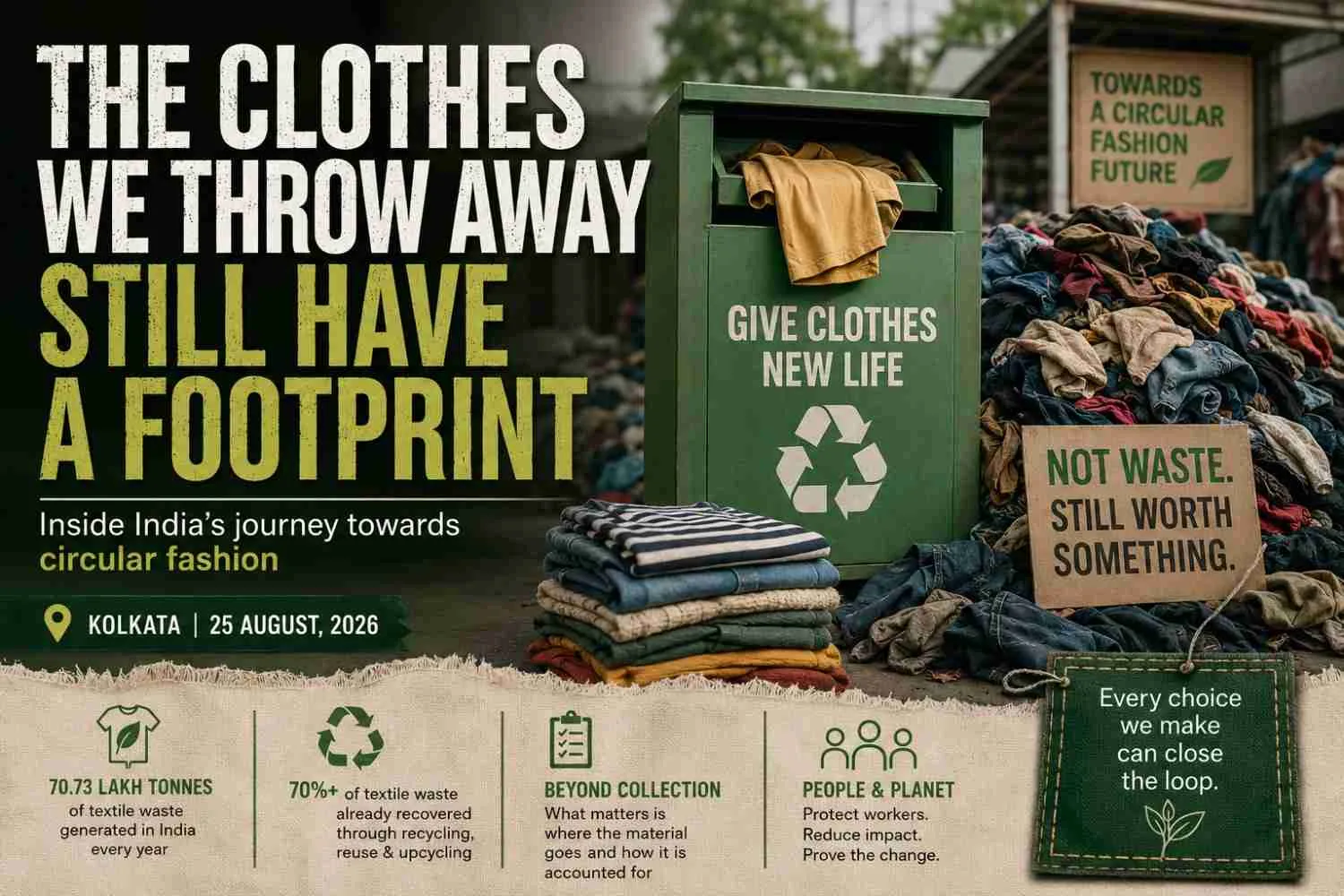
Kolkata | 25 August, 2026 India’s fashion industry is experimenting with textile recycling, cleaner production and circular retail models, but the real test is whether discarded clothes actually stay in the material loop - and whether companies can prove where they go. SummaryIndia generates about 70.73 lakh tonnes of textile waste every year, with around 58% coming from post-consumer disposal. At the same time, more than 70% of total textile waste is already being recovered through recycling, reuse, upcycling and downcycling, showing that India has an established recovery ecosystem rather than a complete absence of recycling. The bigger challenge is what happens to clothes after consumers stop wearing them. Garments can be reused, repaired, resold, downcycled or recycled, but blended and damaged textiles can be difficult to recover at their original value. Companies are responding through take-back programmes, recycled fibres, organic cotton sourcing, cleaner dyeing technologies and retail trade-ins. Yet a collection box or sustainability label does not automatically make fashion circular. The stronger test is whether companies can account for the material collected, show an audit trail for its destination, protect the workers handling discarded textiles and demonstrate measurable environmental gains against a clear baseline. Keywordstextile waste in India, circular fashion, textile recycling, sustainable fashion, textile waste management, fashion circular economy, textile circularity, post-consumer textile waste, textile waste recovery, textile recycling India, sustainable textiles, clothing waste, garment waste, textile upcycling, textile downcycling, recycled fibres, textile traceability, circular fashion supply chain, sustainable textile production, textile waste workers, informal waste workers, fashion sustainability, textile sustainability, circular textile economy, sustainable fashion India   What really happens to a T-shirt after we stop wearing it?For most of the consumers, a garment’s journey seems to end when it is placed in a donation bag, dropped into a collection box or thrown away. For the textile itself, however, that may be only the beginning.A discarded T-shirt can take several different paths. It may be worn again, repaired and resold, converted into wiping cloths or other products, or mechanically recycled into new fibres. But textiles that are heavily damaged, contaminated or made from difficult-to-separate blends can be much harder to recover and may ultimately end up as waste.This is where the idea of a circular fashion economy becomes more complex than simply collecting old clothes. India’s latest government mapping of the textile-waste value chain estimates that the country generates around 70.73 lakh tonnes of textile waste every year. About 42% is pre-consumer waste, generated during manufacturing, while the remaining 58% comes from post-consumer disposal. The study also estimates that more than 70% of total textile waste is already recovered through recycling, upcycling, downcycling or reuse. That changes the way the problem needs to be viewed. India is not starting from zero. A large share of textile waste is already finding its way back into the economy. The bigger challenge is what happens to the remaining material and whether textiles can be collected, sorted and recovered efficiently once they leave the formal manufacturing system. Collecting an old T-shirt does not, by itself, make fashion circular. True circularity begins when the garment has a clear path to its next use. FOLLOW THE FABRICConsumer discards garment↓Collection↓Sorting↓Reuse / Repair → Resale↓Recycling → New Fibre / Product↓Residual Waste → Documented Final Destination  The question: Does every kilogram collected have a documented destination? Can textile collection really make fashion circular?Post-consumer collection is becoming an increasingly visible part of sustainable-fashion efforts. Brands and retailers are encouraging consumers to return unwanted clothes through store collection points, take-back programmes and trade-in schemes. But collection numbers alone can give a misleading picture of circularity. Collecting 10 tonnes of used clothing may sound impressive, but the more important question is what happened to that material after collection.How much was reused? How much was recycled? How much was downcycled? How much was rejected? And where did the rejected material go? This is the difference between collection and actual material recovery.A credible circular-fashion programme therefore needs to maintain a clear mass balance - showing what entered the system, what was recovered, what was converted into another product and what ultimately remained as waste.India’s 2026 government assessment provides an important counterpoint. The country already has a substantial textile-recovery ecosystem, particularly for pre-consumer waste generated during manufacturing. High recovery rates in this segment show that parts of the domestic textile industry already have established systems for collecting and recovering material. The bigger challenge is what happens after a garment leaves the formal manufacturing system and enters the hands of consumers. That is where collection, sorting, logistics and end-market demand become critical to making post-consumer textiles genuinely circular. Is recycling always better than making new clothes?  Not necessarily. The environmental benefit of textile recycling depends on what material is being recycled, which technology is used and what the recovered fibre can replace. Cotton, polyester, nylon and blended fabrics behave differently during recycling. Mechanical recycling, for example, can shorten textile fibres and reduce the quality of the resulting material. More advanced recycling technologies may recover higher-quality fibres from difficult textiles, but they can also require greater investment, energy and specialised infrastructure. This creates an important competing view: Recycling is necessary, but recycling alone cannot solve the problem of overproduction and overconsumption. If brands continue producing large volumes of inexpensive clothing designed for short use, recycling systems may simply end up managing the waste created by a high-consumption model. That is why repair, reuse, resale and longer garment life need to be treated as equally important parts of the circular-fashion system. A garment that is worn for longer, repaired instead of replaced or resold to another consumer can delay the point at which recycling becomes necessary. The goal of circular fashion is therefore not simply to recycle more clothes. It is to keep garments and their materials in productive use for as long as possible. THE CIRCULARITY HIERARCHYLONGER USE↓REPAIR↓REUSE / RESALE↓RECYCLING↓DOWNCYCLING↓DISPOSALKeep the garment in use before breaking it back into material. Can fashion cut its water footprint before a garment even becomes waste?The environmental impact of clothing begins long before a garment reaches the end of its life. Processes such as dyeing and finishing during manufacturing can require significant amounts of water.This has led brands and technology companies to explore waterless and low-water dyeing technologies. Some emerging systems use alternatives such as supercritical carbon dioxide, while others use digital, foam-based or other processes designed to reduce conventional water consumption.The potential benefit is straightforward: using less water for the same production output can reduce pressure on freshwater resources while also lowering the volume of wastewater generated. But the technology still needs to pass an evidence test. A company should not simply state how many litres of water it saves per garment. It should explain what the saving is measured against and what the calculation includes.What exactly does the reported reduction cover? Is it limited to dyeing, or does it include finishing as well? Does the alternative process save water but consume more energy? Has it been proven at commercial scale? And how much has the company actually invested compared with what it originally announced? These questions matter because a technology can look highly efficient in a pilot project but deliver very different results when used across a large manufacturing operation. A water-saving technology becomes meaningful only when its environmental benefits can be demonstrated at commercial scale.Does organic cotton automatically make a garment sustainable?Organic cotton can be part of a lower-impact sourcing strategy, but the label alone cannot tell the complete sustainability story. What matters is how the cotton was produced, verified and traced through the supply chain. Companies need credible certification and traceability systems to establish whether suppliers are meeting the required environmental and production standards. There is also a crucial social question: Who is able to participate in this transition? Who are the farmers producing the cotton? What prices are they receiving? Can small producers afford certification? Who pays for compliance and verification? If sustainable sourcing requirements become too expensive or complicated, smaller farmers may find it harder to participate.Responsible sourcing therefore needs to look at both environmental performance and farmer inclusion. Certification can provide an important layer of verification, but it should be treated as a starting point for scrutiny rather than the final proof that a supply chain is sustainable.Can retail trade-ins actually make fashion more circular?Trade-in programmes are becoming another visible part of the circular-fashion model. Consumers return unwanted clothing to a retailer and receive a discount, store credit or another incentive towards a future purchase. The model can help solve one problem by giving retailers a way to bring used garments back into the system instead of allowing them to disappear into the waste stream. But there is also a potential contradiction. If a trade-in reward simply encourages consumers to buy another garment immediately, the programme could increase consumption rather than reduce it. A truly circular model would prioritise repair, resale and reuse for returned clothing, with recycling serving as the last option.The priority should be to keep the garment in use for as long as possible before breaking it down into fibre or treating it as waste.Who handles India’s discarded textiles?  India’s textile-recovery system cannot be understood without looking at the workers who already operate within it. Waste pickers, sorters, aggregators and small recycling units play an important role in collecting and recovering materials that formal systems may not reach. Yet much of this work remains invisible in corporate sustainability reporting. That raises an important CSR question: If companies want to build a circular fashion economy, what happens to the workers who are already recovering its materials? A responsible transition should consider fair wages, workplace safety, protective equipment, social-security access and stable incomes. Formalisation should not simply push informal workers out of the value chain. It should improve their working conditions, recognise their contribution and give them a more secure role in the circular economy. Organisations working with waste pickers and vulnerable communities, including Chintan and Goonj, can offer an important perspective on this issue. The worker’s voice matters because circularity cannot be considered fully sustainable if material recovery improves while the conditions of the people doing that work deteriorate.How can companies prove that their circularity claims are real?This is where the evidence test becomes the centre of the story. Saying that a company collected textiles, saved water, used organic cotton or launched a trade-in programme tells us what it did. The more important question is what difference those actions actually made.The more important question is what happened because of that activity.Companies should therefore disclose how much material was collected, how much was actually reused or recycled, what happened to rejected material, how much water was saved against a clear baseline, how much was invested and spent, who benefited and whether the programme continued after the initial funding or pilot period.The reporting boundary should also be clear. A garment collected is not necessarily a garment recycled. A garment recycled is not necessarily a garment returned to an equivalent use. And a sustainability claim is not meaningful unless the company can explain how the claimed benefit was calculated and what happened to the material afterwards. Circular fashion is ultimately not about making better claims about old clothes. It is about building a system in which materials, resources and livelihoods can be tracked from the beginning of the supply chain to what happens after the garment is no longer wanted. THE CIRCULAR FASHION EVIDENCE TEST  ClaimWhat should be proved?“We collected textiles”Total material collected and consumer/beneficiary denominator“We recycled them”Mass balance and material destination“We use recycled fibre”Fibre content and chain-of-custody evidence“We reduced water”Baseline, methodology and actual reduction“We use organic cotton”Certification and sourcing audit trail“We support waste workers”Wages, safety, income and benefit access“We invested in circularity”Budget versus actual expenditure“We reduced our footprint”Absolute and intensity results“Our programme is sustainable”Performance that continues over time This is the difference between a sustainability claim and a sustainability result. A percentage on its own does not tell the full story. Companies should clearly disclose what they measured, where they measured it, the period covered and how the improvement was calculated. A reported 30% reduction may sound significant, but the real questions are: 30% compared with what baseline? Across which facilities? Over what period? Did production increase or decrease? Was the saving measured in absolute terms or per garment? Without this context, sustainability figures can be difficult to verify or compare. Clear reporting boundaries and methodologies are therefore essential to show whether an environmental improvement represents a genuine change in performance. Can India turn textile waste into a resource without leaving its workers behind? India’s policy direction is also moving towards greater textile circularity. The Tex-Eco Initiative, announced in the Union Budget 2026–27, aims to promote globally competitive and environmentally sustainable textile and apparel manufacturing while helping the sector align with international sustainability standards and emerging green markets. Government efforts are also gradually focusing on textile-waste management, recycling technologies and value addition from discarded textiles.This creates an opportunity to move beyond isolated brand-led campaigns and build a wider circular textile system. But recycling cannot carry the entire burden. A genuinely circular apparel model would begin much earlier with durable products designed to last longer, followed by repair, reuse and resale before recycling becomes the final recovery option. That requires action across the entire value chain. Brands need to design garments that are easier to repair and recycle. Retailers need transparent take-back systems. Recyclers need reliable and traceable material flows. Governments need effective standards and enforcement. Consumers need clear information about garment durability, care and disposal. And there is one group that cannot be left out of this transition: the informal workers already collecting, sorting and recovering textile waste. They are not outside the circular economy. In many cases, they are already helping make it work. A truly sustainable textile system must therefore account not only for where the waste goes, but also who handles it, who earns from it and whether those livelihoods become safer and more secure as the system evolves.   THE REAL CIRCULAR-FASHION TESTDESIGN FOR LONGER USE↓REPAIR↓REUSE / RESALE↓COLLECT↓SORT↓RECYCLE↓TRACE THE MATERIAL↓MEASURE THE IMPACT   What should companies actually report?For CSR and corporate sustainability programmes, the most important question is not how many clothes were collected. It is what happened to those clothes afterwards, who handled them, who benefited and what environmental impact was actually avoided. A credible programme should report the total quantity of material collected, where it went and how much genuinely re-entered a productive material or product cycle. It should clearly distinguish between pre-consumer and post-consumer waste, disclose relevant certifications and audit trails, and explain how claims based on those certifications were verified. The people behind the system also need to be visible. When informal workers are involved in collecting, sorting or recycling textiles, companies should report their wages, working conditions, safety measures, access to social protection and how they are being brought into the formal circular economy. Financial reporting should be equally transparent: How much was budgeted? How much was actually spent? How much went towards collection, sorting, recycling, technology, worker protection and infrastructure? The reporting boundary must remain clear throughout. A kilogram collected is not automatically a kilogram recycled.A donated garment is not automatically a garment reused.A certified fibre is not automatically proof that the entire garment has a low environmental footprint.And a percentage reduction means little without a credible baseline and clearly defined methodology. Can fashion become circular without simply moving the waste problem somewhere else? That is the real test of India’s sustainable-fashion transition. India already has a significant textile-recovery ecosystem, with the latest government assessment indicating that more than 70% of textile waste is recovered through different pathways. But recovery alone does not equal circularity. The material still needs to be traced. Workers still need to be protected. Recycling processes still have their own environmental costs. Consumers still need to be encouraged to wear, repair, reuse and resell clothes for longer. And companies still need to demonstrate that their sustainability claims reflect what is actually happening on the ground. This is where the next phase of sustainable fashion will be decided. It will not be defined by how many collection bins a brand installs, how many take-back campaigns it runs or how many recycled garments appear in a catalogue. It will be defined by whether companies can follow a garment from the consumer’s wardrobe to its next useful life - and provide evidence for every major step along the way. Because a fashion system is not circular simply because it collects its waste. It becomes circular when materials stay in productive use, value reaches the people who make the system work, and environmental benefits can be measured and proven. That is the real standard India’s circular-fashion economy now needs to meet. Primary sources:  Ministry of Textiles — Mapping of Textile Waste Value Chain in India (2026)Covers the 70.73 lakh tonnes annual textile-waste estimate, 58% post-consumer / 42% pre-consumer split, recovery pathways, recycling technologies and post-consumer infrastructure gaps.Ministry of Textiles — Mapping of Textile Waste Value Chain in IndiaPress Information Bureau — Ministry of Textiles: Mapping of Textile Waste Value Chain in IndiaOfficial government release covering the report's headline findings, including 70.73 lakh tonnes of annual textile waste and more than 95% recovery of pre-consumer textile waste.PIB — Mapping of Textile Waste Value Chain in IndiaPress Information Bureau — Ministry of Textiles: Textile Recycling and Circular EconomyCovers the government's current textile-recycling and circular-economy initiatives, including the Tex-Eco Initiative.PIB — Textile Recycling and Circular EconomyPress Information Bureau — Ministry of Textiles: Innovative Textile Recycling TechnologiesCovers government support for textile-waste management, recycling, recycled fibres, new materials and value addition from discarded textiles under Tex-Eco.PIB — Innovative Textile Recycling TechnologiesPress Information Bureau — Environmentally Sustainable Production PracticesUseful for the article's cleaner-production, water/energy efficiency, hazardous-chemical reduction, organic textiles, natural dyeing and textile-waste management sections.PIB — Environmentally Sustainable Production PracticesCentral Pollution Control Board — Charter for Water Recycling and Pollution Prevention in Textile IndustriesPrimary regulatory material for the water-consumption, wastewater, chemical use and pollution-prevention angle.CPCB — Charter for Water Recycling and Pollution Prevention in Textile IndustriesPress Information Bureau — Textile Waste Innovation ChallengeDocuments the government's “What Is It Made Of?” Textile Waste Innovation Challenge and its focus on circularity, sustainable production and practical textile-waste solutions.PIB — Textile Waste Innovation ChallengePress Information Bureau — Union Budget 2026–27: Strengthening India's Textile Value ChainUseful for the wider policy context around Tex-Eco, sustainable manufacturing, textile modernisation and circularity.PIB — Union Budget 2026–27: Strengthening India's Textile Value ChainPress Information Bureau — Integrated Programme for the Textile SectorCovers the Budget's broader textile programme, including the Tex-Eco Initiative and sustainable textile manufacturing.PIB — Integrated Programme for the Textile SectorMinistry of Textiles — Textile Recovery Facility, Navi MumbaiParticularly useful for the newer collection, traceability and impact-measurement angle. In August 2026, the Ministry documented a proposed digital circular-textile infrastructure platform for collection, traceability and impact measurement.PIB — Textile Recovery Facility, Navi Mumbai ...Read more

24 Aug 2026

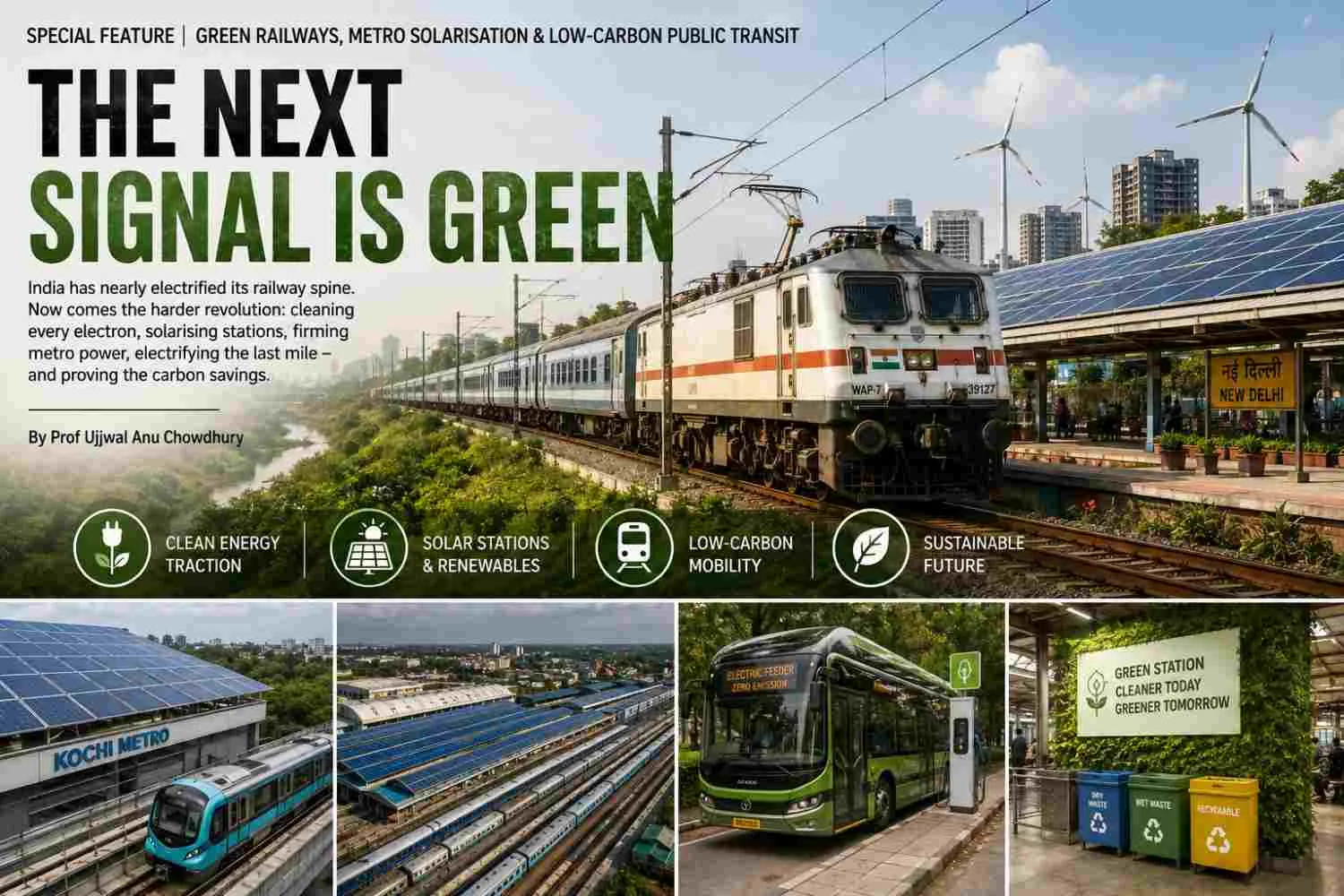
SPECIAL FEATURE | GREEN RAILWAYS, METRO SOLARISATION & LOW-CARBON PUBLIC TRANSIT India has nearly electrified its railway spine. Now comes the harder revolution: cleaning every electron, solarising stations, firming metro power, electrifying the last mile - and proving the carbon savings. BLURBIndia has almost finished the great engineering task of electrifying its broad-gauge railway. The harder transition starts now: making the electricity genuinely low-carbon, turning station roofs and railway land into productive energy assets, using storage and regenerative braking intelligently, and ensuring that the first and last kilometre do not push passengers back into fossil-fuelled vehicles. The test of a green railway is no longer how many megawatts it announces, but how much verified low-carbon mobility it delivers - per passenger, per tonne and across the full life cycle. IN BRIEFIndian Railways reached 99.6% broad-gauge electrification by March 2026 while carrying about 741 crore passengers in FY2025-26. India also crossed 1,155 km of operational metro rail across 26 cities, with daily metro ridership above 1.15 crore. This scale makes rail one of India's most important climate assets, but electrification alone does not eliminate emissions: grid electricity, construction materials, storage, maintenance, last-mile access and accounting methods all matter. The next phase must combine distributed solar, firm renewable procurement, batteries, regenerative braking, low-carbon station design, electric feeder networks and transparent carbon ledgers. Delhi, Kolkata, Kochi, Howrah, Germany, the Netherlands and Santiago offer practical lessons. The central policy message is simple: measure mobility outcomes, not installed capacity alone. KEYWORDS  Indian Railways; railway electrification; metro solarisation; renewable procurement; battery storage; regenerative braking; last-mile connectivity; green stations; lifecycle carbon; public transit HASHTAGS  #GreenRailways #SolarMetros #LowCarbonTransit #IndianRailways #CleanMobility #PublicTransport #EnergyTransition #NetZeroMobility #EVFeeders #SustainableCities DATA NOTE  Facts and project status rechecked to 18 August 2026. Operator estimates and corporate disclosures are identified as such; tendered/awarded capacity is not treated as commissioned capacity. 99.6%Broad-gauge network electrified by Mar 2026741 crorePassenger journeys in FY2025-26>1,260 MWSolar + wind commissioned by mid-20261,155+ kmMetro operational across 26 cities by Mar 2026 Electrification Was the Great First Act At dawn, before the first commuter boards, the railway is already drawing electricity for signals, lifts, escalators, workshops, depots, station lighting, ventilation and traction substations. By March 2026, 99.6% of Indian Railways' broad-gauge network was electrified. The system carried about 741 crore passenger journeys in FY2025-26 and operates roughly 25,000 trains a day. Few infrastructure systems on earth operate at this scale. The speed of the conversion is striking. The Ministry of Railways says about 48,072 route kilometres were electrified between 2014 and 2026, compared with 21,801 route kilometres before 2014. Diesel used for traction fell from 293 crore litres in 2015-16 to 108 crore litres in 2024-25. Between FY2020-21 and FY2024-25, actual expenditure reported on railway electrification projects was Rs 29,826 crore; the traction-energy bill itself was Rs 32,378 crore in FY2024-25. That achievement delivers three structural benefits. Electric traction removes locomotive exhaust from dense station areas and corridors; it improves the efficiency and performance potential of the fleet; and, most importantly, it makes the energy source substitutable. A diesel locomotive remains tied to a liquid fuel. An electric locomotive can become progressively cleaner as its power supply shifts from fossil-heavy grid electricity to solar, wind, hydro, storage-backed renewable contracts and other low-carbon sources. But this is where the celebratory language must become more exact. Electrification eliminates a large part of Scope 1 traction emissions; it does not automatically eliminate Scope 2 emissions from purchased electricity, and it says nothing about the embodied carbon in steel, concrete, rolling stock, batteries, substations or construction. The government's own rail-versus-road comparison points to rail's major efficiency advantage - around 89% lower CO2 in the cited comparison - but the climate prize is fully captured only when the electricity itself gets cleaner and more journeys shift from higher-carbon modes to rail. Megawatts Are Not Megawatt-Hours Indian Railways reported roughly 1,161 MW of commissioned solar capacity and 103 MW of wind by June 2026. The distributed footprint was already broad: by November 2025, 2,626 railway stations were using solar power, and 898 MW of solar had been commissioned, with 629 MW then being used for traction and 269 MW for non-traction loads. That is real progress. Yet the key word is commissioned. Over the years, railway renewable announcements have mixed targets, tenders, awarded capacity, signed power-purchase agreements and operating plants. They are not the same thing. A 500 MW award does not reduce one tonne of CO2 until the project is built, connected, dispatched and contractually attributed to railway consumption. The same discipline is needed for the railway's 2030 ambition. Government planning has linked the net-zero goal to projected electrical demand of roughly 8,200 MW by 2029-30 and a renewable-installation requirement of about 30 GW. That 30 GW is a target for a future portfolio, not today's operating renewable fleet. Reporting should therefore lead with renewable megawatt-hours delivered to railway loads, not only megawatts of nameplate capacity. The engineering possibilities are expanding. In 2020, the 1.7 MW Bina pilot in Madhya Pradesh demonstrated direct connectivity of solar generation to the 25 kV traction system. The deeper opportunity is to combine distributed station and depot solar with utility-scale renewable power, storage and smart dispatch. Solar roofs are excellent for daytime auxiliary loads, but trains run through the night and peak traction demand does not politely follow the sun. Station roofs and railway land are also not frictionless assets. Old roofs may be structurally constrained; heritage stations may limit visual interventions; dust, heat and bird fouling can cut output; monsoons raise waterproofing risks; and cyclone-prone eastern India requires more demanding wind-load design. Every rooftop programme should therefore start with a station-level energy and structural audit and end with a performance contract covering generation guarantees, degradation, inverter replacement, fire access, operations and maintenance, surplus power, insurance, and end-of-life module recycling. THE REPORTING RULECapacity is not generation. Annual renewable generation is not round-the-clock clean supply. A PPA is not a commissioned plant. A certificate is not a physical electron. Every claim should identify status, actual MWh delivered and the accounting boundary. Delhi: From Solar Panels to a Power Portfolio Delhi Metro shows why the next stage is a portfolio problem rather than a rooftop problem. DMRC's 2023-24 annual report listed about 50 MWp of rooftop solar capacity and procurement of 349 million units of solar electricity from the Rewa project during the year. Renewable sources accounted for about one-third of its energy requirement. The important innovation is not only the panel count; it is the ability of a large, creditworthy transport utility to aggregate demand and contract renewable supply at scale. DMRC has since moved toward storage-backed procurement. In October 2025 it issued a central e-procurement tender for inter-state captive renewable supply built around solar photovoltaic generation with co-located battery energy storage. Industry reporting on the tender described a requirement of about 500 million units a year, with roughly 170 MW of solar and 680 MWh of battery storage. The tender's 455-day supply period is a reminder that project status matters: tendered capacity must not be reported as commissioned capacity. Storage changes the operating logic. Solar generation peaks during the day, while metro demand extends into the evening. Batteries can firm renewable supply, shave demand peaks, improve resilience and create a place to capture electricity that might otherwise be curtailed. Regenerative braking adds another layer: when a train brakes, part of its kinetic energy can be returned to the traction system and used by other accelerating trains or, where the architecture allows, stored. The metric that should dominate future metro reporting is energy and carbon per passenger-kilometre. Delhi Metro recorded 2,358.03 million passenger journeys in calendar 2025, averaging 64.6 lakh daily. If ridership rises, total electricity use can rise even while efficiency improves. That is not a climate failure if the network carries far more mobility and replaces car, taxi or motorcycle trips. A metro that cuts electricity by losing passengers is not a sustainability success. Kolkata: Solarise - and Audit the Claim Kolkata Metro illustrates both the opportunity and the accounting challenge. On 1 July 2026, Metro Railway commissioned a 500 kWp rooftop solar plant at Jessore Road station. The operator expects average generation of about 1,800 units a day and annual electricity savings of roughly Rs 50 lakh, with cloud-based monitoring of plant performance. It also says awarded and planned projects could eventually take its solar portfolio toward 34.3 MWp - a forward pipeline that should be tracked separately from operating capacity. The Jessore Road case is valuable because it is a modest, measurable asset serving station loads rather than a distant headline target. Kolkata is also moving into storage. On 25 February 2026, Metro Railway inaugurated a 4 MW/6.4 MWh lithium-iron-phosphate battery energy storage system at Central station on the Blue Line. Its immediate function is resilience: during a major grid failure, it can supply emergency traction to move a stranded train toward a station and support tunnel ventilation. Over time, storage at traction substations can also become part of a wider peak-management and renewable-balancing architecture. But Kolkata offers a warning about climate arithmetic. An official October 2025 release reported 4.556 MWp of solar capacity producing about 57 lakh units annually, while also claiming a reduction of 49 lakh tonnes of carbon footprint each year. Taken literally, those numbers imply roughly 860 kilograms of CO2 avoided for every kilowatt-hour generated - an order-of-magnitude impossibility for electricity accounting. The correct response is not to dismiss the solar effort. It is to correct the emissions claim and institutionalise better reporting. Every railway zone and metro corporation should use a common CEA-aligned methodology, disclose the baseline year, the grid-emission factor used, the reporting boundary, and the treatment of physical PPAs, renewable energy certificates and offsets. The difference between installed and delivered, and between a promotional estimate and an audited carbon result, is where the credibility of green infrastructure will now be won. FACT-CHECK: WHY THE MATH MATTERSMetro Railway's October 2025 release paired 57 lakh solar units a year with a claimed 49 lakh tonnes of annual carbon reduction. Taken literally, that equals roughly 860 kg CO2 avoided per kWh - plainly irreconcilable with power-sector carbon accounting. The solar capacity is real; the emissions figure needs correction or clarification. The First and Last Kilometre Can Cancel the Carbon Win A railway station is an interchange, not the beginning or end of a journey. If a passenger must take a petrol motorcycle, a diesel auto or a private car to reach a metro, the low-carbon advantage of the main line is diluted. The climate boundary of public transport must therefore extend from doorstep to destination: safe walking, cycling, e-rickshaws, electric autos, feeder buses, shared mobility, universal access and coordinated interchange design all belong inside the decarbonisation plan. WRI India's Station Access and Mobility Program has treated this as an implementation problem rather than an aspiration. WRI reports more than 50,000 last-mile trips facilitated and over 240,000 passenger minutes saved through connectivity interventions that have included electric autorickshaws and other station-access solutions. CEEW's work on India's bus transition similarly argues for using electric buses in metro-feeder services and building the charging, contracting and financing ecosystem that makes service reliable. CEEW researcher Anannya Jha puts the priority plainly: 'Electric buses will be central to delivering clean, affordable, and inclusive mobility.' Kochi offers a useful systems example. Its rail metro is complemented by the Water Metro, a network of electric-hybrid boats that connects island communities and is designed to integrate with metro rail, buses and cycling. The lesson is not that every city needs ferries; it is that the main trunk system, its feeders and the ticketing or information layer should be planned as one mobility service. Santiago provides the Global South scale lesson. By early 2026, its Red Movilidad bus system was on course to reach about 4,400 electric buses, around 68% of the fleet, supported by large charging depots and a procurement model that separated fleet and service functions. Indian cities should treat e-buses as the capillaries of metro systems, not as a parallel EV scheme. Every new metro corridor should open with an electric-feeder plan, charging-capacity assessment, frequency obligation and a map of underserved neighbourhoods, schools, markets, hospitals and employment clusters. A Platinum Plaque Is Not a Carbon Ledger The Indian Green Building Council and Indian Railways have already created the Green Railway Stations Rating System, covering energy, water, waste, site planning, passenger experience and environmental performance. Howrah station is a strong eastern India example. Eastern Railway reported that Howrah moved from Gold to Platinum in January 2024 with a score of 83, after initiatives including energy and water audits, rainwater harvesting, waste segregation, air-quality measures, SCADA and extensive rooftop solar coverage. Certification is useful because a station is simultaneously a building, a workplace, a commercial precinct, a mobility hub and a neighbourhood gateway. A genuinely green station should combine efficient equipment and solar generation with water conservation, waste recovery, shade and heat mitigation, universal accessibility, safe walking and cycling access, low-emission feeders, clean indoor air and resilience to heatwaves, floods and extreme rainfall. The next generation of certification should, however, move from design intent to post-occupancy performance. A station should not remain 'green' because panels, meters or rainwater tanks were installed five years ago. Annual recertification data should include electricity per passenger, renewable generation and consumption, water per passenger, waste diverted from landfill, accessibility performance, Scope 1 and Scope 2 emissions, climate-risk readiness, capital and operating expenditure, equipment uptime and savings against a published baseline. Concrete, Steel, Batteries: Count the Hidden Carbon The most misleading phrase in urban rail is 'zero-emission metro'. Electric trains may have no tailpipe, but tunnels require large volumes of concrete; viaducts require cement and steel; stations use glass, aluminium, HVAC and electrical systems; rolling stock carries embodied emissions; construction machines burn fuel; and solar modules and batteries eventually require recovery and recycling. TERI researchers comparing a Delhi Metro case with an Ahmedabad bus rapid transit case showed why lifecycle boundaries matter. Their context-specific study found that while metro rail was highly energy-efficient, the addition of infrastructure and other lifecycle emissions could change the CO2-per-passenger-kilometre comparison. The lesson is not 'do not build metros'. It is: build them in corridors with sufficient long-term ridership, optimise structures, and count the carbon embedded in what is built. Metro detailed project reports should therefore include an embodied-carbon budget alongside the financial budget. Procurement can reward lower-carbon cement and steel, recycled aggregates, leaner structural design, electric construction equipment where feasible, Environmental Product Declarations and end-of-life responsibility. Battery and solar contracts should specify chemistry, expected life, performance degradation, fire safety, refurbishment and recycling pathways. Hydrogen belongs in this technology hierarchy too - but as a niche solution, not a universal replacement for wires. On 17 July 2026, India flagged off its first hydrogen-powered train on the Jind-Sonipat section. The current configuration uses two 1.2 MW power cars, giving 2.4 MW total propulsion power, supported by batteries; a dedicated storage facility at Jind holds about 3,000 kg of hydrogen. The train has no tailpipe CO2, but its lifecycle climate value still depends on how the hydrogen is produced. Where overhead electrification is technically or aesthetically difficult - heritage or isolated routes, for example - green hydrogen or battery-electric traction may be useful. On dense main lines, direct electrification remains the efficiency benchmark. What the World Teaches: Match Energy, Measure Mobility Germany's Deutsche Bahn offers a mature procurement lesson. DB reported that 69.8% of its traction current mix was renewable in 2024 and is pursuing 80% by 2030 and 100% by 2038. Its strategy is broader than rooftop solar: it uses long-term procurement across renewable technologies and works within a railway-specific electricity architecture. For India, the lesson is diversification - solar for daytime, wind and other sources with different production profiles, storage and firming for night operations, and contracts that clearly identify what is delivered and when. The Netherlands adds a more subtle accounting lesson. NS reported 16.5 billion passenger-kilometres in 2025, up from 16.1 billion, while energy intensity improved from 69.6 to 68.4 Wh per passenger-kilometre. Crucially, its climate reporting distinguishes market-based electricity emissions from location-based emissions and includes material Scope 3 categories, including passenger journeys before and after the train. Renewable Guarantees of Origin are disclosed as accounting instruments rather than confused with the physical hourly grid mix. This is exactly the transparency India needs. A metro buying certificates should not imply that every train is physically powered by zero-carbon electrons at every hour. Onsite generation, physical PPAs, open-access renewable supply, grid electricity, storage, certificates and offsets should be disclosed separately. Avoided emissions should also be distinguished from an organisation's own emissions inventory. The broader Global South lesson is to leapfrog selectively. Santiago demonstrates that large electric feeder fleets and charging depots can be built in a middle-income urban system. Kochi demonstrates multimodal integration across rail and water. Modelling work in South Asian cities, including studies of rooftop solar opportunities for Dhaka MRT, can help size investments - but modelled avoidance must always be labelled as a scenario until meters and operating data exist. Corporate India: From Capability to Contracted Carbon The corporate ecosystem matters, but the evidence test must be project-specific. Renewable developers, EPC companies, battery manufacturers and fuel suppliers can all support rail decarbonisation. Their corporate portfolio numbers, however, do not become railway carbon savings by association. A transit claim should be tied to a named asset, commissioning status, contracted delivery, measured MWh or charging uptime, lifecycle boundary and capital actually deployed. EntityEvidence statusWhat the evidence supportsNTPC / NTPC GreenDirect rail linkNTPC Renewable Energy won a 500 MW RE-RTC award from REMCL in 2023; report commissioning date and delivered MWh before claiming reduction.ReNewDirect rail linkSigned a 200 MW RTC PPA with REMCL in Jan 2025; underlying portfolio was estimated at ~600 MW. PPA status is not operating status.L&TMetro operator + EPCL&T Metro Rail Hyderabad lists 9.35 MWp solar across depots and 32 station roofs, meeting about 12% of its electricity requirement; L&T also brings rail EPC capability.Tata PowerAdjacent capabilityLarge renewables and charging platform; 1,200+ e-bus charging points reported in 2026. Transit benefit needs named contract, uptime and MWh.Adani GreenAdjacent capabilityUtility-scale renewables and large BESS capability, including multi-GWh storage at Khavda. Do not infer railway savings without a rail contract.Reliance New EnergyManufacturing capabilityBuilding integrated solar and battery manufacturing. Rail relevance is future supply-chain potential unless a specific transit asset is contracted.IndianOilLast-mile / fuels capability14,000+ EV charging stations reported by Aug 2026. Useful feeder ecosystem potential; project emissions and charging delivery must be separated from group-wide claims.GAILSolar + storage capabilityApproved 700 MW of solar projects with battery storage in 2026. These are not rail projects unless contracted and delivered to transit loads. Two direct railway procurement examples show the importance of status language. NTPC Renewable Energy received a Letter of Acceptance in 2023 for 500 MW of round-the-clock renewable capacity for REMCL, combining solar and wind under a proposed 25-year arrangement. ReNew disclosed in January 2025 that it had signed a 200 MW round-the-clock PPA with REMCL, backed by an estimated 600 MW of underlying renewable capacity. These are important contracting milestones, but the emissions ledger should move only as projects commission and electricity is delivered. The same rule applies to supplier capability. Tata Power's more than 1,200 e-bus charging points, Adani Green's large BESS deployment at Khavda, Reliance's battery-manufacturing build-out, IndianOil's more than 14,000 EV charging stations and GAIL's new solar-plus-storage approvals demonstrate potentially relevant industrial capacity. None should be counted as a rail or metro emissions reduction unless a specific transit contract can show commissioning, delivery and a defensible baseline. For fossil-fuel incumbents such as IndianOil and GAIL, project-level transparency is even more important. Green hydrogen, charging, biofuels or storage can be useful transition businesses, but their benefits should not be allowed to obscure the emissions profile of the wider corporation. Public transport procurement should buy outcomes, not corporate narratives. Rules Exist. The Missing Piece Is a Carbon Protocol India does not need to invent the enabling architecture from scratch. The Ministry of Power's Green Energy Open Access Rules reduced the eligibility threshold to 100 kW, widening the pool of consumers that can contract renewable electricity. CERC provides the electricity-market and certificate framework; CEA maintains the country's CO2 baseline database; MNRE sets renewable and storage policy; SECI structures competitive procurement; BEE can strengthen efficiency benchmarks and audits; and the Ministry of Railways, RITES/REMCL and metro corporations can aggregate demand and execute contracts. What is missing is a common Rail and Metro Carbon Protocol. It should be jointly designed by the Ministry of Railways, MoHUA, Ministry of Power, MNRE, CEA, CERC, BEE, SECI, RITES/REMCL and state metro corporations. It should define the reporting boundary and force every major system to publish an annual dashboard using the same vocabulary. At minimum, the dashboard should show total traction and non-traction electricity; onsite renewable generation; renewable MWh physically procured; storage charge/discharge and availability; Scope 1 and both location-based and market-based Scope 2 emissions; material Scope 3 emissions; passenger journeys and passenger-kilometres; tonne-kilometres for freight; kWh and gCO2e per unit of mobility; modal-shift estimates; and capital allocated, contracted and actually spent. This is also where independent scrutiny by CEEW, TERI, WRI India, CSE and IEEFA South Asia is valuable. CSE's urban-mobility warning remains concise: 'Cities will have to reduce health risk and climate risk together.' IEEFA's storage work makes the system point equally clearly: 'Energy storage is integral to renewable integration and grid resilience.' The transition is not only an engineering programme; it is an accountability programme. THE 10-POINT GREEN-RAIL EVIDENCE TEST• Name the asset, location, technology and lifecycle boundary.• State status and date: announced, tendered, awarded, PPA signed, under construction, commissioned or operating.• Report nameplate MW/MWp and actual MWh delivered.• Show the power source by time period, grid imports, storage and curtailment where material.• Publish Scope 1, location-based and market-based Scope 2, plus material Scope 3.• Separate physical renewable supply, RECs/GoOs and carbon offsets.• Disclose the baseline year and denominator: passenger-km or tonne-km.• Publish both absolute emissions and intensity results.• Distinguish capex approved, committed and actually spent; include O&M and uptime.• Use independent assurance and a public correction protocol for material errors. 2035: Build a Clean-Mobility Operating System Imagine the railway of 2035 not as a set of trains, but as a national mobility-energy operating system. Station roofs, depots, parking canopies and suitable railway land produce solar electricity. Wind and solar farms hundreds of kilometres away supply traction through long-term contracts. Batteries at selected substations absorb cheap midday energy, smooth acceleration peaks and support emergency operation. Pumped hydro and other firming resources cover longer-duration needs. Regenerative braking feeds usable energy back into the system. Artificial intelligence forecasts passenger loads and adjusts train frequency, cooling and station demand. Digital twins predict component failures and optimise maintenance. Feeder buses arrive according to train schedules. E-autos are geofenced into organised interchange areas. Walking routes are shaded and barrier-free. Bicycles and shared mobility sit inside the same journey-planning layer, while interoperable payment through NCMC and future mobility-as-a-service platforms makes transfers less punitive. The rural opportunity is just as important. Railway stations in district towns can become clean-mobility hubs for electric buses, e-rickshaws and shared vehicles linking villages to regional rail. Solar canopies can provide daytime charging; storage can reinforce weak local grids; station redevelopment can combine logistics, public services and resilient cooling. Decarbonisation then becomes not an elite metropolitan project, but a public-service upgrade across the country. The investment rule should be 'efficiency first, renewable second, storage where valuable, offsets last'. Reduce waste through LEDs, efficient pumps, variable-speed drives, optimised ventilation and cooling, timetable management and regenerative braking. Then replace remaining electricity with additional renewable supply. Use storage where it reduces peak charges, improves resilience or increases renewable utilisation. Reserve offsets for residual emissions that cannot yet be eliminated, and disclose them separately. The final accountability shift is from infrastructure completion to mobility performance. Each new project should publish a commissioning timetable and then a post-commissioning record: actual energy generation, uptime, MWh delivered, tariff, savings, carbon factor, passenger intensity, first/last-mile access and lifecycle impacts. If a project misses its stated performance, the annual report should say why and what will be corrected. The Destination Is Mobility, Not Megawatts India has almost completed one of the largest railway electrification transformations in history. The achievement is historic, but it was the easier revolution. The next one is more difficult because it cuts across the power system, station architecture, rolling stock, city streets, procurement rules, data standards and passenger behaviour. The winning formula is now visible: electrify the network; decarbonise the electricity; cut energy intensity; build storage and flexibility where they add value; design electric first- and last-mile services into the network; certify stations for measured performance; reduce embodied carbon; and report the lifecycle honestly. Rail can carry more people and freight while reducing carbon intensity - but only if India measures both absolute emissions and emissions per unit of mobility. The greenest train is not the one with the most solar panels in the photograph. It is the one embedded in a system where clean power, efficient operations, resilient stations, transparent accounting and low-emission access make the entire journey better. If India can achieve that at its extraordinary scale, it will do more than decarbonise a railway. It will build one of the world's most consequential and affordable laboratories for low-carbon mass mobility - and give the Global South a model worth adapting.   SOURCEBOOK | VERIFIED PRIMARY AND AUTHORITATIVE REFERENCES 1. Press Information Bureau, Ministry of Railways. The Ever-Evolving Journey of Railways. 15 Apr 2026. Source link 2. Press Information Bureau, Ministry of Railways. India Emerges as Global Leader in Railway Electrification.... 22 Jul 2026. Source link 3. Press Information Bureau, Ministry of Railways. 2,626 Solar-Powered Railway Stations Supporting Cleaner Operations. 16 Dec 2025. Source link 4. Press Information Bureau. 25 States Achieve 100% Railway Electrification. 11 Feb 2026. Source link 5. Press Information Bureau, Ministry of Railways. Indian Railways set to meet all its energy consumption needs... (Bina direct traction solar). 27 Aug 2020. Source link 6. Press Information Bureau, Ministry of Railways. Indian Railways to become Net Zero Carbon Emitter by 2030. 15 Mar 2023. Source link 7. Press Information Bureau. The Story of India's Hydrogen Train. 25 Jul 2026. Source link 8. Press Information Bureau. Ease of Living: India's Journey of Inclusive Progress. 15 Jun 2026. Source link 9. Delhi Metro Rail Corporation. Annual Report 2023-24. 2024. Source link 10. Delhi Metro Rail Corporation. Delhi Metro - the lifeline of Delhi-NCR.... 15 Mar 2026. Source link 11. Government of India eProcurement System / DMRC. RfS ORE/CGP/01: ISTS captive solar PV with co-located BESS. 8 Oct 2025. Source link 12. Mercom India. Delhi Metro Invites Bids to Procure 170 MW Solar, 680 MWh BESS. 10 Oct 2025. Source link 13. Metro Railway Kolkata. 500 KWP Solar Power Plant at Jessore Road. 3 Jul 2026. Source link 14. Metro Railway Kolkata. BESS inaugurated in Blue Line. 25 Feb 2026. Source link 15. Metro Railway Kolkata. Metro generating solar power to reduce carbon footprints. 14 Oct 2025. Source link 16. Eastern Railway. Coveted IGBC Platinum Rating Awarded to Howrah Station. 4 Jan 2024. Source link 17. World Resources Institute India. Unlocking Connectivity to Mass Transit in India. accessed 18 Aug 2026. Source link 18. Council on Energy, Environment and Water. How can India's Bus Market Scale up Sustainable Public Transport?. 25 Sep 2025. Source link 19. The Energy and Resources Institute. Carbon footprint of urban public transport systems in Indian cities. research paper. Source link 20. Centre for Science and Environment. Media briefing on urban mobility and climate change. 17 Feb 2017. Source link 21. IEEFA / JMK Research. The standalone energy storage market in India. 28 Apr 2025. Source link 22. Deutsche Bahn. Integrated Report 2025 - share of renewable energies in DB traction current mix. 2026. Source link 23. Deutsche Bahn. How Deutsche Bahn uses solar energy. accessed 18 Aug 2026. Source link 24. NS (Nederlandse Spoorwegen). Annual Report 2025 - Sustainability / Climate and Energy. 2026. Source link 25. Institute for Transportation and Development Policy. 2026 Sustainable Transport Award case material: Santiago and Kochi. 13 Jan 2026. Source link 26. NTPC. NTPC wins 500 MW RE-RTC capacity for Indian Railways. 28 Apr 2023. Source link 27. ReNew. 200 MW RTC PPA with REMCL. 9 Jan 2025. Source link 28. L&T Metro Rail Hyderabad. Green Metro - Eco-Friendly Transit. accessed 18 Aug 2026. Source link 29. Tata Power. Q1 FY27 results / charging network update. 27 Jul 2026. Source link 30. Adani Green Energy. Commissioning of large single-location BESS at Khavda. 26 May 2026. Source link 31. Reliance Industries. Q1 FY27 Analyst Presentation - New Energy. 17 Jul 2026. Source link 32. IndianOil. About IndianOil - EV charging network. updated 13 Aug 2026. Source link 33. GAIL (India) Limited. Approval of 700 MW solar projects with battery storage. 14 Apr 2026. Source link 34. Ministry of Power / PIB. Green Energy Open Access Rules, 2022. 2022. Source link 35. Central Electricity Authority. CDM CO2 Baseline Database - Version 21.0. accessed 18 Aug 2026. Source link 36. Ministry of New and Renewable Energy. Schemes, guidelines and Energy Storage Systems. accessed 18 Aug 2026. Source link ...Read more

24 Aug 2026

Summary: Originally acclaimed as the kidney of Kolkata, the East Kolkata Wetlands suffer instances of encroachment in the form of settlements, agriculture and other land use changes. A Ramsar site, the role of East Kolkata Wetlands in Kolkata’s natural drainage and sewage system, water filtering by means of phytoplanktons and algae, maintaining urban micro climate, carbon sequestration and being a rich source of biodiversity can never be left unnoticed. Its time that the East Kolkata Wetlands are preserved for the betterment of our larger society.  Keywords: Environment, East Kolkata Wetlands, Urban Heat Island, Carbon sequestration  Illegal encroachments have surfaced on the eastern fringes of Kolkata with residents accusing land sharks of once again targeting the East Kolkata wetlands (EKW), an internationally recognized Ramsar site by filling up a sprawling waterbody in Nayabad for suspected real estate development. A complaint has been lodged with urban development minister Agnimitra Paul, the Municipal Commissioner and the East Kolkata Wetland Management Authority, alleging that a large pond near Sadhubari on Nayabad Main Road, close to the Upohar Condominium off Eastern Metropolitan Bypass is being systematically filled up in broad daylight without any visible intervention from the authorities.   East Kolkata Wetlands has an area of 12,500 hectares with 254 sewage fed fisheries spread across 37 mouzas and is internationally considered to be a Ramsar site. Shrinking wetlands could increase urban flooding, destroy biodiversity, force huge spending on artificial drainage and contribute to urban heating as a result of change in weather.     Photo plate: East Kolkata Wetlands (Photo by Dr Kanailal Das, 2024)    Figure 1: Change of EKW through years (1922,1968,2026: prepared by author using Survey of India toposheets and Google Earth Imagery) As climate change brings more intense rainfall, these wetlands absorb these wetlands absorb enormous volumes of water. Losing these will worsen flooding, destroy livelihoods and force the city to spend hundreds of crores in preparing infrastructure for artificial drainage.  The latest allegations come six months after the January 26 blaze in Anandapur that killed 27 people inside a warehouse and an adjacent food manufacturing unit. Investigation later revealed that the gutted warehouses stood on land bordering or forming part of the East Kolkata Wetlands.   Locals and environmental activists alleged the operation follows a familiar pattern seen across the wetlands. Asbestos sheds are first erected; settlers are brought in and after a while the land is cleared for permanent residential or commercial structures.  The role of East Kolkata Wetlands as Kolkata’s natural wastewater treatment system, flood buffer and carbon sink cannot be looked down upon and the shrinking condition of this Ramsar site needs immediate and stringent action.  History of East Kolkata Wetlands: East Kolkata Wetlands owes its formation through the natural avulsions of river Bidyadhari. The evolution of East Kolkata Wetlands dates back to British colonial canal building into the world’s largest natural wastewater fed aquaculture and sewage treatment system and has gone a long way to become noted as Ramsar site.  Originally a marshy saline lake system of the 18th century, East Kolkata Wetlands abounded in fish and birds before tidal flows receded to leave freshwater environments. East Kolkata Wetlands treat about 60-80% of Kolkata’s sewage naturally as the world’s largest organic sewage management system, supporting almost 50,000 agro workers and supplying about 1/3rd of Kolkata’s fish requirement.  East Kolkata Wetlands got its name from late Dhrubajyoti Ghosh, Special Advisory (Agricultural Ecosystem) Commission on Ecosystem Management, who reached this incredible but neglected part of the city, while working as an engineer for the Water and Sanitation Department, Government of West Bengal on his quest for an answer to the question what exactly happens to the city sewage.  These natural waterbodies which were known just as fisheries provided the answer. Devised by the local fishermen and farmers, these wetlands served in effect as the natural sewage treatment plant for the city.  Despite protective legislation enacted since 2006, the East Kolkata Wetlands have experienced severe physical reduction. The total area declined approximately 65 sq km to 41 sq km within just 30 years. This is due to illegal land conversion. This continuous reduction in size has directly harmed the livelihoods of fishing communities and sewage farmers who depend on the ecosystem for their survival. In 1991 the West Bengal Government accepted an offer by a nonresident Indian to build a World Trade Centre and allotted 227 acres of wetlands for this purpose. As a result, the NGO “People United for Better Living in Calcutta (PUBLIC) filed a public interest litigation in the Calcutta High Court arguing for the importance of the wetlands and why they should be left unchanged. The order of Justice Umesh Chandra Bannerjee on this matter is considered a landmark judgement. As an outcome, the proposal for World Trade Centre was turned down in its original form and strict conditions were laid “I do not find any justiciable reason to disagree with the opinion expressed by the environmentalists that wetland should be preserved and no interference or reclamation should be permitted”.   Following the order of the Calcutta High Court in 1992 to its credit, the State Government did not appeal but accepted the ruling. In fact, the environment Secretary Kalyan Biswas applied for the East Calcutta Wetlands to be designed a “wetland of international importance” under the Ramsar Convention. This was observed in 2002.  Methods for Conservation:  To demarcate the boundaries of East Kolkata Wetlands. To take measures to stop, undo and prevent any unauthorized development project in EKW. To prevent, prohibit or restrict any mining, quarrying, blasting or other operations in EKW. To direct demolition or alteration of any hoarding frame, post, kiosk, structure, neon signed or sky sign erected, exhibited illegally for the purpose of advertisement on any land in EKW. To take measures to abate pollution in EKW and conserve the flora, fauna and biodiversity in general. To prepare action plans conforming to the resolutions taken and recommendations made from time to time underRamsar Convention and to update the land use maps of EKW. To promote research and disseminate findings of such research among the stakeholders. To raise awareness about the utility of the wetlands in general and the EKW in particular. To promote basic conservation principles like sewage fed pisciculture and ecotourism in the EKW. To enforce land use control in substantially waterbody-oriented areas of EKW. To detect changes of ecological characters and land use in EKW. To conduct enquiry or scientific study within the scope of the project.   About 100 species of flora have been recognized in and around EKW. Several kinds of water hyacinths across these wetlands. The area is also home to large numbers of coconut and betel nut trees. Varieties of vegetables like cauliflower, eggplant, pumpkin, sunflower are farmed.  Numerous species of fish are farmed in sewage fed ponds called bheries in EKW. These include silver carp, tilapia. The area is also home to the marsh mongoose and small Indian mongoose, Palm civet and small Indian Civet.  This sewage fed aquaculture is an example of potential carbon sink. East Kolkata Wetlands can sequester 1.9 MgC/ha/year, mitigating at least 118 Gg atmospheric CO2 per year. Also, carbon intake by harvested fish crop corresponds to 61 Gg CO2 per year rewarding US $ 3.6/kg blue carbon harvested. East Kolkata Wetlands act as vital natural thermal sink and sponge for Kolkata. They regulate the urban microclimate by moderating temperature gradients reducing the Urban Heat Island (UHI) effect maintaining ambient humidity through high evaporation rate and sequestering carbon. High rates of water surface evaporation sustainably regulate relative humidity in the eastern fringes of the urban sprawl. Abundant aquatic vegetation and phytoplankton generate large quantities of oxygen supporting cleaner local air circulation. The wetlands act as a natural retention basin that absorbs heavy monsoon downpours and slowly releases stored moisture during dry spell stabilizing local hydrological micro rhythms.    About Author Dr Karabi Das, Masters in Geography from University of Calcutta, former Senior Research Fellow, UGC, PhD on Physical and Socioeconomic changes in the Indian Sundarban is presently working as Assistant Professor of Geography, Dr Kanailal Bhattacharyya College, Howrah.She has participated in many national and international seminars and has 12 papers and 10 book chapters to her credit.Her areas of interest include Fluvial Geomorphology, river in equilibrium and human environment relationship.   ...Read more

20 Aug 2026

Kolkata | 20 August, 2026  Every day, millions of flowers are offered at India’s temples. Once the prayer is over, however, those flowers become part of a growing waste-management challenge. Across pilgrimage towns, municipalities, temple trusts, women’s self-help groups and private enterprises are trying to give them a second life - as incense, natural colours, compost, flower powder and other products. The bigger opportunity is not simply to prevent flowers from reaching rivers. It is to build a system where ritual waste creates reliable rural livelihoods, supports women and waste workers, and can prove every environmental claim it makes. SummaryTemple flowers can become more than biodegradable waste. They can become products, income and a reason to strengthen local circular economies. But a credible model must answer difficult questions. How much waste was actually collected? Where would it have ended up without the intervention? How much was successfully converted into usable products? Where did the remaining material go? How much did the workers earn? What did the project cost? And, most importantly, can the claimed reduction in river pollution be supported with clear evidence? The future of India’s temple economy may depend less on how many flowers are collected and more on whether the entire chain can be measured and trusted. KeywordsTemple Flower Waste, Floral Waste Management, Circular Economy India, Temple Waste Recycling, Women Self-Help Groups, Sustainable Livelihoods, Circular Economy, Waste to Wealth, River Pollution, Environmental Impact, CSR, Sustainable Communities When Devotion Becomes a Waste-Management ChallengeFor a devotee, flowers are an offering made with faith and devotion. But for temples that receive thousands of visitors every day, those offerings eventually become a large and regular source of organic waste. The problem arises when floral waste is mixed with other garbage or dumped in drains, open spaces and water bodies. Although flowers are biodegradable, that does not make them harmless when large quantities are disposed of, without proper treatment. When floral waste enters water bodies in large amounts, it can increase organic pollution, reduce dissolved oxygen and put additional stress on aquatic ecosystems. The scale of the waste can be significant. At Ujjain’s Mahakaleshwar Temple, which receives an estimated 75,000–100,000 visitors a day, around 5-6 tonnes of floral and other waste are generated daily. A processing plant with a reported capacity of three tonnes per day is part of the temple’s waste-management system, while women’s self-help groups also help turn collected floral waste into useful products. Tirupati offers another example. More than six tonnes of floral waste are reportedly handled every day, with around 150 women from self-help groups involved in recycling the material. These examples highlight an important reality: a major temple is not only a place of worship. It is also a large local ecosystem involving visitors, livelihoods, waste management and the environment. Temple floral-waste scale  Ujjain: 75,000–100,000 visitors/day | 5–6 tonnes floral + other waste/day | 3-tonne/day processing capacityTirupati: 6+ tonnes floral waste/day | 150 women involved in recyclingGulf of Mannar: 849 kg garland waste collected → 155 kg usable flower powder | 60 women involved Can Temple Flowers Become a Source of Livelihood?Floral waste is often discussed as an environmental problem, but it can also become an economic opportunity when it is collected, processed and reused properly. A model in the Gulf of Mannar Biosphere Reserve shows how this can work. Temples were used as collection points, with 15 collection drums installed across five temples, according to UNESCO. Between May and August 2025, around 849 kg of garland waste was collected and processed. After segregation and drying, 155 kg was converted into usable flower powder, while 60 women received training in processing, quality control, packaging, pricing and managing micro-enterprises. The numbers also show why waste processing cannot be measured simply by comparing what is collected with what is sold. 849 kg went into the process, while 155 kg became usable flower powder. That difference is expected. Flowers contain significant moisture, while temple offerings can also contain threads, plastic, synthetic decorations and other unwanted material. Some of the material is removed during sorting, while further losses can occur during drying and processing. Not all collected waste will necessarily be suitable for the final product. This is why credible circular-economy projects need a clear mass balance - tracking how much material enters the system, how much is recovered, how much is converted into products and how much ultimately remains as waste. Collected → segregated → processed → converted into product → sold/used → residual material → final destination. Without that chain, “X tonnes recycled” can hide what happened between collection and the final product.  Who Benefits When Temple Flowers Get a Second Life? The strongest potential of floral-waste circularity may lie in its ability to address waste while creating local livelihoods. Women’s self-help groups can take part in collection, segregation, drying, processing, packaging and sales. This can keep more of the economic value within pilgrimage centres and nearby communities, instead of sending the waste to a distant processing facility.But formalising the waste stream can also affect people who already depend on it for their livelihoods. Before a new floral-waste system is introduced, it is important to ask: Who was collecting, sorting or recovering value from this waste before the project began?Informal waste workers may already be earning an income from these activities. If a formal system replaces their work without including them, it could solve a waste-management problem while creating a new livelihood problem.A responsible circular-economy model should therefore examine whether informal workers are:included in the new system or offered alternative livelihoods;provided formal contracts or predictable payments; given appropriate protective equipment and training;included in decisions that affect their work;given opportunities to participate in higher-value stages of processing and sales; andactually, earning more or receiving a more stable income as a result.The same principle applies to women-led self-help groups. Saying that a project has “created 100 jobs” does not narrate the full story. It is important to know whether these are full-time or occasional jobs, how much workers are paid, who pays them and whether the income will continue after the pilot or CSR funding ends.A circular-economy project should create value not only from discarded flowers, but also for the people whose work keeps that system running.  VALUE-CHAIN FLOW   FLOWER OFFERED → TEMPLE COLLECTION → SEGREGATION → WOMEN/WASTE-WORKER NETWORK → PROCESSING → PRODUCT → MARKET → INCOMEWaste residue → documented destination  Can Temple Trusts Turn Faith-Based Giving into Environmental Action?India’s religious institutions already play a major role in supporting education, healthcare, food distribution, welfare and other community programmes. This gives temple trusts and endowment bodies an opportunity to extend that work into environmental management and circular-economy initiatives.Instead of leaving floral waste entirely to municipal systems, temple administrations could invest in the infrastructure needed to manage it properly, including: separate collection points;storage and transportation systems;processing equipment and facilities;training and protective equipment for workers;support for women-led enterprises;market development for products made from floral waste; andregular monitoring and independent audits. Tirumala Tirupati Devasthanams, for instance, already operates several social-service and charitable programmes through dedicated trusts and institutional structures. This established model of organised giving could be expanded to support environmental stewardship, responsible waste management and sustainable livelihood opportunities for local communities. But funding a circular-economy project is only the beginning. Temple trusts should also be able to demonstrate how that money is being used and what it is achieving. Capital expenditure, operating costs, worker payments, equipment purchases and actual programme spending should be clearly documented. A large budget announcement does not necessarily mean the money has been spent. A large processing facility does not automatically mean the system is functioning. And a finished product on a shelf does not prove that the wider floral-waste stream is being managed responsibly. The real measure of a temple’s circular-economy investment is not how much it announces or builds, but how effectively it turns waste into environmental and social value. Can Private Companies Help Take Temple-Waste Circularity to Scale?Taking temple floral-waste circularity to a larger scale will likely require more than temple trusts and municipal bodies. Private companies can bring the technology, logistics, packaging, market access, training and investment needed to build a more efficient system. Different industries can contribute in different ways. FMCG companies could support product development and distribution, while packaging companies could help create lower-impact packaging for products made from floral waste. Recyclers and producer-responsibility organisations could bring expertise in collection, traceability and material management. Companies in sectors such as automobiles, electronics and batteries could also support floral-waste initiatives through CSR funding, livelihood programmes and wider circular-economy partnerships. Businesses involved in repair and reuse can bring another useful lesson: materials retain greater value when they are kept in productive use instead of being discarded. But corporate participation should not turn floral-waste management into another branding exercise.If a company supports such a project through CSR, there should be clear answers to basic questions: How much money was committed? How much was actually spent? What was built? Who benefited? What results were achieved? And what continued after the funding ended? That transparency is what separates a CSR announcement from a functioning programme that delivers lasting environmental and social impact. Who Is Responsible for Making Temple-Waste Management Work?Temple floral waste does not exist separately from the wider urban waste-management system. In pilgrimage towns, municipal corporations are responsible for local waste collection, sanitation and supporting infrastructure. That makes coordination with temple administrations essential. Running two separate waste systems in the same town can create gaps, duplication and confusion over responsibility. The regulatory framework is equally important. The Central Pollution Control Board (CPCB) and State Pollution Control Boards play a role in pollution monitoring and environmental compliance, while the Ministry of Environment, Forest and Climate Change (MoEFCC) provides the broader policy framework. BIS may be relevant where standards apply to particular products or processes, while the Central Consumer Protection Authority (CCPA) has a role in addressing misleading environmental claims. This becomes especially important as circular-economy projects use environmental benefits as part of their public messaging. India’s 2024 Guidelines for Prevention and Regulation of Greenwashing and Misleading Environmental Claims require environmental claims to be truthful, clear and supported by evidence. Floral-waste projects should meet the same standard. If a project claims to have “saved a river,” the crucial question is whether that claim can be supported by clear, verifiable evidence. Can a Floral-Waste Project Prove Its Environmental Impact?Collecting waste does not automatically tell us how much pollution has been prevented. Suppose a project collects 1,000 kg of flowers. It cannot simply claim that 1,000 kg of waste was diverted from a river. To make that claim, the project needs to establish where that waste would have gone without the intervention. Was it entering a river or other water body? Was it being sent to a landfill? Was it already being composted? Was it being collected separately?The environmental benefit depends on the answer. A credible project should therefore report at least four things: Waste collected: How much floral waste entered the programme?Waste diverted: How much was demonstrably prevented from its documented previous disposal route?Product output: How much was converted into a usable product?Residual waste: Where did the remaining material go? The scale of the project should also be taken into account. Reporting both absolute and intensity-based results can provide a clearer picture.For example: Absolute: 10 tonnes of floral waste diverted in one year. Intensity: 10 kg of floral waste diverted per 10,000 visitors. The second measure can make comparisons between temples of very different sizes more meaningful. Is the Final Product Really the Measure of Circularity?Not necessarily.It is easy to focus on the visible end products - incense sticks, soaps, colours, compost, paper or decorative items made from flowers. But these products represent only one part of the circular-economy process.The system begins with segregation and collection and ends only when the material, money and people involved can be accounted for.That means asking: Material: Where did the collected flowers go?Money: How much was spent and how much revenue was generated?People: Who did the work, who benefited and was anyone’s existing livelihood affected?Environment: What pollution or waste was actually avoided?Market: Were the products actually sold and used, or simply produced?Longevity: Did the model continue after the initial grant, CSR funding or pilot ended?Organisations working on waste management, informal labour and environmental justice - including groups such as Chintan, Toxics Link, Waste Ventures India and Goonj - can bring an important perspective here: a circular system should not only change where waste goes; it should also improve the conditions and opportunities of the people handling it. What Would a Truly Circular Temple-Waste System Look Like?A genuinely circular temple economy would begin before the flower becomes waste.Temples would have dedicated collection systems and ensure that plastic, thread and other contaminants do not enter the floral-waste stream. Municipalities would integrate these systems into local waste-management plans. Temple trusts could support infrastructure, worker training and livelihood development. Women’s self-help groups and existing waste workers could participate across the value chain, rather than being restricted to the lowest-paid collection work. Private companies could contribute technology, logistics, packaging and market access. NGOs and waste-sector organisations could help monitor worker safety, inclusion and environmental outcomes. Regulators could ensure that environmental claims are backed by evidence. The final test is straightforward: Can the project trace the flower from the moment it is offered to its final destination? If it can, that flower becomes more than waste. It can become a product, a source of income, an opportunity for local enterprise and a measurable part of pollution prevention.But if a project cannot show where the waste went, how much became a usable product, how much workers earned, what the system actually cost or how its environmental claims were calculated, then “circularity” risks becoming little more than a label.India does not have to choose between faith and sustainability. It can build systems where faith supports environmental stewardship, environmental action creates local livelihoods and every claimed impact is supported by credible evidence. A flower offered at a shrine should not have to end its journey in a polluted river.But making that journey truly circular requires more than collecting the flowers - it requires tracking their journey and proving what happens to them at every stage.   THE CIRCULARITY TEST” SCORECARD  What a project claimWhat readers should ask“X tonnes recycled”How much was actually collected, processed and converted?“River pollution avoided”Where would the waste have gone without the project?“Women employed”How many women, doing what work, for how much income?“Waste diverted”What was the baseline disposal route?“Circular product”Where did processing residues go?“₹X crore invested”How much was actually spent and on what?“Sustainable”What evidence supports the environmental claim? Before You Call It Circular, Follow the Flower.  “849 KG → 155 KG”Use the Gulf of Mannar case as a simple mass-balance graphic:849 KG GARLAND WASTE↓SEGREGATION + DRYING + PROCESSING↓155 KG USABLE FLOWER POWDER Side panel: 60 women involved15 collection drums5 templesMay - August 2025 “Collected material ≠ final product.”   EDITORIAL EVIDENCE BOX:  For every floral-waste project studied, the reporting checklist should be:  Collection recordsWeighing/mass-balance recordsProcessing capacity vs actual throughputFinal-product quantityResidual-material destinationBaseline disposal routePollution or environmental baselineWorker numbers and actual incomeWorker safety provisionsCSR/temple/municipal budget and actual expenditureSales/market evidenceAudit or certification trailClear reporting boundaryAbsolute and intensity results  Primary sources:  PIB / Ministry of Housing & Urban Affairs — Floral Waste is boosting circularity in economy — Ujjain, Tirupati, temple trusts, SHGs, processing capacity and employment. PIB sourceUNESCO — Advancing Circular Economy and Inclusive Waste Management in the temples of Gulf of Mannar Biosphere Reserve — 5 temples, 15 collection drums, 849 kg collected/processed, 155 kg flower powder, 60 women and processing workflow. UNESCO sourcePIB — Flower Power: India’s Temple Waste Transformation — Ujjain, Siddhivinayak, Phool, HolyWaste and Aaruhi case studies. PIB featureSwachh Bharat Mission Urban — Petals to Profit — official government resource on temple floral-waste recycling and circular-economy models. Swachh Bharat Mission sourceCCPA — Guidelines/Guidance on Prevention and Regulation of Greenwashing, 2024 — substantiation, verifiable evidence and accuracy of environmental claims. CCPA sourceTirumala Tirupati Devasthanams / Andhra Pradesh Endowments material — TTD funds, donations, offerings and permitted social/institutional uses of funds. TTD Endowment Act sourceUNESCO — Phool: A Story of Change — floral waste, river-pollution context, recycling into incense and employment of marginalised women. UNESCO / Phool sourceKolkata Municipal Corporation project — 2026 — temple flowers being collected for incense and herbal aabir, with an initial employment target for 15 women. The available report quotes a senior state municipal-affairs official, so I would treat this as reported municipal information, rather than an independently audited source. Kolkata floral-waste project report ...Read more

18 Aug 2026

Kolkata| 18 August, 2026  As renewable energy, electric mobility and sustainable agriculture create new livelihood opportunities, the real test for CSR is whether women gain lasting access to skills, decent wages, finance and leadership - not just training certificates. SummaryIndia’s green transition is opening opportunities across solar energy, electric mobility, sustainable agriculture and other emerging sectors. Yet women remain underrepresented in many technical clean-energy jobs. A 2026 CEEW-NRDC analysis found that women account for only 11% of the workforce in India’s solar and wind deployment and manufacturing sectors, while more than half of the women working in these sectors are in non-technical roles. At the same time, India’s clean-energy ambitions could create more than 44 lakh full-time-equivalent jobs. The opportunity is therefore significant, but access remains uneven. CSR can help women enter technical occupations and build green enterprises by combining training with employment, finance, market access, safety and social protection. Its success, however, should be measured by wages, retention, benefits and income growth rather than the number of women trained alone. Keywords: Women in Green Economy, Green Jobs, Women in Renewable Energy, Green Skills, Women’s Employment, CSR, Clean Energy, Women Entrepreneurs, Sustainable Agriculture, EV Jobs, Gender Equality Can Women Become a Key Workforce in India’s Green Transition?India’s green economy is opening up job opportunities in areas that were once seen as highly technical or largely male-dominated. Solar installation and maintenance, electric-vehicle servicing, battery management, climate-resilient agriculture, waste management and energy-efficient construction are creating new career possibilities for women, including jobs with potential for long-term income and growth. But women are still significantly underrepresented in these roles. The latest CEEW-NRDC analysis shows that women account for only 11% of the workforce across solar and wind deployment and manufacturing. Their representation is highest in rooftop solar, at 15%, while wind manufacturing has only around 6% women workers. More than half of the women employed across the clean-energy sectors studied are still working in non-technical roles such as administration, accounting and human resources. This raises an important question for companies supporting green CSR and skilling programmes: Are they actually preparing women for technical careers, or are they mainly directing them towards support roles? India’s clean-energy targets could generate more than 44 lakh full-time-equivalent jobs. If women remain largely excluded from technical positions, a significant share of this employment opportunity could remain out of reach for them. Where Is the Missing Link?India already has programmes aimed at building a skilled renewable-energy workforce. The government’s Suryamitra programme, for instance, trains solar photovoltaic technicians in installation, operation and maintenance, with more than 51,000 Suryamitras trained by the end of 2022. But completing a training programme does not mean automatically securing a job. A woman may earn a technical certificate and still struggle to find employment because of limited transport to project sites, lack of equipment, workplace barriers or the challenge of balancing paid work with unpaid care responsibilities. This is where CSR programmes need to rethink how they measure success. Reporting that 1,000 women completed a training course shows the reach of a programme, but it does not show whether the training improved their livelihoods or not. The more meaningful questions are: How many women found jobs? How much did they earn? How many remained employed after six or 12 months? How many moved into technical roles? How many received social-security benefits? And how many were able to progress in their careers? The focus therefore needs to shift from how many women were trained to how many women are earning, staying employed and moving forward in the green economy.Can Women Turn Green Skills into Real Jobs? Women are already entering technical and clean-energy roles, showing that green-skills training can create real employment opportunities when it is linked to actual jobs and local demand. Government programmes have documented women receiving training in solar installation and maintenance, while other clean-energy initiatives are helping women from communities whose traditional livelihoods are changing to access new opportunities in the renewable-energy sector.The key lesson is clear: training creates greater impact when it is designed around the skills and jobs that are actually in demand in the local economy. For example, A CSR programme in a region experiencing rapid growth in solar installations could equip women with skills in installation, maintenance and after-sales services, helping them access emerging employment opportunities in the sector. Near an electric-mobility hub, training could focus on EV diagnostics, battery maintenance and charging infrastructure. The same approach can work in agriculture. Women farmers could be trained in climate-resilient farming, efficient irrigation, solar-powered agricultural equipment, soil management, livestock services and value-chain activities. The goal should not be to simply add more people to the list of training certificate holders. Instead, it should be to create sustainable local green livelihoods that provide a steady source of income and remain viable even after CSR funding ends. Can Green Skills Help Women Build Their Own Businesses? A job is not the only way women can participate in the green economy. For many, entrepreneurship could offer a more flexible and sustainable route to earning a livelihood. A woman trained in solar maintenance could become a local service provider. A group of women could run a farm-equipment service centre. An EV-trained technician could start a small repair business. A farmer could adopt climate-smart practices and better equipment to improve productivity and access higher-value markets. But training alone is not enough to turn these skills into viable businesses. Women also need working capital, equipment, access to credit, digital payment systems and reliable market connections. India already has a strong institutional network that can support this transition. By February 2026, DAY-NRLM had mobilised more than 10.05 crore rural women into over 90.90 lakh self-help groups, while cumulative bank credit to women’s SHGs had crossed ₹11.10 lakh crore. This creates an opportunity for CSR programmes to connect green skilling with existing women-led financial and community networks, instead of creating separate systems from scratch.The government’s SVEP model similarly supports rural entrepreneurs in setting up businesses and provides assistance until they become more stable. CSR can strengthen these existing systems by providing targeted support for green enterprises, helping women turn their skills into viable businesses, reliable incomes and long-term economic opportunities. Could Financial Inclusion Decide Whether Women Stay in the Green Economy?Access to finance can determine whether green-skills training leads to real economic independence. A woman may have the technical skills to provide solar maintenance or run a green enterprise, but without the money to purchase tools, equipment or basic business inputs, she may remain dependent on an employer. Access to small-business finance, on the other hand, can give her the opportunity to build and manage her own livelihood. But finance alone is not enough. Women also need access to markets. Providing loans without ensuring access to customers, procurement opportunities or business support can leave women with financial obligations but without a stable and sustainable source of income. This is where companies can use their own supply chains to create stronger opportunities. Large businesses in sectors such as construction, logistics, healthcare and education could create procurement opportunities for women-led enterprises providing solar maintenance, waste-management services, sustainable food supplies or energy-related solutions. Such an approach can move CSR from simply training women for employment to helping them build sustainable sources of income and participate in the wider green economy. Are Green Jobs Creating Better Work for Women?The quality of employment matters just as much as the number of women entering the green workforce. Green jobs are often presented as automatically better opportunities, but a job does not become a decent job simply because it is linked to renewable energy or sustainability. Women entering these sectors still need fair wages, safe workplaces, reasonable working conditions, effective grievance mechanisms and access to social protection. These factors also influence whether women remain in technical roles over the long term. If women leave their jobs within a few months because of low wages, unsafe working conditions or limited opportunities for career growth, a programme may appear successful on paper while failing to create lasting employment opportunities. Companies therefore need to look beyond job placements and understand what happens after women enter the workforce. Regular feedback and worker interviews, conducted independently and without management present, can help identify issues that may not appear in official programme reports - such as harassment, wage disputes, unsafe conditions, inadequate transport or difficulties accessing workplace benefits. The real measure of success is not simply whether women get green jobs, but whether those jobs provide the security, dignity and opportunity needed to build lasting livelihoods. What Should Companies Actually Measure? For women-focused green CSR programmes, measuring activities alone is not enough. The real test is whether those activities lead to meaningful and lasting improvements in women’s employment, income and economic opportunities. FROM TRAINING TO GREEN LIVELIHOOD  Women Enrolled↓Training Completed↓Job / Enterprise Started↓Wage or Business Income↓6–12 Month Retention↓Benefits + Grievance Access↓Career / Business GrowthCompanies should also report the starting point or baseline against which changes in income or employment are measured. If a programme reports an increase in women’s earnings, it should clearly establish their income levels before the intervention to demonstrate the actual change achieved. The same clarity is needed when reporting beneficiaries. For example, if an NGO trained 1,000 women, but only 400 completed the course and 180 found employment, these figures should be reported separately rather than combined into one broad “beneficiaries reached” number. Financial reporting should follow the same approach. Companies should clearly state: How much was budgeted? How much was actually spent? How much went towards training, equipment, job placement and support for women-led enterprises? Clear reporting of these numbers helps show the difference between a CSR announcement and a programme that is actually being implemented and creating results.So, Can Women Actually Lead India’s Green Economy?India’s green economy is opening up new opportunities for women, but participation alone will not be enough. The real opportunity lies in ensuring that women can enter the sector, build stable livelihoods and progress into roles with greater skills, responsibility and decision-making power. The clean-energy transition is creating a new employment landscape in India, but women are still underrepresented in the technical roles that will shape its future. CSR can help close this gap by connecting women with opportunities in renewable-energy technology, EV maintenance, sustainable agriculture and green enterprises. But the strongest programmes will not end when the training period does. Training must be the starting point - not the finish line. Its impact should continue through employment, fair wages, access to finance and markets, safe working conditions, social protection and opportunities for career progression. For companies, the real measure of success goes beyond training numbers.They need to ask whether women are earning more, staying employed, receiving workplace benefits and moving into higher-skilled and better-paid roles. For women, being part of the green workforce should only be the beginning. They should have opportunities to grow into technicians, entrepreneurs, supervisors and decision-makers who help shape India’s green future.India is preparing for a greener economy. The real CSR test is whether women are being given the skills, opportunities and support to lead it.Sources: CEEW–NRDC — Driving Energy Transition: Workforce, Skills, and Gender in India’s Renewable Energy Sector (https://www.ceew.in/publications/driving-energy-transition-workforce-skills-and-gender-in-indias-renewable-energy-sector) (CEEW)CEEW–NRDC — India’s clean energy targets could create over 44 lakh jobs by 2030 (https://www.ceew.in/press-releases/india%E2%80%99s-clean-energy-targets-could-create-over-44-lakh-jobs-2030-rooftop-solar) (CEEW)Ministry of New and Renewable Energy (MNRE) — Suryamitra Skill Development Programme (https://mnre.gov.in/en/skill-development-programme/) (Ministry of New and Renewable Energy)Ministry of Rural Development / PIB — DAY-NRLM and Self-Help Groups (https://www.pib.gov.in/PressReleasePage.aspx?PRID=2224571) (Press Information Bureau)Ministry of Rural Development / PIB — DAY-NRLM financial inclusion and SHG credit (https://www.pib.gov.in/PressReleasePage.aspx?PRID=2222697) (Press Information Bureau)Ministry of Rural Development / PIB — Start-up Village Entrepreneurship Programme (SVEP) (https://www.pib.gov.in/PressReleasePage.aspx?PRID=2205172) (Press Information Bureau)Ministry of Rural Development / PIB — Women-led enterprises and public procurement under DAY-NRLM (https://www.pib.gov.in/PressReleasePage.aspx?PRID=2229449) (Press Information Bureau)Ministry of Rural Development / PIB — DAY-NRLM outcomes and financial inclusion, 2026 (https://www.pib.gov.in/PressReleasePage.aspx?PRID=2287316) (Press Information Bureau) ...Read more

17 Aug 2026

Kolkata | 17 August 2026  As e-commerce and logistics companies electrify delivery fleets, the next challenge is building enough charging, battery-swapping and power infrastructure to keep the transition moving. SummaryIndia’s e-commerce and logistics sector is steadily shifting towards electric delivery vehicles as companies seek to reduce fuel costs and transport emissions. Amazon has already crossed its target of 10,000 electric delivery vehicles in India, while Flipkart has reported more than 13,000 EVs in its delivery ecosystem and is working towards a fully electric fleet by 2030. However, the transition involves more than replacing conventional vehicles with EVs. Commercial fleets also require dependable charging and battery-swapping infrastructure, adequate grid connections and careful management of electricity demand. As electric fleets expand across delivery hubs and logistics networks, the availability and capacity of supporting power infrastructure will become central to the success of India’s commercial e-mobility transition. Is India’s E-commerce Sector Ready to Electrify the Last Mile?  Every day, thousands of delivery vehicles carry parcels across Indian cities. These vehicles often follow fixed routes, return to warehouses or delivery hubs and operate for long hours, making last-mile logistics one of the areas where electric vehicles can be adopted at scale. The transition is already underway. Amazon India set a target of deploying 10,000 electric delivery vehicles by 2025 and reached that goal ahead of schedule. Flipkart has set a longer-term target of making its last-mile delivery fleet fully electric by 2030. The shift is also spreading beyond the country’s largest e-commerce companies. Electric mobility firms are supplying vehicles to quick-commerce platforms, food-delivery companies and logistics operators, expanding the market for electric two-wheelers, three-wheelers, vans and other commercial vehicles. But the size of an electric fleet alone does not show whether the transition is working or not. For an EV to be useful in commercial delivery, it must be able to complete its route, recharge within the required time and return to service without disrupting operations. That makes charging infrastructure one of the biggest challenges in India’s move towards electric last-mile delivery. What Happens When the Vehicle Is Ready but the Charger Isn’t? For a private EV owner, charging can usually be planned around personal schedules. For a commercial delivery fleet, however, charging directly affects business operations. Every hour a delivery vehicle spends waiting for a recharge is an hour it is not on the road making deliveries. The challenge becomes even greater when several vehicles return to the same warehouse or delivery hub around the same time, creating a sudden increase in electricity demand. This is why companies are gradually exploring dedicated fleet-charging hubs instead of relying entirely on public charging stations. Tata Power has been expanding its charging network across public, semi-public and fleet locations, while oil and energy companies are also becoming part of the growing EV-charging ecosystem. The wider transition involves companies such as NTPC, NTPC Green, Tata Power, Reliance New Energy, ReNew, Adani Green, Indian Oil and GAIL. Their roles vary from renewable power generation and electricity supply to charging infrastructure, energy storage and existing fuel-station networks - but they are connected to the same shift towards electric mobility. The last-mile EV transition, therefore, is no longer just about replacing petrol and diesel vehicles with electric ones. But also, about building the energy and charging infrastructure needed to keep those vehicles moving.Could Battery Swapping Help Delivery Fleets Stay on the Move?  Charging time matters even more for electric two- and three-wheelers that spend most of the day making deliveries. For these high-use vehicles, battery swapping can offer an alternative to conventional charging. Instead of waiting for a depleted battery to recharge, a delivery vehicle can exchange it for a fully charged one and get back on the road. Reliance’s Jio-bp has explored battery-swapping and Battery-as-a-Service models for electric mobility, while India’s policy framework has also started recognising battery swapping as part of the broader EV-charging ecosystem. For delivery companies, the benefit is clear: less time spent charging can mean more time making deliveries. However, battery swapping also creates new challenges. Companies will also need to address key questions around battery ownership and maintenance, compatibility across different vehicle models, the location of swapping stations and who will bear the cost of setting up and operating the network.  Without common standards and enough vehicles using the network, swapping stations may struggle to reach the scale needed to remain commercially viable. Battery swapping can help reduce charging downtime, but it does not remove the need for a strong and reliable infrastructure network. Instead, it shifts the focus from charging stations to a wider network of batteries, swapping points and supporting systems.  Could Faster Charging Put More Pressure on India’s Power Grid?  One of the less visible challenges of the EV transition is its growing impact on India’s electricity network. Electric vehicles reduce dependence on petrol and diesel, but they also shift transport energy demand from fuel stations to the power grid. For commercial delivery fleets, this shift can be particularly significant because vehicles often operate for long hours and need to recharge within tight schedules. A large delivery depot could have dozens or even hundreds of vehicles requiring power within a limited period. If several vehicles charge at the same time, the local distribution network could face a significant increase in demand. This does not necessarily mean that India’s power grid cannot support the growth of electric vehicles. The bigger issue is where, when and how that electricity is consumed. Smart-charging systems can shift charging to periods of lower electricity demand. Battery storage can help manage peak loads, while renewable energy can reduce the emissions associated with charging. Careful planning can also help companies avoid placing large charging facilities in locations where the local power network is already under pressure. The move towards electric delivery, therefore, cannot be managed by fleet operators alone. Companies and electricity providers will need to plan charging capacity together so that the growth of electric fleets does not create unnecessary pressure on the power system. Can India’s Commercial Freight Sector Make the Bigger Shift to Zero Emissions? Electrifying two- and three-wheelers may be relatively easier, but heavy commercial vehicles present a much bigger challenge. Electric trucks require larger batteries, higher-capacity charging systems and careful route planning to ensure they can cover long distances without disrupting delivery schedules. India is beginning to identify priority freight corridors for zero-emission trucking, with charging infrastructure being planned along major routes. Over time, this could help connect warehouses, logistics hubs and cities through dedicated electric freight networks. However, the financial and operational challenges of this transition cannot be overlooked. Companies will need to account for vehicle purchase costs, battery replacement, charging infrastructure, land requirements, grid connections, electricity tariffs and ongoing maintenance. For investors and corporate sustainability teams, therefore, the important question is not simply whether a company has announced a target for electric trucks. The real test is whether the company has the business model, infrastructure and financial capacity to achieve that target at scale. Could Renewable Energy Make Commercial EVs Even Cleaner?  The environmental benefits of commercial electric vehicles become stronger when the electricity used to charge them comes from renewable sources. In other words, the transition is not only about replacing petrol and diesel vehicles with EVs, but also about ensuring that the electricity powering those vehicles comes from cleaner sources.This is where India’s renewable-energy and power-sector companies have an important role to play. Companies such as NTPC Green, ReNew and Adani Green can contribute to the broader clean-energy ecosystem supporting electric transport, while Tata Power can help connect electricity supply with the charging infrastructure needed by commercial fleets.   The future may therefore involve a much more integrated system:   THE LAST-MILE ELECTRIFICATION CHAIN  Renewable electricity↓Grid & energy storage↓Charging / battery swapping↓Electric delivery fleet↓Zero-emission last-mile deliveries  The success of the transition depends on how well these different parts work together. A growing EV fleet needs sufficient charging capacity to operate smoothly, while charging infrastructure must be supported by proper grid planning to avoid new pressure on the electricity network. At the same time, powering electric vehicles with cleaner electricity can further increase their overall emissions benefits.  The EV Is Only the Beginning   The real test of India’s commercial EV transition will not be the number of targets companies announce. It will be the evidence they provide on what has actually changed.  A company promising a 100% electric fleet by 2030 has set a target. It has not yet achieved an outcome.   To show real progress, companies should disclose how many electric vehicles are currently in operation, what share of deliveries they handle, how many kilometres they travel and how much petrol or diesel use they have replaced. Charging infrastructure also needs to be measured by what it can actually deliver, rather than simply the number of stations announced or installed. Similarly, battery-swapping investments should be assessed through their actual use and operational performance. The financial picture matters too. Companies should clearly report the amount they committed to the transition, the amount actually spent, the number of EVs deployed, the charging capacity brought into operation, the baseline from which progress was measured and the changes achieved as a result.This evidence can help investors assess whether electrification is becoming an integral part of a company’s operations or remains largely a sustainability commitment on paper. The bigger question, then, is whether India can electrify its last-mile delivery network without creating new pressure on the systems that support it. The answer will depend not simply on how quickly companies purchase EVs, but on how effectively the wider ecosystem develops. India needs more electric vehicles, but it also needs well-planned charging hubs, reliable electricity connections, battery-swapping networks where they make economic sense and smart-charging systems that can manage peak demand. Most importantly, companies need to report what happened after the announcement. The case for electrifying commercial delivery is strong. These vehicles operate frequently, travel extensively through cities and account for significant fuel costs. Switching to EVs can help businesses reduce operating costs while also cutting local air pollution and transport-related emissions. But replacing a petrol or diesel vehicle with an electric one is only the beginning. The vehicle may be the most visible part of the transition, but it is supported by a much larger system of batteries, chargers, electricity networks, distribution infrastructure, renewable energy and investment. India’s e-commerce boom has already created the demand for this transition. Now the energy system has to build the capacity to support it. And that is the real story of India’s electric last mile: the shift may begin with an EV, but achieving genuinely lower emissions will depend on the entire system behind it - from batteries and charging infrastructure to the power grid and clean energy.   Primary sources  Amazon India — 10,000 EV milestoneSupports Amazon’s 10,000-EV target, its achievement ahead of schedule, deployment across 500 cities and its continuing work on electric heavy goods vehicles. Amazon India — 10,000 electric vehicles milestone Flipkart — Sustainability JourneySupports Flipkart’s 13,300 EVs and its commitment to 100% electric mobility by 2030. Flipkart — Building for tomorrow: sustainability journey Flipkart — EV Assist, June 2026Supports the current figure on delivery-partner adoption, including the 6,000+ delivery-partner study and 46% willingness to transition to EVs, as well as the 2030 ambition. Flipkart — EV Assist Tata Power — Integrated Annual Report 2025–26Supports the article’s discussion of commercial/fleet charging infrastructure, with 5,800+ public, semi-public and fleet charging points and 1,200+ e-bus charging points reported as operationalised. Tata Power — Integrated Annual Report 2025–26 Reliance Industries / Jio-bp — EV and battery-swapping initiativesSupports the claims about Jio-bp exploring battery swapping, Battery-as-a-Service and charging/swapping points, including applications for three-wheelers and commercial/last-mile mobility. Reliance — Jio-bp and Mahindra EV partnership Central Electricity Authority — EV Charging Station / Power Consumption ReportsThis is the key government source for the article’s grid and electricity-demand section. CEA maintains dedicated EV Charging Station/Power Consumption Reports as part of its energy-transition work. CEA — EV Charging Station / Power Consumption Reports Ministry of Power — EV Charging Infrastructure GuidelinesSupports the article’s discussion of charging infrastructure, grid-support requirements and fast charging for long-range/heavy-duty EVs. The guidelines specify fast-charging stations for heavy-duty vehicles at 100-km intervals on designated highways and call for supporting infrastructure such as transformers and feeders. Ministry of Power — EV Charging Infrastructure Guidelines WRI India — Electrifying India’s HighwaysSupports the section on electric freight and explains why e-truck charging requires high-capacity grid connections, larger sites and carefully planned electrical systems. WRI India — Electrifying India’s Highways WRI India — Accelerating India’s Freight DecarbonizationSupports the article’s discussion of electric freight, charging constraints, corporate adoption and the structural challenges facing zero-emission trucking. It currently reports 869 electric medium- and heavy-duty freight vehicles and identifies charging infrastructure and upfront costs as major barriers. WRI India — Accelerating India’s Freight Decarbonization WRI India — Fi-ZET: Financial Impact Assessment for Zero-Emission TrucksSupports the article’s discussion of the financial and operational feasibility of electric trucks, including vehicle costs, financing and route-specific economics. WRI India — Fi-ZET           ...Read more

10 Aug 2026

Tribal India at 79 - The Republic's Unfinished Promise of Rights, Resilience and Renewal International Day of the World's Indigenous Peoples | 9 August 2026 They protected forests before biodiversity became policy language, practised circularity before ESG became a boardroom metric, and built community institutions long before participatory development entered textbooks. Yet tribal India has also carried a disproportionate burden of displacement, poor health, educational exclusion and loss of control over land. On the International Day of the World's Indigenous Peoples, the real question is not how to bring Adivasis into a supposedly superior mainstream, but how India can guarantee mobility without uprooting, prosperity without dispossession and modernity without cultural disappearance. Quick SummaryIndia's Scheduled Tribe population was 10.45 crore, or 8.6% of the population, in Census 2011 - still the latest completed Census benchmark used in official reporting. Globally, the ILO estimates about 476.6 million Indigenous Peoples, 6.2% of humanity. Seventy-nine years after Independence, India has an unusually extensive architecture of reservations, Scheduled Area protections, self-government, forest rights, schools, health missions and livelihood programmes. Progress is visible: ST literacy has risen, EMRS coverage has expanded and major mission-mode investments now target tribal-majority villages and Particularly Vulnerable Tribal Groups. But nutrition, health, land security, community forest rights, local decision-making and enterprise ownership remain unfinished. Ladakh shows the contemporary edge of the debate: job and domicile safeguards were strengthened in 2025, while 2026 negotiations over constitutional protection and democratic representation remain unresolved. The next tribal compact must therefore move from welfare for communities to rights, ownership and governance with them. Keywords: Scheduled Tribes, Adivasi, Indigenous Peoples, Fifth Schedule, Sixth Schedule, PESA, Forest Rights Act, Ladakh, EMRS, tribal health, tribal entrepreneurship, PM-JANMAN, Dharti Aaba, sustainability, Indigenous knowledge, Gen Z Hashtags: #WorldIndigenousPeoplesDay #TribalIndia #Adivasi #IndigenousPeoples #TribalRights #ForestRights #PESA #SixthSchedule #Ladakh #Sustainability #IndigenousKnowledge #TribalEntrepreneurship FACTS AT A GLANCE India10.45 crore ST citizens | 8.6% of population | Census 2011World476.6 million Indigenous Peoples | 6.2% of humanity | ILO estimateLiteracyST 73.4% vs overall 80.9% | PLFS 2023-24HealthST infant mortality 41.6 vs overall 35.2 per 1,000 | NFHS-5EMRS511 functional schools | 167,045 students | 728 sanctioned locationsForest Rights23.88 lakh individual + 1.21 lakh community titles by March 2025Political representation47 of 543 Lok Sabha seats reserved for STs in 2024Mission modePM-JANMAN ₹24,104 crore | Dharti Aaba/PM-JUGA about ₹79,156 crore   The real test is not whether development reaches tribal India, but whether it reaches without requiring people to surrender land, language, memory or the right to decide their own future.   A DAY OF PRIDE - AND A DAY OF RECKONING August 9 is the United Nations' International Day of the World's Indigenous Peoples, widely marked in India as Adivasi Divas or Tribal Day. The 2026 observance carries the theme 'Honouring Indigenous Midwives: Safeguarding Life and Well-being' - a useful reminder that Indigenous knowledge is not decorative heritage. It can be a living system of care, ecology, language and social trust. The statistics need precision. India's constitutional category is Scheduled Tribes, notified under Article 342; 'Adivasi' has deep social and political resonance, while 'Indigenous Peoples' is the international rights vocabulary. These categories overlap substantially but are not perfect synonyms. India has more than 700 notified ST groups, ranging from Gonds, Bhils, Santhals and Mundas to Khasi, Garo, Naga, Mizo, Toda, Dongria Kondh, Nicobarese and Ladakhi communities. There is no single tribal language, economy, religion or ecological practice. Officially, Census 2011 counted 10.45 crore Scheduled Tribe citizens - 8.6% of India. The global ILO estimate is about 476.6 million Indigenous Peoples, or 6.2% of the world's population. The frequently quoted 11% for India and 9% globally are therefore useful reminders of demographic scale, but they are higher than the principal official baselines. The deeper story is a paradox. Tribal cultures are celebrated in festivals, museums, handicraft fairs and tourism campaigns; tribal lands have simultaneously supplied minerals, timber, hydropower, infrastructure corridors and conservation landscapes. The citizen can be protected by the Republic and displaced in the name of the Republic. That contradiction is one of India's longest-running democratic tests.   79 YEARS LATER: PROGRESS, BUT NOT YET PARITY The most defensible assessment is neither despair nor triumph. It is progress with a persistent structural gap. PLFS 2023-24 data cited by the Government put ST literacy at 73.4%, compared with 80.9% for the overall population. This is a major advance over Census 2011, when ST literacy was about 59%, though the two surveys are methodologically different and should not be treated as a single uninterrupted series. Health has improved in access and institutional delivery, but the gap remains visible. NFHS-5 reported infant mortality among STs at 41.6 per 1,000 live births, compared with 35.2 for the general population. Among ST children under five, 40.9% were stunted, 23.2% wasted and 39.5% underweight, all above national levels. Geography is part of the inequality: a health centre that exists on paper is not accessible if a pregnant woman must cross a river, forest track or mountain road to reach it. Education illustrates the same two-sided reality. The National Education Society for Tribal Students currently lists 511 functional Eklavya Model Residential Schools serving 167,045 students, with 728 locations approved. Scholarships, hostels and digital access have expanded opportunity. Yet a school can still alienate if the child's first language is absent, local history appears nowhere in the curriculum, teachers rotate rapidly and achievement is defined as distance from one's own culture. Reservation remains an indispensable ladder. In all-India Central Government direct recruitment through open competition, the ST benchmark is 7.5%; seats are also reserved in legislatures and education under the constitutional and statutory framework. In the 2024 Lok Sabha, 47 of 543 seats are reserved for ST candidates. These measures have helped create generations of tribal teachers, administrators, doctors, engineers, academics, police officers, elected representatives and professionals. But reservation becomes meaningful only when a child reaches the starting line. A reserved seat cannot repair a failed primary school, and a vacancy cannot help a young person pushed out of education at 14.   LAND IS HOME, MEMORY, MARKET - AND POWER For many tribal communities, land is not merely a transferable asset. A hill may be sacred; a grove can be temple, pharmacy, watershed and community archive; a pasture may embody seasonal rights; a forest can carry food, fuel, medicine, ritual and ancestry. When such a landscape is lost, compensation per acre cannot recreate the social ecosystem that disappears with it. This is why displacement is more than moving a house. It can mean loss of common grazing, burial grounds, fishing access, sacred sites, minor forest produce, customary institutions and intergenerational ecological knowledge. It can also shift a household from subsistence security into precarious wage labour. 'Ease of doing business' in tribal territory must therefore be tested against an equally fundamental question: whose ease, whose consent and whose long-term costs? The Forest Rights Act, 2006 attempted a historic correction by recognising individual and community rights that colonial and post-colonial forest administration often failed to record. Government data up to March 2025 reported 23.88 lakh individual titles and 1.21 lakh community titles, covering about 232.66 lakh acres. That is significant. But the next frontier is community forest-resource governance, not merely individual pattas. A forest governed as a commons is institutionally different from a forest fragmented into private plots. The principle should now be rights before irreversible projects. Forest-right claims, community-resource boundaries, Gram Sabha processes, cultural impacts and rehabilitation obligations should be settled before mining, infrastructure, mass tourism or conservation restrictions lock in a new reality. Consultation cannot become a ritual held after the decision has effectively been made.   THE CONSTITUTIONAL SHIELD: STRONG ON PAPER, UNEVEN ON THE GROUND India did not leave tribal citizens constitutionally unprotected. The Fifth Schedule under Article 244(1) creates a special administrative framework for Scheduled Areas in ten states, including protections around tribal land and Tribes Advisory Councils. The Sixth Schedule under Article 244(2) goes further in specified tribal areas of Assam, Meghalaya, Tripura and Mizoram by creating Autonomous District and Regional Councils with legislative, executive, financial and certain judicial powers. PESA - the Provisions of the Panchayats (Extension to the Scheduled Areas) Act, 1996 - carried a radical democratic idea: the Gram Sabha should not be a spectator where community resources, traditions and local development are concerned. Three decades later, implementation still depends on state rules and whether mining, forest, excise, land, water and police procedures genuinely respect that authority. There has been recent movement. By 2026, nine of the ten PESA states had framed rules; the Ministry of Panchayati Raj added Jharkhand's PESA Rules 2025 to its official repository on July 27, 2026, while Odisha's rules were still being finalised. This is progress - and also evidence of how slowly a transformative law can travel from Parliament to the village meeting. The lesson is institutional: constitutional protection is not self-executing. A Gram Sabha needs legal literacy, records, funds, technical support and officials willing to treat it as a democratic authority rather than an inconvenience. The Fifth Schedule, PESA and FRA work best as a connected architecture, not as isolated files in separate departments.   LADAKH: THE NEW FRONTIER OF THE AUTONOMY DEBATE Ladakh has become the clearest contemporary illustration of the difference between welfare protection and political autonomy. When it became a Union Territory without a legislature in 2019, the National Commission for Scheduled Tribes recommended bringing Ladakh under the Sixth Schedule. The Commission noted the region's overwhelmingly tribal character and argued that constitutional devolution could protect culture, agrarian rights and local development. The Centre and Union Territory administration have since strengthened employment and domicile protections. The 2025 recruitment framework reserves 80% of direct-recruitment posts for Scheduled Tribes, 4% for residents of areas adjoining the Line of Control, 1% for Scheduled Castes and 10% for Economically Weaker Sections, leaving 5% unreserved. Domicile rules were also formalised. These measures address an important fear: that local youth could be crowded out of public employment. But Ladakh's movement has never been only about jobs. Its core demands have included statehood, stronger democratic representation, constitutional safeguards for land and culture, a public-service architecture and greater local control over an ecologically fragile high-altitude region. Violent clashes and police firing in Leh in September 2025 left four people dead, deepening mistrust. The 2026 dialogue has therefore evolved. In May and July, representatives of the Leh Apex Body and Kargil Democratic Alliance reported discussions with the Union Home Ministry around an elected territory-level democratic structure and constitutional safeguards modelled partly on Article 371-type provisions. By July 31 they were still awaiting a formal draft, and on August 7 leaders warned of renewed agitation over cases and compensation arising from the 2025 violence. The original statehood and Sixth Schedule demands have not vanished. Ladakh is now a live constitutional negotiation over how land, identity, ecology and democratic power can be secured together.   HEALTH: RESPECT KNOWLEDGE, BUT BUILD A REFERRAL CHAIN The UN's 2026 focus on Indigenous midwives makes a central point: cultural trust can determine whether modern healthcare is reached in time. Tribal communities possess extensive empirical knowledge of medicinal plants, food diversity, childbirth, seasonal disease and local ecology. The correct response is neither to romanticise every traditional remedy nor to dismiss knowledge simply because it did not originate in a laboratory. India's tribal health architecture is increasingly moving toward targeted missions. PM-JANMAN, with an outlay of ₹24,104 crore, focuses on 75 Particularly Vulnerable Tribal Group communities across 18 states and one Union Territory through housing, water, education, nutrition, health, roads, telecom and livelihoods. The National Sickle Cell Anaemia Elimination Mission targets elimination by 2047 and has prioritised screening and management in tribal and high-prevalence regions. The next step should be continuity, not camps: locally recruited health workers, mobile units linked to real referral hospitals, telemedicine where it works, reliable transport, nutrition surveillance, mental-health services and evidence-based engagement with tribal healers and midwives. A trusted community practitioner can become the first node in a safe referral chain rather than the last alternative before a crisis.   EDUCATION: GIVE THE CHILD THE WORLD WITHOUT TAKING AWAY HER WORLD The objective of tribal education should not be assimilation disguised as opportunity. A Santhal child should be able to learn artificial intelligence without being taught that Santhali is a lesser language. A Gond student should encounter global science without finding Gondi knowledge absent from every page. A Khasi or Mizo student should not have to become culturally invisible to become professionally mobile. The strongest model is multilingual in the early years, locally staffed where possible, academically ambitious and technologically enabled without becoming technology-dependent. It should place tribal history, literature, ecology, art, law and contemporary role models beside STEM, English, communication, entrepreneurship and digital skills. Elders, artisans, healers, farmers and storytellers can be knowledge partners, not museum exhibits. This is also a Gen Z question. Young tribal Indians now move between village and university, forest and city, hostel and home, local market and digital platform. The policy challenge is not to force a choice between roots and routers. It is to give young people the capability to carry both.   FROM LIVELIHOOD TO OWNERSHIP: THE ENTERPRISE QUESTION Tribal India is economically active, but too much value still leaves the producer before the product reaches the consumer. Forest-produce gatherers, farmers, pastoralists and artisans often sell raw mahua, lac, bamboo, tamarind, honey, millet, textiles or medicinal products while intermediaries capture the margin through processing, certification, packaging, finance and distribution. Van Dhan, TRIFED, minimum-support-price mechanisms, cooperatives, self-help groups and concessional finance have helped create market access and local value addition. A newer policy signal is equally important: at Dharti Aaba TribePreneurs 2025, more than 45 ST-founded startups were showcased and a ₹50-crore Venture Capital Fund for Scheduled Tribes was highlighted. That begins to expand the image of the tribal entrepreneur beyond souvenirs. The next generation should be able to found food companies, community-owned tourism platforms, design labels, media studios, logistics businesses, drone services, climate-tech ventures and AI enterprises. Ease of enterprise should mean working capital, simpler compliance, broadband, warehousing, laboratories, logistics, procurement preference, design support, intellectual-property protection and patient capital. A Gond artist should not remain the anonymous supplier while a distant company owns the brand built around Gond art. The Dharti Aaba Janjatiya Gram Utkarsh Abhiyan adds a system-level opportunity: about ₹79,156 crore, 17 ministries and 25 interventions aimed at critical gaps in tribal-majority villages. Its promise lies in convergence, because deprivation does not arrive department-wise. A malnourished girl in a village without secondary school, secure forest tenure or transport does not have four separate problems. She has one systems problem.   THE PEOPLE WHO PRACTISED SUSTAINABILITY BEFORE IT HAD A NAME Tribal communities should not be frozen into the romantic stereotype of the 'noble ecological savage'. Poverty, market pressure, population change and shortened fallow cycles can make once-resilient practices unsustainable. But many Indigenous institutions contain principles that modern climate and sustainability policy is urgently rediscovering: collective management of commons, seasonal harvesting, mixed cropping, seed diversity, repair and reuse, climate-responsive architecture, sacred groves, locally adapted food systems and knowledge of ecological indicators. The Apatani landscape of Ziro Valley is an Indian illustration. UNESCO's tentative-list documentation describes meticulous irrigation channels, wet-rice cultivation and forest conservation around the valley's watersheds, reinforced by customary rules. Sacred groves across tribal and Indigenous landscapes similarly show how culture can create de facto conservation zones long before a statutory protected-area notification. Globally, FAO notes that Indigenous Peoples manage roughly 28% of the world's land surface, including some of the most ecologically intact forest areas. Evidence from forest regions also shows a powerful relationship between secure collective tenure and lower deforestation. The lesson is not that tradition is automatically green. It is that people protect landscapes more effectively when they possess long-term rights, local knowledge and a reason to care what the ecosystem will look like two generations later. Modern science and Indigenous knowledge therefore need not behave like rivals. Satellite imagery can meet the herder's route memory. Weather forecasts can meet a farmer's reading of insects and flowering. GIS can map a watershed while villagers identify the spring that fails first in drought. Biotechnology can analyse a medicinal plant while community knowledge identifies where inquiry should begin - with benefit-sharing and consent built in.   GEN Z ADIVASI: ROOTS WITH ROUTERS The most visible transformation may be generational. A young musician can sing in a tribal language and distribute the song globally. An artisan can photograph work on a phone and sell beyond the local haat. A student can learn Python while recording oral folklore. A designer can transform inherited motifs into contemporary fashion while asking the modern legal question: who owns the design? A filmmaker can tell a community's story without waiting for an outsider to arrive with a camera. Digital life can therefore preserve as well as erode culture. It creates archives, audiences, markets and political visibility; it also accelerates language loss, algorithmic homogenisation and commercial appropriation. In the twenty-first century a community can lose something without losing an acre of land: it can lose control over its songs, motifs, medicinal knowledge, biological data or oral history. Cultural copyright, biodiversity benefit-sharing, community-controlled archives and data sovereignty should consequently become part of tribal-rights policy. The smartphone need not silence the drum. It can broadcast it - if the community retains agency over what is recorded, circulated and monetised.   WHAT THE REST OF INDIA CAN LEARN The question cannot remain only, 'What can India do for tribal communities?' It must also ask, 'What can India learn from them?' The answer is not imitation but institutional humility. Tribal and Indigenous experience can remind a hyper-individualised economy that communities are infrastructure; remind cities drowning in waste that repair and reuse were normal before disposability became a business model; remind industrial agriculture that seed diversity and seasonal foods are forms of risk management; remind climate policy that a forest is more than stored carbon; remind democracy that participation is more than voting every five years; remind architecture that climate-responsive design existed before green-building labels; and remind economics that commons can carry immense value even when they have no market price. Most importantly, many tribal worldviews refuse to separate economy, ecology, culture and social responsibility as completely as industrial modernity has done. Prosperity and possession are not identical concepts. The world does not need to 'become tribal'; it needs the humility to recognise that modern industrial systems did not invent every form of intelligence.   WHAT THE STATE MUST DO NEXT: AN EIGHT-POINT COMPACT 1. Rights before projects. Complete and transparently audit FRA claims and community forest-resource rights before irreversible mining, infrastructure, tourism or conservation decisions. Measure cultural and livelihood loss, not only land value. 2. Make PESA real. Align state land, mining, forest, water, excise and minor-forest-produce laws with PESA; give Gram Sabhas legal literacy, records, funds and technical support; complete Odisha's rules and audit implementation in every PESA state. 3. Build multilingual excellence. Recruit local-language teachers, co-create textbooks with communities, digitise languages, bring elders and artisans into classrooms, and pair cultural grounding with first-rate STEM, AI, communication and entrepreneurship. 4. Create a tribal public-health architecture. Strengthen nutrition, maternal and child health, sickle-cell screening, mental health, mobile medicine and referral networks. Engage Indigenous midwives and healers through evidence-based training and referral, not token celebration. 5. Move from livelihood to ownership. Use Van Dhan, TRIFED, concessional credit and startup funds to build producer-owned brands, processing companies, tourism enterprises and technology businesses. Add procurement, certification, logistics and patient capital. 6. Protect land, culture and digital sovereignty. Enforce safeguards against alienation and coercive transfer. Let communities determine how songs, designs, stories, medicinal knowledge, biological resources and digital data are documented and commercialised, with benefit-sharing. 7. Pay for stewardship. Route a greater share of climate finance, watershed restoration, biodiversity and community-forest budgets to Gram Sabhas and accountable local institutions. Conservation should create an economic stake for the people doing it. 8. Govern with tribal citizens. Put tribal youth, women, entrepreneurs, scholars, traditional institutions and Gram Sabhas inside programme design and evaluation. Measure success by health, learning, income, ecological security, mobility and control over the future - not merely allocations and inaugurations.   DEVELOPMENT WITHOUT DISAPPEARANCE For generations, development quietly assumed that the future would make tribal cultures less tribal: forests would give way to markets, customary institutions to formal administration, local languages to dominant ones, and young people would prove their progress by leaving inherited worlds behind. That assumption should end. A young Adivasi woman becoming a surgeon is progress; she should not have to stop speaking her language to prove it. A tribal entrepreneur building a large company is progress; the community's forest should not have to disappear for the company to exist. A highway reaching a remote settlement is progress; it should not become the road through which the settlement loses control of its land. A child learning artificial intelligence is progress; it is richer if that child also knows the songs, plant names and ecological memory of a grandmother. The goal is mobility without uprooting, prosperity without dispossession, education without cultural erasure, conservation without exclusion and modernisation without disappearance. The forest was never empty. The mountain was never empty. The island and grassland were never empty. They held knowledge systems that conventional economics often failed to count because much of their wealth was shared rather than sold. At the precise moment when humanity is searching for resilient food systems, biodiversity protection, low-carbon lifestyles and stronger communities, India's tribal worlds contain knowledge that should be engaged with - not extracted from. The Republic's task is therefore neither to freeze Adivasi citizens in a romantic past nor absorb them into a homogenised future. It is to protect the power to choose: the right to remain, the freedom to move, the opportunity to prosper, the authority to govern, the confidence to modernise and the dignity to remain themselves. That would be a far greater tribute than one commemorative day each year.   SOURCES & VERIFICATION NOTE This feature integrates the substantive themes and arguments of the uploaded 73-page working document, while reconciling duplicated drafts and updating time-sensitive claims to 10 August 2026. Census, PLFS, NFHS and programme dashboards measure different things in different years; figures are therefore labelled by source/year rather than blended into a false single timeline. Ladakh is described as an evolving negotiation, not as a settled constitutional outcome. • United Nations DESA: International Day of the World's Indigenous Peoples 2026 - theme and observance. Source • ILO: Implementing ILO Convention No. 169: estimate of 476.6 million Indigenous Peoples, 6.2% of world population. Source • Press Information Bureau / Ministry of Tribal Affairs: ST population 10.45 crore (8.6%); policy and TRIFED context. Source • Press Information Bureau: PLFS 2023-24 literacy and NFHS-5 health/nutrition comparisons for STs. Source • NESTS: Current EMRS dashboard: functional schools, students and sanctioned locations. Source • Ministry of Panchayati Raj: PESA Rules framed by states; Jharkhand Rules 2025 added July 27, 2026. Source • Press Information Bureau / NCST: 2019 NCST recommendation to include Ladakh under the Sixth Schedule. Source • Ladakh Administration: 2025 domicile and reservation framework / recruitment protections. Source • The New Indian Express: July 31, 2026 status of Ladakh negotiations on elected body and Article 371-type safeguards. Source • Press Information Bureau: PM-JANMAN scope and ₹24,104-crore outlay. Source • Press Information Bureau: Dharti Aaba Janjatiya Gram Utkarsh Abhiyan: convergence across 17 ministries and tribal-majority villages. Source • Press Information Bureau: Dharti Aaba TribePreneurs 2025 and ₹50-crore Venture Capital Fund for ST entrepreneurs. Source • Press Information Bureau: FRA progress to March 2025: individual/community titles and area vested. Source • FAO: Indigenous Peoples manage about 28% of the world's land surface and are key forest/biodiversity stakeholders. Source • UNESCO World Heritage Centre: Apatani Cultural Landscape: customary watershed conservation and irrigation in Ziro Valley. Source • Election Commission of India: 2024 Lok Sabha Atlas: 47 seats reserved for Scheduled Tribes. Source Editorial note: The phrase 'tribal' is used because it remains common in Indian law and public discourse; 'Scheduled Tribes' is the precise constitutional category, while 'Adivasi' and 'Indigenous Peoples' carry wider cultural and international meanings.   ...Read more

10 Aug 2026

Kolkata | August 6, 2026 Climate-tech companies are beginning to deliver the kind of investor returns once reserved for mainstream technology start-ups. High-value private equity exits, founder wealth creation and employee stock payouts suggest India's green economy is entering a more mature phase. Yet behind the headline deals lies a more complex reality, although sustainability attracts unprecedented investment globally, many early-stage climate innovators still struggle to secure the capital they need. Quick SummaryIndia's climate-tech ecosystem is reaching an important milestone as sustainability-focused start-ups begin generating meaningful financial returns for investors, founders and employees. Successful private equity exits, strategic acquisitions and expanding ESOP wealth creation indicate that green businesses are gradually moving from experimental ventures to commercially viable enterprises capable of attracting institutional capital. These developments could strengthen investor confidence and encourage greater participation from banks, infrastructure funds, venture capital firms and green-bond issuers. However, beneath these success stories, early-stage climate-tech companies continue to face tightening funding conditions, higher investor expectations and longer fundraising cycles. As India's clean economy expands, the real challenge is ensuring that capital supports not only established winners but also the next generation of innovators developing technologies needed for the country's long-term climate transition. KeywordsClimate Tech, Green Investment, PE/VC, Sustainable Finance, Green Startups, Climate Innovation, ESG Investment, Clean Technology, Startup Funding, India Sustainability Are Climate-Tech Exits Creating a Stronger Green Investment Cycle? For years, climate-tech entrepreneurs faced a familiar question: Can sustainability generate attractive financial returns? Although investors recognised the long-term potential of sectors such as clean energy, battery recycling, carbon capture, green materials and circular manufacturing, many remained cautious about investing. Climate-tech businesses often require years of research, large upfront investments and supportive government policies before they become profitable, making them a riskier bet than many conventional technology start-ups.That perception is gradually changing.Across India, a growing number of climate-tech companies are moving beyond the experimental stage and proving that environmental innovation can also be commercially successful. High-value acquisitions, private equity exits and strategic investments are giving investors the returns they have been waiting for while rewarding founders who have spent years building businesses around the low-carbon economy. For venture capital and private equity firms, these deals represent far more than isolated success stories. Every successful exit strengthens confidence that climate-tech can become a profitable business. It shows that companies in the sector can grow, attract institutional buyers and generate competitive returns, encouraging more investors to back climate-focused innovation.The benefits are also reaching employees.Many professionals who joined climate-tech start-ups in their early years are now benefiting through Employee Stock Ownership Plans (ESOPs), turning years of equity ownership into real financial gains. In a sector long driven by purpose as much as profit, wealth creation is becoming an important sign of maturity. These success stories are also helping attract experienced professionals who may once have viewed climate-tech as a risky career choice. However, the headlines tell only part of the story. While a handful of established climate-tech companies are securing impressive valuations and rewarding investors, many younger start-ups continue to struggle to raise funding. Investors have become far more selective, preferring businesses that already have clear revenue streams, strong financial performance and a realistic path to profitability. As a result, many promising early-stage innovators are finding it difficult to secure the capital needed to grow. This reflects one of the biggest challenges facing India's green economy. If the wealth created through successful exits is reinvested across the broader climate-tech ecosystem, it could encourage new ideas, support emerging businesses and accelerate India's transition to a low-carbon economy. But if investment remains concentrated in a small number of mature companies, many promising innovators may never receive the support needed to develop the technologies that will drive India's future in clean energy, resource efficiency and net-zero development. The debate is therefore no longer about whether climate-tech can create economic value. The real question is whether today's success stories will generate enough fresh investment to support tomorrow's innovators and strengthen the ecosystem that made those achievements possible. From Climate Ambition to Commercial Returns India's climate-tech sector has changed dramatically over the past decade. What was once a niche investment space focused mainly on renewable energy has grown into a broad ecosystem of businesses working on electric mobility, battery technologies, sustainable materials, carbon management, resource efficiency and circular economy solutions. This growth has been fuelled by a combination of government support, rising investor confidence and increasing demand from businesses for low-carbon technologies. Policies promoting clean energy, electric vehicles and green manufacturing, together with India's net-zero commitment and growing ESG expectations, have encouraged companies to develop solutions that not only reduce environmental impact but also create long-term commercial value. As the sector has matured, the pattern of investment also evolved.In the early years, most climate-tech start-ups depended on angel investors, incubators and venture capital firms willing to back high-risk ideas. Today, many successful companies are attracting larger investors, including private equity firms, infrastructure funds, strategic corporate buyers and institutional investors. This shift reflects growing confidence that climate-tech can deliver strong and sustainable financial returns.For investors, a successful exit represents far more than the success of a single company. When a company is acquired or investors sell their stake, they recover their investment, demonstrate returns to their backers and free up capital to invest in the next generation of start-ups.  This recycling of capital is essential for keeping the innovation ecosystem healthy. Without successful exits, investors become more cautious, fundraising slows and fewer new businesses receive the support they need to grow.India is beginning to see the benefits of this cycle.Large infrastructure investors, climate-focused funds and financial institutions are treating green businesses as long-term investment opportunities rather than experimental ventures. Organisations such as IREDA continue to expand financing for renewable energy and clean technology projects, while SIDBI Venture Capital is strengthening support for innovation-driven enterprises. Alongside them, specialised climate funds and impact investors are broadening the range of financing available for businesses working on decarbonisation, sustainable manufacturing and resource efficiency.The country's expanding green finance market is also playing an important role. Green bonds, sustainability-linked loans and ESG-focused investment products are opening new funding channels and attracting larger pools of institutional capital. Banks, non-banking financial companies (NBFCs) and infrastructure funds are gradually evaluating climate-tech businesses not only for their environmental benefits but also for their commercial potential and long-term resilience. While the sector has made significant progress, important hurdles remain.  While established climate-tech companies are attracting larger investments and delivering successful exits, many younger start-ups continue to struggle to raise funding. Investors have become more selective, favouring businesses with proven revenues, efficient operations and a clear path to profitability. As a result, many promising start-ups are finding it difficult to secure the funding needed to develop and expand their technologies. This growing gap raises an important question. If successful exits are creating wealth and attracting new investors, how can India ensure that enough of this capital reaches the next generation of climate innovators who will drive the country's future green economy?   The Climate-Tech Capital Cycle Innovation → Seed Funding → Series A/B Growth Capital → Scale-Up → Private Equity / Strategic Investment → Exit → Capital Reinvested into New Climate Start-ups Key takeaway: Successful exits do more than reward investors- they recycle capital back into the innovation ecosystem. The Exit Economy: When Green Innovation Starts Delivering Returns For venture capital and private equity investors, a successful exit is more than a profitable deal- it is a sign that an industry has reached a new level of maturity. Climate-tech companies have traditionally taken longer to grow than conventional technology start-ups. Many require significant investment, years of research and supportive regulations before becoming commercially successful. Because of this, investors often had to wait much longer to see returns. Today, however, successful acquisitions, private equity exits and secondary sales are changing that picture, showing that businesses built around sustainability can generate strong financial returns alongside environmental impact. These success stories are boosting investor confidence. Institutional investors are viewing climate-tech as a promising long-term investment rather than a niche sustainability sector. Large transactions in renewable energy, electric mobility, battery technology, climate software and sustainable materials are encouraging infrastructure funds, pension-backed investors and growth capital firms to increase their exposure to India's green economy. The gains are not limited to investors and founders. Employees who joined climate-tech companies in their early years are also beginning to benefit through Employee Stock Ownership Plans (ESOPs), turning years of equity ownership into significant financial rewards. These outcomes are helping attract experienced engineers, scientists, sustainability professionals and business leaders who may once have considered climate-tech too risky as a long-term career choice. For entrepreneurs, successful exits carry equal importance. They validate years of innovation, business development and investor confidence, proving that sustainability-focused businesses can scale successfully while delivering meaningful environmental solutions.  Many founders who achieve successful exits also go on to become angel investors or mentors, using their experience and capital to support the next generation of climate-tech start-ups. However, these encouraging developments reveal only one side of the story. While established climate-tech companies are attracting larger investments and delivering strong investor returns, many younger start-ups continue to face a difficult fundraising environment. Investors are becoming selective, favouring businesses with stronger revenues, clear business models and a faster path to profitability. As a result, many early-stage companies developing new technologies are finding it harder to secure the funding needed to grow. This has created an uneven investment landscape. A small number of mature companies are generating impressive returns, while many promising start-ups continue to struggle for early-stage funding. Industry experts warn that if investment remains concentrated only in established businesses, India could slow the development of the next generation of technologies needed to support its long-term decarbonisation and sustainability goals. Successful exits, therefore, are only part of the story. They prove that climate-tech can create both environmental impact and financial value. But the long-term strength of the sector will depend on whether today's returns are reinvested in the innovators building tomorrow's clean technologies. Where the Returns Go Successful Climate-Tech Exit ⬇ ✔ Investors recover capital ✔ Employees benefit through ESOPs ✔ Founders gain liquidity ✔ Confidence in climate-tech grows ✔ Fresh capital flows into future ventures Key takeaway: Every successful exit has the potential to finance the next generation of climate innovation- but only if capital continues moving downstream.  Beyond the Headlines: Are Green Returns Reaching the Next Generation of Innovators? The recent wave of climate-tech exits has strengthened confidence in India's green economy. However, experts caution that headline valuations and high-profile deals alone do not reflect the true health of the sector.Every successful acquisition or investor exit marks the end of one investment journey. The bigger question is whether the money generated from these deals is being reinvested in the next generation of climate-tech start-ups or remaining concentrated in a small number of established companies. Research organisations such as the Council on Energy, Environment and Water (CEEW), Climate Policy Initiative India (CPI India) and WRI India have consistently pointed out that achieving India's climate and net-zero goals will require steady investment at every stage of innovation. This includes everything from early research and product development to large-scale commercial deployment. In other words, a strong climate-tech ecosystem depends not only on successful exits but also on a continuous flow of funding for new ideas and emerging businesses. This is where the funding gap becomes more visible. While investors continue to announce ambitious climate commitments, much of the available capital is flowing towards companies with proven business models and stable revenues. Early-stage start-ups working on technologies such as green materials, carbon removal, industrial decarbonisation and advanced battery solutions often face longer fundraising periods and greater difficulty attracting investment, despite their long-term importance. For policymakers, the challenge is not simply attracting more investment but ensuring that it reaches the right parts of the ecosystem. Institutions such as the Reserve Bank of India (RBI), SEBI, IREDA, SIDBI and the Ministry of Finance are gradually strengthening India's sustainable finance ecosystem through green bonds, climate-focused lending and improved disclosure frameworks. However, experts argue that financing must support innovation as much as infrastructure if India hopes to remain a leader in climate technology. Looking beyond headline numbers is therefore essential. A large investor exit may signal growing confidence in the sector, but it does not tell the complete story. Analysts believe that market performance should also be assessed through transparent reporting, realistic valuations and clear distinctions between announced investments and capital that has actually been deployed. Such disclosures provide a more accurate picture of the sector's long-term growth. Transparency is equally important. Large funding announcements often make headlines, but less attention is given to how that capital is used, how projects perform over time or whether they deliver meaningful environmental outcomes. Experts believe that stronger disclosure around investment deployment, technology adoption and measurable impact would help investors identify businesses creating lasting value rather than short-term optimism. Ultimately, the future of India's climate-tech sector will not be defined by the size of a few high-profile exits alone. Its long-term success will depend on whether today's financial gains help fund tomorrow's innovators, ensuring that investment continues to support not only companies already delivering returns but also those developing the technologies that will power India's low-carbon future.   Evidence Check Evidence TestWhat Investors Should AskMethodologyHow was the valuation calculated?Peer BenchmarkHow does the company compare with similar climate-tech firms?Implementation GapWas announced investment fully deployed?BaselineWhat was the company's starting scale before investment?Reporting BoundaryAre only financial returns measured, or environmental impact too?Capital DeploymentHow much funding actually reached projects?Long-Term ValueDoes the exit strengthen future climate innovation? Key takeaway: A successful exit proves commercial viability-but a healthy climate-tech ecosystem is measured by how effectively capital is reinvested into future innovation. The Road AheadClimate-tech has reached an important turning point.Not long ago, many green start-ups depended on bold ideas, supportive policies and investors willing to wait years for returns. Today, that picture is changing. A growing number of successful exits show that businesses built around sustainability can create real financial value while helping address environmental challenges. They also reflect a more mature ecosystem where climate-focused companies are attracting institutional investors, rewarding founders and creating wealth for employees through ESOPs. But a few high-profile success stories alone cannot define the future of the sector. For India's climate-tech ecosystem to remain strong, investment must continue across the entire innovation journey- from research labs and early-stage start-ups to companies ready for large-scale commercial growth. If funding keeps flowing only to businesses that have already proven themselves, many promising ideas may never reach the market. The real success of climate-tech will not be measured only by billion-dollar exits or investor returns. It will depend on whether today's gains help build tomorrow's innovators. If the capital generated through successful exits is reinvested into the next wave of entrepreneurs, India will not only strengthen its green economy but also accelerate the development of technologies needed for a cleaner and, a more sustainable future. Evidence Check Evidence TestStatusMethodology disclosedVaries across transactionsExit completed or announcedMust be independently verifiedPeer benchmark availableEssential for valuation comparisonCapital actually deployedMore important than commitments announcedESOP wealth disclosedLimited public reportingLong-term reinvestmentKey indicator of ecosystem maturity Key Takeaways:Climate-tech exits are validating India's green innovation ecosystem.  Private equity returns can attract the next wave of sustainable investment.  ESOP payouts are creating wealth and attracting talent to climate ventures.  Early-stage funding remains significantly tighter than growth-stage capital.  Long-term ecosystem strength depends on reinvesting today's returns into tomorrow's climate innovators.  Expert SnapshotCEEW: Climate innovation requires sustained investment across the entire technology lifecycle.  Climate Policy Initiative India: Long-term climate finance must support both infrastructure and innovation.  IEEFA South Asia: Strong capital flows are essential, but funding must remain diversified across emerging technologies.   Sources: Securities and Exchange Board of India (SEBI) – ESG disclosures, sustainable finance and capital marketshttps://www.sebi.gov.in/ Reserve Bank of India (RBI) – Climate risk, sustainable finance and financial stability reportshttps://www.rbi.org.in/ Ministry of Finance, Government of India – Green finance and economic policy updateshttps://finmin.gov.in/ Indian Renewable Energy Development Agency (IREDA) – Annual Reports, project financing and renewable energy lendinghttps://www.ireda.in/ Small Industries Development Bank of India (SIDBI) – Venture Capital and MSME innovation financinghttps://www.sidbi.in/ Council on Energy, Environment and Water (CEEW) – Climate-tech investment, energy transition and clean economy researchhttps://www.ceew.in/ Climate Policy Initiative (CPI) India – Climate finance reports and investment analysishttps://www.climatepolicyinitiative.org/ WRI India – Climate innovation, sustainable finance and energy transition researchhttps://wri-india.org/ IEEFA South Asia (Institute for Energy Economics and Financial Analysis) – Clean energy investment and financial market analysishttps://ieefa.org/ Rainmatter Foundation – Climate innovation grants and ecosystem supporthttps://rainmatter.org/ Climate Collective Foundation – Indian climate-tech ecosystem and start-up support initiativeshttps://climatecollective.net/ Baring Private Equity Partners India (now part of EQT) – Private equity investment insights and portfolio informationhttps://eqtgroup.com/     ...Read more

01 Aug 2026

India's growing vehicle scrappage ecosystem is transforming end-of-life vehicles into valuable resources, but the success of a circular material economy will depend on formal recycling, stronger infrastructure and public participation  Kolkata | August 1, 2026:Every vehicle eventually reaches the end of its useful life. The real question is what happens next. For years, old and damaged vehicles in India were largely dismantled in informal scrapyards, where valuable materials were recovered with little environmental oversight or scientific waste management.  Today, that approach is gradually giving way to a more organised system. As India expands its vehicle scrappage programme and establishes authorised recycling facilities, end-of-life vehicles (ELVs) are beginning to play a much larger role in the country's transition towards a circular economy. The shift comes at an important moment. India is one of the world's largest automobile markets, and millions of vehicles are expected to retire from the roads over the next decade. Managing this growing volume is no longer just about disposing of ageing vehicles. It is becoming an opportunity to recover valuable resources, reduce industrial waste and strengthen sustainable manufacturing. Under the government's Vehicle Scrappage Policy, ageing and unfit vehicles are encouraged and in certain cases required- to undergo fitness assessments before being transferred to Registered Vehicle Scrapping Facilities (RVSFs). These authorised centres are designed to dismantle vehicles scientifically, safely handle hazardous components and recover reusable materials such as steel, aluminium, copper, plastics, and rubber. Experts believe this approach could significantly improve India's resource efficiency. Recovering metals from scrapped vehicles requires far less energy than extracting and processing newly mined raw materials, helping reduce both production costs and carbon emissions.Recycled steel and aluminium are also expected to become increasingly valuable as demand continues to grow across the automotive, construction and infrastructure sectors.Yet building an efficient circular material chain remains a complex task. A substantial portion of vehicle dismantling is still carried out by the informal sector, which has supported recycling activities for decades through well-established local networks. While these businesses recover a significant amount of recyclable material, environmental safeguards, worker safety standards and material traceability often remain inadequate. Integrating informal operators into a regulated recycling ecosystem is therefore seen as one of the biggest challenges facing the sector. Infrastructure presents another hurdle. Expanding the number of authorised scrapping facilities is only part of the solution. Experts say the wider ecosystem-including testing centres, dismantling capacity and supporting infrastructure- still falls short in many parts of the country.The transition also faces another obstacle: participation. Public awareness of the scrappage policy remains limited, while logistical constraints and uneven implementation across states continue to slow the growth of formal recycling systems. Experts believe that without meaningful economic incentives, encouraging wider participation from vehicle owners will remain a significant challenge. Vehicle owners are more likely to participate when scrapping offers tangible financial benefits through tax concessions, incentives or discounts on new vehicle purchases. At the same time, manufacturers stand to benefit from a more dependable supply of recycled materials, strengthening supply-chain resilience while reducing dependence on newly extracted resources. The advantages extend well beyond the automobile industry. A well-developed vehicle recycling ecosystem can reduce landfill waste, improve air quality by replacing highly polluting vehicles and create new employment opportunities across dismantling, material recovery, recycling, and secondary manufacturing. It also supports India's wider objectives of improving resource efficiency, lowering industrial emissions and promoting circular economy practices within domestic manufacturing. Environmental experts believe that transition cannot end with vehicle recycling alone.A truly circular automotive sector will require vehicles to be designed for easier recycling, valuable materials to be recovered more efficiently, battery recycling systems to expand and manufacturers to take greater responsibility for the entire life cycle of their products. As India's vehicle population continues to grow, the country's next sustainability milestone may not be measured by how many new vehicles are manufactured, but by how responsibly older ones are managed at the end of their life. The programme's success will not be measured by the number of vehicles it dismantles, but by the value it creates from them. It will be measured by how effectively yesterday's vehicles are transformed into tomorrow's resources, reducing waste, conserving raw materials and strengthening India's circular economy. The journey of a vehicle should not end at the scrapyard. In a truly sustainable economy, it should continue through the materials it leaves behind - fueling new industries, conserving natural resources and reinforcing the idea that the most valuable resources are often those already in our hands. Sources: Ministry of Road Transport and Highways (MoRTH) – Vehicle Scrapping Policy: Notifications and Ruleshttps://www.morth.gov.in/en/Circulars-Notifications-related-to-Vehicle-Scrapping-PolicyPress Information Bureau (PIB) – Vehicle Scrapping Policy: Progress of Registered Vehicle Scrapping Facilities (RVSFs)https://www.pib.gov.in/PressReleasePage.aspx?PRID=2099130&lang=2&reg=48National Government Services Portal – Registered Vehicle Scrapping Facility (RVSF) Portalhttps://services.india.gov.in/service/detail/apply-for-registered-vehicle-scrapping-facilityMinistry of Road Transport and Highways – State-wise Registered Vehicle Scrapping Facility (RVSF) Notificationshttps://www.morth.gov.in/en/rvsf-notificationsCentral Pollution Control Board (CPCB) – Environmentally Sound Management of End-of-Life Vehicleshttps://cpcb.nic.in/NITI Aayog – Reports on Circular Economy and Resource Efficiencyhttps://www.niti.gov.in/Down To Earth – Coverage on vehicle scrappage, recycling and the circular economy in Indiahttps://www.downtoearth.org.in/The Energy and Resources Institute (TERI) – Research on resource efficiency, recycling and circular economyhttps://www.teriin.org/Ministry of Steel, Government of India – Steel recycling and secondary raw materials initiativeshttps://steel.gov.in/Press Information Bureau (PIB) – Voluntary Vehicle Fleet Modernization Programme (Vehicle Scrapping Policy)https://www.pib.gov.in/newsite/erelcontent.aspx?lang=2&reg=48&relid=265928 ...Read more

01 Aug 2026

As India pushes sustainable aviation fuel to cut aviation emissions, questions over feedstocks, costs and competition for land and food are beginning to shape the debateKolkata| August 1, 2026: The future of aviation may depend not only on how aircraft are designed, but also on what powers them.Today, aviation contributes around 2–3% of global carbon dioxide emissions, and unlike road transport, long-distance flights still have limited alternatives to conventional liquid fuels. As governments and airlines look for ways to reduce emissions without disrupting air travel, Sustainable Aviation Fuel (SAF) has emerged as one of the sector's most promising solutions. For India, adopting Sustainable Aviation Fuel is not simply a question of replacing one fuel with another. It requires balancing climate ambitions with economic viability, feedstock availability and long-term sustainability. SAF is produced from renewable or waste-based feedstocks instead of conventional crude oil. Depending on the production pathway, it can substantially reduce lifecycle greenhouse gas emissions while remaining compatible with existing aircraft engines and airport infrastructure. Its compatibility with existing aircraft engines and airport infrastructure makes SAF one of the most practical and scalable solutions for reducing aviation emissions. India is gradually bringing Sustainable Aviation Fuel into the centre of its clean energy and climate strategy.Government agencies, airlines, oil marketing companies and research institutions are working to expand domestic production, support pilot projects and prepare for future blending mandates.Beyond reducing aviation emissions, these efforts are intended to strengthen energy security and help India secure a place in the emerging global SAF market. The real challenge, however, extends beyond policy ambition. It lies in ensuring a sustainable and reliable supply of feedstock that can support production on a commercial scale. Experts point to agricultural residues, used cooking oil, municipal solid waste, forestry waste and certain non-food energy crops as the most promising sources for Sustainable Aviation Fuel. Unlike food-based feedstocks, these resources can help reduce emissions without affecting food security. The challenge, however, lies in building efficient supply chains, as collecting, transporting and processing these materials remains expensive and operationally complex. The conversation becomes far more complex when cleaner fuel begins to compete with food and land resources. Using edible oils, sugar crops or fertile agricultural land as feedstocks could place additional strain on food prices, water availability and rural livelihoods. Environmental experts also warn that clearing forests or natural ecosystems to cultivate energy crops may erode many of the climate gains that Sustainable Aviation Fuel seeks to achieve. As a result, the real challenge is not simply producing cleaner aviation fuel- it is ensuring that the path to cleaner aviation does not create new environmental or social pressures along the way.  Cost remains one of the biggest hurdles for Sustainable Aviation Fuel. Production volumes are still limited, supply chains are yet to mature and, as a result, SAF continues to cost significantly more than conventional jet fuel. For airlines already operating in a highly competitive market with narrow profit margins, absorbing these additional costs will not be easy without targeted policy support and market incentives. That is why the design of future blending mandates could determine how quickly SAF moves from ambition to widespread adoption. Rather than imposing immediate large-scale adoption, many countries are introducing phased blending mandates that gradually expand the use of Sustainable Aviation Fuel while supporting domestic production and maintaining industry competitiveness. Experts argue that India will need a similar approach—one that balances climate commitments with commercial realities and gives producers, refiners and airlines the certainty and time needed to expand investments, production capacity and supporting infrastructure.Despite these challenges, experts emphasise that Sustainable Aviation Fuel is only one part of the solution. Reducing aviation emissions will also depend on more fuel-efficient aircraft, improved air traffic management, operational efficiencies and the development of future technologies such as hydrogen-powered aircraft. The future of aviation decarbonisation won’t rest on SAF alone. It will sit alongside efficiency, new aircraft, and operational changes. For India, Sustainable Aviation Fuel represents more than an alternative fuel- it offers an opportunity to reshape the future of cleaner aviation. A successful SAF ecosystem could create economic value from agricultural waste, strengthen energy security, encourage innovation and help the country move closer to its climate commitments. But lasting success will depend on ensuring that the transition protects food security, safeguards ecosystems and supports the communities that depend on them. The future of aviation will not be judged only by how much it reduces emissions, but by how responsibly it achieves that transition. Because sustainable flight truly begins long before it’s take-off - with fuel that is as sustainable in its production as it is in its purpose. Sources: International Civil Aviation Organization (ICAO) – SAF Feedstocks (CORSIA Framework)https://www.icao.int/CORSIA/feedstocksInternational Civil Aviation Organization (ICAO) – Guidance on Policy Measures for SAF Development and Deploymenthttps://www.icao.int/SAF/saf-guidance-policy-measuresInternational Civil Aviation Organization (ICAO) – SAF Rules of Thumb (Feedstocks, Costs & Production Pathways)https://www.icao.int/SAF/saf-rules-of-thumbICAO ACT-SAF Programme – India Sustainable Aviation Fuel Feasibility Studyhttps://www.icao.int/sites/default/files/environmental-protection/Documents/ACT-SAF/Feasibility_Study_India.pdfInternational Air Transport Association (IATA) – Global Feedstock Assessment for SAF Production Outlook to 2050https://www.iata.org/globalassets/iata/publications/sustainability/global-feedstock-assessment-for-saf-production-outlook-to-2050.pdfMinistry of Petroleum and Natural Gas (Government of India) – Biofuels and Sustainable Aviation Fuel policy updateshttps://mopng.gov.in/Ministry of Civil Aviation (Government of India) – Aviation sustainability initiatives and SAF developmentshttps://www.civilaviation.gov.in/NITI Aayog – Reports on biofuels, energy transition and low-carbon transporthttps://www.niti.gov.in/International Energy Agency (IEA) – Aviation and Sustainable Fuelshttps://www.iea.org/Down To Earth – Coverage on SAF, biofuels, feedstock availability and food-versus-fuel concerns in Indiahttps://www.downtoearth.org.in/ ...Read more

01 Aug 2026

As pumped storage gains momentum across India, debates over land, ecology, financing and cleaner alternatives are growing alongside it KOLKATA | August 1, 2026: India's renewable energy capacity is expanding rapidly, but the next phase of the transition will depend on solving a critical challenge: storing clean electricity when renewable sources are not generating power. Pumped storage hydropower (PSH) has emerged as one of the country's most promising solutions and is now playing a central role in India's energy planning. However, as projects begin moving from policy announcements to on-ground development, they are also raising important questions about land, ecology, financial viability and whether alternative storage technologies can deliver the same benefits with fewer trade-offs. Pumped storage hydropower functions like a giant rechargeable battery. Surplus electricity is used to pump water from a lower reservoir to an upper one, where it is stored until demand rises. When additional power is required, the water is released back through turbines to generate electricity. Its ability to provide long-duration energy storage and stabilise the electricity grid has made pumped storage an important part of India's strategy for integrating larger amounts of solar and wind power. Pumped storage hydropower is emerging as a cornerstone of the Union government's long-term clean energy strategy. Across states such as Maharashtra, Andhra Pradesh, Madhya Pradesh, Odisha and Karnataka, a growing pipeline of projects is expected to play a vital role in integrating larger volumes of solar and wind power into the grid. Yet as development gathers pace, the conversation is expanding beyond energy storage to include questions of land, ecology, financial viability and sustainability. While pumped storage offers important benefits for the power sector, many proposed projects are located in ecologically sensitive hilly and forested areas. Developing two reservoirs often requires significant land acquisition and extensive civil works. Experts caution that large-scale construction, forest diversion and changes to natural drainage systems could have lasting impacts on biodiversity, wildlife movement and local ecosystems. In many regions, residents have also expressed concerns about displacement, water availability and the long-term effects on their livelihoods. Financial sustainability is another issue shaping the debate. The financial challenge begins long before a pumped storage project starts generating electricity. While these facilities can operate for decades with relatively low operating costs, they demand substantial upfront investment and long construction timelines. Delays in environmental clearances, land acquisition or financing can sharply increase costs and affect overall project viability. Developers also need reliable revenue mechanisms that recognise the value of energy storage and grid-balancing services, rather than compensating only for electricity generation. These constraints have led to a broader discussion on whether alternative storage technologies could offer faster or more flexible solutions.Battery Energy Storage Systems (BESS) are emerging as a promising alternative, with declining costs and faster deployment making them well suited for a wide range of energy storage applications.Yet experts believe each technology serves a different purpose. While batteries perform well for short-duration storage, pumped storage hydropower remains better suited for storing large amounts of electricity over longer periods. Other solutions, including green hydrogen and advanced battery technologies, are also making steady progress, but they are still some ways from delivering the scale and reliability needed to support India's national electricity grid. Experts argue that pumped storage and batteries should be viewed as complementary rather than competing technologies. As renewable energy expands, India's electricity system is expected to require a combination of storage solutions capable of meeting different grid requirements. At the same time, policymakers face a broader challenge. Future projects will need rigorous environmental assessments, transparent engagement with local communities, fair compensation frameworks and stronger ecological safeguards to support both sustainable development and investor confidence. As India's renewable energy capacity continues to grow, pumped storage hydropower is expected to play a defining role in keeping the power system reliable. But its legacy will not be determined by storage capacity alone. It will be defined by whether development can balance environmental responsibility, financial sustainability and public trust alongside the country's growing energy needs.In the years ahead, the clean energy transition will be judged not only by how much renewable electricity India generates, but by how responsibly it chooses to store it. Sources: Ministry of Power, Government of India – Pumped Storage Projects Guidelines & Policy Initiativeshttps://powermin.gov.in/ Central Electricity Authority (CEA) – National Electricity Plan (Volume II: Transmission & Energy Storage)https://cea.nic.in/ NITI Aayog – Energy Storage Roadmap for Indiahttps://www.niti.gov.in/ International Energy Agency (IEA) – Electricity Storage & Hydropower Analysishttps://www.iea.org/ International Hydropower Association (IHA) – Pumped Storage Hydropowerhttps://www.hydropower.org/ Central Electricity Authority (CEA) – Status of Pumped Storage Projects in Indiahttps://cea.nic.in/hydro/ Down To Earth – Reports on pumped storage projects, environmental clearances and ecological concerns in India.https://www.downtoearth.org.in/ Mongabay India – Coverage of pumped storage projects, biodiversity impacts and community concerns.https://india.mongabay.com/ The Hindu BusinessLine – Coverage on pumped storage investments, project financing and renewable integration.https://www.thehindubusinessline.com/ Ministry of Environment, Forest and Climate Change (MoEFCC) – Environmental clearance notifications and project approvals.https://moefcc.gov.in/ ...Read more