India

India is a diverse and culturally rich country located in South Asia, known for its ancient history, vibrant traditions, and rapidly growing economy. This category covers everything related to India, including its geography, culture, heritage, politics, technology, lifestyle, and current developments.

Showing 4/40

26 Mar 2026

The Winter of Awakening In the grand, often chaotic narrative of Indian urbanization, the transition from late 2025 into the early months of 2026 marked a subtle yet profound inflection point. For decades, the story of the Indian city was one of unbridled expansion—a tale written in concrete, steel, and glass, often at the expense of the very environment that sustained it. The skyline was a graph of economic ambition, rising vertically with little regard for the thermal or ecological consequences on the ground. Green architecture, where it existed, was frequently relegated to a checklist for certification or a luxury add-on for the elite—a "vertical garden" in a corporate lobby or a solar panel on a gated community roof, serving more as a badge of prestige than a functional imperative. However, the winter of 2025 brought a different kind of quiet to the four great sentinels of India’s urban landscape: Kolkata, Chennai, Mumbai, and Delhi. Between December’s brittle cold and February’s uncertain warmth, these cities began to breathe differently. They were not merely expanding outward or upward; they were rethinking how buildings live, consume, and coexist with their inhabitants. The impetus was no longer just aesthetic or regulatory; it was existential. The harsh lessons of recent heatwaves, the choking reality of smog, and the erratic behavior of the monsoon had transformed green architecture from a niche experiment into a survival strategy. The prevailing sentiment across the Indian construction sector in 2025 was one of anxiety. The urban heat island effect had turned dense neighbourhoods into thermal traps, and water scarcity had become a chronic operational risk for large developments. The response from the architectural community, as observed over the last three months, was a pivot from "green washing"—superficial applications of sustainability—to "defensive design". This shift is characterized by a move away from the universal glass box, a remnant of Western modernism ill-suited to the tropics, toward forms that respect the local climatology. It is a negotiation between old wisdom and new technology. The data supports this transition. The Indian Green Building Council (IGBC) noted that green buildings in India are now saving approximately 199.3 billion litres of water annually—equivalent to 14% of Mumbai's yearly water supply—and reducing carbon emissions by 53.1 million tonnes a year. These are not abstract figures; they represent a fundamental operational shift in how cities function. The narrative of the last three months confirms that the future of Indian cities will not be decided by how fast they grow, but by how wisely they breathe. Kolkata: The Restoration of Breath and Heritage To understand the green revolution in Kolkata, one must turn away from the gleaming glass towers of the IT corridors and look instead toward the crumbling, charismatic lanes of the north. In neighbourhoods like Shyambazar, a quiet "architectural correction" unfolded over the last few months. For decades, the aspiration of the middle class was to seal their homes—to replace slatted windows with sliding glass, to enclose balconies for extra square footage, and to rely entirely on split air conditioners to battle the stifling humidity. But as energy costs soared and the urban heat island effect intensified, a reversal began. In the winter of 2025, a century-old residential block near Shyambazar underwent a renovation that stunned observers—not for what was added, but for what was removed. Architects and conservationists, rather than demolishing the structure, chose to reopen high ventilators, shaded verandas, and internal courtyards that had been sealed over the last forty years. "We didn't invent anything new," remarked a conservation architect involved in the project. "We simply removed the mistakes of the last 40 years". This sentiment captures the essence of Kolkata's green shift: it is a reclamation of memory. The city remembered that its colonial and pre-colonial wisdom—high ceilings for thermal buoyancy, louvers for cross-ventilation, and thick walls for thermal mass—was far superior to the thin-skinned concrete boxes that replaced them. A critical component of this "correction" is the revival of lime plaster. Modern construction in India has been dominated by cement, a material that is robust but impermeable. Cement traps heat and moisture, creating a "greenhouse effect" within interiors that necessitates air conditioning. Lime, by contrast, is breathable. Research conducted in similar climatic zones in India, such as Ahmedabad, provides the scientific validation for Kolkata's intuitive return to tradition. Lime plaster possesses a significantly lower thermal conductivity (approximately 0.16 W/m-K) compared to cement plaster (1.58 W/m-K). This physical property means that lime resists the transfer of solar heat into the building envelope much more effectively than cement. Furthermore, lime acts as a natural humidity regulator. It has a high moisture buffering capacity, meaning it can adsorb excess moisture from the air during humid periods and release it when the air is dry. Studies indicate that lime-plastered buildings maintain lower indoor relative humidity levels by 6% to 10% compared to cement-plastered spaces. In a city like Kolkata, where humidity is the primary antagonist to thermal comfort, this regulation is vital. It reduces the "stuffiness" of indoor air and prevents the formation of mold, a common scourge in the humid tropics. The energy implications are profound. By reducing the internal heat load and moderating humidity, lime plaster reduces the reliance on mechanical cooling. Data suggests that lime-plastered spaces can be 3–5°C cooler than their cement counterparts, providing approximately 536 more hours of thermal comfort annually without the use of electricity. This is passive cooling in its most elemental form. While North Kolkata looks backward to move forward, the satellite townships of New Town and Rajarhat act as the city's laboratory for modern green urbanism. Here, the definition of "green" shifts from passive restoration to active technological intervention. New Town, declared a "Solar City" and "Smart Green City" by the government, represents the organized, state-driven face of sustainability. In the last three months, corporate offices and IT campuses in these areas have normalized features that were once considered experimental. Green roofs that reduce indoor temperatures by 3–4°C and sensor-based lighting systems responding to daylight availability have become standard tender language. The scale of intervention in New Town is district-wide. The authorities have implemented a 500 KW grid-connected canal-top solar power plant, utilizing the water bodies to cool the panels and increase efficiency while conserving land. Other initiatives include the installation of "Tall Tree Nurseries" to ensure a steady supply of mature trees for urban planting, and the creation of "green verges" along major arterials to act as dust buffers. The integration of technology is seamless; floating solar power plants on canals generate energy while reducing evaporation, a dual benefit that speaks to the "Smart City" ethos. Kolkata's adaptive reuse wave finds a strong resonance with European movements, particularly in cities like Copenhagen and Rome, though the drivers differ. Just as Kolkata is repurposing its heritage, Copenhagen transformed the Jaegersborg Water Tower into student housing, integrating biophilic elements such as crystal protrusions to harvest natural light. Similarly, the concept of adaptive reuse is embedded in Rome's DNA, where ancient ruins like the Teatro Marcello serve as foundations for modern life. However, a key divergence remains. In Europe, adaptive reuse often centers on aesthetic preservation and circular economy principles. In Kolkata, the primary driver is climatic survival. The reopening of a veranda in Shyambazar is not just about restoring a look; it is about restoring an airflow pattern that makes the house habitable without a generator during a power cut. It is, as the local architect noted, "repairing the relationship between buildings and the breeze from the Hooghly". Chennai: The Thermodynamics of Survival If Kolkata’s narrative is one of nostalgia and repair, Chennai’s is one of defensive warfare. The enemy is heat—relentless, radiating, and lethal. The last three months have served as a stark reminder to the city that concrete traps heat, and in a rapidly warming world, design is a matter of survival. The heatwaves of 2024 left an indelible mark on the city's psyche, shifting the priorities of homebuyers and developers alike. In residential neighbourhoods from Perumbakkam to Velachery, the conversation has shifted dramatically. Post-2024, buyers are no longer just asking about square footage or tile finishes; they are asking, "How hot does the house get at 2 pm in May?". This consumer pressure has forced a return to passive cooling architecture, a discipline that had been largely forgotten during the era of cheap electricity and ubiquitous air conditioning. The architectural response has been a retreat from the "glass box". New developments are minimizing East-West orientation to reduce solar heat gain. Builders are employing double-roof systems with air gaps, a technique where a secondary roof shields the primary slab, allowing air to circulate and carry away radiant heat before it penetrates the interior. Deep-set windows with shading fins are replacing flush facades, creating pockets of shadow that cool the air before it enters the building. The most significant and scalable development in Chennai's green architecture landscape in 2025 has been the Cool Roof Initiative. What began as a pilot project has now scaled into a city-wide movement, endorsed by global bodies like the UNEP. The concept is deceptively simple: coating terraces with white high-albedo paint, china mosaic tiles, or specialized reflective membranes. However, the impact is profound. Studies associated with the initiative demonstrate that cool roofs can lower indoor temperatures by 2–6°C in concrete homes and by as much as 13°C in dwellings with metal (tin) roofs. For low-income residents in areas like Pulianthope, this temperature drop is not just a matter of comfort; it is a health intervention that prevents heat stroke and reduces the reliance on fans, thereby lowering electricity bills. The initiative draws technical inspiration from historical Madras terrace roofing found in heritage structures like the Chepauk Palace, which used layers of lime mortar and clay tiles to naturally regulate heat. Modern cool roofs are the high-tech successors to this tradition. The program has also integrated a social sustainability component, training women’s collectives and youth groups to apply these coatings, thereby generating local employment. Green architecture in Chennai is inextricably linked to water security. The city’s history of oscillation between devastating floods and acute droughts has made Net Zero Water buildings a priority. The Radiance Regalia project stands as a testament to this new standard, becoming Tamil Nadu's first residential project to achieve both IGBC Net Zero Water and Green Homes Gold certification. The project integrates a suite of water management technologies, including dual plumbing lines for greywater recycling and advanced rainwater harvesting systems designed to handle intense rainfall bursts. Permeable paving replaces concrete pavers, allowing water to seep into the ground, reducing urban flooding and increasing groundwater recharge. Chennai's strategies share a kinship with Mediterranean cooling techniques, though the execution differs due to humidity. Seville, Spain, has experimented with reviving the ancient Persian Qanat system—underground tunnels that use water and air to cool public spaces naturally. The CartujaQanat project reduces ambient temperatures by up to 10°C using these natural techniques. While Chennai hasn't dug tunnels, its use of courtyard-based planning in new public health centers mirrors the Qanat's principle of creating cool microclimates through evaporative cooling and shading. Research comparing Chennai to Mediterranean cities like Barcelona shows that cool roofs are universally effective. However, the challenge in Chennai is greater due to humidity. A cool roof reflects radiation but does not remove moisture. Therefore, Chennai's architecture must pair reflective surfaces with ventilation—high ceilings and cross-ventilation—to remove the humid air, a nuance less critical in the dry heat of Spain. Mumbai: Verticality, Density, and the Green Premium Mumbai builds vertically because it has no choice. Constrained by the Arabian Sea on three sides and a burgeoning population within, the city’s only trajectory is up. However, the narrative of 2025/2026 is a shift from "how high" to "how responsible". The city is attempting to inject nature and efficiency into its verticality, driven by a pragmatic realization that sustainable buildings are cheaper to run. The completion of Mumbai Metro Line 3 (Aqua Line) in late 2025 has been a catalyst for this shift. This fully underground corridor connects the southern tip of Colaba to the western suburbs of Aarey, linking key business districts like Bandra Kurla Complex (BKC) and MIDC. The metro is not just a transport project; it is a green spine. It has enabled a form of "green mobility" that complements green architecture. Transit-Oriented Development (TOD) around these stations is prioritizing walkability and reducing the parking footprint of new commercial towers, a major departure from the car-centric planning of the past. In the commercial hubs of Lower Parel and BKC, "green" is now a line item on the balance sheet. December 2025 marked the completion of multiple green-certified towers where the focus was on operational savings. Common areas in these towers are increasingly powered by renewable energy sources, while motion-sensor ventilation in parking levels and smart HVAC systems reduce energy loads. High-performance facades feature advanced glazing and shading devices to reduce heat ingress while maximizing daylight. One project manager noted that electricity bills dropped before full occupancy, turning finance teams—typically sceptical of the "green premium"—into advocates for sustainability. This underscores a key Mumbai trait: sustainability here is transactional. It succeeds because it saves money. A persistent aspiration in Mumbai has been the "Vertical Forest," inspired by Milan’s iconic Bosco Verticale. However, the reality of implementing this in a tropical, monsoon-heavy city is complex and fraught with challenges. Milan’s Bosco Verticale hosts 800 trees and 4,500 shrubs, effectively lowering surface temperatures by up to 30°C and indoor temperatures by 2-3°C. It is a triumph of engineering and botany. However, the maintenance is centralized and costly, estimated at $1,800 per month per unit for the gardens alone. Research indicates that in tropical climates, vertical gardens face specific challenges. High humidity can lead to fungal growth, while the intense heat of the non-monsoon months requires significant irrigation. Modular pot systems often suffer from clogging and technical failures. Instead of full-scale forests on balconies, Mumbai is opting for more pragmatic solutions: Green Walls on podiums and Terrace Gardens. Retrofitting housing societies with organic waste composting units and installing solar panels for common utilities is the more common "green" approach. It is less photogenic than Milan’s towers but more functional and financially sustainable for the average cooperative housing society. Mumbai is also in the midst of a massive redevelopment boom. Old chawls and dilapidated buildings are giving way to modern high-rises. This presents both a risk and an opportunity. The demolition generates massive waste, but the new construction offers a chance to integrate the Circular Economy. Forward-thinking developers are adopting "Zero Waste" construction methodologies, using recycled aggregates from demolished structures for non-structural applications like paving and filling. The use of fly ash bricks and AAC blocks, which utilize industrial waste, is becoming standard. While supply chain fragmentation remains a hurdle for a fully circular ecosystem, the shift is undeniable. Mumbai’s attempt to create green pockets amidst extreme density invites comparison to Barcelona’s Superblocks (Superilles). Barcelona systematically reclaimed streets from cars to create pedestrian-friendly green public spaces, reducing pollution by 30%. Mumbai lacks the regular grid structure of Barcelona to create perfect superblocks. However, the concept of "pedestrianizing" areas around new Metro stations (like BKC) and creating "green corridors" mimics this intent. The challenge is the sheer density; reclaiming even a meter of road space in Mumbai is a political and logistical battle. Yet, the integration of green mobility with green architecture offers a path toward a similar outcome: a city that prioritizes people over cars. Delhi: Designing in the Shadow of Smog In Delhi, the winter smog is not just a weather event; it is a structural determinant. The architecture of the capital has been forced to evolve into a filtration system. The narrative of the last few months is one of buildings becoming "air filters". New and renovated structures, particularly schools and hospitals, are incorporating advanced filtration technologies directly into the building envelope. Startups like UBreathe have piloted plant-based air purification systems in Delhi-NCR schools and municipal offices. These systems use "Breathing Roots" technology to amplify the natural phytoremediation of plants by up to 500 times. A pilot in a Gurugram municipal office reported a 40% reduction in indoor PM2.5 levels. Architects face the contradiction of needing ventilation while blocking pollution. Solutions include double-skin façades and filtered air intakes that allow buildings to "breathe" without inhaling the toxic particulate matter. The Delhi government’s response to pollution has shifted from temporary bans to structural mandates. The "Anti-Smog Gun" mandate for high-rise buildings and construction sites is a crude but visible example of this. While experts debate their efficacy as a long-term solution, their presence signals a securitization of the environment—architecture is now an active combatant against the air. Furthermore, the Air Pollution Mitigation Plan 2025 has introduced stricter regulations, including the installation of indoor air quality monitoring systems in public buildings. This transparency is driving demand for better-designed buildings. Delhi’s struggle with environmental management finds a constructive counterpoint in Bangkok. Bangkok faces flooding and heat, and it responded with the Chulalongkorn Centenary Park, a "sponge" park designed to tilt and collect runoff, holding a million gallons of water. It is active infrastructure disguised as a park. Delhi is adopting similar "nature-based solutions" for dust and heat. The massive tree plantation drives and the creation of "city forests" (biodiversity parks) are Delhi’s version of the sponge city—designed to trap dust and cool the air. Tokyo has mandated green roofs since 2001 to combat the urban heat island. Delhi is moving in this direction, with bodies like the NDMC incentivizing rooftop greening to combat the thermal inversion that traps smog over the city. The primary driver for green architecture in Delhi has shifted from Energy (saving electricity) to Health (saving lungs). Parents demand schools with air purification; office goers choose buildings with "indoor air quality monitoring" screens in the lobby. Green architecture here is a public health intervention. Global Convergences: A Comparative Architectural Critique The evolution of green architecture in India does not happen in isolation. It is a dialogue with global trends, adapted to the specific constraints of the Indian context. Bangkok’s Benjakitti Forest Park and Chulalongkorn Park have set the gold standard for Asian megacities, functioning as active infrastructure that manages floods and filters water through wetlands. Indian cities are adopting this in fragments, with Mumbai’s flood-resilient basements and Chennai’s recharge wells serving as micro-sponges. However, India lacks a grand, central "Sponge Park" on the scale of Bangkok, though the opportunity lies in transforming Delhi’s Yamuna floodplains or Kolkata’s East Kolkata Wetlands into formally designed resilience landscapes. Milan’s Bosco Verticale proved that trees can live in the sky. In India, this concept often gets diluted to "potted plants on balconies" due to cost. However, the impact of Green Walls (vertical gardens) on microclimates is measurable. In Mumbai and Delhi, they are serving as dust screens and sound barriers, though the challenge remains maintenance; without the automated, sensor-driven irrigation of Milan, Indian vertical gardens often turn into brown walls in summer. Globally, cool roofs are a standard energy-saving measure. Chennai has turned this into a community movement, providing immediate human relief for the non-AC population. This is a critical distinction: in the West, green architecture saves carbon; in India, it saves lives. Green architecture is living architecture, and it requires care. The research on vertical gardens in tropical climates highlights a "constant maintenance difficulty," driven by the high cost of irrigation systems, pruning, and structural waterproofing. The solution lies in developing native plant palettes that are drought-resistant, moving away from exotic ornamental species to robust local flora that can survive an Indian summer with minimal water. The "take-make-waste" model is ending, and the Circular Economy is becoming central to real estate. Urban Mining—recovering materials from demolished buildings for new construction—is gaining traction in Mumbai’s redevelopment sector. While circular construction requires higher initial investment, lifecycle cost analyses validate the economic advantages through operational efficiencies and reduced waste management costs. There is a growing realization that "green" commands a premium. Green-certified buildings in Mumbai and Bangalore attract higher rentals and better quality tenants. This economic incentive is driving developers to adopt IGBC and LEED standards not just for the environment, but for the bottom line. By 2026, the myth of the "green premium" was collapsing. While green buildings demanded higher upfront investment, lifecycle costs told a different story. Reduced energy consumption, lower water dependence, and healthier indoor environments translated into tangible financial returns. Future Horizons: The Smart, Biophilic City of 2030 As we look toward the rest of 2026 and beyond, several trends are crystallizing that will define the next decade of Indian architecture. The future is digital. By 2026, "Smart Homes" in Indian metros will move beyond voice assistants to fully integrated Energy Management Systems. AI algorithms will optimize HVAC usage based on occupancy and weather patterns, shifting from passive sustainability to active, data-driven efficiency. Homes will "learn" the thermal habits of their occupants and adjust accordingly to minimize waste. The concept of Biophilia—the innate human connection to nature—is moving from interior design to urban planning. Trends include "breathing" facades, indoor forests in corporate campuses, and the integration of biodiversity corridors in city master plans. The goal is to blur the boundary between the "built" and the "natural". The role of government policy will be decisive. Linking green compliance to FSI (Floor Space Index) incentives—allowing developers to build more if they build green—is a powerful tool. Maharashtra and West Bengal already offer such incentives, and their broader enforcement could tip the scale. The adoption of rigorous energy codes like the ECBC (Energy Conservation Building Code) for residential buildings will ensure that the "green" label is backed by verifiable performance. The Resilient Sentinel The story of green architecture in India’s metros in late 2025 and early 2026 is not one of uniform aesthetic or singular technology. It is a mosaic of local responses to global crises. Kolkata has looked backward to move forward, finding solace in the breathable lime plaster of its ancestors. Chennai has painted itself white to reflect the sun’s fury. Mumbai has engineered its way upward, attempting to balance density with efficiency. Delhi has turned its buildings into lungs to survive the smog. These cities are no longer building "green" for the sake of a plaque on the wall. They are building for survival. The "green building" has evolved into the "resilient building". These sentinels are awake, and they are turning green not out of vanity, but out of necessity. It is reactive, born from heat, flood, and smog. It is pragmatic, valuing electricity savings and thermal comfort over visual gimmicks. It is indigenous, rediscovering local materials and passive wisdom. Together, they tell a single, powerful story: the future of Indian cities will not be decided by how fast they grow, but by how wisely they breathe. In that adaptation lies not just sustainability, but dignity, health, and survival. The cities are learning again. And for the first time    ...Read more

26 Mar 2026

There are two West Bengals that rarely meet in the same policy room. One is the familiar story of a culturally rich state with busy cities, strong political theatre, and pockets of impressive social progress. The other is the quieter, harder truth that lives at the edges: the saline, amphibious delta of the Sundarbans in the south and the arid, undulating plateau of Purulia in the west. These are not just “remote” regions. They are frontline geographies where development repeatedly breaks—under climate stress, under market extraction, under governance gaps, and under the daily arithmetic of deprivation. At first glance, Sundarban and Purulia look like they belong to two different countries. In the delta, life is negotiated with the tide; water surrounds you, yet safe water can be scarce and sometimes dangerous. In Purulia, the land rises into lateritic uplands—red earth, scattered hills, sal forests—and long months when the sky withholds rain and the ground cracks like old pottery. But the two places carry a shared burden that the word “backwardness” fails to explain. The poverty here is not a single problem; it is a system. And systems persist because multiple forces keep reinforcing them. This report reads these two regions together—because their crises rhyme. It names the “what, who, when, where, and how” of chronic rural underdevelopment, and then draws a practical road forward: not abstract “growth,” but a sustainable rural economy built on water security, nutritional dignity, resilient livelihoods, fair markets, and institutions that treat people as partners rather than beneficiaries. Two geographies, one pattern: development that keeps collapsing When people describe “lack of development,” they often list familiar deficits—low income, weak roads, inadequate healthcare, poor schooling, few jobs. In Sundarban and Purulia, those deficits are real, but the deeper story is structural: development here behaves like a temporary structure in a storm zone. A cyclone, a drought, a funding freeze, a disease outbreak, or a market crash doesn’t merely create hardship; it resets households back to zero. In such places, poverty is not only low income. Poverty is the absence of safe choices. The system typically runs through four reinforcing loops. One loop begins with fragile nature and fragile livelihoods. In Purulia, rain falls but the land cannot hold it; in the Sundarbans, water arrives as salinity, floods, storm surges, and contamination. When the environment is stressed, livelihoods collapse fast because they are narrow—too dependent on a single crop, a single season, or a single risky extractive activity. A second loop turns weak public services into a hidden “poverty tax.” If drinking water is unreliable, healthcare distant, transport patchy, schools under-resourced, and welfare unpredictable, the household pays every day—through lost workdays, debt, undernutrition, dropouts, and untreated illness. This tax is rarely counted, yet it is the most consistent drain on rural resilience. A third loop is the extraction market problem. When producers sell raw goods—paddy, fish, forest products, lac, leaves—into markets controlled by intermediaries, value leaks out of the region. The village remains busy, but poor. A fourth loop is chronic risk that forces distress decisions. Repeated shocks—cyclones, embankment breaches, crop failure, wage delays, illness—push rational short-term choices that damage long-term prospects: pulling children out of school, selling assets, cutting mangroves for repairs, overfishing, over-extracting groundwater, or accepting unsafe migration. This is why these regions are not merely “underdeveloped.” They are trapped in development that repeatedly breaks. Where the story unfolds: islands of water, uplands of runoff The Sundarbans crisis concentrates in the remote blocks of South 24 Parganas—the island and riverine geographies where roads, hospitals, and markets are expensive to build and easy to lose. Places like Gosaba, Patharpratima, and Kultali sit at the meeting point of ecology and insecurity. The very soil is unstable; the cost of every concrete structure includes ferries, tides, and logistics. In such terrain, infrastructure does not simply “arrive.” It must survive. Purulia’s crisis concentrates in a different ecology: the lateritic soil, rugged topography, and uneven hydrology of the Chota Nagpur Plateau fringe. The district receives significant rainfall in many years, but the landscape’s geology—porous laterite and crystalline basement rock, combined with undulating slopes—pushes water into rapid runoff and evaporation rather than storage and recharge. This creates a cruel paradox: “green drought” fields that look alive after rain but cannot hold soil moisture long enough to carry crops through dry spells. Two landscapes, two hazards—cyclones and salinity in one, drought and runoff in the other—yet both produce a similar outcome: a permanent survival economy. What “backwardness” actually looks like: capabilities denied, not only income lost The most honest way to measure underdevelopment is to look at capabilities: can people reliably access safe water, secure housing, healthcare, education, and dignified work? In Purulia and the Sundarbans, these capabilities are routinely interrupted, delayed, or denied. Consider nutrition, the most intimate ledger of development. In Purulia, child wasting is extremely high, with under-five wasting reported in the range of roughly a quarter to nearly a third of children—an indicator of acute malnutrition that cannot be explained away as a seasonal dip. It signals chronic food insecurity and fragile access to basic services, especially in the most marginalized hamlets. Among some tribal communities, the nutrition crisis is even more severe. In the Sabar community, studies referenced in the notes indicate very high prevalence of malnutrition among children, including a significant share categorized as severely malnourished. This is not merely “poverty.” It is a prolonged emergency that reduces learning capacity, health outcomes, and lifetime earnings. In the Sundarbans, malnutrition wears a coastal accent. Children show alarming levels of stunting and anaemia, and women and adolescent girls carry a heavy anaemia burden—shaped by poverty diets, limited vegetable cultivation in saline conditions, and repeated health shocks. Here, water quality is not a footnote. Saline contamination and unsafe drinking sources feed disease, increase healthcare costs, and reduce household productivity. A region cannot “grow out of poverty” when bodies are repeatedly weakened before children even reach school age. Housing exposes the same structural trap. In the Sundarbans, kutchha mud houses are not merely an indicator of low assets; they are a cyclone-risk multiplier. Each major storm—Aila in 2009, Amphan in 2020, Yaas in 2021—does not just damage homes. It wipes out savings, destroys stored food and tools, kills livestock, contaminates ponds, and pushes families into debt to rebuild the same fragile structure again. Poverty becomes a literal cycle: build, lose, rebuild, lose again. In Purulia, the housing trap is tied to heat, dryness, and water scarcity. Families spend hours fetching water as local sources dry by late winter or early summer. This “time poverty” falls heavily on women and girls. The hours lost are hours not spent on income generation, childcare, education, or rest—yet they are spent merely to keep the household functioning. Underdevelopment here is visible in what people cannot reliably do: drink safely, stay healthy, keep children learning continuously, save without fear of sudden loss, and plan beyond the next shock. Who pays the price: the most vulnerable become the default shock absorbers Underdevelopment always has a face. In these regions, the face is often tribal, female, young, and land-poor. In Purulia, a large share of the population belongs to Scheduled Tribes and Scheduled Castes, groups that have historically been excluded from land security, quality public services, and stable markets. The Sabar community sits at the extreme edge of this exclusion. Branded under colonial frameworks as a “criminal tribe” in 1871, they continue to face stigma and suspicion that blocks access to mainstream livelihoods and dignity. When welfare mechanisms falter, the Sabars are often the first to fall through the cracks—because their social distance from power is greatest. In the Sundarbans, the frontline shock absorbers are often women. They collect water, manage households, and frequently participate in livelihoods that put bodies directly in contact with saline water—such as collecting prawn seedlings. The region’s “saltwater burden” is not just an environmental term; it is a gendered health crisis. Prolonged exposure to saline water, combined with poor sanitation options and limited healthcare access, is associated in the notes with widespread reproductive health problems and infections. The desperation to escape chronic pain and illness has reportedly led many women to undergo hysterectomies at young ages. Meanwhile, pregnant women exposed to high salinity in drinking water face elevated risks of gestational hypertension and preeclampsia, placing both mothers and infants at risk and perpetuating intergenerational poor health. Youth pay in a different currency: the collapse of safe options. When schooling is interrupted, skills remain thin. When local skilled jobs are absent, migration becomes the default. But informal migration pathways often mean wage theft, unsafe work, and coercion. In the Sundarbans, where post-disaster desperation spikes, the notes describe heightened vulnerability to trafficking: young girls and women lured with promises of marriage or jobs and then exploited in distant cities. In Purulia, seasonal migration to brick kilns frequently resembles bonded labour conditions—low wages, poor living conditions, missing schooling, and health risks. The “who” of underdevelopment is therefore not abstract. It is the people with least power to buffer shocks: the landless, the unrecorded sharecropper, the migrant, the adolescent girl, the tribal household on uplands where water runs away. When the crisis deepened: policy paralysis meets climate acceleration These regions have faced long histories of neglect, but the crisis has sharpened in recent years as climate impacts intensify and governance becomes less reliable. The Sundarbans has lived through repeated cyclone shocks with increasing intensity and devastating storm surges. Each major event has left behind a familiar chain reaction: embankment breaches, saline inundation of fields, contamination of ponds, crop failure, disease spikes, livestock loss, and migration. The embankment system itself is a historical artifact; many stretches trace back to colonial-era construction and remain fragile earthen structures. When they fail, it is not merely flooding; it is a chemical invasion of salt that can keep land fallow for months or years, destroying food security and forcing livelihood pivots. In Purulia, climate variability shows up as erratic monsoons and longer dry spells, sharpening the mismatch between water-intensive monoculture and the region’s hydrological reality. The notes describe how even when rainfall totals appear adequate in theory, rapid runoff and evapotranspiration leave farmers exposed to dry spells. That exposure turns crop failure into routine risk rather than an exception. Then came an additional human-made shock: the prolonged disruption of the rural employment safety net. The notes describe that since around late 2021 and particularly after the stoppage of MGNREGA funds from March 2022 amid allegations of irregularities and political conflict, a massive number of rural workers were left without wages and work. For rainfed Purulia and single-crop Sundarban islands, this freeze is not a bureaucratic dispute; it is a manufactured famine condition. When the guaranteed-work buffer collapses, the poorest households lose their only predictable cash flow during lean months. The results follow quickly: reduced food intake, distress sale of assets, untreated illness, and forced migration under worse terms. This is the “when” that matters: climate risk rising faster, while institutional reliability weakens—creating a compound crisis. How poverty is produced “by design”: policy and governance that sustain exclusion A hard truth runs through both regions: deprivation is not only accidental. It is also produced through choices—what is funded, what is enforced, what is ignored, and who is treated as a legitimate citizen. One design failure is the collapse or politicization of entitlements. MGNREGA was meant to guarantee a basic floor of employment. In these geographies, it also served as a resilience tool: families could survive lean months without selling assets or migrating under coercion. When funds and work are withheld for extended periods, starvation becomes not a “mysterious tragedy,” but a predictable outcome of policy paralysis. A second design failure is tenure insecurity—who legally belongs on land and who is treated as temporary. In the Sundarbans, the notes describe abysmal implementation of the Forest Rights Act of 2006, especially where tiger reserve status is used to justify a fortress-conservation mindset. Traditional fishers, honey collectors, and forest-dependent communities remain in limbo, often treated as encroachers rather than custodians. Without community forest rights and secure recognition, people live under constant threat of harassment, fines, and eviction. They cannot invest in long-term livelihoods because the state refuses to recognize their legitimacy. In Purulia, the design problem shows up through land alienation and weak enforcement of protective tenancy laws. Statutes intended to protect tribal land can be undermined through loopholes, fraudulent transfers, and administrative complicity. Sharecroppers also face exclusion when they are unrecorded. Without formal recognition, they cannot access institutional credit, crop insurance, or farmer-support benefits; they remain trapped in informal debt markets with usurious terms. A third design failure is contractor-centric infrastructure that treats crises as recurring construction opportunities rather than opportunities to build durable resilience. In the Sundarbans, embankment spending can become a revolving door of repair contracts. When quality oversight is weak and designs ignore ecosystem dynamics, embankments breach again, and the same villages pay again—in damaged homes, lost crops, and renewed debt. A fourth design failure is budgetary illusion: allocation that looks substantial on paper but is structurally inadequate for the scale of the problem, while also being consumed by recurring or ad-hoc expenditures rather than transformative adaptation. The notes point to an allocation of hundreds of crores for Sundarban affairs that still becomes a “drop in the ocean” once one accounts for the extraordinary costs of deltaic infrastructure and the tendency for spending to cluster around hard engineering rather than long-term bioshields and water security. Underdevelopment, then, is not simply “lack of money.” It is money spent in ways that do not change vulnerability. How poverty is produced “by default”: survival strategies that become ecological traps Not all damage comes from villains. Much comes from patterns that make sense today but destroy tomorrow. In the Sundarbans, one of the most destructive defaults is the uncontrolled expansion of brackish-water shrimp aquaculture. Shrimp offers the lure of quick profit in a region where agriculture is increasingly unviable under salinity. But the notes describe how saline river water introduced into inland ponds and paddy fields gradually salinizes surrounding soil and freshwater sources, turning adjacent land infertile for years. Shrimp itself is vulnerable to viral disease; a failed crop can leave a farmer in massive debt with ruined land. Over time, the “boom and bust” dynamic creates a few winners with capital and many losers who watch their land’s long-term viability collapse. The ecological cost compounds when shrimp farms encroach on mangrove buffers or when polluted wastewater harms indigenous fish populations, reducing traditional fishers’ catch. The landscape becomes poorer at producing food and more dependent on risky exports. In Purulia, the default trap is an ecological mismatch—persisting with water-intensive paddy monoculture in a semi-arid, runoff-prone geography. When monsoons are erratic, crop failure becomes routine and debt accumulates. Meanwhile, unscientific cultivation on undulating terrain accelerates soil erosion. Each heavy rain washes away topsoil, leaving behind rocky subsoil that produces even less, requiring more inputs for less yield. Poverty limits investment in water management; low productivity sustains poverty. The loop tightens. Groundwater mismanagement sits across both regions as a silent default. Where private submersibles proliferate in stressed blocks, the commons is depleted. Drinking water wells dry earlier, women walk farther, and the hidden poverty tax increases. Regulation exists on paper but is often weak on the ground, allowing the tragedy of the commons to become a normalized reality. Defaults are not moral failures. They are predictable behaviours when survival is uncertain. The real question for development is whether policy can make the sustainable choice the easiest choice. The lived experience: how deprivation enters bodies, calendars, and decisions In Purulia’s most marginalized hamlets, hunger is not dramatic; it is constant. The notes describe deaths that are officially attributed to “illness” but sit on a foundation of chronic malnutrition and untreated conditions. When wages are absent and healthcare costs require travel, even manageable diseases become fatal. Families reduce meals, sell goats, sell utensils, and borrow at crushing interest. This is not a story of laziness; it is a story of systems that fail the poorest at predictable moments. In the Sundarbans, deprivation arrives with the tide and with the storm. A household may count the day’s water trips, the salt taste in a pond, the medicine cost for hypertension, the lost wage if a clinic visit takes a whole day by boat. Post-cyclone months magnify everything: water-borne disease spikes, food stocks shrink, schooling breaks, and traffickers exploit desperation. Underdevelopment is also temporal. In Purulia, poverty has a seasonality: lean months when agriculture provides little work and households survive on migration or odd jobs. In the Sundarbans, poverty has a disaster rhythm: years and months are remembered by cyclones, embankment breaches, and the time it takes land to recover from salinity. In both, the calendar is a development indicator. What sustainable rural development actually means here: resilience that you can see and feel Sustainability in these regions cannot be reduced to slogans. It must be visible in everyday life. In Purulia, sustainability begins with water security through decentralization. The defining move is to capture rain where it falls, slow runoff, store water, and recharge groundwater—so that agriculture can support more than a single rainfed gamble. Climate-smart agriculture then becomes possible: shifting toward millets, pulses, oilseeds, horticulture, and agroforestry systems that match the water reality while improving soil health and nutrition. Livelihood diversification—goatery, poultry, lac cultivation on host trees such as palash and kusum—creates income options when crops fail. The real measure is whether a household can go through summer without a water crisis and through lean months without distress migration. In the Sundarbans, sustainability begins with bio-shield protection and saline-adapted livelihoods. The mangrove is not scenery; it is infrastructure. Where the mangrove buffer is intact, cyclone damage is reduced. Where it is degraded, storms cut deeper. Saline-tolerant agriculture and indigenous seed revival become crucial—rice varieties that can survive inundation where high-yield varieties fail, allowing food security to persist after embankment breaches. Safe water sovereignty must be treated as a development emergency: household-level rainwater harvesting and filtration that remains functional through floods. A sustainable tourism model is not an imported resort economy but community-owned eco-villages, homestays, and guided conservation experiences where revenue stays local and creates incentives to protect forests and wildlife. Across both regions, sustainable rural development becomes real when public services are reliable, when value addition happens inside the region rather than outside it, when women’s economic power is visible in enterprises and decision-making, when youth can earn locally in skilled roles, and when risk is managed rather than merely endured. What is already being done: green shoots worth scaling, and why they matter Despite the severity of the crisis, these regions are not empty of solutions. The notes describe multiple real-world practices that already work—and could work at scale if supported with policy, finance, and governance. In Purulia, one transformative approach is the “Hapa” or farm-pond model promoted by organisations such as PRADAN. By dedicating a small fraction of land to a rainwater harvesting pond, marginal farmers can irrigate a second crop, grow vegetables, and sometimes rear fish—creating both income and nutrition. The power of this model is that it converts monsoon rain from a fleeting event into stored capital. When such ponds are combined with contour trenches, check dams, and watershed treatment, the landscape itself begins to hold water rather than shed it. Government programs oriented toward rainwater harvesting and pond re-excavation have similar design logic. The core insight is straightforward: in a runoff-dominated landscape, water assets must be created and maintained as a system, not as one-off construction targets. In the Sundarbans, seed sovereignty initiatives are a quiet but profound revolution. Community groups conserving and distributing indigenous salt-tolerant varieties have demonstrated that climate adaptation is not always high-tech; sometimes it is the retrieval of locally evolved intelligence. When storms inundate fields with saline water, seed choice becomes the difference between harvest and hunger. Women’s collectives and self-help groups matter in both regions because they can do what fragmented households cannot: bargain, save, invest, and enforce community rules. In Purulia, women’s groups have taken up lac cultivation and marketing, breaking middlemen control. In the Sundarbans, women’s groups managing mangrove nurseries link livelihoods directly to protection of the bio-shield. Community-led eco-village models in the delta, supported by local organisations, show how tourism can be regenerative rather than extractive: solar-powered village services, community-managed mangrove tours, and homestays where revenues circulate locally. And the region has emerging value levers. A geographic identity for products like Sundarban honey can raise market value through quality control, branding, and direct procurement—if benefits are protected for primary producers rather than captured by intermediaries. The lesson is not that labels solve poverty. The lesson is that place-based value can become a bargaining tool when producers are organised. These “what is being done” stories matter because they prove a crucial point: the barrier is not absence of ideas. The barrier is scale, continuity, and power. What must be done next: from relief to rights, from projects to systems The road ahead cannot be a pile of disconnected schemes. It must be a resilience economy compact—built around rights, water, health, livelihoods, and fair markets—with clear roles for state, local institutions, civil society, and communities. The immediate horizon is stabilization. Both regions require administrative reliability: entitlements should arrive on time, wages should not be delayed for months, and public systems must behave predictably. Restoring the employment guarantee is not optional; it is the shock absorber that prevents starvation, asset sales, and unsafe migration. In Purulia, emergency employment must be tied to drought-proof assets—ponds, check dams, contour bunds, and recharge structures—so that work today creates water security tomorrow. In the Sundarbans, employment and climate funds must prioritize mangrove nurseries, bio-shield restoration, raised plinths, and water systems that remain safe through floods. Safe water must be treated as a frontline public health intervention, not a slow infrastructure project. In the delta, household-level rainwater harvesting tanks and filtration reduce the saltwater burden that drives disease and reproductive health harm. Mobile medical services—especially boats equipped for women’s health screening—must reach remote islands, because distance is itself a health determinant. In Purulia, the summer drinking-water crisis requires pre-season readiness: source revival, groundwater governance, and local storage that reduces hours lost to water collection. The medium horizon is to build local economies that keep value at home. In the Sundarbans, this means regulating aquaculture so that short-term profit does not permanently salinize landscapes and concentrate benefits among a few. Integrated systems—fish and crab culture with mangrove buffers, saline-tolerant cropping where feasible, and community rules to reduce conflict and disease—can convert water into livelihood without converting land into waste. Fisheries require value-chain upgrades: ice, grading, cold rooms, reliable transport, and direct market access so fishers earn more per kilogram rather than chasing higher volumes at greater ecological cost. Honey and non-timber forest products require processing units, quality standards, cooperatives, and transparent procurement. In Purulia, the medium horizon requires a decisive crop and livelihood shift: millets, pulses, oilseeds, agroforestry, horticulture, and livestock systems matched to hydrology. But farmers will not shift on “awareness” alone. The shift requires input support, extension services that actually reach marginal farmers, and assured markets through procurement, local processing, and integration into nutrition programs. Value addition in forest-based products—lac, sal leaves, mahua-based products—requires common facility centres, storage, branding, and direct buyer links. Craft clusters and regulated, locally owned tourism can diversify incomes if profits do not leak out to external operators. The long horizon is political economy reform: how power and value flow. Climate adaptation must become the core development plan, not an add-on. In the Sundarbans, sea level rise, salinity intrusion, and cyclone intensification are not future threats; they are operating conditions. Infrastructure must be designed to survive repeated shocks: cyclone shelters that double as community centres, raised housing plinths, resilient water systems, decentralized solar microgrids, and livestock structures built for floods. Bio=shields—mangroves and nature-based defences—must be treated as first-line infrastructure, with community stewardship incentivized and enforced. In Purulia, controlling extraction and landscape degradation is essential. Mining and quarrying pressures that destabilize hills and forests worsen runoff, reduce recharge, and deepen water insecurity. Without regulation and enforcement, the district’s water crisis will intensify no matter how many ponds are dug. The region needs a water-first development doctrine: watershed governance as the foundation for agriculture, health, and livelihoods. Across both regions, contractor governance must shift toward community-governed infrastructure. Embankments, water bodies, commons, and local assets need transparent quality audits, maintenance budgets, and local monitoring, because repeated failure is not “natural disaster”; it is preventable vulnerability. Finally, girls’ trajectories must be protected as development strategy, not charity. Early marriage remains high in these contexts and directly reduces education, health, and economic capacity. Sustainable rural development will not happen if half the population is prevented from becoming skilled adults. Education must integrate local ecology and resilience knowledge, while also creating pathways to skilled rural service roles—solar technicians, para-vets, water system operators, disaster responders, food processors, eco-guides, and digital sellers—so youth can earn locally with dignity rather than migrate by compulsion. The future that matters: staying as a choice, not a trap Imagine two ordinary scenes. In the Sundarbans, a household enters cyclone season without the feeling that everything can be erased overnight. Safe water is stored. A shelter is reachable. Livelihoods can recover because the economy is built with the tide, not against it. Women are not forced into illness by the saltwater burden. Children return to school because the shock did not become permanent displacement. In Purulia, a farmer watches the monsoon without seeing it as a verdict. Water is stored. Soil holds moisture longer. A second crop is possible. Income does not collapse for half the year. Women do not lose days walking for water. Children eat and learn with bodies strong enough to absorb education. This is the real definition of rural development in frontline geographies: people remain not because they are trapped, but because staying becomes a rational, dignified choice. The tide will still rise. The red soil will still dry. Nature will remain challenging. But chronic backwardness is not nature’s destiny. It is a system humans have built—and therefore a system humans can rebuild.  ...Read more

26 Mar 2026

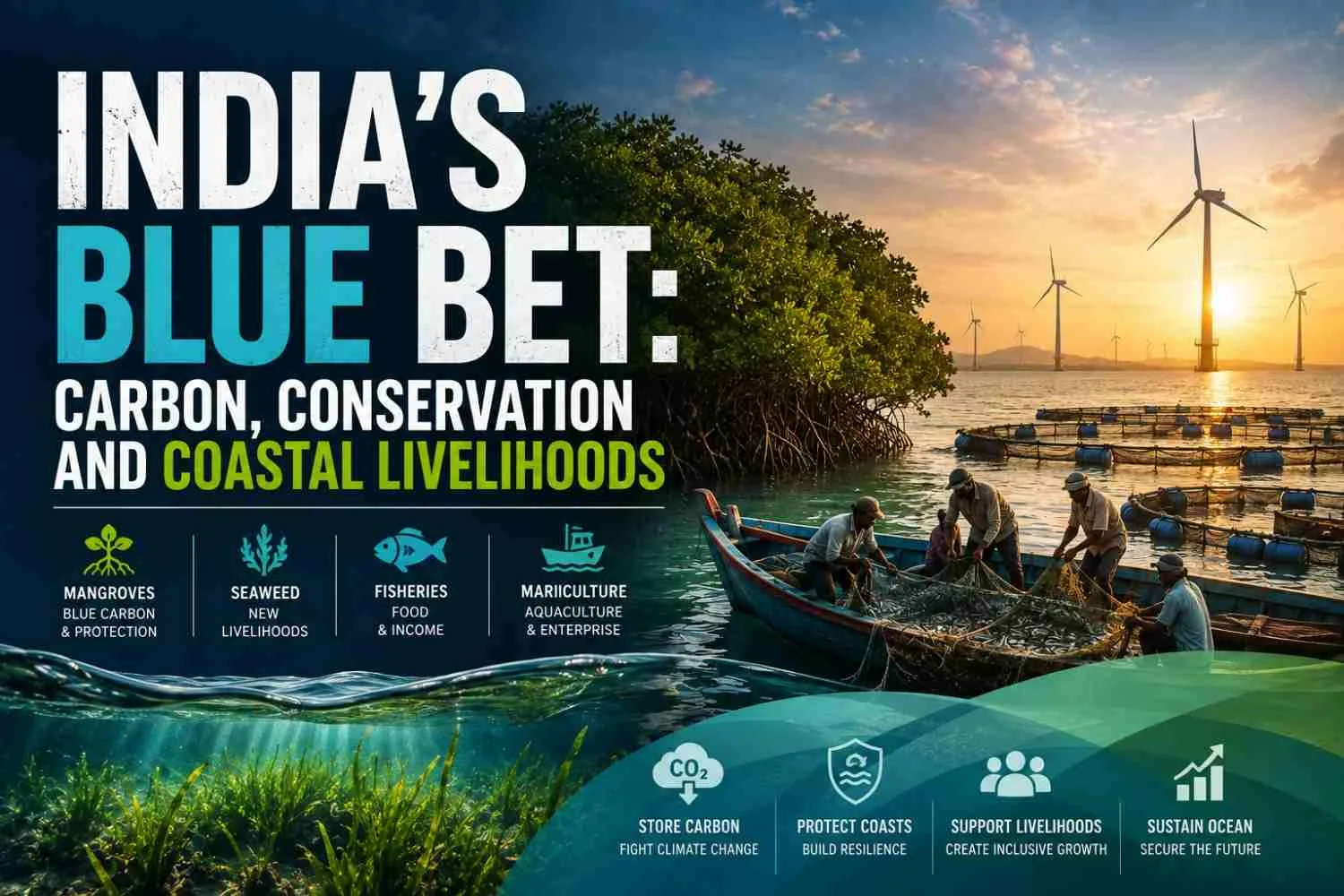
Along India’s western edge, the Arabian Sea does not feel like “nature” in the abstract. It feels like a neighbour with moods, memory, and consequences. In the hours before sunrise, when the first light is still trapped behind the horizon, you can hear a coastline waking up in two different dialects. In Goa, the sea arrives like a storyteller—warm, intimate, full of small signs that people read with their bodies more than their eyes. In Gujarat, the sea arrives like a force—wide, tidal, muscular, sometimes generous and sometimes brutally indifferent. And yet, whether you stand on the palm-lined sands near Betul in South Goa or on the working harbours of Veraval and Porbandar, the same truth holds: marine fisheries are not merely a livelihood. They are a public food system, a coastal economy, a culture, and an ecosystem service—rolled into one daily gamble that millions benefit from and far too few truly understand. This is why the sustainability crisis in marine fisheries is never “only” about fish. It is about how we manage risk, reward, waste, pollution, and power—right at the boundary where land ends and our collective choices begin. Goa’s Dawn: Where Work Looks Like Ritual In a Goan fishing village, the day does not start with a phone alarm. It starts with the texture of the wind. João—he could be any João from any coastal hamlet—steps into the shallows as if stepping into an old conversation. His canoe nudges forward. Nets lie folded like the day’s first prayer. Someone points to the sea’s surface and reads it the way others read headlines. Dolphins arc in the distance. For many fishers, that brief flash is not entertainment; it is reassurance, a sign that the water is alive and the food chain is still intact. Goa’s coastline is short compared to Gujarat’s, yet its marine diversity is outsized because its geography is a mosaic. Sandy beaches, rocky patches, estuaries like the Mandovi and Zuari, mangrove-lined creeks, sheltered bays—each creates nurseries for juvenile fish and corridors for migratory species. This is why Goa’s fisheries have historically been strong even with predominantly small-scale, artisanal practice. The traditional gears—gill nets, hook-and-line, canoe-based fishing—are not “backward.” They are often more selective, more local, and more ecosystem-sensitive than industrial methods. But artisanal does not mean easy. João’s hands know the small cuts of rope, the salt burn, the tension of a net pulled wrong in a sudden current. And when a community shore seine, like the ramponn, is used, the act becomes almost theatrical: more hands, more coordination, more laughter and argument and song—because fishing here is also society at work, not only economics at work. The Fish Market as a Mirror of the Coast Walk through a Goan market in the early morning and you understand sustainability in one glance. Mackerel, sardines, pomfret, prawns, crabs—laid out on ice or in baskets—are not just seafood. They are nutrition, affordability, festival memory, and household budgeting. One family buys mackerel because it stretches, another buys pomfret because guests have come, another buys prawns because a child has passed an exam and joy must be cooked into the day. Markets also reveal the first cracks. When the catch is smaller, prices rise, tempers sharpen, and the smallest fishers feel the squeeze first. When the fish are smaller in size, even if the basket looks full, experienced buyers quietly notice. When the smell is “off,” rumours of pollution travel faster than any official notice. This is the invisible intelligence of coastal communities: they read ecosystems through food. And the market is not only run by “the fishing community” in some generic sense. It is run by women—by the women who sort, dry, bargain, finance small household needs, and keep the fish economy moving when boats are on the water. Their labour rarely appears in policy language with the respect it deserves, yet the stability of the marine fish value chain depends on them as much as it depends on engines and nets. The Monsoon Pause: A Ban That Is Also a Bargain With Life One of the most visible sustainability measures along India’s west coast is the monsoon fishing ban. In Goa, the seasonal closure is not simply a government order; it is also something many communities intuitively accept because they understand breeding cycles. The sea needs time to recover. Fish need time to spawn. A pause is not laziness; it is a form of long-term thinking built into tradition and reinforced by regulation. Yet this is where sustainability becomes complicated. A ban on fishing is meaningful only when it is paired with income protection, fair enforcement, and honest monitoring. Otherwise, the ban becomes a period of hunger and debt for small fishers while better-connected operators find loopholes or shift effort elsewhere. A closure without social security is not conservation; it is a test of endurance imposed on the vulnerable. In Goa, many families use the monsoon months to repair nets, maintain boats, and preserve fish through drying and salting. This is not quaint heritage—it is food security engineering. Dry fish markets carry the smell of survival because they are exactly that: survival. But the pressure is rising because the cost of living rises faster than the value of small-scale catch, and younger people watch their parents struggle and ask a hard question: why inherit a life of uncertainty when tourism, services, or urban jobs promise steadier cash? Tourism’s Bright Lights and the Coastal Blind Spot Goa’s story cannot be told without tourism. Tourism brings money, jobs, and global attention, but it also brings a sustainability paradox. When the coast becomes a product, water becomes an accessory. The sea is admired for sunsets but ignored as a working commons that needs protection. Fishers speak, often quietly at first, about what happens when coastal waters receive untreated sewage, when rivers carry pollutants, when construction squeezes wetlands, and when mangroves are treated as “wasteland” instead of nurseries. The impacts rarely arrive as one dramatic disaster. They arrive as slow damage: fewer fish close to shore, more time spent for less catch, strange algae blooms, occasional fish mortality events that trigger panic and then fade from public memory. A coastal economy that sells “clean beaches” but tolerates dirty outflows is living on borrowed credibility. The sea will eventually invoice us—with declining fish stocks, public health scares, and the collapse of livelihoods that once stabilised coastal society. Velsao’s Warning: When Fish Float Up, So Do the Truths Recent fish mortality incidents on parts of Goa’s coastline have acted like a harsh spotlight, forcing uncomfortable conversations about effluents, regulation, and accountability. When fish die in large numbers and wash up on a shoreline, it is not only an ecological tragedy; it is also a governance test. People ask: who polluted, who permitted, who monitored, who acted quickly, and who will ensure it does not happen again? For fishers, such events are not just environmental news—they are economic shocks. A dead coastline does not sell fish, does not inspire confidence, and does not feed families. It also breeds mistrust because communities often feel they are asked to “prove” their suffering, while the polluting systems are given time, paperwork, and procedural comfort. Sustainability cannot be built on that imbalance. It requires a simple principle that is too often diluted in practice: if a coastal ecosystem is harmed by a human activity, the cost of recovery should not be paid by fishing families. Gujarat’s Scale: Where the Sea Is an Industry and a Frontier If Goa feels like a close conversation with the sea, Gujarat feels like a vast negotiation. The coastline stretches and stretches, and in places like the Gulf of Kutch the tide itself seems to breathe—pulling back to reveal mudflats that run to the horizon, returning with force that reshapes the day’s possibilities. In towns like Veraval, harbours are crowded with mechanised boats, trawlers, ice plants, transport networks, agents, auctions, and export-oriented infrastructure. This is marine fisheries at scale—powerful, productive, and deeply exposed to global market currents. A catch here is not only a meal; it is a commodity that may travel to distant consumers who will never see the fisher’s face or understand the coastal risks embedded in a neatly packed box. And yet, behind the industrial noise, there are old stories. There is Salim from Okha, whose grandfather may have travelled in wooden dhows and whose father navigated by experience rather than screens. Now Salim uses GPS. The sea has changed, he says—not only in temperature but in temperament. The unpredictability is sharper. Fuel costs bite harder. The margins feel thinner even when the boats look bigger. The High Cost of “Abundance” Gujarat’s waters are rich—ribbonfish, croakers, shrimps, squid, cuttlefish, and seasonal abundance near river mouths. But richness can become a trap when it is treated as infinite. As mechanisation expands, fishing becomes capital-intensive. Each trip carries a bundle of costs: diesel, ice, maintenance, gear repair, labour, harbour fees, loan repayments. For many families, debt is not a rare crisis; it is the background music of the profession. This is where sustainability must be understood as economic design. When fishers are locked into debt, they are pushed toward more effort, riskier weather decisions, and gear choices that maximise short-term catch even if they damage long-term stocks. In such a system, moral lectures about “conservation” land badly. People protect the future when the present is not trying to break them. Women in Gujarat’s fisheries, as in Goa, hold up the invisible half of the economy. They mend nets, peel shrimp, manage household finances, negotiate with agents, and absorb the emotional load when boats are delayed. Their hands smell of brine and diesel because the coast’s prosperity is literally handled into existence by labour that is too easily ignored. If policy continues to treat women as “helpers” instead of economic actors, sustainability planning will remain half-blind. The Trawler Question: When Efficiency Becomes Extraction Few debates are as emotionally charged along India’s coasts as the conflict between small-scale fishers and trawler operators. Trawling, especially bottom trawling, can be extremely efficient in bringing large quantities of fish to shore. It can also be extremely destructive when it scrapes seabeds, pulls in juveniles, and generates heavy bycatch—life that is killed and discarded because it is not profitable in that moment. In Gujarat, where mechanisation is widespread, the trawler question is not theoretical. It shows up in daily resentment: artisanal fishers complaining that nearshore zones are invaded, that nets are destroyed, that catches shrink, that the sea is being mined rather than harvested. Even many mechanised fishers privately admit that the sea is less generous than it used to be, and that smaller fish in the nets are a warning sign, not a “good day.” Sustainability here is not about choosing one community over another; it is about designing fair rules for a shared commons and enforcing them. Nearshore zones reserved for small-scale fishers exist in law and policy in various forms, but enforcement is often the missing bridge between what is promised and what people experience. When rules are not enforced, the sea becomes a battleground where the strongest technology wins—and ecosystems tend to lose. Climate Change: When Seasons Stop Keeping Promises Now a deeper disruption is rewriting both Goa’s and Gujarat’s fishing calendars: climate change. Fishers speak in practical terms about what scientists describe in models. The monsoon arrives late, or arrives angry. Wind patterns shift. Sea temperatures rise. Fish migration routes change. Some species move farther, deeper, or become less predictable. Acidification threatens shell-forming species in ways that are slow but serious. On India’s west coast, cyclones have become a sharper fear in recent years, and memories of severe storms have entered fishing communities like permanent caution. When cyclones intensify, “risk” is no longer an abstract term; it is a night when boats do not return, a harbour where families wait without certainty, a reminder that coastal livelihoods live at the edge of safety. Climate change also exposes inequality. Bigger vessels may have better navigation tools, stronger engines, and more access to information. Smaller fishers may have less capacity to outrun a storm or recover from a damaged boat. Adaptation, therefore, must be treated as a public responsibility, not an individual burden. Early warning systems, safe harbours, insurance that actually pays on time, and training in safety protocols are not “benefits.” They are the minimum architecture of climate resilience. Government Initiatives: Useful Starts, Uneven Outcomes Across India, fisheries governance has grown more visible through schemes and regulatory measures designed to modernise the sector, improve infrastructure, and strengthen sustainability. Harbour upgrades, cold chain investments, and support for value addition can reduce post-harvest losses and improve incomes. Seasonal fishing bans are meant to protect breeding cycles. Newer rules and advisories against destructive practices are signals that the state recognises ecological limits. But a critical examination is necessary. Modernisation is not automatically sustainability. If improved harbours and better logistics simply enable more fishing effort without strong stock assessment, habitat protection, and enforceable limits, then “development” becomes a faster road to depletion. If subsidies reduce operational costs without rewarding selective gear and responsible practices, they can unintentionally accelerate overfishing. Policy also tends to speak loudly about boats and infrastructure and softly about governance quality. Who monitors nearshore zones? Who checks mesh sizes? Who prevents illegal fishing methods? Who ensures industrial units do not treat rivers and creeks as disposal channels? Who defends the rights of small fishers in practice, not only in documents? Sustainability is built not by announcements but by everyday enforcement and transparent accountability. And there is a deeper policy gap that communities feel in their bones: social security. Fishers face occupational risk comparable to some of the hardest professions, yet insurance coverage, pension-like protection, and reliable disaster compensation remain uneven. When a fisher loses a boat, they do not lose a “vehicle.” They lose their workplace, their future earnings, and their dignity. If we want sustainable fisheries, we must treat fishers as essential workers in the food system, not as a romantic coastal backdrop. Quiet Revolutions: Tradition Meets Science Despite the pressures, resilience is not absent. It is simply less advertised than crisis. Along stretches of coast, fishers are experimenting with better information, safer practices, and community discipline. There are efforts to reduce fuel use by fishing smarter rather than fishing harder. There are initiatives where data helps predict shoals, where training improves post-harvest handling so value is earned through quality, not only volume. The most promising trend is not a new gadget; it is a new relationship. When communities participate in rules—when they co-manage local zones, voluntarily protect spawning grounds, respect closures, and agree on mesh sizes—compliance rises because dignity rises. Top-down regulation alone often fails because it feels imposed. Co-management works because it feels owned. Women’s collectives in the post-harvest economy are also a sustainability lever waiting to be fully recognised. Better storage, hygienic processing, fair pricing systems, and access to credit can transform the value chain. When women are economically strengthened, households become more resilient, children stay in school longer, and fishing decisions are less desperate. Sustainability is often built in kitchens and markets as much as it is built at sea. Mangroves: The Nurseries We Keep Forgetting If there is one ecosystem that quietly holds coastal fisheries together, it is mangroves. Mangroves stabilise shorelines, buffer storms, store carbon, and—most crucially for fishers—serve as nurseries where juvenile fish and crustaceans grow before moving into open waters. When mangroves are cut, fisheries weaken like a roof losing its beams. Gujarat has seen significant mangrove-focused attention in parts of its coastline, including restoration efforts that link livelihoods with ecology. Such work matters not only for biodiversity but for economics because it strengthens the base of the marine food chain. Goa, too, depends on estuaries and mangrove-linked systems, and movements to protect river health are inseparable from fisheries sustainability, even if the debates are often framed as “pollution control” rather than “food system survival.” The lesson is simple and uncomfortable: if we treat nurseries as expendable, we will eventually pay for fish scarcity with higher prices, poorer nutrition, and deeper poverty in fishing communities. A New Blue Economy: Beyond Catch to Care The near future of coastal livelihoods cannot rely only on harvesting wild fish stocks. The sea can support new forms of income that reduce pressure on capture fisheries while strengthening resilience. Seaweed cultivation, for instance, is emerging as a serious opportunity along parts of Gujarat’s coast, creating pathways for supplementary livelihoods tied to the same marine landscape but with different ecological pressures. Diversification is not a way to “push fishers out of fishing.” It is a way to reduce vulnerability. When a bad season arrives—through weather, pollution, market crash, or stock decline—families with diversified income survive without being forced into harmful fishing intensity. Technology, used wisely, can also act as a fairness tool. Transparent auctions, traceability that rewards responsibly caught fish, digital access to weather and market information, and vessel tracking that improves safety can all shift the balance from extraction toward stewardship. But technology must be distributed fairly. A coast where only the largest operators can access modern tools becomes a coast where inequality deepens and conflict grows. A Near-Future Pact With the Sea The sustainability challenge in Goa and Gujarat is ultimately a question of what kind of relationship we want with the ocean. Do we want a relationship where the sea is treated as an unlimited warehouse until it proves otherwise? Or do we want a relationship where the sea is treated as a living commons, protected by rules that are enforced, supported by science that is shared, and strengthened by communities that are respected? A realistic pact with the sea would look like this: strong protection of nearshore zones for small-scale fishers, enforced without exception; serious action against pollution sources in rivers and creeks because fisheries cannot survive in dirty nurseries; selective gear and bycatch-reduction methods rewarded through policy, not treated as optional morality; seasonal closures paired with income support so conservation does not become hunger; investment in mangroves and estuaries treated as fisheries investment, not as “environment work”; climate resilience built through early warnings, safe harbours, insurance that works, and training that saves lives; and finally, recognition of women as core economic actors whose empowerment is not charity but coastal strategy. If these steps are taken with sincerity, something remarkable becomes possible. Fishers begin to see regulation not as harassment but as protection. Young people begin to see the sea not as a sentence but as a skilled profession with dignity. Consumers begin to understand that sustainable seafood is not a luxury trend; it is a necessary contract between cities and coasts. Goa and Gujarat may speak differently through their landscapes—one with intimate estuaries and cultural closeness, the other with vast gulfs and industrial scale—but both are reading from the same changing ocean. The sea will keep breathing, tides will keep returning, and nets will keep carrying stories. The only question is whether the stories will be of collapse—or of a coast that chose, in time, to become wise. Table 1: The Tale of Two Fisheries (2023-2024 Estimates) Annual Marine CatchPrimary MethodRamponnKey SpeciesLabor ForceCritical ThreatCultural SymbolSangoddKharwaPagadiya    Table 2: The Cost of the Changing Sea Climate ChangeTrade & GeopoliticsConflict     Bottom of Form   ...Read more

26 Mar 2026

At dawn in a village on Rajasthan’s edge, Meera lowers a rope into the family well the way her mother did. The bucket used to splash before it was half-way down. Now it drops, and drops, and lands with a dry thud that sounds like a door closing. She stands still for a moment, as if listening for an answer from the earth. Then she lifts the empty bucket, balances two pots, and starts walking toward a tanker that may or may not arrive on time. Two thousand kilometres away, on a Sundarbans island in West Bengal, a handpump coughs and sputters before giving up. The water that comes out is sometimes brackish, sometimes rusty, sometimes just not enough. People speak of boreholes going deeper each year, of tubewells that once felt reliable now turning uncertain, of salty tides and cyclones that leave a taste of the sea in soil and ponds long after the winds have gone. In coastal Gujarat, the crisis can be quieter and crueler. Water can still be found, but it changes character. It becomes saline. It corrodes pipes, spoils fields, and forces families to choose between expensive treatment and unsafe compromises. The sea does not need to invade on the surface; it can arrive underground. In Tamil Nadu, the story shifts again. When the summer comes early and the rains behave strangely, cities and farms start drawing harder from the same hidden reserves. In years of stress, water trains, tanker queues, private borewells, and rising salinity become part of urban routine. A city discovers, painfully, that groundwater does not announce its limits until it is already too late. These are not four separate stories. They are four chapters of one national plot: India’s groundwater is being asked to do more than it was ever designed to do, and it is being extracted faster than nature can replenish it in many places. The result is a slow-motion emergency with sudden moments of shock. The Invisible Utility Holding Up India Groundwater is India’s quiet backbone. It cushions drought years, stabilises drinking water supply, and keeps farms alive when canals, tanks, and rivers fall short. It is also the water source that individuals can access privately, through a pump, a borewell, or a handpump, without waiting for a pipeline or a municipal schedule. That ease has made groundwater feel like a personal asset rather than a shared resource. It has also made it dangerously easy to overuse. Surface water looks finite because you can see it. A river thins, a reservoir shrinks, a lake turns into a field. Groundwater behaves like a hidden bank account. People keep withdrawing because the day-to-day signals stay deceptively normal. The pump still runs. The water still comes. The crisis only becomes visible when the water table falls below suction, when wells fail, when water turns saline, or when contamination becomes concentrated enough to become undeniable. This is why groundwater is not merely an environmental issue. It is a food security issue because cropping and irrigation are, in large parts of India, groundwater decisions. It is a public health issue because depleted aquifers often become saline or concentrate pollutants. It is an economic stability issue because well failure pushes farmers into higher costs and deeper debt while cities face rising operational risks and water inflation. It is a social equity issue because the poorest households cannot drill deeper, buy tankers, store water, or treat it. It is a climate resilience issue because erratic rainfall reduces predictable recharge, and intense downpours create floods without replenishing aquifers effectively when water runs off too quickly. A Simple Thermometer That Explains a Complex Crisis One of the clearest ways to read groundwater stress is through the idea of extraction versus replenishment. If a region withdraws groundwater faster than it is naturally recharged, it is eating into its long-term savings. At the national level, India’s overall extraction-to-availability ratio can look deceptively “manageable.” But groundwater does not fail nationally. It fails locally, aquifer by aquifer, block by block, until a district crosses a threshold and daily life begins to unravel. India’s true groundwater reality is therefore best understood as a patchwork of extremes. Some areas are structurally water-scarce. Some are water-rich but quality-stressed. Some are stable in average years but collapse under two failed monsoons. Some have enough water underground but lack governance and infrastructure to use it sustainably. That patchwork becomes clearer when we travel through four contrasting states that represent four different kinds of groundwater pressure: Rajasthan, Tamil Nadu, coastal Gujarat, and West Bengal. Rajasthan: Where the Crisis Is About Quantity and Time Runs Faster Rajasthan is the most intuitive groundwater story in India because its surface reality mirrors its underground reality. Heat is intense, rainfall is low, and many regions have limited surface storage. The dependence on groundwater is high, and in many places it has become an overdraft economy beneath the soil. When extraction exceeds sustainable replenishment year after year, the water table retreats like a horizon. What makes Rajasthan’s groundwater fall so hard is not only the climate. It is the interaction between fragile aquifers and modern extraction. In large parts of Rajasthan, aquifers do not behave like vast underground lakes that refill easily. They behave like limited storage systems, sometimes fractured hard rock systems, which can be drained quickly and recharge slowly. Once depleted, the bounce-back is difficult unless rainfall is captured at scale and allowed to infiltrate. The state also carries the psychology of drought. When rainfall is uncertain, a borewell becomes insurance. When every farmer pumps “just in case,” the collective result is a tragedy of the commons. Add to this the economics of pumping, where cheap or free electricity can encourage longer run-times, and you get a system that rewards extraction more than efficiency. Yet Rajasthan also carries a powerful lesson of hope: the land responds when communities treat rainfall as a harvest. Traditional systems of water harvesting and local recharge, revived and adapted through community mobilisation, have shown that groundwater can return seasonally when catchments are protected and small structures are maintained. The sustainability insight is blunt in Rajasthan: in low rainfall zones, groundwater survival depends on both demand discipline and recharge culture. One without the other fails. Tamil Nadu: Hard-Rock Aquifers, Urban Thirst, and a Monsoon You Must Catch Tamil Nadu’s groundwater story often gets simplified into the language of drought, but the deeper truth is about variability and storage. Rainfall can be intense but seasonal, and aquifers in many regions are hard-rock with limited capacity. In such systems, recharge is not a slow, forgiving process. It is a narrow window. If rainwater is not captured and infiltrated quickly, it is lost to runoff and the sea. Tamil Nadu also reveals how groundwater crises emerge in cities. Urban demand can expand faster than water systems can keep up, and when surface sources falter, the city turns to groundwater and tankers. The crisis then shows up in two stages. First, quality changes: as fresh groundwater levels fall, salinity risks rise in coastal aquifers, and contamination risks increase where sanitation and waste management are weak. Then quantity collapses: borewells fail, tankers multiply, and a shadow water economy takes over, where those who can pay get water first. In Tamil Nadu, there is also a well-known counter-narrative: the state’s push for rainwater harvesting, including rooftop systems, helped mainstream the idea that monsoon water must be captured rather than drained away. Tamil Nadu’s sustainability signature is the insistence that every building and every neighbourhood has a role in recharge. The larger lesson is not that rainwater harvesting alone solves the crisis. It is that in hard-rock and variable rainfall states, groundwater security is built through a layered system: capturing rain, recharging aquifers, reusing treated water, and reducing demand through irrigation efficiency and sensible cropping patterns. Coastal Gujarat: When Depletion Turns Into Salinity and the Sea Moves In Underground Gujarat’s groundwater story is split between inland scarcity and coastal vulnerability. Inland regions can experience periodic stress typical of semi-arid landscapes, but the coast carries a different kind of threat. Here the crisis is often not announced by “no water,” but by “water that has turned unusable.” In coastal belts, freshwater and seawater exist in a delicate balance. When freshwater levels fall because of heavy pumping, saltwater can seep into aquifers through tidal influence and mixing, particularly in low-lying tracts. The sea does not need to breach embankments to damage groundwater; it can travel invisibly through the subsurface. The result is brackish water that is corrosive for infrastructure, harmful for many crops, and unsafe without treatment. This coastal challenge is intensified by concentrated demand. Farming, expanding settlements, and industrial corridors near ports can combine into high-density extraction zones. When surface water substitution is limited, groundwater becomes the default supply, and the coastal aquifer becomes a battleground between freshwater needs and saline intrusion. Gujarat also offers an important practical insight for the future: large-scale recharge drives and robust water conservation infrastructure can slow depletion, but coastal sustainability requires explicit salinity management. That means monitoring and regulating extraction in vulnerable zones, creating recharge barriers where feasible, and prioritising surface water and treated water reuse to relieve pressure on aquifers. Coastal groundwater must be treated as a frontier that needs defence, not merely a reservoir that needs refilling. West Bengal: The Water-Rich Paradox and the Double Threat of Salinity and Quality West Bengal is often assumed to be safe because it is riverine, rain-fed, and part of a vast deltaic system. Its overall extraction ratios can appear moderate compared to Rajasthan. But West Bengal’s groundwater risk is not captured by one statewide number because the state’s challenges are sharply local. In some belts, depletion rises with irrigation intensity. In coastal and deltaic regions, salinity risk grows when freshwater storage weakens. And across parts of the delta, water quality threats can be as serious as quantity threats. The Sundarbans captures this complexity with painful clarity. In blocks like Gosaba, people are confronting a pattern that feels like a slow retreat of freshwater. Tubewells that once produced dependable water now run dry or turn brackish. Boreholes must be drilled deeper, often at costs that small households can barely bear. Handpumps fail earlier in the season. During cyclones and storm surges, saline water floods land and ponds, contaminating local storage and forcing greater reliance on groundwater at exactly the time when recharge is weakest. When groundwater levels fall, saltwater intrusion accelerates, turning a shortage into a quality collapse. The Sundarbans story also reveals how groundwater crises become livelihood crises. Farmers who cannot find reliable freshwater for irrigation either invest in deeper wells, abandon crop cycles, or watch yields fall as salinity stresses the soil. Household water chores expand, especially for women and children, who walk farther for water that is often poorer in quality. Food security erodes not in one dramatic event but through repeated small losses: a failed crop, a contaminated pond, a fish stock damaged by salinity, an extra month of tanker costs. West Bengal also carries a lesson for urban India: not all cities sit on accessible shallow aquifers in a way that makes groundwater a reliable fallback. Urban planning must be based on hydrogeology, not assumptions. Where groundwater is limited or vulnerable, the city must lean harder on surface water resilience, treated water reuse, leak reduction, and decentralised rain capture. Why the Crisis Deepens: The Human System Behind the Hydrogeology It is tempting to blame groundwater depletion on climate and geography alone, but the real drivers are largely manmade. The crisis is a product of incentives that reward withdrawal and underinvest in replenishment, governance, and efficiency. The first driver is the economics of pumping. When electricity is free or heavily subsidised, when metering is weak, and when regulation is inconsistent, groundwater becomes an underpriced input. Farmers pump more because it makes immediate economic sense. Institutions pump because it is convenient. Industries pump because it reduces dependency on uncertain municipal supply. In such a system, individual rational choices add up to collective depletion. The second driver is cropping and irrigation choices. Groundwater depletion is tightly linked to what India grows, where it grows it, and when it grows it. Water-intensive crops cultivated in unsuitable agro-ecologies force groundwater substitution. Dry-season rice cultivation in certain belts turns groundwater into an invisible canal. Pricing, procurement, and market signals can unintentionally reward water stress by making certain crops profitable regardless of local water realities. Farmers do not choose groundwater depletion; they choose livelihood stability in the incentive landscape they are given. The third driver is urbanisation that blocks recharge. Cities consume water, but they also alter the land’s ability to absorb water. Paved surfaces reduce infiltration. Stormwater drains speed runoff. Wetlands and lakes that once acted as recharge engines are encroached, polluted, or disconnected from their catchments. The monsoon becomes a flood problem rather than a recharge opportunity. The fourth driver is fragmented governance. Groundwater is local, but governance is often split across departments that manage drinking water, irrigation, agriculture, rural development, urban infrastructure, and industry. Without aquifer-level budgeting and shared accountability, interventions become scattered. Recharge structures are built without demand control. Subsidies promote extraction while programmes plead for conservation. Data is collected but not always used to enforce limits. The fifth driver is quality collapse. Even where groundwater quantity remains, it can become unusable. Excess fertiliser can increase nitrate levels. Poor sanitation can contaminate shallow aquifers. Industrial discharge can poison subsurface water. In coastal and arid belts, salinity can rise as freshwater pressure drops. Groundwater then becomes a trap: the more you pump, the more you risk degrading the resource you depend on. The Corporate Connection: Groundwater as Operations, Risk, and Reputation Groundwater depletion is often narrated as a farmer’s problem, but it is equally a corporate and institutional problem, because modern India runs on groundwater in ways it rarely acknowledges. Many hotels, campuses, stadiums, malls, and factories use borewells when municipal supply is inadequate or unreliable. This turns groundwater into an invisible subsidy for urban growth. When regulators push institutions to shift toward treated wastewater and rainwater harvesting, the resistance is often not ideological; it is operational. Groundwater has been easy. Switching requires investment, redesign, and discipline. For businesses, groundwater is also a major risk variable. Falling water tables mean rising costs for deeper drilling, pumping energy, and treatment. Salinity and contamination add further costs and operational uncertainty. In water-stressed basins, community tensions can rise when local people believe commercial users are drawing down shared reserves. In a world increasingly shaped by ESG expectations, groundwater can become a reputational fault line, especially when corporate water stewardship is limited to CSR projects that do not address the actual extraction footprint. There is also a quieter connection through supply chains. A company may not pump groundwater directly, yet it may rely on agricultural and industrial suppliers whose production is groundwater-dependent. When water stress intensifies, supply reliability drops and costs rise. This is why serious sustainability strategy must treat groundwater as a basin-level issue rather than a factory-level efficiency metric. The question is not only how efficiently a unit uses water, but whether the water use is sustainable in its local aquifer context. What India Is Doing: The Toolkit Exists, the Alignment Is Hard India has not ignored the groundwater crisis. The country has built monitoring systems, mapping programmes, recharge missions, and community-led schemes. The challenge is that the problem is both vast and deeply local, and the hardest part of the solution is not engineering. It is alignment. Government initiatives increasingly recognise that groundwater must be managed with better data, better planning, and better community engagement. Aquifer mapping and regular assessments aim to move decision-making from guesswork to groundwater intelligence. Large national campaigns have focused on water harvesting, recharge, and water-body rejuvenation, aiming to restore local storage and infiltration capacity. Community-led groundwater management programmes have attempted to shift the conversation from “more wells” to “shared water budgets,” encouraging villages to plan extraction based on recharge realities. Agricultural schemes that promote micro-irrigation and efficiency seek to reduce demand without cutting productivity. Civil society has played a crucial last-mile role. Across India, NGOs and community groups have repeatedly demonstrated that groundwater is best saved through collective action. One farmer adopting water-saving practices cannot protect an aquifer if neighbouring farms continue to pump without limits. Community initiatives that revive tanks, protect catchments, maintain recharge structures, and create social norms around pumping can be remarkably effective, especially when local leadership is strong and benefits are visible. And yet, the gap remains demand control. Recharge projects are visible, fundable, and politically attractive. Demand management is harder because it forces changes in incentives and behaviour. It requires crop rationalisation, irrigation discipline, metering, pricing reform, and enforcement against unsustainable extraction by both private and institutional users. Without demand control, recharge becomes a treadmill: water is added back in, but extraction simply rises to match it. What the World Teaches: Three Global Lessons That India Can Adapt Other water-stressed regions have learned, often painfully, that groundwater cannot be managed by good intentions alone. Three lessons stand out for India, not as templates to copy but as principles to translate. The first lesson is governance with accountability. In places like California, groundwater overdraft prompted a legal and institutional shift toward basin-level management where local agencies must create sustainability plans and face consequences if they fail. The critical idea is not central control for its own sake; it is enforceable responsibility at the scale where groundwater actually behaves. The second lesson is the power of reuse. Countries like Israel treated wastewater not as waste but as a strategic resource, building high levels of treatment and reuse, particularly for agriculture. This reduced dependence on freshwater sources and created a circular water economy. India’s cities and industries can relieve groundwater pressure dramatically if treated wastewater becomes a mainstream supply for non-potable uses, landscaping, construction, and certain categories of industrial demand. The third lesson is measurement before markets. In parts of Australia, basin governance evolved toward caps, monitoring, and structured allocation systems, with trading mechanisms operating within defined limits. The essential insight is that allocation is only fair when measurement is credible and ecological safeguards are real. India’s immediate need is not a market-first model; it is measurement, caps in over-stressed aquifers, and local institutions empowered to implement and enforce groundwater budgets. Possibilities Ahead: The Path to a Groundwater-Secure India India’s groundwater future will not be decided by one mega-project. It will be decided by whether the country can build a culture of water accounting and a politics of sustainability. In Rajasthan, the path forward demands a relentless focus on catching rainfall where it falls, protecting micro-catchments, reviving and maintaining local recharge systems, and coupling those efforts with serious irrigation efficiency. The goal is not merely to create water structures but to rebuild water commons. In Tamil Nadu, the future depends on turning cities into recharge-friendly landscapes, treating stormwater as a resource rather than a drainage problem, expanding reuse so that treated wastewater displaces groundwater for non-drinking purposes, and supporting farm transitions toward efficient irrigation and climate-fit cropping. In coastal Gujarat, groundwater security must be framed as salinity defence. Monitoring must be tight, extraction must be disciplined in vulnerable zones, and surface water substitution and reuse must be scaled to reduce coastal pumping pressure. Industry and ports must treat groundwater stewardship as a core operational responsibility, not an optional CSR narrative. In West Bengal, especially in the delta, groundwater sustainability must be tied to climate resilience. The Sundarbans needs stronger freshwater storage through rain capture and pond conservation, resilient drinking water infrastructure that reduces emergency over-pumping, and local adaptation planning that acknowledges salinity as a permanent risk. In areas where groundwater quality threats exist, safe sourcing, regular testing, and alternative supply systems become as vital as recharge. Across all regions, the deeper shift is the same. Farmers need incentives that reward water-smart choices, not water-blind productivity. Cities need design norms that prioritise infiltration, reuse, and leak reduction. Corporations need water stewardship that includes basin health, extraction transparency, and circular systems, not only efficiency claims. Governance needs to move from counting structures to managing aquifers, from celebrating projects to sustaining outcomes. The Hidden River, and the Choice India Must Make Groundwater is often described as water beneath our feet, but that phrase does not capture what it truly is. It is a hidden river of stability that runs through India’s food system, health system, and economic system. When it falls, everything becomes more fragile. Crops fail more easily. Diseases spread faster. Inequality sharpens. Migration accelerates. Conflict becomes more likely, not because people want conflict, but because water is the base layer of dignity. India is at a crossroads that does not look dramatic until it becomes unavoidable. The country can continue pumping as if the underground is infinite, and accept that wells will fail more frequently and water quality will worsen. Or it can choose a groundwater transition that treats water as a shared resource with real limits, invests in recharge and reuse, reforms incentives, and builds local institutions capable of governing aquifers. If India makes that choice, the scenes that opened this story can change. Meera’s bucket can splash again, not because a miracle happened, but because the village treated rain as wealth and pumping as a shared decision. Gosaba’s handpumps can become more reliable, not because cyclones will stop, but because freshwater storage and supply resilience reduced the need to mine fragile aquifers. Coastal Gujarat’s water can stay usable, not because the sea retreated, but because humans stopped inviting it underground. Groundwater is not just a resource. It is memory, survival, and the quiet infrastructure of life.   ...Read more