India

India is a diverse and culturally rich country located in South Asia, known for its ancient history, vibrant traditions, and rapidly growing economy. This category covers everything related to India, including its geography, culture, heritage, politics, technology, lifestyle, and current developments.

Showing 12/40

14 Jul 2026

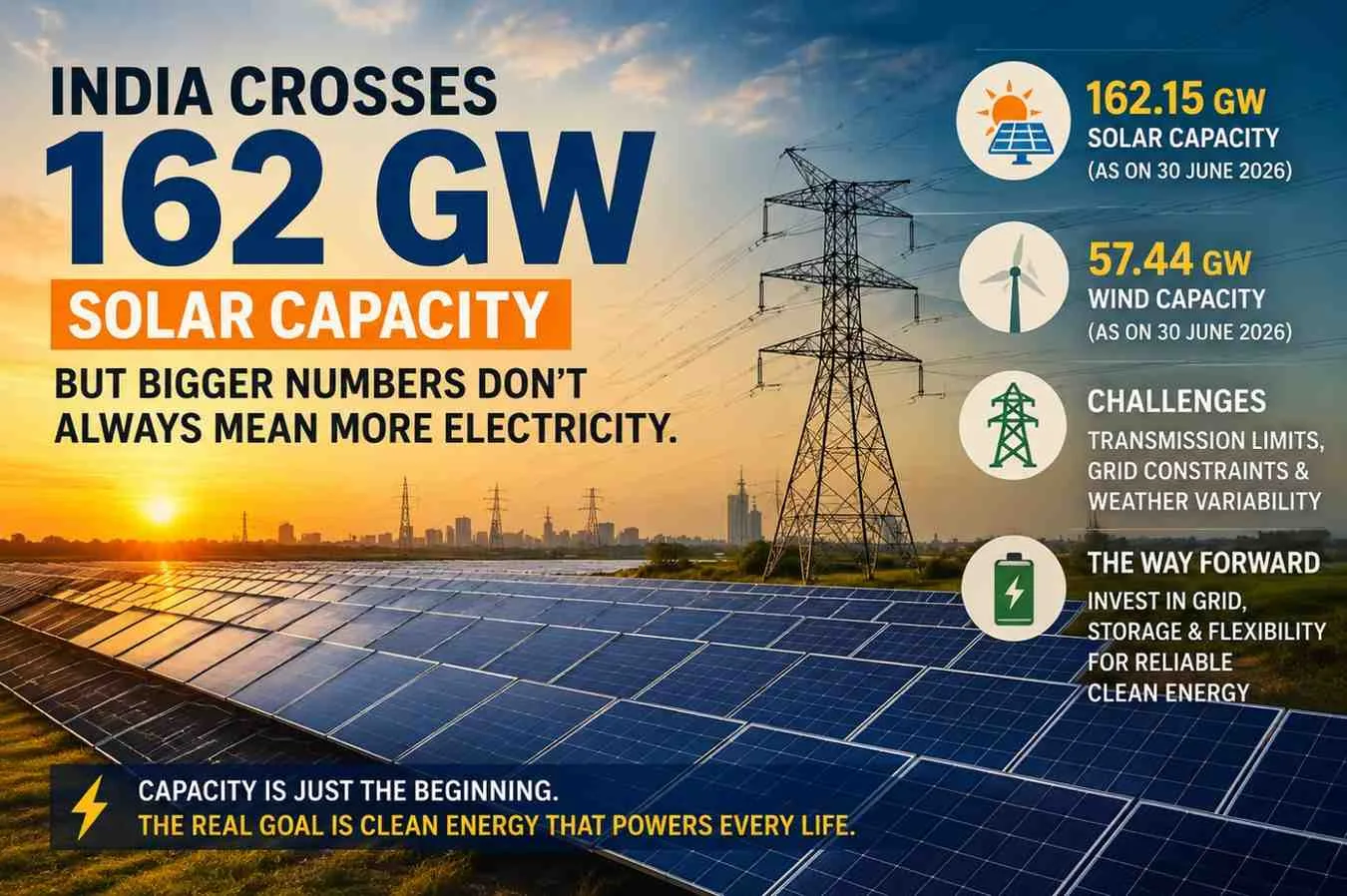
India’s renewable energy dashboard grows a little greener every month. In its latest achievement, it has reached another milestone.  According to the latest physical progress update issued on 8th July by the Ministry of New and Renewable Energy (MNRE), India’s cumulative solar capacity has surged to 162.15 GW. Driven by the addition of over 5.1 GW in June alone. Wind Capacity currently stands at 57.44 GW. Highlighting Solar's progressive increase as the nation's fastest-growing source of renewable energy.   At first glance, the remarkable advancement is the main focus of the picture. Yet beneath this huge milestone lies a very important question: Is the addition of renewable capacity directly proportional to the generation of more electricity? Not necessarily. The installed capacity simply measures the maximum amount of electricity produced by a power plant under ideal conditions. The real-world challenges are not accounted for. Power is generated by the Solar panels only when the sun is shining. Wind turbines depend on favourable weather. Both of which can face transmission constraints preventing the full absorption of the electricity generated.    Installed CapacityElectricity GenerationIndicates the maximum power generation capability of a power plant under ideal conditions.Indicates the actual electricity produced and supplied over a period of time.Measured in MW or GW.Measured in MWh, GWh or Billion Units (BU).Represents infrastructure that has been built.Represents electricity actually delivered to consumers.Does not account for weather, maintenance, curtailment or transmission bottlenecks.Depends on sunshine, wind availability, grid capacity, storage, and electricity demand.   The latest June figures unveil another clear trend. With the steady increase in solar, other renewable technologies struggle to keep up. Following this, Wind recorded decent additions, but other technologies such as biomass, small hydro, and waste-to-energy have seen little to no significant growth. Resulting in a renewable energy portfolio progressively driven by a single technology.  The sector continues to gain momentum, especially as India works towards its goal of accomplishing 500 GW of non-fossil electricity capacity by 2030. Experts note that capacity additions alone cannot ensure a successful energy transition, even with the rapid expansion of solar capacity. To ensure reliable and efficient delivery of renewable electricity, the investments in transmission infrastructure, battery storage, and grid flexibility are no less critical.   TechnologyAddition in June 2026 (MW)FY 2026–27 Addition (Apr–Jun) (MW)Installed Capacity (30 June 2026)Solar Power5,105.5611,891.30162,152.00 MW (162.15 GW)Wind Power636.351,348.5557,443.39 MW (57.44 GW)Biomass (Bagasse)0.000.009,821.32 MWBiomass (Non-Bagasse)0.000.001,048.84 MWWaste-to-Energy0.000.00324.24 MWWaste-to-Energy (Off-grid)0.001.04554.16 MWSmall Hydro Power2.4010.405,181.76 MWTotal RE (Excluding Large Hydro)5,744.3113,251.29236,524.72 MW Source: MNRE Physical Progress Report (as on 30 June 2026).  The latest MNRE data reflects the fast mobility of the country towards a cleaner energy future. However, it highlights the next challenge: to ensure the transition of every newly installed megawatt into usable and dependable power for millions of people.  At the end of the day, a gigawatt installed is only the beginning. The ultimate benchmark of success is the amount of clean electricity that powers everyday life.  ...Read more

08 Jul 2026

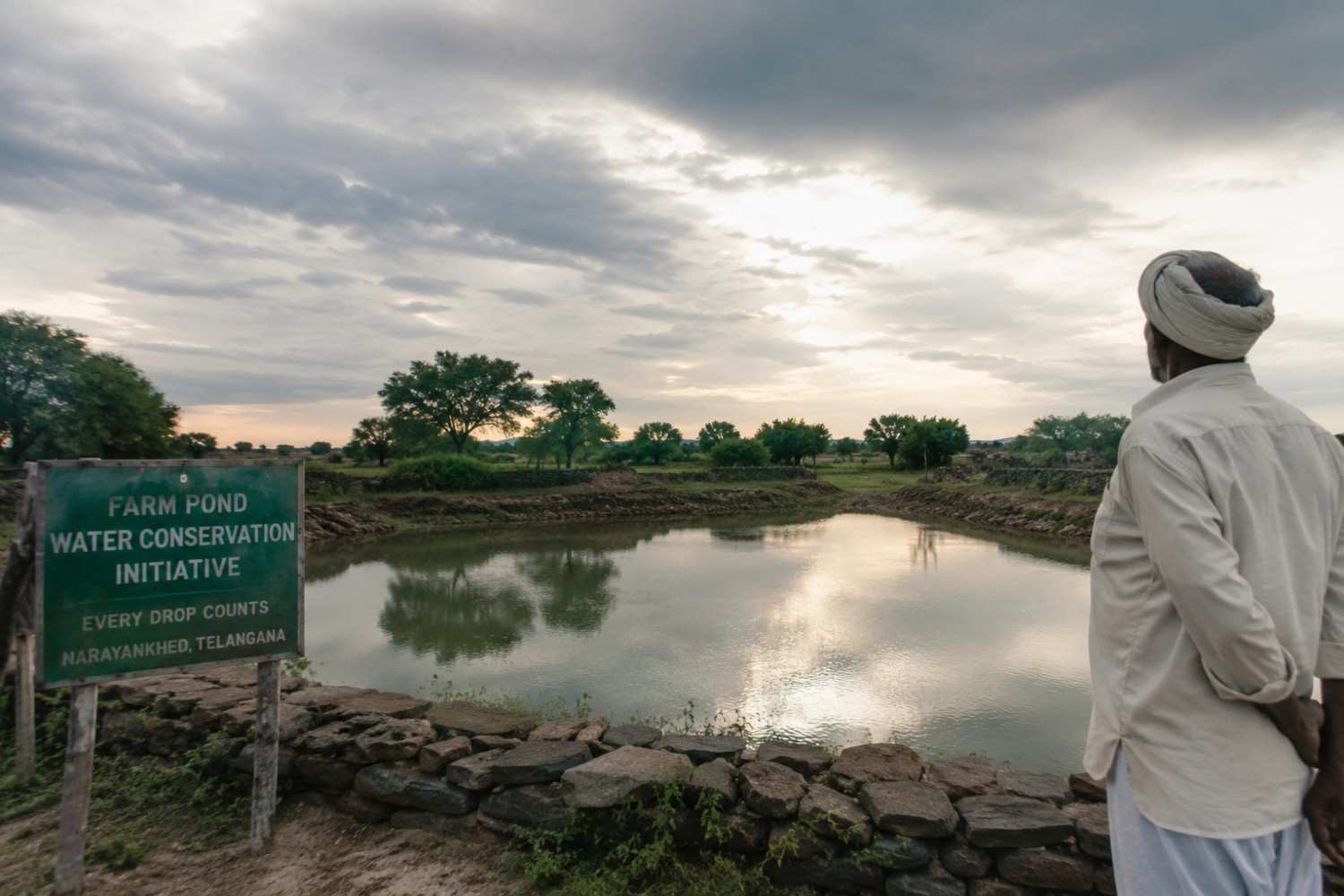
An unexpected initiative is helping villages make every drop of rain count.  How can a village receive rainfall every year and still struggle for water? It’s a question – many  parts of India continue to face. Wells run dry. Crops suffer. And by the summer season, lack of water becomes a major reason to worry! This is a real-life story covering a small town - Narayankhed, Telangana. The problem wasn’t lack of rain. It was lack of water conservation. Most of the rainwater flowed away before it could reach the roots of the ground. Years passed, and this cycle continued.  Farmers were aware of the problem. But addressing the problem wasn’t easy. Till someone showed up unexpectedly from an unexpected place as their ray of hope. Every Friday night, Dr P. Sudhakar Naik, an IRS officer posted in Mumbai, boarded a bus to Telangana. For seven consecutive weekends, he travelled about 600 kilometres to work with the villagers facing the crisis.  Environmentalist Paladugu Gnaneshwar, along with the local officials and residents, came together with him and helped him build farm ponds, soak pits and stone barriers. Simple structures. Simpler Ideas. But ones that could preserve rainwater and stop it from being wasted. And the cost? JUST 2 LAKHS!  The impact? Water that was nowhere to be seen now has a chance to stay. Groundwater levels are improving gradually. Farmers are becoming hopeful. And villages that suffered miserably due to lack of rain are now learning how to make every drop count. The story carries a larger and more impactful message. Water scarcity isn’t always caused by less rainfall. Sometimes, it’s about how we conserve the rain we already receive.  SOURCE- This report is based on a real-life story published by The Better India, an independent digital media platform known for reporting grassroots innovations and addressing positive social changes across India. ...Read more

08 Jul 2026

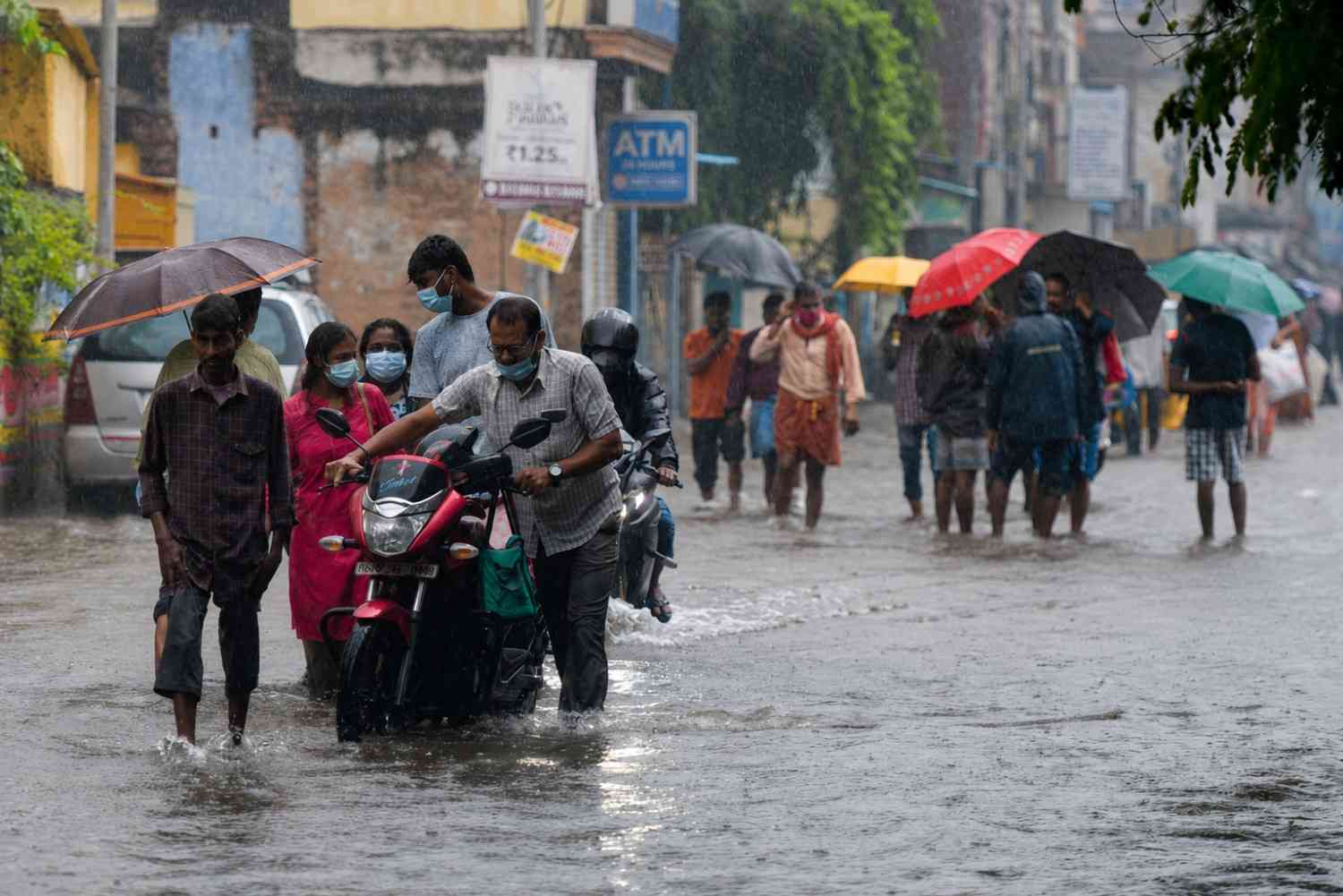
  Image courtesy: Imagesbazaar Expensive grocery bills? Neighbourhoods hotter than usual? Unpredictable rains? Well, it’s not your imagination, it’s the present reality. India has been warned about the probability of receiving below-normal rainfall in July 2026. This made June 2026 the driest in over a century. Why you may ask? That is because a monster is awakening in the open waters of the Pacific Ocean for months.  Delayed crop sowing, rising vegetable prices and increased pressure on water resources – all of which are influenced by one climate event.  A natural climate pattern which happens when sea surface temperatures become warmer in the central Pacific Ocean. How can something so far away, so deep affect India? Distance doesn’t matter; the air circulation is altered at a global level. This leads to the weakening of the southwest monsoon and uneven rainfall patterns in South Asia.  This climate event or pattern is known as El Nino. This year, the increasing intensity of El Nino conditions has been observed by the meteorologists. Having triggered concerns related to uneven heavy showers during the crucial monsoon season.  But the question is WHY should one care? One should, because this is where your grocery expenses become relevant. Monsoon is more than just a regular season for India’s farmers – it is the backbone of agriculture. The sowing of important crops such as rice, soybean, cotton, and maize may postpone due to delayed rainfall.  There have been reports of slower kharif crop planting compared to last year because of late rainfall.  When agricultural production becomes less, the consumers pay the price. Decrease in crop yield leads to increase in prices of vegetables, grains, and other food items. This eventually impacts the local market.  Image courtesy: Imagesbazaar Another growing concern is Water. Multiple reservoirs depend on monsoon rainfall to restore supplies. Several regions may face lack of water availability if rainfall remains below normal. Which may lead to stricter water management measure both in rural and urban areas.  Why does the weather drastically change on a day-to-day basis? One of the recent phenomena faced by some regions in India is very heavy rainfall and thunderstorm one day and heatwaves the very next day. This is the effect of El Nino. One of its most confusing aspects is that it doesn’t just cause less rainfall. It often changes how rain falls. Rather than even showers spread across the whole season, rainfall may occur as sudden bursts of intense storms followed by dry weather conditions. This may cause flash floods in one region while water shortages on another.  Such inconsistent weather results in difficulty in irrigation planning by farmers and drainage system management in city authorities.  Rise in global temperatures is causing the impacts of El Nino to be more pronounced even though El Nino is a naturally occurring climate cycle. More moisture is held by a warmer atmosphere intensifying extreme weather conditions. Heatwaves become hotter and rainfall becomes increasingly unpredictable.  Now, what do we await? The next few weeks will be very crucial for India’s monsoon. El Nino is closely monitored by India Meteorological Department (IMD) since it is expected to persist through the following months. However, some regions may have an improvement in rainfall.  For the common people, El Nino is not just a scientific term discussed by the meteorologists. It may be the rising expense of vegetables, lack of water availability in reservoirs, prolonged heat resulting in high electricity bills, and how difficult it is to cope with the uncertain climate changes for the farmers.  As the monsoon unfolds, the echoes of a warming Pacific Ocean remind us of a simple truth: in an interconnected climate, even the most distant changes can hit closest to home. Sources World Meteorological Organization (WMO) – Prepare for El Niñohttps://wmo.int/news/media-centre/wmo-prepare-el-ninoScroll.in – El Niño likely to intensify as India's monsoon advances slowlyhttps://scroll.in/article/1093913/el-nino-likely-to-intensify-as-indias-monsoon-advances-slowlyDown To Earth – Tackling the trilemma of El Niño, stagflation and shrinkflationhttps://www.downtoearth.org.in/climate-change/tackling-the-trilemma-of-el-nino-stagflation-and-shrinkflation ...Read more

11 May 2026

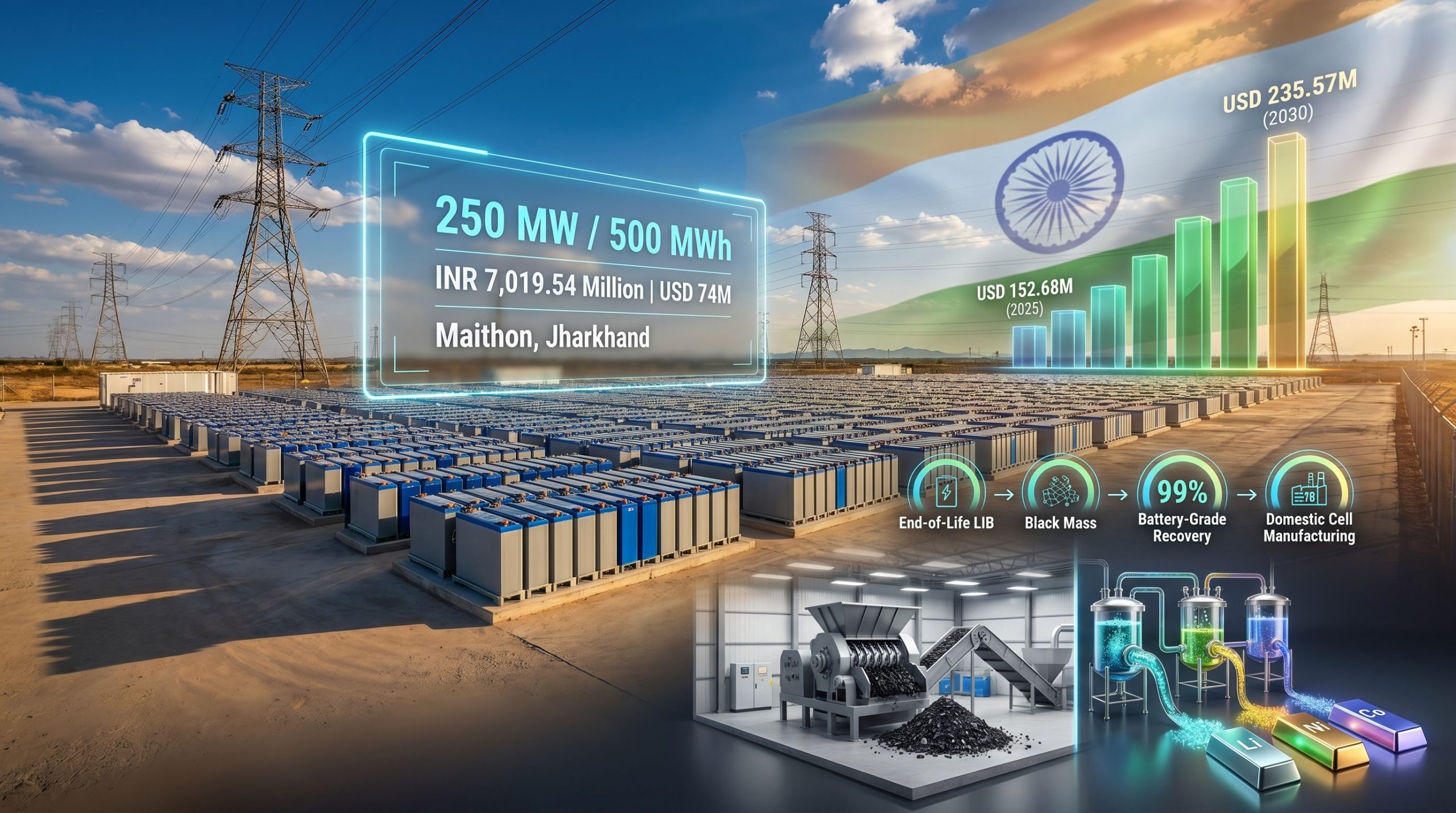
The Battery Waste Management Rules (BWMR) 2022, and their subsequent 2025 amendments, represent a transformative shift in India’s environmental and industrial policy, evolving from a mere waste-disposal framework into a strategic pillar for securing the nation’s critical minerals supply chain. Under the mandate of the Ministry of Environment, Forest and Climate Change (MoEFCC), these rules have institutionalized the principle of Extended Producer Responsibility (EPR), compelling manufacturers, importers, and brand owners—collectively termed "producers"—to take full accountability for the entire lifecycle of batteries, including portable, automotive, industrial, and electric vehicle (EV) types. Central to this framework is the aggressive escalation of material recovery targets; for instance, recyclers are now required to meet a 70% material recovery rate in FY 2024-25, rising to 80% by FY 2025-26, which effectively creates a "secondary mine" within the domestic economy. This is particularly vital as India navigates a high import dependency for primary sources of lithium, cobalt, and nickel—the "big three" minerals essential for the lithium-ion batteries that power the clean energy transition. By mandating that a specific percentage of recycled materials be reintegrated into new batteries from FY 2027-28 onwards, the government is forcing a circular loop that reduces reliance on volatile global markets and geopolitical risks. The 2025 amendments further sharpened these tools by introducing mandatory digital traceability through unique barcodes or QR codes on every battery pack, linking them to a centralized Central Pollution Control Board (CPCB) portal to eliminate the "leakage" of waste into the informal sector, which historically handled the majority of India's battery waste. This formalization is supported by the National Critical Minerals Mission (NCMM), approved in early 2025, which specifically identifies "recovery from end-of-life products" as a strategic priority alongside domestic mining and overseas asset acquisition. As India aims for significant expansion in annual battery production by 2030, the demand for cathode active materials is projected to grow exponentially; in this context, the BWMR serves as a safeguard, ensuring that valuable minerals like manganese and graphite are not lost to landfills but are instead harvested to fuel domestic value addition. Furthermore, the rules provide a legal pathway for "second-life" applications, allowing EV batteries to be refurbished for stationary energy storage before final recycling, thereby maximizing the utility of every gram of imported lithium. Through the interplay of strict EPR credit trading, heavy environmental compensation penalties for non-compliance, and the development of indigenous hydrometallurgical recycling technologies, India is building a resilient, self-reliant ecosystem. This integrated approach not only addresses the environmental hazard of toxic heavy metals like lead and cadmium but also positions battery recycling as a multi-billion dollar industry, ultimately ensuring that India's journey toward its 2070 Net Zero goal is powered by a secure, circular, and strategically independent critical minerals supply chain. ...Read more

02 Apr 2026

From Bengal’s sewing rooms to Rajasthan’s deserts, women are rewriting the rules of survival, leadership and livelihood—one small saving at a time. Across rural India, change does not always arrive with speeches, slogans, or spectacular announcements. Sometimes it comes quietly, in a circle of women sitting on mats, counting coins, sharing worries, and deciding that their lives will not remain the same forever. That quiet turning point is at the heart of your note on Self-Help Groups, which I have reimagined here as a magazine-style longform feature. The original note’s central spirit—women building strength through solidarity—runs through this retelling.  The Revolution Nobody Saw Coming India has often spoken the language of development through highways, factories, digital platforms, and policy missions. Yet one of the most transformative movements in the country has unfolded away from the cameras, in villages where women once had little money, less mobility, and almost no say over household or community decisions. The Self-Help Group, or SHG, changed that equation. At one level, an SHG is simple. A small number of people, usually women, come together regularly, save small amounts, keep records, build trust, and support one another through loans and collective action. But in practice, SHGs do something far bigger than pooling savings. They create a moral and economic commons. They help women move from isolation to association, from dependence to decision-making, and from silence to public voice. India’s institutional support for this movement did not emerge by accident. The SHG-Bank Linkage Programme, supported by NABARD, helped connect women’s groups to formal banking, while the Deendayal Antyodaya Yojana–National Rural Livelihoods Mission built a wider architecture for organizing poor rural women into institutions that can support livelihoods, credit, enterprise, and social development.  But the deeper story is not administrative. It is human. It is about what happens when a woman who never handled money begins signing loan papers, managing accounts, negotiating with traders, speaking in public meetings, and telling her daughter, with new conviction, that life can be different. A Bengal Evening, a Small Contribution, a New Beginning Imagine a village in West Bengal at the edge of a paddy landscape. The day is ending. Smoke curls up from kitchens. Children chase each other in dusty lanes. A woman named Madhabi, like so many women around her, has spent years inside a routine of unpaid labour—cooking, cleaning, caring, stretching every rupee, and making sure everyone else survives. Then comes an invitation to join a Self-Help Group. At first, it feels almost absurd. What can a woman with no formal education and no independent income contribute? Yet she goes. Ten women begin meeting. They save ten rupees each. Ten rupees is not much. It buys almost nothing in today’s economy. But that is not the point. The saving is economic, yes, but it is also psychological. It says: I belong to a circle. I can contribute. I can plan. I can participate. Soon the group begins lending among themselves. A sewing machine is purchased. Blouses and school uniforms are stitched. A little money starts coming in. Then confidence follows. That is how many SHG stories begin—not with a miracle, but with rhythm. Small saving, regular meetings, internal lending, shared discipline, and the first taste of economic agency. In Bengal, this pattern has repeated itself in thousands of forms—through tailoring, food processing, poultry, agarbatti-making, mushroom cultivation, jute crafts, and local service enterprises. The earnings may begin modestly, but the identity shift is profound. A homemaker becomes an earner. An earner becomes a decision-maker. A decision-maker becomes, sometimes, a community leader. When the Desert Starts Yielding Possibility Travel west to Rajasthan, to a district where water is scarce, heat is unforgiving, and women often spend hours every day fetching what urban India takes for granted. Here, poverty is not just about income. It is about time, geography, and social hierarchy. For a widow like Rekha, the burden is heavier still. That is where the SHG becomes more than a savings club. It becomes social insurance in a place where formal systems often feel distant. A group of women saves together, learns together, borrows together, and begins investing in something suited to the local ecology—goat rearing. The choice matters. Good SHGs do not impose random enterprise models. They grow around what the land, climate, skill base, and market can realistically support. Goat rearing in Rajasthan is not glamorous. It does not appear on startup panels or investment decks. But it is resilient, practical, and rooted in local knowledge. Women learn breeding, animal care, vaccination schedules, and basic bookkeeping. Within a couple of years, incomes rise. Debt pressure falls. Respect grows. And respect is a currency of its own. In many parts of rural South Asia, one of the most radical outcomes of women’s collectives is not simply income growth but social legitimacy. A widow once pitied or ignored becomes a person others consult. This transition—from being acted upon to becoming an actor—is one of the most important dimensions of empowerment. Cutting Out the Middleman, Restoring the Maker In Tamil Nadu, the story takes a different texture. Here the issue may not be the absence of skill but the unfairness of the market. A weaver can be deeply talented and still remain poor if the chain between craft and customer is controlled by middlemen. For women like Lakshmi, the SHG becomes a platform of collective bargaining. That phrase may sound technical, but its meaning is simple: alone, a woman can be underpaid; together, women can negotiate. They can buy raw materials directly. They can compare rates. They can explore exhibitions, cooperatives, digital marketplaces, and NGO-supported channels. They can learn branding, packaging, pricing, and customer presentation. Across India and South Asia, this is one of the defining battles of rural livelihoods. The poor often do not suffer from lack of effort. They suffer from weak market power. The farmer does not control the mandi. The fisherwoman does not control the cold chain. The artisan does not control the retail shelf. The home-based worker does not control the platform. SHGs help close that gap, not perfectly, but significantly. This is especially visible in craft regions of India, in handloom clusters of Assam, in kantha and jute work in Bengal, in embroidery collectives in Gujarat, in coir and fish-processing units in Kerala, and in hill produce groups in Uttarakhand. Once women organize, the value chain begins to look different. What was once “helping out” becomes recognized as labour. What was once “traditional work” becomes an enterprise. The Mountain Learns to Speak In Uttarakhand, the terrain itself teaches patience and fragility. Landslides, poor connectivity, limited employment, and ecological vulnerability make rural life difficult. Women bear much of that weight. They collect firewood, manage the household economy, care for children and elders, and often absorb the consequences of male migration or unemployment. Here, SHGs often evolve around organic farming, medicinal herbs, local food products, and ecological enterprises. These are not just livelihood choices; they are place-based responses. A well-functioning group learns to align enterprise with geography. Organic vegetables, local pulses, herbs, pickles, and natural products can fetch better prices if the group has enough training, some market access, and a basic understanding of quality and branding. But there is another layer. SHGs in many parts of India do not stop at economics. Once women start meeting regularly, a new public culture emerges. They talk not only about savings and loans but also about alcoholism, domestic violence, sanitation, school dropouts, nutrition, and access to schemes. The circle widens. What begins as thrift becomes citizenship. That is when the village changes most deeply. From the Coast to the Forest: Different Geographies, One Pattern On the Kerala coast, fisherwomen have long done hard work in fish sorting, drying, selling, and household management, often without proportionate control over earnings. SHGs help shift that balance when women move into small processing units, hygienic packaging, dried products, pickles, ready-to-cook items, and collective marketing. One major gain is stability. Daily uncertainty gives way, at least partly, to planned income. In Jharkhand, among tribal communities, the challenge may be less about markets alone and more about access—to finance, training, institutions, and recognition. When women organize around lac cultivation, forest produce, leaf plates, minor agro-processing, or local crafts, the first breakthrough is often financial literacy itself. Opening a bank account, understanding repayment, keeping group records, and interacting with officials can be revolutionary acts. In Bihar, where male migration has shaped rural family life for decades, SHGs have often helped women build local income streams through dairy, poultry, food processing, and small livestock. The emotional consequence is significant. A woman who once waited for remittances begins generating her own earnings. This changes not just her financial position but her standing inside the household. In Assam and the wider North-East, SHGs have played an important role in linking women’s skills in weaving, food products, and handicrafts to wider markets. Here too, the future depends not merely on production but on design, visibility, and fair market access. Different state, different product, different language, different landscape. Yet the pattern remains strikingly similar. Women organize. They save. They learn. They borrow. They build trust. They earn. They speak. They lead. The Law Is Not the Whole Story, But It Matters No movement of this scale can thrive on goodwill alone. It needs legal and policy ecosystems that protect dignity, participation, and access. Globally, the moral architecture is clear. The Convention on the Elimination of All Forms of Discrimination against Women recognizes the rights of rural women to participate in development, access credit, and benefit from rural progress. The UN’s Sustainable Development Goal 5 places gender equality and women’s empowerment at the center of sustainable development. The ILO’s framework on moving workers from the informal to the formal economy also matters because so much of women’s rural labour remains invisible, insecure, and poorly protected.  In India, the legal ecosystem around rural women’s empowerment is spread across several domains rather than a single SHG law. The 73rd Constitutional Amendment gave constitutional status to Panchayati Raj and mandated reservation for women in local governance, helping create a generation of rural women with a public role in decision-making. Several states have increased that reservation to 50 percent, and the scale of women’s participation in local bodies is now enormous.  Then there are laws that protect the social conditions within which empowerment must happen. The Protection of Women from Domestic Violence Act, 2005 provides a legal framework against abuse inside the family. The Prohibition of Child Marriage Act, 2006 is crucial because child marriage cuts short education, mobility, health, and economic agency. Without confronting these realities, economic empowerment remains incomplete.  Government programmes also matter. India’s women’s empowerment architecture includes support systems under the Ministry of Women and Child Development and rural livelihood systems under the Ministry of Rural Development. Together, these create channels through which women’s groups can access training, credit, social support, and local institutional recognition. The law, of course, cannot create courage. But it can make courage more survivable. The Real Issues Beneath the Success Stories: It is tempting to tell SHG stories only as success narratives. But that would make the feature emotionally satisfying and intellectually incomplete. The truth is that SHGs operate in a landscape of persistent structural barriers. Many groups struggle to move beyond savings into sustainable enterprise. Credit may be available, but profitable market access remains weak. Women may produce well but sell poorly. They may have skills but lack logistics, branding, storage, transport, or digital literacy. Some groups suffer from poor bookkeeping or overdependence on one or two stronger members. In conservative settings, women may still face resistance from families unhappy with their mobility or public visibility. The burden of unpaid care work remains huge. A woman may be an entrepreneur at noon and still be expected to perform all domestic labour at dawn and dusk. Then there is the challenge of informality. Large numbers of women’s enterprises operate at the edge of the formal economy—without stable contracts, social protection, strong legal recourse, or reliable business development services. That makes them vulnerable to shocks, especially illness, climate disruption, market downturns, or household crisis.  Climate change is emerging as a particularly serious concern. For women dependent on agriculture, livestock, fisheries, forests, or local natural resources, changing rainfall, floods, droughts, salinity, and heat stress can wipe out fragile gains. In South Asia, empowerment can no longer be discussed separately from ecological resilience. And yet, despite all this, the movement endures. Why? Because the social capital created by SHGs often outlasts the immediate economic cycle. Even when an enterprise struggles, the group remains a support system. It carries knowledge, confidence, and collective memory. This Is About Society, Not Just Savings: One of the biggest mistakes outsiders make is to treat SHGs as miniature banks. They are much more than that. A functioning SHG changes the social architecture of a village. It improves the circulation of information. Women learn about health services, school entitlements, insurance, pensions, local schemes, sanitation campaigns, and grievance processes. They start attending gram sabha meetings. They question why a road was not built, why the anganwadi is irregular, why the school lacks toilets, why alcohol abuse is rising, why girls are being pulled out of school. In this sense, SHGs are democratic schools. This is why they matter so much in India and South Asia. In societies where hierarchy often decides who speaks and who stays silent, regular group meetings teach deliberation. Women learn to listen, disagree, record decisions, monitor repayments, and settle conflicts. They acquire procedural confidence. That confidence later travels into public life. A woman who can run a group ledger can often run a village committee. A woman who can question a defaulting borrower can question a negligent official. A woman who can bargain with a trader can bargain with the state .That is why the SHG story is not small. It is one of the grassroots foundations of a more participatory republic. What Activists, Citizens, Government and Business Must Do Next: If SHGs are to become engines of deeper transformation rather than islands of inspiring struggle, different actors have to step up with seriousness. Activists must stop romanticizing rural women and start strengthening their negotiating power. That means sustained training in legal literacy, financial literacy, leadership, digital tools, enterprise planning, climate resilience, and rights awareness. It also means helping women confront uncomfortable issues such as domestic violence, unpaid labour , property exclusion, and caste-based barriers, not merely celebrating entrepreneurship in abstract language. Citizens, especially in towns and cities, need to rethink consumption. Too often, we speak of empowerment and then buy the cheapest thing from the most exploitative supply chain. If urban consumers, resident groups, schools, universities, and community networks consciously source products and services from credible women’s collectives, they can help build fairer local markets. Respect also matters. SHG-made products should not be treated as charity purchases but as value-bearing goods and services. Government has the heaviest responsibility. It must ensure that SHGs are not reduced to targets on paper. What they need is deeper last-mile support: strong field facilitators, reliable bookkeeping systems, easier access to affordable credit, better market intelligence, procurement opportunities, digital infrastructure, transport support, quality certification pathways, and social protection buffers. Governments also need to integrate SHGs more intelligently with agriculture, nutrition, skilling, climate adaptation, panchayats, and local value chains. The private sector, meanwhile, must move beyond symbolic CSR. Companies can help by investing in design, packaging, market access, e-commerce onboarding, logistics, quality systems, climate-smart production, and fair procurement from women-led collectives. Banks and fintech players can build products that reflect rural realities rather than urban assumptions. Retail chains can create shelf space. Platforms can reduce onboarding friction. Agribusiness and food companies can build ethical sourcing partnerships. Media firms can tell better stories that do not flatten women into stereotypes of either victimhood or miracle success. Most importantly, all four actors must understand one core principle: empowerment is not a one-time intervention. It is a process. It takes years for confidence to grow, institutions to mature, and livelihoods to stabilize. SHGs thrive where support is patient, relational, and rooted in local context. The Future Is Already Sitting in a Village Meeting: The next phase of the SHG movement in India will not look exactly like the first. It will be more digital, more networked, more market-aware, and, one hopes, more ambitious. Women’s collectives are beginning to use mobile banking, digital records, e-commerce channels, and platform-based learning. Younger women are entering these spaces with new aspirations. Traditional livelihoods are being reimagined through branding, design, sustainability, and niche markets. But the soul of the movement remains unchanged. It still begins with women coming together. It still depends on trust before transaction. It still grows from the smallest act of shared discipline. And it still proves one of the oldest truths in development: that people change fastest when they are not treated as beneficiaries alone, but as agents. From Bengal’s sewing circles to Rajasthan’s goat herders, from Tamil Nadu’s weavers to Uttarakhand’s organic growers, from Kerala’s fisherwomen to Jharkhand’s tribal collectives, the lesson is the same. Real transformation often begins below the radar of national attention. It begins where women who were told to endure begin instead to organize. India’s villages are full of such circles. Inside them are ledgers, loans, laughter, disputes, recipes, worries, repayment schedules, and plans for the future. But inside them also lies something larger: a new social imagination of who rural women can be. Not dependents. Not shadows. Not “helpers.” Builders Earners Negotiators Leaders and perhaps that is the most powerful part of the story. The SHG is not merely helping poor women survive at its best, it is helping remake the meaning of citizenship, dignity, and development in rural India itself.   ...Read more

02 Apr 2026

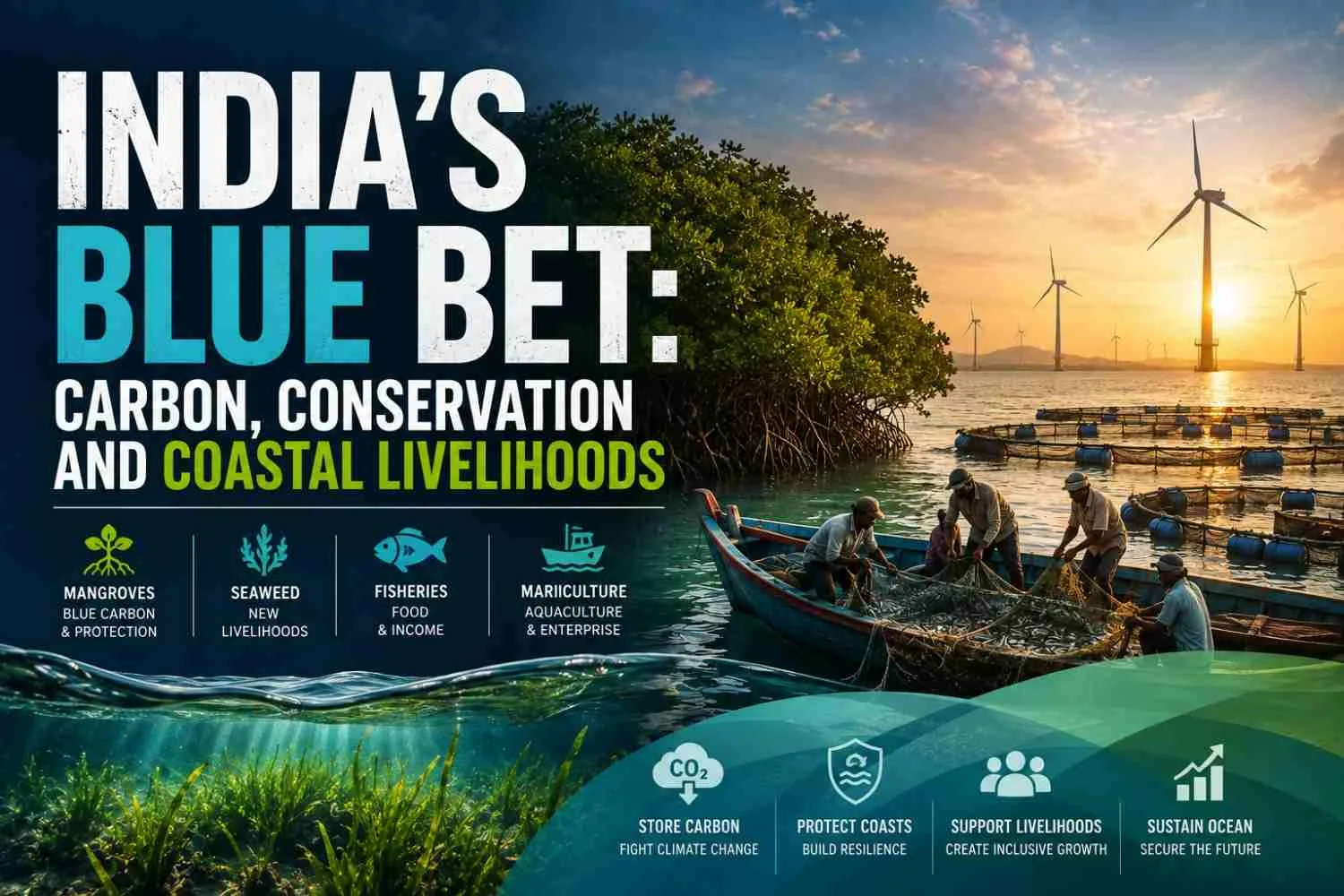
Along its vast coastline, India’s blue economy is expanding at speed—powered by ports, fisheries and technology, even as rising seas, storms and inequality threaten to undo it. By Prof Ujjwal K Chowdhury |  A Deep-Dive Feature on India's Coastal Economy Before the sun lifts fully above the Bay of Bengal, the boats are already gone. In a cluster of mud-and-thatch homes at the edge of the Sundarbans — that vast, drowned forest where the Ganga surrenders itself to the sea — the women are already sorting yesterday's catch. The smell of salt and fish oil hangs over everything. A child runs barefoot across the bank. A mobile phone rings. The world has arrived, but the tide has not waited for it. This is coastal India: ancient, adaptive, and increasingly imperilled. It is also the story of a nation trying to grow fast enough to survive what the sea is slowly taking back. India's coastline stretches 7,516 kilometres if you count only the mainland, and considerably more once you fold in the 1,382 islands of the Andaman, Nicobar, and Lakshadweep archipelagos. Along this edge live roughly 250 million people — more than the entire population of Brazil — whose livelihoods are tied, in one way or another, to the water. They are fishermen, port workers, hotel staff, salt farmers, aquaculture entrepreneurs, mangrove honey collectors, and software engineers whose offices happen to face the sea. Together, they inhabit an economy that contributes approximately four per cent of India's GDP directly through fisheries, shipping, and tourism — and far more if you count the invisible supply chains that move through this littoral corridor every single day. "India's coastal economy is not a sector. It is a civilisation — one that the country is only beginning to understand." That economy is now at a turning point. Climate change, rapid industrialisation, a revolution in deep-sea technology, and a tectonic shift in global maritime trade routes are simultaneously reshaping what it means to live and work on India's shores. The story is not simple, and it is not the same on all three coasts. The west is a story of industrial muscle. The south is a story of human capital. The east is a story of painful reinvention. And threading through all three is a question that no government, no corporation, and no activist has yet fully answered: can you grow an economy and save the sea at the same time? The Invisible Engine Running Beneath the Waves Most Indians think of the coast as a holiday destination or, perhaps, a fishing village seen from a train window. The reality is considerably more complex. India is one of the world's top five fish-producing nations, with an annual output of roughly 195 lakh tonnes, a figure that makes seafood one of the country's most significant agricultural exports. The journey of a single prawn from a shrimp farm in coastal Andhra Pradesh to a dinner table in Tokyo is a sophisticated, multi-stage logistics operation involving feed suppliers, pond managers, processing plants, cold-chain trucks, customs agents, and container shipping lines. It is, in miniature, a portrait of what economists call a blue value chain — and India has hundreds of them running simultaneously. Then there is the port economy. India has 12 major ports and more than 200 notified minor ones, and they handle over 95 per cent of the country's international trade by volume. When a garment made in Tiruppur reaches a wardrobe in Manchester, it has almost certainly passed through Chennai port. When an onion from Nashik reaches a kitchen in Singapore, Mundra or JNPT has handled it. The port is not merely infrastructure; it is the hinge on which India's $600 billion export ambition turns. Beyond fish and freight, there is tourism — Goa's beach shacks and Kerala's houseboats, the diving reefs of the Andamans and the temple-towns of Tamil Nadu's Coromandel coast. India's coastal tourism industry is worth tens of thousands of crores annually. And then there is the emerging frontier: offshore wind energy, seabed mining for polymetallic nodules worth an estimated $110 billion, marine biotechnology, and ocean-based carbon capture. This is where the story of the coast is no longer about yesterday's economy, but tomorrow's life and livelihood. Three Coasts, Three StoriesThe Western Wall: Ports, Petrochemicals, and the Price of Scale If you wanted to understand the economic ambition of modern India, you would start on the western coast. Here, in Gujarat and Maharashtra, the coastline has been transformed over the past three decades from a fishing frontier into an industrial colossus. Gujarat alone accounts for 8.1 per cent of India's GDP, a share that has risen steadily from 6.4 per cent at the turn of the millennium. Its per capita income now sits at 160 per cent of the national average — higher even than Maharashtra's 150 per cent. The engine of this growth is not agriculture or IT services. It is the coast. Mundra Port, operated by Adani Ports and Special Economic Zone, is now the country's largest commercial port by cargo volume. A few hours north, Kandla — officially renamed Deendayal Port — handles the bulk cargo that feeds India's oil refineries and fertiliser plants. The Jamnagar refinery complex, the world's largest single-location refinery, draws its crude through dedicated marine terminals and exports refined products from the same. In economic terms, the western coast is a fully integrated industrial ecosystem, where petroleum, chemicals, automobiles, and textiles move through purpose-built port infrastructure with a precision that rivals Rotterdam or Singapore. Maharashtra adds financial depth to this industrial foundation. Mumbai remains India's commercial capital, and its historic port — now being reimagined as a mixed-use waterfront development — is the symbolic centre of a city whose entire identity is coastal. Jawaharlal Nehru Port, across the harbour, is the country's primary container port. And further south, the Konkan coast, with its dramatic cliffs and protected bays, is being steadily developed for tourism and fisheries. Yet growth here has come with visible costs. The fishing communities of Gujarat's coastline — the Kharwas, the Machhis, the Vadvals — have been squeezed between industrial expansion and a regulatory system that has often prioritised cargo over community. Coastal erosion near industrial zones is measurable and documented. The creek systems around Mumbai, once among the most biodiverse in the subcontinent, have been severely degraded by decades of untreated effluents. In Ratnagiri, Maharashtra, thousands of fishermen and farmers mounted sustained protests against the proposed Nanar oil refinery, succeeding eventually in stalling it. The western coast teaches a clear lesson: scale without ecological accounting is not growth. It is borrowing from the future. "The shrimp on your plate may have been farmed, frozen, packed, and shipped from coastal Andhra to Tokyo in less time than it took you to plan your dinner." The Southern Mind: Brains, Backwaters, and Biodiversity The five southern states — Kerala, Tamil Nadu, Karnataka, Andhra Pradesh, and Telangana — together account for 30 per cent of India's GDP, and their coastlines are among the most economically and ecologically complex in Asia. This is the coast of paradoxes: some of India's most-educated fishing communities live here, alongside some of its most severe coastal erosion. The region hosts world-class ports and ancient temple-towns. It is where traditional catamaran builders and satellite engineers both call themselves children of the sea. Kerala is perhaps the most studied coastal economy in India, not because it is the largest, but because it is the most instructive. With a literacy rate of 96.2 per cent — the highest in the country — and a fishing sector deeply integrated into local culture and cooperative economics, Kerala has built a coastal livelihood model that other states regularly send delegations to study. The backwaters of Alleppey and Kumarakom are not just tourist attractions; they are working waterways that support inland navigation, paddy farming on reclaimed polders, and a freshwater fishery that has its own distinct economy. The Vizhinjam deep-sea transshipment port, currently under construction south of Thiruvananthapuram, promises to be a game-changer — a facility deep enough to handle the world's largest container vessels, potentially pulling trans-oceanic traffic that currently bypasses India for Colombo. Tamil Nadu's Chennai is already a major port, but the state's coastal economy extends far beyond it. The Gulf of Mannar, separating Tamil Nadu from Sri Lanka, hosts one of India's richest marine biospheres — a chain of coral reefs, seagrass meadows, and mangrove patches that support both artisanal fisheries and a growing marine tourism economy. Thoothukudi is a major industrial port, while Nagapattinam and Karaikal are fishing hubs with deep cultural identities shaped by the 2004 Indian Ocean tsunami, which killed over 10,000 people in Tamil Nadu alone. The 2004 tsunami remains the south's defining coastal trauma. It arrived without warning at dawn on December 26, erasing villages in minutes. The reconstruction period that followed revealed something important: communities with higher social capital — better education, stronger women's self-help groups, more responsive local governance — recovered faster and more completely. This lesson has since been absorbed into disaster risk frameworks, and Tamil Nadu and Kerala now have some of India's most sophisticated coastal disaster management systems. Andhra Pradesh contributes enormously to India's seafood exports through its massive shrimp aquaculture industry, particularly in the Krishna and Godavari delta districts. Visakhapatnam is a steel and petroleum port, but it also handles pharmaceutical exports from the Hyderabad hinterland. The coast here is industrial but not entirely so — the Coringa Wildlife Sanctuary near Kakinada protects one of India's largest mangrove forests, a natural buffer between cyclone-prone sea and densely-populated deltaic farmland. The Eastern Comeback: Corridors, Cyclones, and Careful Optimism The eastern coast tells the most complicated story. From the Sundarbans of West Bengal, sweeping south through Odisha and Andhra Pradesh to the northern tip of Tamil Nadu, this is the coastline most battered by cyclones, most challenged by poverty, and most in need of both investment and protection. It is also the coast with perhaps the greatest unrealised potential. West Bengal was once India's industrial heartland. In 1960-61, it accounted for 10.5 per cent of national GDP. By 2023-24, that figure had fallen to 5.6 per cent — a relative decline that mirrors the broader deindustrialisation of the state after the 1970s. Kolkata, once the second city of the British Empire, is no longer a port of global consequence. The Haldia dock complex handles some petroleum and fertiliser traffic, but it is a pale shadow of what this coast once was. The Sundarbans, however, are a world unto themselves. This 10,000-square-kilometre tidal mangrove delta — split between India and Bangladesh — is a UNESCO World Heritage Site, home to the Bengal tiger, the Irrawaddy dolphin, and roughly four million people who make their living from fishing, crab collection, and honey harvesting from the world's most dangerous forest. Cyclone Amphan in 2020 caused losses exceeding Rs 1 lakh crore in West Bengal alone, and much of the damage fell on these delta communities. The Sundarbans are sinking — literally. Ghoramara Island has lost more than half its land area to the sea in the last four decades. Sagar Island, where hundreds of thousands of pilgrims gather each January for Makar Sankranti, is measurably shrinking. Odisha has reversed its decline through mineral wealth and ambitious infrastructure. Its per capita income has climbed from 55.8 per cent of the national average in 2000-01 to 88.5 per cent today. Paradip Port, handling iron ore, coal, and fertilisers, is growing rapidly. The state has also dramatically improved its cyclone resilience: in 1999, the super-cyclone killed nearly 10,000 people. When Cyclone Fani, equally powerful, struck in 2019, fewer than 100 lives were lost — a testament to evacuation systems, improved housing codes, and community preparedness that the world took notice of. The most ambitious plan for the eastern coast is the East Coast Economic Corridor, India's first coastal economic corridor, stretching 2,500 kilometres from Kolkata to Kanyakumari. Its first phase, the Visakhapatnam-Chennai Industrial Corridor, is backed by $500 million from the Asian Development Bank and aims to link mineral-rich Odisha and Andhra Pradesh with Tamil Nadu's manufacturing base. The goal is not just to attract industry but to reduce India's notoriously high logistics costs — currently 13-14 per cent of GDP, against a global average closer to 8 per cent. Cheaper, faster movement of goods through this corridor could make India's exports significantly more competitive. "The Sundarbans are sinking. Ghoramara Island has lost half its land in four decades. This is not a forecast. It is already happening." Neighbours in the Same WaterBangladesh: Resilience Carved from Catastrophe Any serious account of India's eastern coast must cross the border into Bangladesh. The two countries share the Sundarbans, the Bay of Bengal's cyclone belt, and a fisheries ecology that does not respect national boundaries. Bangladesh's ocean economy contributes approximately 3.33 per cent of its GDP — a figure that understates the sector's social importance given that fisheries alone provide 60 per cent of the country's animal protein intake and the sector supports the livelihoods of roughly 30 million people. Chittagong Port, renamed Chattogram, is the country's economic lifeline — handling 92 per cent of import-export cargo and 98 per cent of containerised trade. In 2025, it achieved a historic throughput of 3.4 million TEUs, driven largely by the garment sector, which accounts for 84 per cent of Bangladesh's export earnings. The ready-made garment industry is coastal in a peculiar sense: its goods move through a single port chokepoint, making the country extraordinarily vulnerable to any disruption at that gateway.   Bangladesh's disaster risk management is among the most celebrated in the world. In 1970, Cyclone Bhola killed an estimated 500,000 people — one of the deadliest natural disasters in recorded history. Today, Bangladesh's network of cyclone shelters, early warning systems, and trained community volunteers has reduced cyclone mortality by more than 99 per cent relative to those devastating mid-century events. The country has done this on a fraction of the budget that rich nations spend on comparable protections. It is a model that India's eastern coast should study closely.   Sri Lanka: Lessons from a Hub that Nearly Sank Sri Lanka's relationship with the sea is total — it is an island, surrounded on all sides. The Port of Colombo is one of the Indian Ocean's great transshipment hubs, a place where container ships from Europe, East Africa, and East Asia cross paths. In 2024, Sri Lanka attracted 2.05 million tourist arrivals — a 38 per cent increase over the previous year — with India remaining the single largest source market, accounting for over 20 per cent of visitors. Tourism earnings exceeded $3 billion, a figure critical to the country's recovery from its 2022 economic meltdown, when foreign reserves fell to a catastrophic $50 million and fuel queues stretched for kilometres. The Sri Lankan crisis — driven by unsustainable debt, a sudden ban on chemical fertilisers that devastated agriculture, and the catastrophic loss of tourism revenue during the pandemic — is a cautionary tale about the fragility of coastal economies over-dependent on a few sectors. The country's recovery has been managed through an IMF programme worth $3 billion and a historic restructuring of $17 billion in external debt. The new government has prioritised anti-corruption reforms and targeted investment in port modernisation and marine tourism. Sri Lanka's eight UNESCO World Heritage Sites and extraordinary marine biodiversity — from the blue whales of Mirissa to the reefs of Pigeon Island — remain assets that, if managed wisely, can sustain the economy for generations. The Laws That Protect — and the Loopholes That Don'tUNCLOS, the Paris Agreement, and India's Shifting CRZ The ocean has a constitution. It is called UNCLOS — the United Nations Convention on the Law of the Sea — and it was adopted in 1982 after nine years of negotiation. UNCLOS divides the sea into zones: the territorial sea (12 nautical miles from shore, under sovereign control), the contiguous zone, and the Exclusive Economic Zone or EEZ (200 nautical miles, where the coastal state has sovereign rights over resources). For India, the EEZ covers 2.3 million square kilometres — an enormous maritime territory rich in fish, minerals, and as-yet-unexploited energy resources. UNCLOS does not directly address climate change, but its provisions requiring the protection and preservation of the marine environment are increasingly being interpreted to cover ocean warming and acidification. The Paris Agreement, meanwhile, obligates signatory nations — including India — to limit greenhouse gas emissions in ways that will reduce sea level rise and cyclone intensity. India has committed to net-zero emissions by 2070 and has pledged that 50 per cent of its electricity will come from renewable sources by 2030. For coastal communities, the pace of this transition is not an abstract policy question. It is an existential one. Domestically, the most contested piece of coastal law is the Coastal Regulation Zone notification. The CRZ rules govern what can be built, farmed, or mined within specified distances from the high-tide line. The 2011 notification established a No Development Zone of 200 metres in rural coastal areas and froze urban construction density at 1991 levels, prioritising conservation. The 2019 notification reversed much of this, reducing the NDZ to 50 metres in densely populated rural areas and unlocking floor space index norms in urban coastal areas. Developers celebrated. Environmentalists called it a systematic dismantling of protection. Crucially, the 2019 rules removed the 'Hazard Line' — a demarcation based on predicted sea-level rise and tidal ingress — from regulatory planning, relegating it to an informative tool rather than a planning constraint. This means that hotels, roads, and residential buildings can be constructed in areas that hydrological models identify as likely to be submerged within decades. Critics argue this is not development; it is the subsidisation of future disaster. India also has the Environment Protection Act of 1986 and the Wildlife Protection Act of 1972, both of which have provisions relevant to coastal ecosystems. The Forest Rights Act of 2006 has been used by coastal communities to assert rights over mangrove areas and traditional fishing grounds. But the gap between law on paper and enforcement on the ground remains wide enough to drive a trawler through. Illegal sand mining along Kerala's beaches has caused severe erosion. Industrial effluents continue to reach the sea in violation of the Water Prevention and Control of Pollution Act. The problem is rarely the absence of law. It is the presence of indifference. Technology at the Water's EdgeFrom GPS Buoys to Deep-Sea Submarines: The Digital Transformation The fisherman from Dakhinpara who once read the sky to predict weather now gets a satellite forecast on his mobile phone. This is not a small change. It is the difference between a boat that sets out into a cyclone and one that stays safely at home. The Indian National Centre for Ocean Information Services disseminates Potential Fishing Zone advisories via SMS and satellite, telling fishermen exactly where ocean temperatures and currents suggest fish are most likely to be concentrated. The result is less fuel burned, fewer empty nets, and more time at home with family. But this is just the visible surface of a deeper technological revolution. At the institutional level, the National Fisheries Digital Platform has created digital identities for over 26 lakh coastal stakeholders, linking them to formal credit, crop insurance, and government schemes. The platform acts as a single window through which a fisherman in Mangaluru can apply for a loan, register his boat, and claim disaster relief — services that once required days of travel to government offices. Simultaneously, 'Blue Port' pilots are being developed in collaboration with the UN Food and Agriculture Organisation at Vanakbara in Diu, Jakhau in Gujarat, and Karaikal in Puducherry, deploying IoT sensors, 5G connectivity, and solar-powered cold chains to transform old fishing harbours into smart, export-ready hubs. For the high seas, India has placed a significant bet on its Deep Ocean Mission — a Rs 4,077 crore programme that is simultaneously the country's most ambitious scientific expedition and its most strategic economic play. The mission's centrepiece is MATSYA 6000, a manned submersible designed to dive 6,000 metres beneath the surface. Its pressure vessel is a sphere of titanium alloy with 80-millimetre walls, built to withstand 600 times atmospheric pressure, welded using electron beam technology developed by ISRO after 700 trials. In 2025, MATSYA successfully dove to 5,000 metres in the Andaman Sea and returned with cobalt-rich polymetallic nodules — early proof of a seabed that India's ocean scientists believe holds 380 million metric tonnes of mineral wealth, including copper, nickel, cobalt, and manganese critical to green energy technologies. In the private sector, a new generation of startups is rewriting the economics of aquaculture. NatureDots uses AI and satellite imagery to monitor coastal pond conditions in real time, detecting early signs of disease outbreaks that can destroy entire shrimp crops. Aquaconnect provides precision feeding and health analytics that reduce the cost and environmental footprint of aquaculture operations. GreenGrahi converts food waste into insect-based protein for fish feed, reducing the industry's dependence on wild-caught fish meal — a practice that depletes the very ocean stocks that coastal communities depend on. These companies are small now. But they represent the direction of travel. "MATSYA 6000 dove to 5,000 metres and returned with mineral nodules worth billions. India's next economic frontier may lie two kilometres below the sea." The Unfinished Story of Coastal JusticeWomen, Work, and the Economy Nobody Counts Walk into any fish market on any Indian coast and you will find women. They sort the catch, set the prices, manage the credit, and run the micro-enterprises that convert raw fish into packaged product. Studies across coastal states consistently find that women control between 60 and 80 per cent of post-harvest fisheries activity. Yet they are counted in almost no official economic data. They do not own the boats. They rarely own the land. Their labour is invisible to GDP calculators and ignored by most credit systems. This is a social injustice, but it is also an economic mistake. Self-help groups of coastal women in Kerala and Tamil Nadu have demonstrated that when women are given access to revolving credit funds and collective marketing channels, the productivity of entire fishing communities rises. In Odisha, women trained in mangrove afforestation through state and NGO programmes have become the primary guardians of coastal forests that protect their own villages from storms. In Bangladesh, women's early warning networks have been instrumental in saving lives during cyclones. The evidence is overwhelming: investing in coastal women is one of the highest-return strategies available to any coastal economy. What Activists, Citizens, Government, and Business Must Do The future of India's coast is not predetermined. It will be shaped by choices made now — by governments, corporations, communities, and individuals. What is required is not a single grand plan but a coordinated set of actions, sustained over decades, that treat the coast as what it actually is: a living system that produces enormous value precisely because it is alive. For governments, the most urgent task is to restore the Hazard Line to regulatory planning — not as bureaucratic obstruction but as common sense protection for the people who live in flood-prone areas. The Sagarmala programme has rightly focused on port-led development, but it needs a parallel ecological accounting system that measures what is lost when a mangrove is cleared or a creek is filled. The MISHTI scheme — India's mangrove restoration programme — must be funded at scale and monitored rigorously, with a mandatory 3:1 replanting ratio enforced when coastal development displaces natural vegetation. State coastal zone management authorities, many of which exist largely on paper, need real budgets, real staff, and real enforcement powers. For the private sector, the model to emulate is not the extractive one but the regenerative one. The Godrej Group voluntarily protected 750 hectares of mangroves in Mumbai decades before any law required it — and that forest now provides measurable flood protection to millions of residents. The port industry needs to accelerate the transition to Green Port standards: electric handling equipment, zero-discharge wastewater systems, and marine litter monitoring programmes. For businesses in fisheries and aquaculture, investing in blockchain-based traceability systems is not just an ethical choice; it is a commercial necessity, as the European Union and US are moving toward mandatory seafood traceability requirements that will exclude non-compliant suppliers. For activists and civil society, the role is to ensure that the voices of coastal communities are present in the rooms where decisions are made. The protests against the Sterlite copper plant in Thoothukudi, which led to its eventual shutdown after 13 people were killed by police fire in 2018, demonstrated both the courage of coastal communities and the extreme price they sometimes pay for that courage. More recently, fisherfolk protests over the construction of Vizhinjam port in Kerala raised legitimate concerns about displacement and compensation that were only partially addressed. Documenting violations, filing environmental impact complaints, litigating in the National Green Tribunal, and building coalitions across caste and community lines: these are the tools of coastal activism, and they have proven effective. For citizens living far from the coast, the connection is closer than it feels. Every piece of single-use plastic discarded in a city eventually reaches a river, and every river reaches the sea. Consumer choices — buying sustainably certified seafood, refusing microplastic-heavy cosmetics, supporting ecotourism operators with genuine community benefit-sharing — transmit real signals to coastal economies. The Versova beach cleanup in Mumbai, led by lawyer Afroz Shah, mobilised over 1,000 volunteers over 85 weeks and removed more than 20 million kilograms of plastic, earning a United Nations Champions of the Earth award. It began with one person who was offended by the state of a beach he loved. That is a model for citizenship, not just environmentalism. The Tide That Does Not Wait There is a word in Bengali — 'nadibandhu' — that means 'friend of the river'. On the Sundarbans islands, fishermen use it to describe someone who truly understands the water: its moods, its generosity, its violence. India needs to become a nadibandhu to its coast — not exploiting it or romanticising it, but genuinely understanding it and taking responsibility for it. The numbers support urgency. Sea levels along India's coast are rising at between 1.3 and 3.2 millimetres per year, with some segments rising faster. Cyclone frequency in the Bay of Bengal has increased, and cyclone intensity — the category of storms — has risen sharply in the Arabian Sea, which historically produced fewer severe storms. Fish catch volumes in inshore waters are declining as overfishing and ocean warming displace fish populations into deeper, cooler waters. Groundwater in coastal districts of Gujarat, Andhra Pradesh, and Tamil Nadu is becoming increasingly saline as sea intrusion advances. Against this, India has genuine assets. Its scientific institutions — the National Institute of Oceanography, the Centre for Marine Living Resources and Ecology, the Indian National Centre for Ocean Information Services — are world-class. Its fisheries cooperatives in Kerala are models studied internationally. Its disaster management systems, built painstakingly after the tragedies of 1999 and 2004, have saved hundreds of thousands of lives. Its blue economy startups are innovating at pace. Its diaspora of coastal engineers, marine biologists, and maritime lawyers brings global knowledge back to Indian shores. The question is whether these assets can be mobilised fast enough, and in coordination with each other, to build a coastal economy that is genuinely sustainable — one that feeds its people, trades with the world, explores the deep sea, and still leaves the mangroves standing. India's target of becoming a $5 trillion economy by the late 2020s will not be met from the hinterland alone. The ports must work. The fisheries must thrive. The tourism coasts must be clean enough to attract visitors and honest enough to share the benefits with the communities that live there. The offshore wind turbines must spin. The MATSYA submersible must return from the deep with knowledge and resources that belong to all Indians, not just the few. "Every river reaches the sea. Every coastal decision eventually comes back to the citizen who made it — or failed to." As the boats return at evening to harbours from Saurashtra to the Sundarbans, carrying the day's catch and the day's stories, the sea behind them holds its counsel. It does not care about GDP targets or election cycles or corporate quarterly results. It cares only about balance. And it will enforce that balance, one way or another — by storm or by surrender, by crisis or by wisdom. India still has the chance to choose wisdom. The tide is not yet fully in. But it is coming. The Nation: IndicatorValue/Statistic (2024-2025)ReferenceCoastline Length7,517 km (Mainland + Islands) Exclusive Economic Zone (EEZ)2.3 million sq. km Blue Economy GDP Contribution~4% Real GDP Growth (Q2 FY 2025-26)8.2% Total Fish Production195 lakh tonnes Export Target (2030)$USD\ 1$ trillion (Merchandise) Maritime Trade Volume>90% of national trade volume  The West: StateGDP Share 1960-61GDP Share 2023-24Per Capita Income vs Nat. Avg (2023-24)MaharashtraHighHighest (Constant)150.0%Gujarat6.4% (in 2000-01)8.1%160.7%Goa-ExceptionalDoubled since 1970-71 The South: Region/StateKey Coastal Hubs Economic Specialization Social Indicator Karnataka Mangaluru, Karwar IT, Petrochemicals, Food Processing High Literacy/Skilled Tamil Nadu Chennai, Thoothukudi Automobiles, Textiles, Renewable EnergyPioneered Midday Meals Andhra Pradesh Visakhapatnam, Kakinada Pharmaceuticals, Metallurgy, AquaparksLarge Aquaculture base KeralaKochi, Vizhinjam Tourism, Fisheries, Remittances96.2% LiteracyTelangana Hyderabad (Hinterland link)Biotech, IT, Vaccines High GVA growth  Node/ProjectPhaseFocus IndustryFunding/Partner VCIC (Visakhapatnam-Chennai)Phase 1 of ECECPharma, Metallurgy, Electronics ADB ($500 million)Koparthy Industrial AreaVCIC NodeGeneral ManufacturingNICDITParadip Port ModernizationECEC AnchorIron Ore, Coal, PetrochemicalsSagarmalaKakinada NodeVCIC NodeFood Processing, ChemicalsState of AP   Bangladesh: Bangladesh SectorGDP Contribution / ValueKey DetailOcean Economy (Total)3.33% of GDPValue: ~$6.2 billion (2014-15)Fisheries (Total)3.57% of GDP60% of animal protein sourceChittagong Port Volume3.409 million TEUs (2025)Record handling milestone Livelihoods Dependent~30 million people~20% of the population   Sri Lanka: Sri Lanka Indicator2024 StatisticChange/DetailTourist Arrivals2,053,46538.1% YoY increaseTourism EarningsExceeded $USD\ 3$ billionTarget for recoveryTop Source MarketIndia (20.3%)Cultural & Geographic tiesForeign Reserves$USD\ 6.5$ billion (March 2025)Up from $50m in 2022   India: Legal Demarcations: FeatureCRZ 2011CRZ 2019NDZ (Rural IIIA)200 meters50 metersFSI/FAR in Urban AreasFrozen at 1991 levelsDe-frozen to current levelsIntertidal ActivitiesHighly restricted18 permissible activities allowedHazard LineMandatory for zoningInformative; removed from limitsTourism HomestaysNot specifically mentionedPermitted in NDZ   Indian Coastal Technology: TechnologyApplication in Blue EconomyImpact/BenefitIoT SensorsSmart Port MonitoringOperational efficiency & safetySatellite ImageryPotential Fishing Zones (PFZ)Reduces fuel waste & overfishingAI & Big DataAquaculture ManagementYield prediction & disease controlBlock ChainSeafood TraceabilityBoosts export competitivenessOTECOffshore DesalinationClean water for island communities   ...Read more

02 Apr 2026

The crisis in West Asia is testing India’s resilience—exposing vulnerabilities in energy dependence, trade, and economic confidence. Prof Ujjwal K Chowdhury How a faraway conflict in West Asia is tightening household budgets, rattling markets, testing diplomacy and forcing India to confront the cost of global dependence War used to arrive with warning. It came with the rumble of tanks, the scream of sirens, the grainy urgency of radio announcements, the sudden darkening of city lights, the long lines outside ration shops and the whispered fear that the border had moved closer. People knew when war had begun because it had a visible geography. It had fronts, trenches, uniforms, maps and marching orders. It had a place. That certainty has collapsed. In the twenty-first century, war does not always need to cross your border to enter your life. It can remain geographically distant and still alter what you pay for fuel, what you spend on food, how much your currency holds, whether your export order arrives on time, whether your son working in the Gulf feels safe, whether your government can keep inflation under control, and whether tomorrow feels stable enough to plan for. That is the deeper Indian story of the ongoing US-Israel-Iran war. The missiles may be streaking across West Asian skies. The strategic calculations may be unfolding in Washington, Tel Aviv and Tehran. The fire may be burning around oil routes, military bases, diplomatic red lines and maritime chokepoints. But the consequences are travelling much farther than the battlefield. They are moving through crude markets, shipping lanes, insurance premiums, investor nerves, exchange rates, airline routes, labour flows and public psychology. They are arriving in places that will never appear on a war map. They are arriving in India. In a modest apartment in Kolkata, a family sits down for dinner and does the arithmetic that millions of Indian households know too well. Petrol has become dearer. The LPG refill feels heavier than before. The price of vegetables has shifted again. The son who works in the Gulf has called twice this week instead of once. The father, who runs a small trading operation, has started hearing the words that businessmen dread because they sound mild but mean danger: delay, risk, hold, uncertain. Nobody at the table says the word war. Nobody needs to. War is already there, seated quietly between the dal and the rice. That is how modern conflict works. It enters not only through armies but through costs. Not only through destruction but through disruption. Not only through headlines but through habits. And for India, this is not a side story in foreign affairs. It is a test of economic resilience, social stability, diplomatic agility and developmental maturity. This war, though not India’s in authorship, is already India’s in consequence. A Battlefield With No Frontline in India, Yet No Escape Either There was a time when distance offered emotional comfort. A war far away was tragic, certainly, but still far away. Today distance has lost much of its protective value. In an interconnected world, geography is no longer a sufficient shield. Energy flows across oceans. Financial sentiment crosses continents in seconds. Supply chains depend on multiple jurisdictions. Labour migrates. Capital reacts instantly. Rumour itself can move markets before a single official announcement is made. India’s rise has brought many benefits from this interdependence. It has also increased exposure to external shocks. The same networks that carry growth also carry panic. The same integration that helps a country expand also makes it more vulnerable to geopolitical aftershocks. India has become too large to remain isolated from global turmoil, but not yet insulated enough to absorb it without strain. That is the paradox of a rising power in a turbulent world. Success deepens entanglement. Entanglement enlarges risk. A war involving Iran was always likely to matter to India because West Asia is not a distant theatre in the Indian imagination. It is an energy lifeline, a labour corridor, a diplomatic zone of delicate balancing, a maritime space of strategic concern and a region woven into the everyday survival of millions of Indian households. The Gulf is not just abroad. It is economically intimate. Its tremors echo in Indian kitchens, markets, ports, ministries and bank accounts. So when the conflict escalates there, India cannot watch as a detached spectator. It has to count the likely costs almost immediately. How will oil react? Will shipping be affected? Will remittances come under stress? Will aviation routes become longer and costlier? Will markets punish emerging economies? Will the rupee weaken? Will inflation become harder to contain? Will the state have to spend more on cushioning the blow? Will growth lose speed just when jobs are desperately needed? These are not theoretical questions. They are the real domestic vocabulary of a distant war. Oil Speaks First, and India Hears It Loudly In every major West Asian conflict, oil becomes the first language of anxiety. This is neither new nor surprising. Oil remains one of the world economy’s most politically sensitive commodities, and the Gulf remains one of its most combustible regions. Iran’s location gives it outsized strategic importance because any threat to the Strait of Hormuz immediately disturbs global calculations. One does not even need a total closure of energy routes to trigger consequences. In today’s nervous markets, fear is enough. Speculation can do the rest. For India, this matters with almost punishing immediacy. The country imports the bulk of its crude oil. That dependence means global volatility becomes domestic discomfort very quickly. A spike in crude prices is not confined to corporate balance sheets or ministerial briefings. It enters the bloodstream of everyday life. Fuel costs rise. Transport becomes more expensive. Logistics firms recalibrate. Food prices feel the pressure. Fertilizer costs shift. Industrial input costs move upward. Households begin adjusting before policymakers even finish their internal meetings. A tea seller in North Kolkata does not need to study geopolitical analysis to understand the shock. He only needs to notice that milk costs more, transport costs more, cooking fuel is no longer easy to absorb, and the customers who once bought two rounds of tea now pause after one. He hesitates before raising the price by a rupee. That hesitation is the human face of global conflict. It is the moment when a war thousands of kilometres away becomes an ethical question in a local business decision. A truck owner moving produce from a wholesale market sees diesel as destiny. A restaurateur cannot ignore the rising cost of edible supplies that arrive by road. A construction firm knows that petroleum-linked inputs affect margins. Even a household that rarely thinks about oil discovers that oil has been invisibly present in almost everything it buys. That is because oil is not one commodity among many. It is an underlying cost embedded inside transportation, production, distribution and movement itself. When oil becomes uncertain, the economy does not merely pay more for fuel. It pays more for normalcy. The Price Rise That Does Not Explode but Slowly Occupies Life Bombs terrify because they are dramatic. Inflation weakens society because it is relentless. If this war continues to keep energy markets on edge, India’s greatest domestic challenge may not be a single sudden shock but the slower erosion caused by rising prices. Inflation is a quieter violence. It does not arrive with flames. It accumulates through weekly purchases, monthly bills, postponed expenses and shrinking comfort. It does not wound all at once. It wears down. The burden is not evenly shared. The affluent can reorganize. The poor are forced to absorb. The lower middle class, perhaps India’s most economically anxious social category, is squeezed from both sides. It is too proud to call itself distressed and too pressured to feel secure. It is precisely this class that experiences war most intimately through inflation. In an ordinary urban household, the signs begin small. The petrol bill grows. The grocery basket costs more than expected. Gas cylinder refills are no longer shrugged off. Eating out becomes occasional. The replacement of a broken appliance is delayed. A school-related purchase is postponed. The monthly budget starts resembling a battlefield of subtractions. In rural India, the story is harsher. A farmer does not experience inflation as an abstract number debated on television. He experiences it as a question of diesel, transport, fertilizer, pesticide, crop viability and debt. If fuel prices rise and agricultural inputs become costlier, the burden travels quickly through cultivation decisions. Produce may become dearer to transport. Margins narrow. Borrowing becomes riskier. Households that are already vulnerable become more fragile. This is how distant war reshapes the social atmosphere of a country. It makes citizens more cautious, more defensive, more tired. They may not know the exact contours of the conflict, but they know life has become more expensive and more uncertain. That knowledge alone can change the emotional rhythm of an economy. When millions of people begin spending less freely, the economy itself turns hesitant. Consumption slows. Small businesses feel the pinch. Inventories remain unsold for longer. Job creation loses pace. Growth starts acquiring a layer of anxiety. Inflation, then, is not only a monetary phenomenon. It is a social mood. It teaches a population to think in terms of survival rather than aspiration. And for a developing country that still needs confidence, appetite and mobility to grow, that psychological change can be as damaging as the price rise itself. Trade Routes Are Not Just Lines on Maps. They Are India’s Daily Bread. The global economy spent decades preaching the virtues of seamless movement. Goods would move efficiently, cheaply and on time. Production would be optimized across continents. Inputs would arrive when needed. Consumers would benefit from speed. Distance, we were told, had been defeated. War has exposed the arrogance of that assumption. All modern supply chains are built on a hidden faith in predictability. Not perfect stability, but enough stability to permit planning. The moment war injects uncertainty into strategic corridors, shipping lanes and regional security calculations, that predictability begins to unravel. Even without total closure, trade can become slower, costlier and more complicated. Insurance premiums rise. Freight becomes more expensive. Routes get re-evaluated. Delivery timelines lose credibility. Traders begin inserting caution into contracts. Manufacturers begin worrying about components that were once taken for granted. A manufacturer in Chennai waiting for imported parts does not need a missile to land nearby to feel the war. A delay notification is enough. An exporter in Mumbai who finds buyers suddenly more tentative is already living with the conflict’s consequences. A logistics planner recalculating timelines because a route has become risk-prone is doing the invisible work of adapting to war. India’s ambitions in manufacturing and exports make this especially significant. The country wants to become a major global production base, a reliable alternative in uncertain times, a node in restructured supply chains. Yet that aspiration depends on the world believing that India can offer dependability amid chaos. A wider regional war complicates the broader environment in which such confidence is built. And yet, buried inside that challenge lies an opportunity. Whenever conflict disturbs existing channels, businesses begin searching for alternatives. That search can favour countries that combine scale, political stability and execution capacity. India has long argued that it can be one such country. But moments like this demand proof, not rhetoric. They require functioning ports, efficient customs, energy reliability, transport infrastructure, skilled labour and policy coherence. A war elsewhere can therefore do two things at once. It can disrupt India’s present flows while also inviting India to become more important in future flows. Whether India captures that possibility depends not on external sympathy but on domestic preparedness. When the Rupee Becomes a Barometer of Fear Currencies are among the first instruments through which geopolitical fear announces itself. Investors facing uncertainty move toward what they perceive as safer assets. Emerging market currencies often come under pressure. The US dollar strengthens. The rupee feels the strain. Once that happens, imports become more expensive, especially imported fuel. A weaker rupee therefore has a cruel multiplier effect. It does not merely reflect external instability. It amplifies its domestic consequences. In Mumbai’s dealing rooms and on countless phone screens across India, the war becomes visible through numbers before many citizens fully grasp the strategic context. Markets begin fluctuating. Equities react. Bond sentiment shifts. Foreign investors grow cautious. Business plans are rethought. Expansion decisions are delayed. Financial volatility is often treated as a concern of the wealthy. That is too narrow a reading. Markets shape business confidence. Business confidence shapes investment. Investment shapes hiring. Hiring shapes household security. What begins as investor nervousness can travel steadily toward employment anxiety. A young professional checking a mutual fund statement may only see temporary loss. A company considering a new plant may see reason to wait. A startup hoping to raise capital may find the room suddenly colder. A mid-sized exporter may worry about currency risk. The chain is long, but its effects are real. War, therefore, alters not only commodity prices but the atmosphere in which economic decisions are made. It changes the willingness to take risks. It makes caution look rational. And when caution becomes the dominant instinct in finance and enterprise, economies lose energy even without entering formal crisis. The State Must Cushion the Blow Without Losing Its Balance In such moments, the state becomes the ultimate site of expectation. Citizens look to government not merely for statements but for insulation. They expect some kind of shield against price rise, against panic, against wider instability. The challenge is that governments facing an imported shock do not control the original source of the problem. They can only manage the transmission. That is harder than it sounds. If fuel prices rise sharply, should taxes be cut? That eases pressure but reduces revenue. Should subsidies expand? That may protect households but strain public finances. Should strategic reserves be used? That offers temporary relief but cannot be a permanent solution. Should monetary policy stay tight to contain inflation? That may slow growth. Should it soften to support demand? That may allow price pressures to spread. Every option has a cost. Every intervention solves one problem while creating another. Governance in wartime spillovers is therefore an art of incomplete choices. At the Union government level, such a conflict rapidly becomes a whole-of-government challenge. Finance officials worry about inflation and deficits. Petroleum officials monitor crude. Commerce officials study trade implications. External affairs tracks diplomatic fallout. Civil aviation watches routes. Shipping follows maritime risk. Defence watches strategic spillovers. Agriculture feels the pressure through input costs. No ministry can treat the issue as external once the economic ripples begin. The deeper difficulty is developmental. India is still a country with immense welfare needs, infrastructure ambitions and employment pressures. When external conflict forces additional fiscal cushioning or strategic expenditure, there is always a silent question in the background: what developmental priorities will have to wait? That is one of war’s least discussed cruelties. It often compels states far from the battlefield to spend political attention and public money on emergency stabilization rather than long-term human advancement. Guns in the Distance, Pressure on Development at Home Every major geopolitical shock sharpens security thinking. For India, that has obvious logic. The country sits in a contested region, has difficult borders, significant maritime interests and expanding strategic aspirations. A major West Asian war cannot be viewed simply through the lens of oil and trade. It also raises questions about naval security, intelligence readiness, regional alliances, defence procurement and strategic autonomy. That almost inevitably means a stronger security orientation. There is practical sense in that. No serious state can ignore a turbulent geopolitical climate. But there is also a moral tension. In developing countries, every rise in strategic expenditure occurs in the shadow of unfinished social justice. Education needs money. Public health needs money. Climate adaptation needs money. Rural transformation needs money. Urban infrastructure needs money. Employment generation needs money. War, even distant war, can shift the grammar of public spending from human development toward security preparedness. And yet, as always, there is a paradox. Greater security awareness can also spur domestic industrial opportunity. Defence manufacturing may receive more attention. Indigenous capability may be accelerated. Strategic industries may gain orders. Certain segments of the economy may actually expand under geopolitical tension. That is the bitter duality of war economics. It depresses society broadly while rewarding select industries sharply. The question is whether a nation can use the industrial opportunities without becoming captive to a militarized imagination. India’s real challenge is not choosing between security and development. It is refusing to let one devour the other. The Gulf Is Not Abroad for India. It Is Family. Few regions are as emotionally and economically linked to India as the Gulf. For decades, millions of Indians have worked across Gulf countries in construction, healthcare, retail, hospitality, logistics, domestic work, engineering, energy, services and management. Their remittances have sustained families, built homes, funded education, paid for treatment, enabled weddings, lifted social status and injected money into local economies far from metropolitan India. In many districts across the country, the Gulf is not an abstract region. It is a recurring presence in family history and daily aspiration. This is why any major West Asian war produces a uniquely Indian kind of anxiety. It is not just about oil. It is about people. As news of escalation spreads, Indian families begin watching events not as distant spectators but as households with someone at stake. A worker in Dubai, Doha, Muscat, Riyadh, Kuwait City, Abu Dhabi or elsewhere becomes the focal point of emotional calculation. Is the situation worsening? Will travel become difficult? Could jobs be affected? Will salaries continue on time? Is there panic on the ground? Will evacuation be needed? Should money be sent home more quickly? Remittances are usually described in macroeconomic language, but at the household level they are deeply personal. They are the difference between debt and relief, between dropping out and staying in school, between untreated illness and care, between a leaking roof and a repaired one. Any threat to that flow creates fear well beyond the formal labour market. There is another layer of risk. If economic uncertainty or regional instability begins affecting employment in Gulf economies, India could face returning workers at a difficult time. Reintegration is not easy. Skills are not always portable. Local labour markets are already under pressure. The emotional prestige of overseas work can collapse into domestic insecurity very quickly. So when West Asia burns, India does not only think about barrels and shipping lanes. It thinks about its people. It thinks about voices on late-night calls saying, “Everything is fine for now,” with the kind of pause that tells families everything may not be fine at all. Even the Sky Becomes More Expensive in Wartime: Modern war does not remain on land or sea. It redraws the sky as well. As regional risk grows, air routes can lengthen, airspaces can become restricted and operational decisions can turn cautious. Flights take longer routes. Fuel consumption rises. Costs go up. Schedules become more fragile. Passengers pay more. Airlines absorb or pass on the burden. Aviation-linked cargo becomes less predictable. For a country like India, where aviation is central not only to business and tourism but also to labour mobility and family continuity, this matters more than it may first appear. A migrant worker returning home may find fares unaffordable. A family emergency may become harder to navigate. Corporate travel costs increase. Logistics related to air cargo face disruption. What appears on paper as route adjustment can become, in lived reality, a delayed reunion, a postponed journey, a missed connection or a higher debt. This is another way modern war enters civilian life. It lengthens not only flight time but uncertainty itself. India’s Diplomacy Walks a Tightrope If economics is the immediate domestic story, diplomacy is the strategic drama behind it. India’s foreign policy has, over the years, tried to preserve strategic autonomy in an increasingly polarized world. It has deepened ties with the United States, maintained close defence relations with Israel, retained an interest in connectivity and engagement involving Iran, relied on Gulf countries for energy and labour linkages, and sought to navigate the multipolar order without becoming trapped in rigid blocs. A war among actors central to India’s external relationships tests this approach severely. To tilt too visibly toward one side could alienate another important partner. To remain too passive could make India appear timid or opportunistic. To speak in moral language without strategic calculation would be naive. To act only in strategic language without moral clarity would diminish credibility. This is not diplomacy in comfortable times. It is diplomacy performed on a narrow ledge above multiple consequences. India’s task is to preserve relationships, protect access, support de-escalation, defend its interests and maintain flexibility all at once. It must talk peace without appearing powerless. It must guard national interest without sounding cynical. It must protect energy and labour linkages without sacrificing its image as a responsible global actor. That is particularly difficult at a time when the wider world itself is changing. The international system is more fragmented, more transactional and more unstable than it was a decade ago. Old certainties are fading. Power is diffusing. Middle powers have greater room in some moments and less in others. For India, this means diplomacy is no longer merely a matter of prestige. It is increasingly a matter of domestic economic security. A country that mishandles external balancing may pay the price internally through fuel, trade, remittances and market sentiment. The First Casualty Nobody Mentions Enough: Sustainability War does not only threaten peace. It also undermines the future. Whenever major conflict drives energy insecurity, long-term climate goals are among the first casualties. Governments under pressure prioritize immediate access to fuel. Fossil energy regains strategic urgency. Environmental transitions slow. Public debate shifts from sustainability to survival. India, which has tried to position itself as both a developing economy and a responsible climate actor, faces a difficult contradiction here. On the one hand, it needs affordable and reliable energy to protect growth and shield citizens from external shocks. On the other hand, every return to conventional dependency deepens future vulnerability. This is not just about global warming as an abstract future danger. It is about present resilience. A country overexposed to imported fossil turbulence is a country permanently vulnerable to external conflict. Clean energy, domestic generation, storage capacity, transport electrification and diversified supply are not merely ecological aspirations. They are strategic defences. Yet war makes that argument harder in the short term. When prices surge, governments are tempted to prioritize immediate relief over structural transition. Citizens facing inflation naturally think first about affordability, not carbon intensity. Industries under pressure resist new environmental costs. Political attention moves toward firefighting. That is how sustainability becomes the invisible casualty of conflict. The danger for India is clear. If each geopolitical crisis pushes the country back toward old energy insecurities, it will remain trapped in a cycle of dependence. It will spend the future reacting to shocks rather than outgrowing them. True resilience requires using crisis as a reason to accelerate transition, not postpone it. Could Crisis Also Create a New Opening for India? History rarely offers clean opportunities. It offers troubled openings. This conflict may expose India’s vulnerabilities, but it also reveals where India could grow stronger. As companies rethink geopolitical concentration, as supply chains seek diversification, as investors look for large and relatively stable destinations, India could gain. It has scale, market depth, talent and strategic relevance. In a world hungry for dependable alternatives, those are powerful assets. But opportunity in geopolitics is never automatic. It belongs to countries that are ready when disorder creates space. India must therefore prove that it can convert external uncertainty into internal reliability. That means ports that move faster, policies that remain stable, infrastructure that works, logistics that improve, and industrial ecosystems that can respond quickly. There is also an opportunity at the level of national strategy. A war-induced energy scare can become the argument for faster renewable deployment, better storage systems, stronger strategic reserves, more resilient public transport, local manufacturing in key sectors and a deeper understanding that economic sovereignty in the twenty-first century is not autarky but resilient interdependence. India’s future advantage will not come from pretending it can detach from the world. It will come from becoming less breakable within it. The Most Powerful Economic Force in a War Is Fear In the end, perhaps the most significant consequence of a distant war is not any one commodity spike or market reaction. It is fear. Fear changes consumer behaviour. Fear delays investment. Fear weakens demand. Fear spreads through rumour. Fear makes families save instead of spend. Fear makes firms postpone recruitment. Fear causes traders to become conservative. Fear teaches society to live defensively. At a tea stall, a customer decides against an extra order. In a wholesale market, a trader reduces the scale of a purchase. In a small office, an owner delays a new hire. In a village, a family postpones repairing the house. In a city, a salaried couple postpones travel or an appliance purchase. None of these decisions looks historic on its own. Together they become the social economy of war. This is why modern conflict is so insidious. It does not only destroy what exists. It freezes what might otherwise have become possible. It reduces momentum. It narrows imagination. It makes a society that was moving forward start walking more carefully, then more slowly. India’s Real Question Is Not Whether It Can Survive This Shock India has survived many shocks. It has endured wars, oil crises, financial distress, sanctions, pandemics and climatic disasters. It has repeatedly demonstrated a capacity to absorb trauma and continue. That resilience is real and important. But survival alone is no longer enough. The more urgent question is whether India can use each shock to reduce the next one’s power over it. The ongoing US-Israel-Iran war is a warning in that sense. It reveals how vulnerable a large developing nation remains to energy dependence, maritime insecurity, currency pressure, trade fragility and external labour exposure. It also reminds India that economics, security, diplomacy and sustainability are no longer separate policy silos. They are different names for the same national challenge: resilience. The lesson is not withdrawal from the world. India cannot and should not retreat into isolation. Its future depends on deep global engagement. But engagement without buffers is exposure. And exposure without preparation is risk. So the real task before India is larger than crisis management. It is structural strengthening. It means diversifying energy sources, deepening strategic reserves, accelerating clean transition, protecting overseas workers, enhancing logistics resilience, building stronger manufacturing ecosystems, improving fiscal flexibility and practicing diplomacy with both intelligence and nerve. This war is not merely asking India how it will respond today. It is asking what kind of country India is trying to become by the next crisis. When the Headlines Move On, the Costs Will Remain The headlines will eventually change. They always do. Another summit, another election, another domestic controversy, another spectacle will push this conflict downward in the news cycle. But ordinary people will continue to live with its consequences long after television studios lose interest. The tea seller will still be adjusting his prices. The farmer will still be recalculating input costs. The migrant family will still be waiting anxiously for steady news from abroad. The exporter will still be watching freight. The policymaker will still be balancing inflation against growth. The young investor will still be reading uncertainty in markets. The middle-class household will still be deciding what to postpone. This may be the defining image of our age: a war without visible proximity but with intimate consequences, a battlefield without maps inside India and yet no Indian life fully outside its economic reach. The missiles are not falling on Indian cities. Yet the war has entered Indian homes. It has entered through the fuel bill, the kitchen budget, the remittance call, the freight delay, the stock market swing, the weak rupee, the uneasy ministry note, the longer flight path and the shrinking confidence with which families plan the future. And perhaps that is the hardest truth modern geopolitics has forced upon us. No war is truly distant anymore. Not when oil is strategic, trade is fragile, labour is transnational, capital is nervous and climate transition is unfinished. Not when the world is this connected and this combustible at the same time. India stands at a serious moment, not because it controls this conflict, but because it must now demonstrate how a large, ambitious democracy responds to the instability of others without losing its own developmental direction. That requires calm, not denial. Preparation, not panic. Strategic imagination, not short-term patchwork. It requires a country that does not merely endure shocks but learns from them with discipline. The question is no longer whether a distant war can touch India. It already has. The real question is whether India will allow that touch to remain a recurring wound, or turn it into the reason to build a stronger, more self-assured and less vulnerable future. That choice, unlike the war itself, is still ours. Top of Form   Bottom of Form   ...Read more

26 Mar 2026

How contaminated supply lines in Indore and Gandhinagar triggered illness, panic, and a deeper question of accountability. It began with something easy to ignore. A smell. The kind that makes you wrinkle your nose, rinse the glass again, and hope it is a one-day problem. In Indore’s Bhagirathpura locality, Preeti Sharma says she noticed it first. The tap water, she recalls, had turned “foul-smelling”. She says she complained to the local councillor—again and again. Nothing changed. The water kept coming. So did the smell. Until the sickness arrived. And once it arrived, it moved fast. Families began rushing between homes, clinics, and hospital corridors with the same frightening pattern: vomiting, diarrhoea, weakness, dehydration. In a matter of days, Indore—often celebrated as India’s “cleanest city”—was confronting an uglier truth: the water itself had become a carrier of disease. Tests later confirmed bacterial contamination in drinking water, traced to leakage in the main supply pipeline. Omprakash, another Bhagirathpura resident, showed samples of muddy tap water to reporters. “Meanwhile,” he said, “sewage kept flowing into our drinking water.” It is the kind of sentence that should never be spoken in a country that talks of smart cities and world-class infrastructure. Yet it was spoken. And people were already paying the price. This is not only an Indore story. In Gandhinagar, Gujarat’s capital, children began arriving at the Civil Hospital with high fever and stomach distress. In just days, over a hundred suspected typhoid cases were reported—most of them children. Doctors warned that new cases could keep emerging for the next two weeks, even as repairs and disinfection began. Two cities. Different pathogens. One shared fear that lodges itself in the mind of every parent: what if the glass of water you gave your child was the beginning of a hospital visit? What happened — and why it matters beyond two cities In late December 2025 and early January 2026, contaminated drinking water triggered outbreaks of severe gastrointestinal illness in Indore and a sharp rise in suspected typhoid cases in Gandhinagar. Reports from Indore said more than 1,400 people were affected as the crisis escalated, and deaths were reported as the city struggled to contain the fallout. Gandhinagar’s hospital load was dominated by children—small bodies fighting a disease that should have been prevented long before the first fever. These outbreaks are not random accidents. They echo a pattern public health and water-systems experts have warned about for years: leak-prone distribution lines, pressure fluctuations, ageing networks, and contamination entering water through breaks and weak points. It is not only about how water is treated at the plant. It is about what happens after treatment—inside the distribution maze that carries water to your kitchen. Who suffers first — and who carries the burden next Water contamination does not hit everyone equally. The first to pay are households in dense neighbourhoods and older networks—places where pipelines run close to drains, where pressure fluctuates, where “temporary fixes” become permanent risk. In Indore, residents say complaints were raised for days before the outbreak was fully recognised as a civic emergency. In Gandhinagar, too, the worst-hit were specific sectors and villages where residents reported foul-smelling, visibly dirty water. Then comes the second burden: The Hospitals: Frontline doctors and nurses handle the overflow of dehydration cases, the panic of families, the crowding in emergency wards, and the quiet chaos of a preventable crisis. One doctor in Indore described a “deluge” of infections and warned that by the time boiling-water advisories spread widely, “it was too late” for many to avoid getting sick. For families, these are not “cases”. They are wages lost, school missed, savings drained, and fear that lingers long after the fever breaks. When the crisis unfolds — the dangerous window nobody watches The critical window in both outbreaks was late December 2025 through the first days of January 2026—exactly when many families were travelling, hosting relatives, or relying heavily on municipal supply during holiday routines. In Indore, the response mobilised as cases spiked around December 29–31, with outpatient attendance rising sharply in the affected locality. This timing matters because outbreaks often become fatal when early warning signs are ignored. The smell, the colour, the turbidity, the sudden change in taste—these are not minor inconveniences. They are alarms. Where it is happening — and why the warning lights are blinking elsewhere Indore and Gandhinagar are the current epicentres. But the warning signs are not confined to them. Reports have also described contamination scares and pipeline-linked illness spikes in other parts of India, including areas where residents complained of frothy, foul-smelling water and suspected sewage intrusion. Your research note underlines the wider stress signals: doubts over water quality, turbidity, faecal contamination risk, and persistent questions about monitoring transparency. When water quality data is not visible, not timely, and not trusted, the public learns the truth only after bodies start arriving at hospitals. Why it is happening — the governance gap between knowing and doing Water safety is not just an engineering issue. It is a governance issue.The National Human Rights Commission took Suo Motu cognizance of the Indore case, citing reports that the main pipeline passed beneath a public toilet and that leakage could have allowed sewage to mix with drinking water. It also noted allegations that residents’ complaints were not acted upon. NDTV’s reporting added a detail that should trouble every administrator: a tender to replace the Bhagirathpura pipeline had reportedly been floated months earlier, but work began only after deaths were reported. This is the deeper failure at the heart of contaminated-water tragedies. Risks are often known. They are sometimes mapped. They can even be budgeted. But they are not fixed in time. And when time is lost, people pay in sickness, and sometimes in death. How “clean” water becomes contaminated — the science of intrusion Public health experts use a stark word for what happens inside damaged networks: intrusion. Water may leave a treatment plant clean. But as it travels through cracked pipes, low-pressure stretches, or poorly maintained intersections with drainage lines, contamination can enter. It can happen through broken mains, cross-connections, and backflow during pressure drops. It can happen when sewage lines run close to drinking-water lines and a leak becomes an open doorway. In Gandhinagar, officials traced the outbreak to sewage leakage near a drinking-water pipeline after residents complained of dirty water for nearly a week. In Indore, official confirmations also pointed to leakage and sewage mixing as likely causes. The mechanics may vary. The consequence is the same: the tap turns into a threat. A humane truth — water is a basic service, but it is also daily trust. Municipal water is not like a road or a park. You do not simply “use” it. You put it inside your body. You give it to infants. You cook a sick parent’s meal with it. You swallow medicines with it. So when water turns unsafe, the damage is not only medical. It is moral. Indore’s crisis pushed that moral question into the open. When a national rights body steps in, it signals something important: safe drinking water is not a luxury. It is a duty of the state. And when that duty fails, accountability cannot be reduced to a press note or a temporary repair. This framing matters because it changes the question. It is no longer only, “Where was the leak?” It becomes, “Why was the warning ignored?” Not only, “How did bacteria enter the line?” but “Why did the system allow delay to become disaster?”   What policymakers must do now — not in the next budget cycle: If India treats these outbreaks as “episodes”, we will keep repeating them as “seasons”. The question is no longer whether contamination can happen. It is whether we will design systems that assume it will—and prevent it before wards overflow. The first shift must be conceptual: distribution networks must be treated as health infrastructure. Hospitals get audits. Vaccines get cold-chain monitoring. Drinking water pipelines require comparable seriousness because they are part of disease prevention, not merely service delivery. India’s drinking water standard, IS 10500, sets expectations. But standards become meaningless if the last-mile network is compromised and unmonitored. Next, every city must be required to operate with a Water Safety Plan mindset—risk management from source to tap. Global public health guidance is unambiguous: safe water is achieved through systematic identification of risks and rapid controls, especially in distribution systems. This means mapping high-risk intersections, ensuring residual disinfection, preventing backflow, and responding quickly when pressure drops or contamination signals appear. Then comes transparency. If residual chlorine drops in a locality, if turbidity rises, if contamination risk increases, citizens should see it as data—timely, local, and public. Not as rumours. Trust collapses in secrecy, and panic fills the gap that information should occupy. The fourth action is procurement discipline. Indore’s reporting points to stalled work and delayed upgrades. Pipeline replacement must be treated as time-bound risk mitigation. It cannot remain a file that waits for “administrative convenience”, because bacteria does not wait for approvals. Finally, every city needs a “first 48 hours” playbook for contamination events. Gandhinagar’s response included surveys, repairs, and disinfection steps, but such responses must become standard practice across the country: immediate alternate water supply, clear boil-water advisories, emergency chlorination, rapid sampling, and daily public updates until safety is restored.   What civil society can do — without waiting for tragedy at its own doorstep: Citizens do not run water utilities, but they can create the pressure and the early-warning systems that save lives. It starts with recognising signals. In both Indore and Gandhinagar, residents reported foul smell, abnormal colour, and dirty water before the case numbers surged. These complaints must be treated as alerts, not inconveniences. RWAs, school committees, and ward groups can build simple reporting chains and escalation points—clear people to call, clear documentation, and collective follow-up. Independent testing also matters. Visakhapatnam has launched a mobile water testing laboratory—a “lab-on-wheels”—to run onsite checks across wards and detect risks early. This should not remain a “good story” from one city. It should become a normal expectation everywhere. Civil society can also support a bigger water logic: protect drinking water for drinking. Your research note highlights greywater reuse as a strong policy direction, with the potential to save 30–40% of household water by recycling domestic wastewater for non-potable purposes. Less pressure on fresh supply often means better maintenance capacity and lower risk. Water stress and contamination frequently travel together. When systems are overdrawn, maintenance weakens and risk rises.   Proof that solutions exist — if we scale what works: India does not lack solutions. It lacks speed and scale. In Ludhiana, a canal-based water supply pipeline project is being built to improve reliable potable supply under a World Bank and AIIB-backed programme. In Chennai, Southern Railway is shifting to recycled sewage water for non-potable operations such as coach cleaning and track maintenance, reducing pressure on drinking-water resources. Your research note also points to smarter monitoring systems—AI-based tracking, predictive analytics, and real-time sensors—to detect leaks and manage networks before they turn into outbreaks. These are not merely “innovations”. They are protections. They are public health measures in engineering form.   The bottom line — before the next glass becomes the next headline: Indore and Gandhinagar are not only news stories. They are warnings written in hospital discharge slips and, in the worst cases, in death certificates. A country that can build metros and missions can also build water systems that do not poison the poor first. But it will require a shift in mindset—from celebrating access alone to guaranteeing safety at the tap. Clean water is not a favour. It is a constitutional promise in practice. And in January 2026, that promise is asking India to act—before the next glass becomes the next headline.   ...Read more

26 Mar 2026

Delhi’s winter air emergency is predictable: the haze returns, the AQI spikes, and advisories urge people to limit exposure. What the city cannot predict is whether the institutions tasked with prevention will act early enough. RTI documents cited by Newslaundry suggest the Union Ministry of Environment, Forest and Climate Change (MoEFCC) held only three meetings focused on Delhi’s air pollution through most of 2025—on September 16, October 10 and November 11. That schedule meant the first dedicated meeting came only weeks before peak winter pollution, despite the crisis following a year-after-year pattern.  Decisions on paper, delays in the field The September 16 meeting produced 19 decisions. But later minutes, as reported by Newslaundry, show that several core measures were still incomplete even as winter approached.  Industrial emissions monitoring was a case in point. Officials discussed installing Online Continuous Emission Monitoring Systems (OCEMS) across 2,433 polluting industries, with procedures to be finalised in September and a monitoring mechanism expected by October 2. Yet by the November 11 meeting, only 179 installations—about 7 percent—were recorded as completed. The remaining units were pushed to a December 31, 2025 deadline, and the RTI material cited in the story does not clearly state whether that deadline was ultimately met.  On emission standards, the timeline also slid. A key IIT Kanpur study on industrial emissions was expected by October 15, with revised industrial norms to be notified by October 31. The October 10 minutes instead recorded that reports for several sectors were still pending. Even by November 11, the norms were not finalised; the Central Pollution Control Board was asked to constitute another expert committee and draft action points by November 25. The RTI responses described by Newslaundry do not clarify what followed after that date.  The minutes also show familiar ground-level contributors—road dust and construction dust—cycling through discussion without firm closure. In September, the ministry decided to convene officials across departments to address pothole-related dust, but the October minutes reportedly did not mention road repairs. By November, the Delhi government was asked for a report on pothole repair work. Construction and demolition waste saw repeated discussion too: in September, Delhi was told to prepare an integrated waste management plan without a deadline; in October, CAQM was asked to hold another meeting; and in November, municipal commissioners were instructed to prepare a “comprehensive plan” and submit it to CAQM before implementation.  Stubble burning was mentioned in all three meetings, with plans to engage Punjab and Haryana. But the RTI responses, as presented in the report, offer no clear confirmation of whether such engagements happened or translated into measurable action.  Filtered air for the few If the RTI minutes portray slow decision-making, a separate RTI reply highlights something faster and more concrete: protection for the ministry itself. Newslaundry reports that six air purifiers costing Rs 2.65 lakh were installed across MoEFCC offices. Five were purchased in February 2025, during the previous winter’s pollution peak, and five of the six were installed in the office of Minister of State for Environment Kirtivardhan Singh.  The contrast lands in a city where winter AQI often crosses 400—levels the report describes as hazardous and linked to severe respiratory and cardiovascular harms. The story cites the World Health Organization estimate that air pollution causes 7 million premature deaths globally each year, and references India-wide estimates exceeding 1.7 million annually—figures the Modi government disputes.  Independent assessments continue to underline how widespread the exposure remains. A Centre for Research on Energy and Clean Air analysis—based on CPCB monitoring data available till December 30, 2025—found most NCR cities breached India’s annual PM2.5 standards in 2025, with Delhi emerging as the most polluted major metro. The Delhi government points to improvement, with environment minister Manjinder Singh Sirsa calling 2025 the capital’s cleanest year in eight years; at the time of publication, Delhi’s average AQI was still in the “poor” category.  Newslaundry says it sent detailed questions to MoEFCC, CPCB, CAQM and the Delhi government, and would update the story if responses arrive.  Courtesy: Newslaundry.   ...Read more

26 Mar 2026

Beyond the unicorns and glittering towers, a grounded framework is transforming grassroots survival into a resilient engine of national dignity and growth. A post 9th YES Summit Note by Prof Ujjwal K Chowdhury India’s economic story is often told through two extremes. At one end stand the large corporations, the unicorns, the glittering towers of finance and technology. At the other end exists a vast, restless universe of nano and micro businesses—tea sellers, women running papad units from their kitchens, handloom weavers, street repairers, waste pickers, small farmers, village processors, home bakers, informal tutors. This is not a fringe economy. This is the real India. It is messy, human, informal, resilient—and chronically underestimated. For decades, grassroots enterprises have been seen as survival mechanisms, not growth engines. Policy treated them as welfare cases, not as businesses with ambition. Banks saw them as risky. Markets saw them as unreliable. Yet quietly, across villages, bastis, and small towns, something has begun to change. A new generation of nano entrepreneurs is no longer satisfied with mere survival. They want dignity, scale, stability, and aspiration. They want their businesses to outlive them. This shift demands a new way of thinking. Not academic theory. Not MBA jargon. But a grounded, practical framework that speaks the language of the street, the field, the workshop, and the kitchen. This is where the idea of the 12Ps of nano and micro business becomes powerful. It is not about marketing alone. It is about reimagining the entire life cycle of grassroots enterprise—from the first spark of intent to long-term sustainability and even exit. What follows is a story of how these 12Ps can help India rethink its grassroots economy, not as a burden to be managed, but as a force waiting to be unleashed, drawing conceptually from the framework detailed in the uploaded document  The First Shift: From Earning a Living to Building a Future (Plan) Every nano business begins with a plan, even if it is unspoken. Traditionally, that plan has been painfully short-term. Earn today, eat today, survive this month. The kirana store owner worries about tomorrow’s cash flow, not next year’s expansion. The woman making pickles at home focuses on the next order, not on brand or scale. The first and most radical change is mental. Planning at the grassroots must move from survival thinking to future thinking. This does not mean five-year projections or spreadsheets. It means clarity. Why am I doing this business? What problem am I solving? Who will still need this five years from now? Consider a vegetable vendor who realises that her real asset is not vegetables but trust. Or a village carpenter who understands that his skill is not labour but design knowledge passed down generations. When the plan shifts from “how do I earn today?” to “how do I grow tomorrow?”, the entire business begins to change shape. At the nano level, planning must be phased. First, stabilise income so the family does not consume business capital. Then consolidate one strong product or service. Only then think of expansion. This phased planning is what allows a small enterprise to breathe before it dreams. Solving Real Problems, Not Chasing Fancy Ideas (Product): Grassroots India does not need clever products. It needs useful ones. The most successful nano businesses are born not from trends but from friction. They emerge where daily life is hard, inefficient, or unfair.A woman in a village who makes compostable sanitary pads is not innovating for applause. She is solving a problem of health, dignity, cost, and waste. A farmer who builds a low-cost storage solution is not chasing technology. He is fighting distress sale. These products succeed because they are rooted in lived reality.At the nano level, a product is rarely just an object. It is often a bundled solution. A spice mix is not only taste; it is trust, purity, memory, and convenience. A handwoven bag is not just fabric; it is labour, culture, and story.Crucially, grassroots products gain strength when they move from raw to refined. Selling turmeric roots keeps a farmer poor. Turning that turmeric into cleaned, processed, branded powder begins to create value. The leap from commodity to product is one of the most powerful transformations in the nano economy. Geography Is No Longer a Prison (Place): For generations, place limited possibility. If your business was in a village, your market was the village. If your town was remote, growth was impossible. Today, that wall is cracking .Physical presence still matters. Trust is built face to face. The local haat , the neighborhood lane, the weekly market remain foundational. But now, digital bridges allow nano businesses to travel far without leaving home .A home-based oil maker in Maharashtra can sell to a customer in Delhi. A bamboo artisan in the Northeast can find buyers in Bengaluru. Place has become layered—local for trust, digital for scale.This shift is not just about e-commerce. It is about confidence. When a small producer realises that geography no longer defines destiny, ambition awakens. The village is no longer the end of the road. It is the starting point. Pricing with Self-Respect, Not Fear (Price): One of the most damaging habits in the grassroots economy is under-pricing. Nano entrepreneurs often charge less than their worth out of fear—fear of losing customers, fear of seeming expensive, fear of rejection .But price is not just a number. It is a signal. It tells the market how you value yourself .The poorest businesses often pay the highest hidden costs. Long hours, unpaid family labour, health damage, environmental harm. When prices ignore these realities, the business bleeds invisibly.Smart grassroots pricing begins with honesty. What does it truly cost to make this product or deliver this service with dignity? Then comes creativity. Smaller pack sizes, flexible units, subscription models, community pricing. This is how affordability and sustainability meet.Over time, as trust grows, pricing power grows too. The journey from cheap to fair to premium is not arrogance. It is maturation. Owning a Clear Identity in a Crowded World (Positioning): In a market flooded with sameness, clarity becomes power. Nano businesses cannot compete by copying big brands. They win by being unmistakably themselves.Positioning at the grassroots is often cultural. Local taste. Local language. Local memory. A beverage that tastes like childhood. A fabric that carries regional motifs. A food item that reminds migrants of home.When a product knows who it is for and what it stands for, it stops shouting and starts attracting. Positioning is not about being everything to everyone. It is about being deeply meaningful to someone.For grassroots enterprises, identity is often their greatest asset. It cannot be imported. It cannot be replicated easily. It must be honoured, not diluted. Reaching the Customer Without Losing Control (Placement): Distribution has historically been where nano businesses lose power. Middlemen control access, squeeze margins, delay payments. The producer works hard while someone else controls the shelf.New models are changing this balance. Direct selling, digital networks, community aggregators, producer collectives. These do not eliminate intermediaries but rebalance relationships.Smart placement is about choice. Selling some volume locally for cash flow. Some digitally for growth. Some in bulk for stability. A single channel is fragile. Multiple pathways create resilience.When a nano business controls even part of its placement, it regains dignity. It stops begging for market access and starts negotiating. When the Wrapper Speaks Louder Than Words (Packaging): Packaging was once an afterthought for grassroots businesses. Whatever was cheap. Whatever was available. But today, packaging tells a story before the product is even touched.Good packaging at the nano level does not mean expensive boxes. It means clean, safe, thoughtful, and honest. It means protecting the product. It means respecting the buyer.Increasingly, packaging also reflects values. Eco-friendly materials. Minimal waste. Reusable containers. For many consumers, packaging is now a moral signal.A small label, a simple design, a short story can transform perception. Packaging becomes the silent salesman, especially when the maker is not present. Businesses Are Built by Humans, Not Models (People): At the heart of every nano enterprise are people—families, neighbours, communities. The success of a grassroots business often depends less on strategy and more on relationships.Leadership at this level is intimate. The entrepreneur is manager, worker, mentor, negotiator, and caregiver. Emotional intelligence matters as much as skill.As businesses grow, people systems must grow too. Training, trust, delegation. Moving from “I do everything” to “we build together” is a difficult but necessary shift.The most transformative grassroots businesses are those where workers become stakeholders, where women gain voice, where confidence grows alongside income. People are not a cost. They are the core. Sustainability as Survival, Not Luxury (Planet): For nano businesses, sustainability is not a trend. It is instinct. When resources are scarce, waste is unaffordable.Many grassroots enterprises are naturally circular. Reusing materials. Repairing instead of replacing. Extracting multiple uses from one resource. This is not ideology; it is wisdom .As markets become more environmentally conscious, this traditional frugality becomes a competitive advantage. What was once seen as backward is now seen as responsible .When nano businesses consciously align with the planet, they future-proof themselves. They reduce dependency on volatile inputs. They build moral credibility. They sleep better. How You Work Matters as Much as What You Sell (Process): The informal economy often runs on invisible processes—long hours, child labour, unsafe practices, delayed payments. These hidden costs keep businesses small and vulnerable.As nano enterprises formalise, process becomes power. Clear workflows. Fair wages. Consistent quality. Transparent sourcing. These are not bureaucratic burdens; they are growth enablers .Good processes build trust—with customers, partners, lenders. They turn a hustle into a system. They allow replication without collapse. For grassroots businesses, improving process is often the bridge between being tolerated and being respected. Infrastructure That Protects Value (Physicality): A farmer without storage loses value overnight. A baker without refrigeration wastes effort. A craftsperson without safe transport risks breakage .Physical infrastructure—however small—multiplies income. A cold box. A shared workspace. A drying unit. A transport crate. These humble assets protect months of labour.When physical constraints ease, confidence rises. The entrepreneur can wait, negotiate, plan. Physicality gives bargaining power.Investing in the right physical assets at the right time often marks the turning point from struggle to stability. Telling Your Story in the Digital Gali (Promotion): Grassroots promotion no longer needs hoardings or television. It happens in chats, videos, voice notes, reels. It is conversational, not corporate.When a maker speaks directly to a buyer—showing how something is made, why it matters—trust forms quickly. This human promotion is difficult for large brands to fake.Language matters. Local stories matter. Familiar faces matter. Promotion at the nano level works best when it feels like a recommendation, not an advertisement .In the digital gali , authenticity travels faster than polish. From Livelihood to Legacy: Progress: The final and most important factor is progress. Not just income growth, but confidence growth. Agency growth. The belief that tomorrow can be better than today.When nano businesses think in terms of progress, new possibilities open. Expansion. Collaboration. Succession. Even exit.A business that can be sold, inherited, franchised, or partnered has crossed a historic threshold. It has moved from hand-to-mouth existence to asset creation. This is the quiet revolution unfolding across India’s grassroots economy. A New Imagination for India’s Smallest Businesses: The 12Ps are not a formula. They are a lens. A way to see nano and micro enterprises not as problems to be fixed but as systems to be strengthened .When planning replaces panic, when products solve real pain, when pricing carries self-respect, when people grow alongside profit, the grassroots economy transforms .India does not need to wait for the next big startup to create jobs. Millions of nano businesses are already here. With the right thinking, they can become engines of dignity, resilience, and inclusive growth .The future of India’s economy will not be built only in boardrooms. It is being shaped right now—in kitchens, lanes, fields, workshops—by entrepreneurs who are small in size, but vast in potential. Sources Top of Form   Bottom of Form   ...Read more

26 Mar 2026

A Different Kind of Light In the sun-baked village of Kardapal, Odisha, the rhythm of life used to follow the flicker of electricity. For Kuni Dehury, a silk reeler, every power cut meant another hour stolen from her already long day. The kerosene lamp filled the room with smoke, her eyes with tears, and her lungs with pain. Yet the work had to go on. Today, that same house hums with a quiet, steady sound: a solar-powered silk reeling machine. The light no longer burns kerosene. It glows clean and constant. Kuni’s story is not just about one woman’s improved livelihood—it is about how India’s clean energy transition is transforming lives, one household at a time. This is no longer a policy story. It is a people’s story—a story of work, health, and dignity, of how the government, civil society, and citizens together are powering a billion dreams.   The Solar Shift: From Fields to Factories—and Kitchens India, blessed with over 300 sunny days a year, is now the world’s third-largest producer of solar energy. But the most transformative stories are not about vast solar parks—they are about rooftops, fields, and small enterprises. Take Munita Devi, a farmer from Jharkhand. For years, she depended on costly diesel pumps to irrigate her fields, spending over ₹10,000 annually on fuel. The pumps were noisy, unreliable, and polluting. When supply faltered, her crops withered. Everything changed in 2020 when she switched to a solar pump. Her fuel costs vanished, her yields grew, and her savings helped send her children to better schools. For her, clean energy means more than power—it means progress. Government schemes like PM-KUSUM aim to solarise agricultural pumps and make farmers “prosumers”—both producers and consumers of energy. The PM Surya Ghar Muft Bijli Yojana targets rooftop solar for one crore households, bringing independence from unreliable grids and relief from rising bills. Together, these initiatives mark a shift—from energy access to energy agency.   When Energy Becomes Women’s Power In India’s rural homes, energy poverty has always carried a gendered burden. Women bear the time cost of collecting fuel, the health cost of smoky kitchens, and the safety cost of poorly lit streets. But clean energy is rewriting that script. In Rajasthan’s Alwar district, Meera Jatt leads a women-run dairy cooperative. For years, spoilage from unreliable refrigeration ate into profits. Now, solar-powered chillers keep milk fresh longer, reducing waste and increasing income. The women no longer depend on erratic power; they control it. Further west, Arti ben used to spend nearly sixty hours a month collecting firewood. A biogas unit in her backyard cut that to fifteen. With time saved, she joined a local handicraft collective, doubling her income. Across India, women are training as solar technicians, managing repairs, and earning independent incomes. Each story adds up to a quiet revolution: energy that gives women their time back, and their power too. The Heat Test: When Cooling Becomes Survival Every summer, heat waves test India’s power grid—and people’s resilience. In 2025, Delhi crossed 40°C in early April. Nights offered no respite, and electricity demand for cooling soared. Hospitals opened special heat wards, filling tubs with ice for patients collapsing from exhaustion. For millions, air-conditioning remains a luxury. But as global temperatures rise, cooling has become a necessity. Two-thirds of Indian households still experience some form of energy poverty, with outages disrupting lives daily. The poor suffer first and longest, relying on smoky stoves and dark nights. The wealthy, meanwhile, switch on diesel generators—solving their problem, but worsening the collective one. The heat crisis shows that energy is not just an economic issue—it is a public health imperative. A reliable, clean power supply is as vital to survival as water and food.   The $400 Billion Challenge India’s clean-energy mission is vast—and expensive. Estimates suggest that $400 billion will be needed by 2030 to build capacity, expand transmission, and develop storage. The government has moved decisively, but challenges remain. One bottleneck lies in plain sight: the financial health of state power distribution companies, or DISCOMs. Their chronic losses and delayed payments stall private investment and slow project momentum. Even when capacity grows—India added 44.5 GW in 2025—transmission lags behind. Nearly 60 GW of renewable projects remain stuck because the grid cannot yet carry their power. The Green Energy Corridor, now in its second phase, aims to fix this gap. A major new line from Ladakh will transmit solar power from the high deserts to the national grid. But progress must quicken. Without strong transmission and storage, clean energy risks becoming a stranded asset. Coal’s Shadow—and the Health Cost We Ignore Coal still powers roughly 70% of India’s electricity. It is cheap, local, and reliable. For decades, it was the fuel that built modern India. But it also darkened the air. Some of the world’s most polluted cities are Indian. In the coal belts of Jharkhand and Chhattisgarh, children cough through school days while the mines hum around them. This is not merely an environmental problem; it is a moral one. Burning fossil fuels undermines the right to health and the right to development. Indoor pollution from firewood kills more Indians every year than road accidents. Outdoor pollution, from coal plants and vehicles, cuts millions of lives short. The transition, therefore, is not about guilt—it is about survival. Phasing down coal will take time. Heavy industries still need steady, base-load power. Gas imports are too expensive for large-scale substitution. But the direction is clear. The government is investing in nuclear, hydro, green hydrogen, and renewables. Coal will fade—not because the world demands it, but because India’s people need clean air.   The Equity Argument: India and the World Internationally, critics say India is not moving fast enough on climate action. But the numbers tell a different story. While India is the third-largest emitter in absolute terms, its per-capita emissions remain less than half the global average. At global climate summits, India argues from principle: those who polluted most must do most to fix it. This idea of “common but differentiated responsibilities,” enshrined in the 1992 Rio Earth Summit, remains the foundation of India’s stance. Developed nations grew rich on fossil fuels; developing ones should not be punished for wanting light, mobility, and growth. Yet India is not shirking its duty. It has exceeded its COP26 target of 50% non-fossil capacity five years early. It leads coalitions like the International Solar Alliance, launched to help other nations harness clean energy. And it has invested billions from domestic budgets—often without waiting for global finance that never arrives. As one negotiator said at COP30, “We are buying time—and doing things on our own.”   Lessons from the Global South India does not have to reinvent the wheel. Across the Global South, nations have built models that combine innovation with equity. Bangladesh scaled solar home systems through smart finance. Its IDCOL programme combined microcredit with after-sales service, installing over four million systems and reaching 18 million people. The lesson: finance and trust matter as much as technology. Kenya’s pay-as-you-go solar firms, such as M-KOPA, used mobile money to make solar affordable for low-income families. Households pay small instalments, building ownership over time. For India’s rooftop solar push, this could be game-changing. Vietnam grew too fast, adding solar capacity without planning grid expansion. The result: curtailment and wasted power. It’s a cautionary tale India is already heeding as it accelerates the Green Energy Corridor. South Africa used competitive bidding through its REIPPPP programme to attract private investment and drive down prices. India’s transparent procurement models can build on that. Brazil and Morocco leveraged blended finance to fund large renewable parks, while Uruguay achieved near-total renewable electricity through policy stability and long-term planning. The message for all of us is simple: the transition is not about speed alone—it’s about structure, continuity, and credibility. From Supply-Centric to People-Centric For years, India’s approach to energy was supply-driven: add capacity, build plants, extend grids. That mindset built scale—but now the focus must shift to people. We need to view energy as a development enabler, not just a sector. Hospitals, schools, small industries, and homes depend on reliable power. Energy reform must therefore include distribution reforms, demand management, and consumer engagement. Prime Minister Narendra Modi has spoken of “energy independence” as a pillar of India@2047. Ambitious goals—like expanding nuclear capacity tenfold and producing five million tonnes of green hydrogen by 2030—show intent. But civil society, academia, and state governments must align to turn these numbers into realities. Environmental and social safeguards also matter. When renewable projects displace communities or degrade ecosystems, they lose legitimacy. A people’s transition must listen to those it aims to uplift.   What We Must Do—Together The next decade is decisive. To build a clean, reliable energy future, we need a strategy that combines scale with sensitivity, and for the policy makers have a big role: Fix distribution reform: Strengthen DISCOMs to ensure that renewable power is financially viable.Build transmission first: Expand grids before adding generation, to avoid bottlenecks.Invest in flexibility: Develop battery storage, demand response, and time-of-use pricing.Empower decentralised systems: Treat mini-grids and rooftop solar as mainstream, not marginal.Include women: Energy access must also mean gender equity in training, employment, and ownership.Cool smarter: Make efficiency the first line of defence against rising heat.Secure materials: Develop circular supply chains for lithium, cobalt, and rare earths.Plan a just transition: Support coal-dependent regions with retraining and economic diversification.Protect the social contract: Prioritise transparency and consultation in clean-energy projects.Embed climate in development: Power hospitals, schools, and public transport as part of climate action. Each of these requires cooperation among government, industry, civil society, and citizens. The transition is not one ministry’s job—it is everyone’s mission. The Light in Kardapal Coal will not disappear overnight. Bureaucracy will slow some moves. Finance will remain a constraint. But the direction is irreversible. The will to change is now embedded in the country’s moral and economic DNA. If we want to measure success, we should not start with national dashboards or global rankings. We should start in Kardapal. Start with a woman whose silk work no longer stops when the grid fails. Start with a farmer whose pump runs on sunlight. Start with a family whose kitchen no longer fills with smoke. Start with a clinic that keeps the lights on through the heat. That is what powering a billion dreams means: an India where energy is not a privilege but a right, not an aspiration but an assurance—and where the light that shines in one village shows the path for us all. ...Read more

26 Mar 2026

A circular economy is not a "waste-to-wealth" magic trick—it is a demand for systemic discipline. By merging policy intent with informal-sector integration, India and the UAE are proving that the future of urban competitiveness is built on what we refuse to throw away. At 5:07 a.m., Mumbai is not yet fully awake, but Dharavi is already at work. Priya ties her hair, folds a sari pallu over her head, and steps into a lane that smells like yesterday’s dinner, today’s hurry, and the quiet panic of “where will this go?”. She carries two sacks because she has learned—through hands, not through policy—that if everything is mixed, nothing is valuable. Even before the first school bell rings, she is touching the material truth of the city: plastic that can be sold, paper that can be rescued, metal that still has worth, and the rest that will rot, burn, or travel to a mountain of decay. Priya does not speak in the language of conferences. She does not say “material recovery facility” or “post-consumer packaging” or “behavioural nudges”. She speaks in weight and smell and price. She knows which plastic fetches money and which plastic becomes a curse. She knows that a little food stuck inside a bottle can ruin a batch, and that one careless household can contaminate what ten careful households tried to segregate. She knows the truth that India often avoids saying aloud: the country’s recycling, for decades, has been carried by informal workers who were treated as if they were untouchable shadows rather than essential service providers. A few kilometres away, Arjun watches a line of garbage trucks move like a slow procession. He works with the city, and the work has a way of changing a person. At first, he believed waste was a technical problem: collection, transport, processing, disposal. Then he started noticing the human geography of it. He began to see who lived closest to dump yards, who breathed the worst air, who worked without gloves, and who could afford to pretend the problem ended at the bin. In Delhi, the skyline has its own unwanted monument—Ghazipur. When people say landfill, they imagine a contained place. Ghazipur is a mountain that should not exist, made of decades of what the city refused to look at. When methane pockets shift and refuse smoulders, it is not a “local nuisance”. It becomes a public-health event, a climate event, a dignity event. Waste, in India, has a way of refusing to stay in its lane. The smell that follows people home In the public imagination, waste management is still too often treated like a cleanliness campaign—something cosmetic, something to show visitors. But waste does not behave like a poster. It behaves like a force. When plastics choke drains, a brief shower becomes knee-deep flooding. Streets turn into stagnant pools and traffic becomes an emergency; ambulances slow down; children splash through grey water; shopkeepers lift goods onto stools and pray the water stops rising. When mixed garbage sits at a street corner, it does not remain “a pile”. It becomes a breeding ground for flies and disease, a feast for animals, an invitation for open burning. When a landfill burns, its smoke does not politely stop at the boundary of poverty. It drifts into apartments and schools, into lungs that had no say in the matter. Waste is also a time thief. It steals hours from women who manage household sanitation, from sanitation workers who spend a day around rot and sharp edges, from citizens who lose working days to illness that began with contaminated surroundings. It is not merely a matter of aesthetics. It is the everyday infrastructure of health, and when that infrastructure fails, public life weakens. And yet, India’s most important waste lesson is also its most hopeful one: the same system that makes waste a disaster can make waste a resource—if it is redesigned. Circular economy: a hard idea with a simple moral The phrase “circular economy” is fashionable now, but the core idea is not complicated. It says: stop designing products and cities as if “away” exists. Reduce what is unnecessary. Reuse what still works. Recycle what can be recycled safely and economically. Recover value from what remains. Regenerate what has been depleted. A circular economy is not an invitation to romanticise “waste-to-wealth” as a magic trick. It is a demand for discipline: at source, in collection, in separation, in markets, in law, and in the ethics of who bears the burden of our convenience. It challenges a society to ask a harder question than “how do we dispose?” It asks, “why did we create this waste in the first place, and who is paying for it with their lungs, their rivers, and their labour?” For Priya, circular economy is not a seminar. It is a future in which her work becomes safer, steadier, and respected—because the city finally admits that the people who keep materials circulating deserve rights, not pity. India’s policy engine: big intent, uneven execution India has, without question, moved waste management from the margins to the centre of governance language. The Government of India’s initiatives in this sector have created momentum that did not exist a decade ago, and in many cities, that momentum has translated into real improvement. But the story is not a simple success narrative; it is a story of strong frameworks meeting uneven capacities. Swachh Bharat Mission–Urban 2.0 signalled that Indian cities are expected to move towards “garbage-free” outcomes, with emphasis on source segregation, scientific processing, and the remediation of legacy dumpsites. The mission’s scale and funding architecture matter because waste management is capital-intensive: vehicles, transfer stations, sorting infrastructure, composting and biomethanation units, material recovery facilities, and the unglamorous systems of monitoring and enforcement that keep operations from collapsing into chaos. India’s Solid Waste Management Rules, 2016 placed source segregation and scientific management at the heart of municipal responsibility. In the years that followed, the country’s regulatory posture sharpened further in areas that had long been treated as “too hard”, particularly plastics and e-waste. Extended Producer Responsibility frameworks—strengthened through amendments and rules in 2022—attempted to move part of the financial and operational burden from municipalities to producers, especially for plastic packaging and electronics. That shift is structurally important. It signals a policy understanding that a city cannot be forced to clean up an economy’s design failures forever. There is also an organic-waste story that is sometimes underappreciated. Through programmes such as GOBARdhan, the policy intent is to turn wet waste and animal waste into value streams—biogas, compressed biogas, compost—so that the most abundant portion of municipal waste does not become methane in landfills. In parallel, India’s role in regional and multilateral conversations, including hosting the Regional 3R and Circular Economy Forum and the Jaipur Declaration, indicates that circularity is being framed not merely as sanitation, but as resource efficiency and economic resilience. This is the strength of India’s approach: it has built a policy canopy wide enough to cover cities, industries, and citizens. It has signalled that waste is not a low-status municipal chore; it is economic governance. The weakness is not the absence of policy. The weakness is the daily struggle to convert policy into habit and infrastructure into performance. Source segregation remains inconsistent across many cities, and when waste is mixed, it contaminates everything downstream. Composting plants receive plastics; recycling units receive organic sludge; processing economics collapse; and landfills remain the ultimate destination. Urban Local Bodies often operate under capacity constraints—staffing, budgets, enforcement powers, procurement quality, contract management—and waste management is precisely the kind of system that fails when daily discipline is missing. Even where rules exist, enforcement is often sporadic and politically sensitive, particularly when it requires confronting citizens and businesses who have grown used to dumping costs onto the public. Perhaps the most ethically urgent weakness is the inconsistent integration of the informal sector. India’s recycling reality has historically been driven by waste pickers and small aggregators, but formalisation, when done poorly, can displace them rather than protect them. The circular economy cannot become a corporate compliance theatre in which paperwork improves while livelihoods collapse. The transition must be designed to include informal workers as rights-bearing partners, not as disposable intermediaries. Indore’s discipline: what “clean” looks like when it becomes routine Indore’s story is often invoked because it demonstrates a simple truth: systems change when daily compliance becomes normal. In Indore, the shift has been credited to door-to-door collection, citizen engagement mechanisms, complaint systems such as “311”, and an administrative culture that insisted on segregation and feedback loops. The point is not that Indore is perfect. The point is that the city treated waste management as a continuous operational system rather than a campaign. Indore’s deeper lesson is social. Waste is managed not only by trucks and plants but by collective behaviour. When a city builds a culture in which households separate waste, institutions follow protocols, and penalties and incentives are consistent, the system becomes less fragile. When a city relies on occasional cleanliness drives and enforcement spikes, it becomes a theatre—and waste, like water, always finds the cracks. India’s circular pioneers: where innovation meets daily reality The phrase “waste-to-wealth” can easily become a slogan used to avoid uncomfortable questions about reduction and responsibility. But India does have an emerging ecosystem of enterprises and models that are turning circular economy from an idea into supply chains. In Kanpur, Phool is often cited as an example of how an urban cultural habit—temple offerings—can be redirected from rivers and drains into products such as incense and other compostable or bio-based outputs. It is a story that connects faith, waste, livelihood, and pollution in a single loop. It is also a reminder that circular economy is not only about plastics and machinery; it is also about designing systems around human behaviour. In the energy and mobility transition, companies such as Lohum represent another crucial frontier: batteries. As India accelerates electric mobility, the end-of-life story of batteries becomes central to resource security and environmental safety. Recycling and repurposing batteries is not merely an environmental service; it is an industrial necessity in a world where critical minerals are geopolitically sensitive. In plastics, the efforts of organisations such as Banyan Nation and Lucro underscore how difficult “recycling” becomes when quality standards, contamination, and market acceptance are not addressed. Turning post-consumer plastics back into usable raw material is the hard work of circularity—less glamorous than awareness campaigns, more impactful than occasional clean-ups. In organic waste management, organisations such as GPS Renewables highlight the logic that the most abundant waste stream—wet waste—should not be transported long distances to become landfill methane. Converting organic waste into biogas and energy is a step toward treating cities as resource ecosystems rather than consumption sinks. Then there are decentralised models such as Saahas Zero Waste’s work in places like Marsur, Karnataka, which illustrates that circularity often performs better when systems are local, community-aligned, and designed to reduce transport and leakage. Decentralisation is not always easy, but it can be more resilient: fewer kilometres travelled by waste, fewer chances for mixing, and more visible accountability. The significance of these Indian cases is not that they are “feel-good stories”. Their significance is that they answer the sceptic’s question: can circularity work in India’s conditions? They show that it can—when the system is designed around segregation, logistics, market linkage, and community participation. Civil society: the bridge between policy and behaviour In the Indian waste ecosystem, civil society is often the difference between policy that exists on paper and practice that exists in lanes. Models such as SWaCH in Pune are frequently referenced because they attempt to integrate waste pickers into structured service delivery, acknowledging that the people who recover value from waste deserve recognition, identity, and stable work structures. Organisations such as Hasiru Dala in Bengaluru have worked on inclusion, livelihoods, and formal recognition for waste pickers, pushing against the tendency to treat informal workers as a temporary embarrassment rather than a permanent asset. In Delhi, groups such as Chintan have long engaged with waste picker rights, informal recycling systems, and public advocacy for safer and more equitable waste management. These organisations do more than collect waste. They build trust, organise labour, and create the social legitimacy without which segregation collapses. They show that the circular economy is not only about materials; it is about people. A truly circular city cannot run on invisible labour. What other nations did that India can adapt without pretending to be them International examples matter not because India must imitate them, but because they clarify what “works” looks like when translated into incentives and systems. Deposit-return systems in countries such as Denmark and Germany illustrate a powerful behavioural truth: people return bottles when it is easy, when there are return points everywhere, and when the deposit value makes throwing away feel irrational. The brilliance is not cultural; it is systemic. The design makes the responsible action the convenient action. Japan’s reputation for disciplined sorting, and the example of places such as Kamikatsu, show how far community norms can go when a society decides that waste is not someone else’s problem. Sweden’s approach to waste-to-energy, often cited for its ability to reduce landfilling, reveals both potential and risk: energy recovery can reduce landfill dependence, but it must not become an excuse to continue producing wasteful products. Other cited examples, such as smart bins and sensors used in cities like Prague to optimise collection and reduce overflow, highlight an operational dimension: when cities measure waste, they manage it better. When they do not measure, waste becomes a fog. The transferable lesson from all these examples is not a technology. It is governance design: predictable rules, infrastructure that supports compliance, market mechanisms that reward correct behaviour, and enforcement that is consistent enough to shape habit. The UAE: circular economy as national competitiveness and city branding If India’s waste story is shaped by scale, informality, and uneven capacity, the UAE’s story is shaped by rapid infrastructure delivery, policy coherence, and a strong linkage between environmental performance and global-city reputation. The UAE Circular Economy Policy 2021–2031, led by the Ministry of Climate Change and Environment, frames circularity across priority sectors such as sustainable infrastructure, transport, manufacturing, and food. This matters because it places circular economy within national economic planning rather than leaving it as a municipal sanitation function. It signals that resource efficiency and waste reduction are part of how the UAE imagines future competitiveness.   The UAE has also articulated national waste diversion ambitions, including high diversion targets for municipal waste away from landfills. In practical terms, one of the most visible components of UAE strategy has been investment in waste-to-energy infrastructure, supported by public-private partnerships and high-capex execution. Sharjah’s waste-to-energy project—linked to BEEAH and Masdar—has been highlighted as a regional landmark, with a narrative that combines landfill diversion, energy generation, and recovery of metals from residual streams. Dubai’s Warsan waste-to-energy plant is another flagship project, described as operating at very large scale, processing thousands of tonnes of waste per day, generating significant electricity, and integrating metal recovery and ash handling into broader industrial loops. Alongside these infrastructure plays, Dubai Municipality’s Circle Dubai initiative has been positioned as a community-driven push aligned with the Dubai Integrated Waste Management Strategy 2041, reflecting an understanding that infrastructure alone cannot deliver circularity unless citizen behaviour and segregation improve. The strengths of the UAE approach are clear. Policy direction tends to translate into projects rapidly. Infrastructure is delivered at speed. Partnerships mobilise capital. The public narrative ties waste management to liveability and global competitiveness. The risks are also clear, and they are not unique to the UAE. Waste-to-energy, while useful for residual waste, can become a convenience trap if reduction, reuse, and recycling do not grow with equal seriousness. If an economy becomes dependent on feeding incinerators, it can lose appetite for upstream redesign. A mature circular economy must eventually move beyond processing waste to preventing it. Masdar City: a brief case-study in “designing sustainability into a place” Masdar City in Abu Dhabi is often presented as an urban laboratory where sustainability is designed into systems rather than bolted on later. Its sustainability reporting has highlighted ongoing efforts to improve waste diversion through composting and recycling, positioned as part of a broader approach that includes energy efficiency and low-carbon urban planning. Masdar City’s most important relevance to the waste conversation is conceptual: a circular city is not built by a single waste plant. It is built by design choices that reinforce each other—materials selection, procurement standards, reuse culture, convenient segregation infrastructure, and operational accountability. When circularity is designed into the city’s DNA, waste management becomes a predictable function rather than an emergency response. For India, the Masdar City lesson is not “build a new city”. It is “treat circularity as design, not as cleanup”. The oldest circular economy: indigenous and tribal lessons we ignore at our own cost Long before circular economy became fashionable, many tribal and indigenous communities lived circularity as a survival ethic. The Maria tribe in Bastar, Chhattisgarh is cited as one example in the broader reflection that such communities used biodegradable materials, repaired and reused, and treated “waste” as something that should safely return to nature. Across India’s diverse indigenous cultures—and in indigenous cultures elsewhere—there is a recurring logic that modern consumption often forgets. Materials are not cheap because they are “available”; they are precious because they are borrowed from ecosystems. When communities treat the environment as kin rather than a warehouse, waste becomes morally unacceptable, not merely inconvenient. This is not about romanticising poverty or pretending traditional life was perfect. It is about recognising that indigenous circularity offers design principles that modern economies can translate: use local and biodegradable materials where possible, build repair culture, share resources, reduce unnecessary packaging, and treat disposal as a last resort. The circular economy, at its best, is modern science meeting ancient restraint. What must happen next, if this story is to end differently The next phase of India’s waste transition must move beyond grand announcements and convert into daily reliability. That transformation will not come from one miracle technology. It will come from a series of interconnected shifts that keep the system from leaking. Source segregation has to become non-negotiable, not only encouraged. Without it, the economics and safety of almost every downstream solution collapses. Wet waste must be treated as a resource stream through local composting and biogas pathways, because transporting rotting waste long distances is both inefficient and hazardous. Material recovery facilities must be built and operated like core public infrastructure, with skilled staffing and transparent monitoring. Extended Producer Responsibility must be enforced as real accountability, not as paperwork, because producers must share the cost of the waste their products generate. Informal workers must be integrated as formal partners with protection, recognition, and stable livelihoods, because a circular economy without dignity is exploitation dressed up as sustainability. Waste-to-energy should be used wisely, as a solution for residual waste that cannot be recycled or composted, not as a shortcut that undermines reduction and reuse. Public procurement should be used strategically, because when government buys circular products and insists on recycled content and repairable designs, markets shift. Measurement and transparent dashboards should become routine, because what is not measured is not managed, and citizens will not trust what they cannot see. Education must treat circularity as a life skill, so that children learn repair, reuse, and segregation as normal behaviour rather than moral preaching. Above all, the cultural idea of “modernity” must be redefined. Modernity cannot mean a life designed around disposability. A truly modern society is one that can enjoy comfort without exporting its costs to landfills, rivers, and invisible workers. The last image: a lane that smells different Imagine Priya again, in the same lane, months from now. The bin is not overflowing because collection is predictable. Two streams remain separate because households learned that segregation is not charity; it is civic discipline. Wet waste is processed locally, turning into biogas or compost instead of methane and stench. Dry waste is channelled into recovery pathways that treat materials as assets. Priya’s work becomes safer, more dignified, less dependent on luck and exploitation. Her child coughs less. The drain does not choke during the first heavy rain. The lane begins to smell like a place people can live in, not merely survive in. This is the real promise of waste management and circular economy. It is not a slogan. It is a redesign of public life. Waste is what a society produces when it refuses to take responsibility for its own habits. Circularity is what a society builds when it finally decides to grow up. And if India and the UAE—two places with very different contexts—are pointing to a shared lesson, it is this: infrastructure matters, policy matters, innovation matters, and culture matters. But the decisive shift is moral. It is the moment a city stops saying, “throw it away,” and begins asking, “where does it go, who pays for it, and how do we keep it in use?” When waste starts talking, the question is whether we will finally listen—and redesign the story before the ending is written in smoke.  ...Read more