
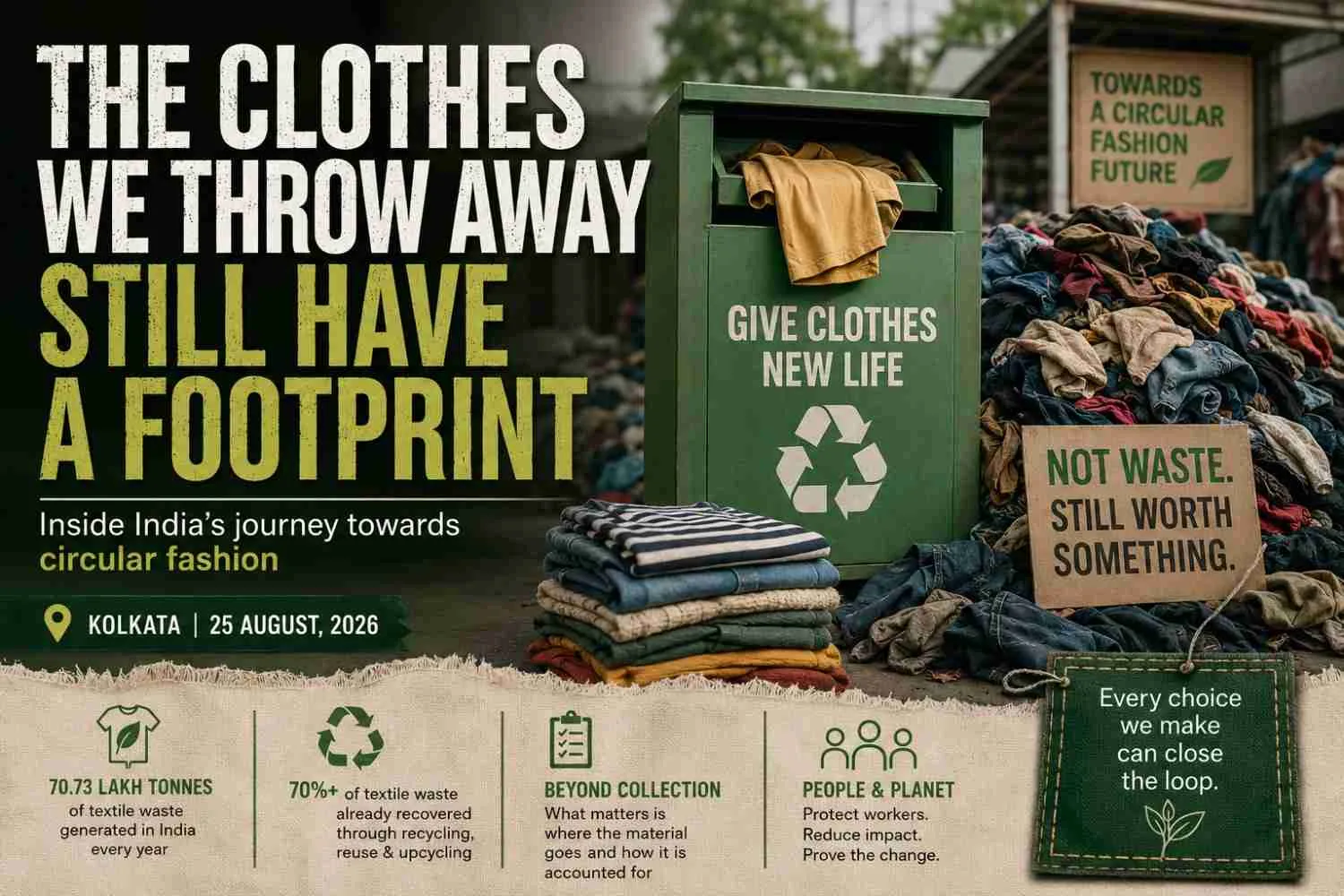
Kolkata | 25 August, 2026
| India’s fashion industry is experimenting with textile recycling, cleaner production and circular retail models, but the real test is whether discarded clothes actually stay in the material loop - and whether companies can prove where they go. |
Summary The bigger challenge is what happens to clothes after consumers stop wearing them. Garments can be reused, repaired, resold, downcycled or recycled, but blended and damaged textiles can be difficult to recover at their original value. Companies are responding through take-back programmes, recycled fibres, organic cotton sourcing, cleaner dyeing technologies and retail trade-ins. Yet a collection box or sustainability label does not automatically make fashion circular. The stronger test is whether companies can account for the material collected, show an audit trail for its destination, protect the workers handling discarded textiles and demonstrate measurable environmental gains against a clear baseline. |
| Keywords textile waste in India, circular fashion, textile recycling, sustainable fashion, textile waste management, fashion circular economy, textile circularity, post-consumer textile waste, textile waste recovery, textile recycling India, sustainable textiles, clothing waste, garment waste, textile upcycling, textile downcycling, recycled fibres, textile traceability, circular fashion supply chain, sustainable textile production, textile waste workers, informal waste workers, fashion sustainability, textile sustainability, circular textile economy, sustainable fashion India |
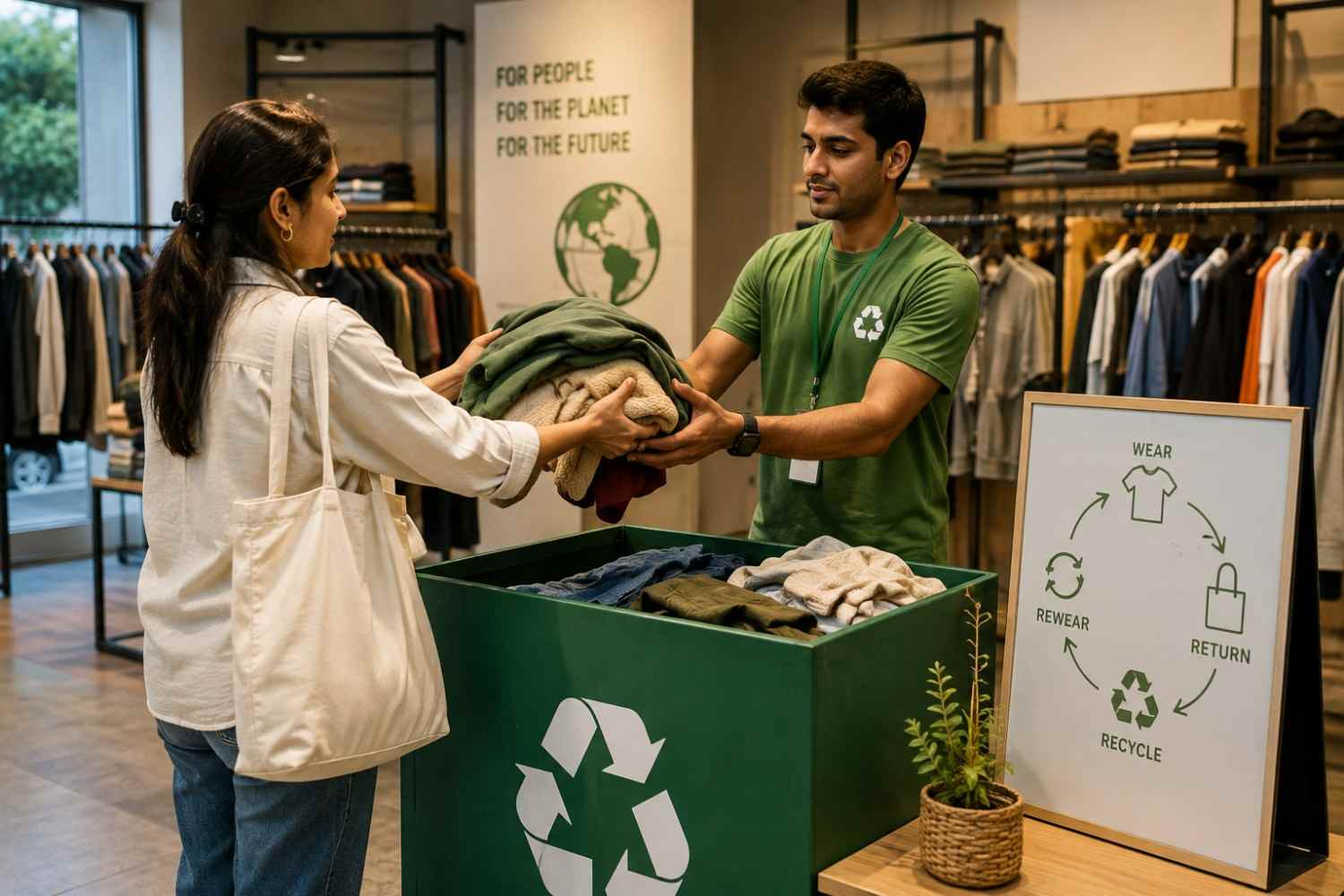
What really happens to a T-shirt after we stop wearing it?
For most of the consumers, a garment’s journey seems to end when it is placed in a donation bag, dropped into a collection box or thrown away.
For the textile itself, however, that may be only the beginning.
A discarded T-shirt can take several different paths. It may be worn again, repaired and resold, converted into wiping cloths or other products, or mechanically recycled into new fibres. But textiles that are heavily damaged, contaminated or made from difficult-to-separate blends can be much harder to recover and may ultimately end up as waste.
This is where the idea of a circular fashion economy becomes more complex than simply collecting old clothes.
India’s latest government mapping of the textile-waste value chain estimates that the country generates around 70.73 lakh tonnes of textile waste every year. About 42% is pre-consumer waste, generated during manufacturing, while the remaining 58% comes from post-consumer disposal. The study also estimates that more than 70% of total textile waste is already recovered through recycling, upcycling, downcycling or reuse.
That changes the way the problem needs to be viewed.
India is not starting from zero. A large share of textile waste is already finding its way back into the economy.
The bigger challenge is what happens to the remaining material and whether textiles can be collected, sorted and recovered efficiently once they leave the formal manufacturing system.
Collecting an old T-shirt does not, by itself, make fashion circular. True circularity begins when the garment has a clear path to its next use.
FOLLOW THE FABRIC
Consumer discards garment
↓
Collection
↓
Sorting
↓
Reuse / Repair → Resale
↓
Recycling → New Fibre / Product
↓
Residual Waste → Documented Final Destination
The question: Does every kilogram collected have a documented destination?
Can textile collection really make fashion circular?
Post-consumer collection is becoming an increasingly visible part of sustainable-fashion efforts. Brands and retailers are encouraging consumers to return unwanted clothes through store collection points, take-back programmes and trade-in schemes.
But collection numbers alone can give a misleading picture of circularity.
Collecting 10 tonnes of used clothing may sound impressive, but the more important question is what happened to that material after collection.
How much was reused? How much was recycled? How much was downcycled? How much was rejected? And where did the rejected material go?
This is the difference between collection and actual material recovery.
A credible circular-fashion programme therefore needs to maintain a clear mass balance - showing what entered the system, what was recovered, what was converted into another product and what ultimately remained as waste.
India’s 2026 government assessment provides an important counterpoint. The country already has a substantial textile-recovery ecosystem, particularly for pre-consumer waste generated during manufacturing. High recovery rates in this segment show that parts of the domestic textile industry already have established systems for collecting and recovering material.
The bigger challenge is what happens after a garment leaves the formal manufacturing system and enters the hands of consumers.
That is where collection, sorting, logistics and end-market demand become critical to making post-consumer textiles genuinely circular.
Is recycling always better than making new clothes?
Not necessarily.
The environmental benefit of textile recycling depends on what material is being recycled, which technology is used and what the recovered fibre can replace.
Cotton, polyester, nylon and blended fabrics behave differently during recycling.
Mechanical recycling, for example, can shorten textile fibres and reduce the quality of the resulting material. More advanced recycling technologies may recover higher-quality fibres from difficult textiles, but they can also require greater investment, energy and specialised infrastructure.
This creates an important competing view:
Recycling is necessary, but recycling alone cannot solve the problem of overproduction and overconsumption.
If brands continue producing large volumes of inexpensive clothing designed for short use, recycling systems may simply end up managing the waste created by a high-consumption model.
That is why repair, reuse, resale and longer garment life need to be treated as equally important parts of the circular-fashion system.
A garment that is worn for longer, repaired instead of replaced or resold to another consumer can delay the point at which recycling becomes necessary.
The goal of circular fashion is therefore not simply to recycle more clothes. It is to keep garments and their materials in productive use for as long as possible.
THE CIRCULARITY HIERARCHY
LONGER USE
↓
REPAIR
↓
REUSE / RESALE
↓
RECYCLING
↓
DOWNCYCLING
↓
DISPOSAL
Keep the garment in use before breaking it back into material.
Can fashion cut its water footprint before a garment even becomes waste?
The environmental impact of clothing begins long before a garment reaches the end of its life. Processes such as dyeing and finishing during manufacturing can require significant amounts of water.
This has led brands and technology companies to explore waterless and low-water dyeing technologies. Some emerging systems use alternatives such as supercritical carbon dioxide, while others use digital, foam-based or other processes designed to reduce conventional water consumption.
The potential benefit is straightforward: using less water for the same production output can reduce pressure on freshwater resources while also lowering the volume of wastewater generated.
But the technology still needs to pass an evidence test.
A company should not simply state how many litres of water it saves per garment. It should explain what the saving is measured against and what the calculation includes.
What exactly does the reported reduction cover? Is it limited to dyeing, or does it include finishing as well? Does the alternative process save water but consume more energy? Has it been proven at commercial scale? And how much has the company actually invested compared with what it originally announced?
These questions matter because a technology can look highly efficient in a pilot project but deliver very different results when used across a large manufacturing operation.
A water-saving technology becomes meaningful only when its environmental benefits can be demonstrated at commercial scale.
Does organic cotton automatically make a garment sustainable?
Organic cotton can be part of a lower-impact sourcing strategy, but the label alone cannot tell the complete sustainability story.
What matters is how the cotton was produced, verified and traced through the supply chain.
Companies need credible certification and traceability systems to establish whether suppliers are meeting the required environmental and production standards.
There is also a crucial social question: Who is able to participate in this transition?
Who are the farmers producing the cotton? What prices are they receiving? Can small producers afford certification? Who pays for compliance and verification?
If sustainable sourcing requirements become too expensive or complicated, smaller farmers may find it harder to participate.
Responsible sourcing therefore needs to look at both environmental performance and farmer inclusion. Certification can provide an important layer of verification, but it should be treated as a starting point for scrutiny rather than the final proof that a supply chain is sustainable.
Can retail trade-ins actually make fashion more circular?
Trade-in programmes are becoming another visible part of the circular-fashion model. Consumers return unwanted clothing to a retailer and receive a discount, store credit or another incentive towards a future purchase.
The model can help solve one problem by giving retailers a way to bring used garments back into the system instead of allowing them to disappear into the waste stream. But there is also a potential contradiction.
If a trade-in reward simply encourages consumers to buy another garment immediately, the programme could increase consumption rather than reduce it.
A truly circular model would prioritise repair, resale and reuse for returned clothing, with recycling serving as the last option.
The priority should be to keep the garment in use for as long as possible before breaking it down into fibre or treating it as waste.
Who handles India’s discarded textiles?
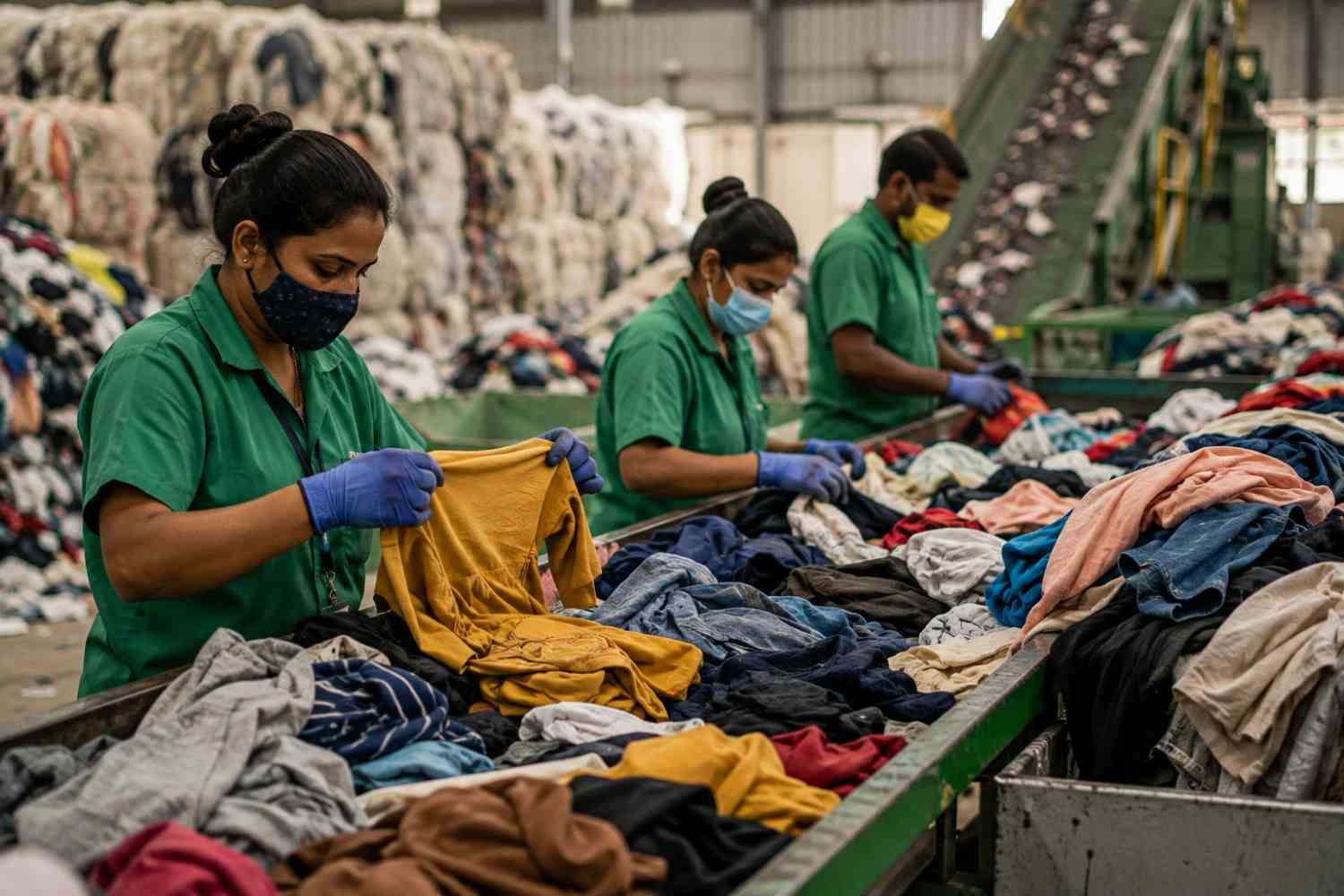
India’s textile-recovery system cannot be understood without looking at the workers who already operate within it.
Waste pickers, sorters, aggregators and small recycling units play an important role in collecting and recovering materials that formal systems may not reach. Yet much of this work remains invisible in corporate sustainability reporting.
That raises an important CSR question:
If companies want to build a circular fashion economy, what happens to the workers who are already recovering its materials?
A responsible transition should consider fair wages, workplace safety, protective equipment, social-security access and stable incomes. Formalisation should not simply push informal workers out of the value chain. It should improve their working conditions, recognise their contribution and give them a more secure role in the circular economy.
Organisations working with waste pickers and vulnerable communities, including Chintan and Goonj, can offer an important perspective on this issue.
The worker’s voice matters because circularity cannot be considered fully sustainable if material recovery improves while the conditions of the people doing that work deteriorate.
How can companies prove that their circularity claims are real?
This is where the evidence test becomes the centre of the story.
Saying that a company collected textiles, saved water, used organic cotton or launched a trade-in programme tells us what it did. The more important question is what difference those actions actually made.
The more important question is what happened because of that activity.
Companies should therefore disclose how much material was collected, how much was actually reused or recycled, what happened to rejected material, how much water was saved against a clear baseline, how much was invested and spent, who benefited and whether the programme continued after the initial funding or pilot period.
The reporting boundary should also be clear.
A garment collected is not necessarily a garment recycled. A garment recycled is not necessarily a garment returned to an equivalent use. And a sustainability claim is not meaningful unless the company can explain how the claimed benefit was calculated and what happened to the material afterwards.
Circular fashion is ultimately not about making better claims about old clothes. It is about building a system in which materials, resources and livelihoods can be tracked from the beginning of the supply chain to what happens after the garment is no longer wanted.
THE CIRCULAR FASHION EVIDENCE TEST
| Claim | What should be proved? |
|---|---|
| “We collected textiles” | Total material collected and consumer/beneficiary denominator |
| “We recycled them” | Mass balance and material destination |
| “We use recycled fibre” | Fibre content and chain-of-custody evidence |
| “We reduced water” | Baseline, methodology and actual reduction |
| “We use organic cotton” | Certification and sourcing audit trail |
| “We support waste workers” | Wages, safety, income and benefit access |
| “We invested in circularity” | Budget versus actual expenditure |
| “We reduced our footprint” | Absolute and intensity results |
| “Our programme is sustainable” | Performance that continues over time |
This is the difference between a sustainability claim and a sustainability result.
A percentage on its own does not tell the full story. Companies should clearly disclose what they measured, where they measured it, the period covered and how the improvement was calculated.
A reported 30% reduction may sound significant, but the real questions are: 30% compared with what baseline? Across which facilities? Over what period? Did production increase or decrease? Was the saving measured in absolute terms or per garment?
Without this context, sustainability figures can be difficult to verify or compare. Clear reporting boundaries and methodologies are therefore essential to show whether an environmental improvement represents a genuine change in performance.
Can India turn textile waste into a resource without leaving its workers behind?
India’s policy direction is also moving towards greater textile circularity.
The Tex-Eco Initiative, announced in the Union Budget 2026–27, aims to promote globally competitive and environmentally sustainable textile and apparel manufacturing while helping the sector align with international sustainability standards and emerging green markets.
Government efforts are also gradually focusing on textile-waste management, recycling technologies and value addition from discarded textiles.
This creates an opportunity to move beyond isolated brand-led campaigns and build a wider circular textile system. But recycling cannot carry the entire burden.
A genuinely circular apparel model would begin much earlier with durable products designed to last longer, followed by repair, reuse and resale before recycling becomes the final recovery option.
That requires action across the entire value chain.
Brands need to design garments that are easier to repair and recycle. Retailers need transparent take-back systems. Recyclers need reliable and traceable material flows. Governments need effective standards and enforcement. Consumers need clear information about garment durability, care and disposal.
And there is one group that cannot be left out of this transition: the informal workers already collecting, sorting and recovering textile waste.
They are not outside the circular economy. In many cases, they are already helping make it work.
A truly sustainable textile system must therefore account not only for where the waste goes, but also who handles it, who earns from it and whether those livelihoods become safer and more secure as the system evolves.
THE REAL CIRCULAR-FASHION TEST
DESIGN FOR LONGER USE
↓
REPAIR
↓
REUSE / RESALE
↓
COLLECT
↓
SORT
↓
RECYCLE
↓
TRACE THE MATERIAL
↓
MEASURE THE IMPACT
What should companies actually report?
For CSR and corporate sustainability programmes, the most important question is not how many clothes were collected. It is what happened to those clothes afterwards, who handled them, who benefited and what environmental impact was actually avoided.
A credible programme should report the total quantity of material collected, where it went and how much genuinely re-entered a productive material or product cycle. It should clearly distinguish between pre-consumer and post-consumer waste, disclose relevant certifications and audit trails, and explain how claims based on those certifications were verified.
The people behind the system also need to be visible.
When informal workers are involved in collecting, sorting or recycling textiles, companies should report their wages, working conditions, safety measures, access to social protection and how they are being brought into the formal circular economy.
Financial reporting should be equally transparent:
How much was budgeted? How much was actually spent? How much went towards collection, sorting, recycling, technology, worker protection and infrastructure?
The reporting boundary must remain clear throughout.
A kilogram collected is not automatically a kilogram recycled.
A donated garment is not automatically a garment reused.
A certified fibre is not automatically proof that the entire garment has a low environmental footprint.
And a percentage reduction means little without a credible baseline and clearly defined methodology.
Can fashion become circular without simply moving the waste problem somewhere else?
That is the real test of India’s sustainable-fashion transition.
India already has a significant textile-recovery ecosystem, with the latest government assessment indicating that more than 70% of textile waste is recovered through different pathways.
But recovery alone does not equal circularity.
The material still needs to be traced. Workers still need to be protected. Recycling processes still have their own environmental costs. Consumers still need to be encouraged to wear, repair, reuse and resell clothes for longer. And companies still need to demonstrate that their sustainability claims reflect what is actually happening on the ground.
This is where the next phase of sustainable fashion will be decided.
It will not be defined by how many collection bins a brand installs, how many take-back campaigns it runs or how many recycled garments appear in a catalogue.
It will be defined by whether companies can follow a garment from the consumer’s wardrobe to its next useful life - and provide evidence for every major step along the way.
Because a fashion system is not circular simply because it collects its waste.
It becomes circular when materials stay in productive use, value reaches the people who make the system work, and environmental benefits can be measured and proven.
That is the real standard India’s circular-fashion economy now needs to meet.
Primary sources:
- Ministry of Textiles — Mapping of Textile Waste Value Chain in India (2026)
Covers the 70.73 lakh tonnes annual textile-waste estimate, 58% post-consumer / 42% pre-consumer split, recovery pathways, recycling technologies and post-consumer infrastructure gaps.
Ministry of Textiles — Mapping of Textile Waste Value Chain in India - Press Information Bureau — Ministry of Textiles: Mapping of Textile Waste Value Chain in India
Official government release covering the report's headline findings, including 70.73 lakh tonnes of annual textile waste and more than 95% recovery of pre-consumer textile waste.
PIB — Mapping of Textile Waste Value Chain in India - Press Information Bureau — Ministry of Textiles: Textile Recycling and Circular Economy
Covers the government's current textile-recycling and circular-economy initiatives, including the Tex-Eco Initiative.
PIB — Textile Recycling and Circular Economy - Press Information Bureau — Ministry of Textiles: Innovative Textile Recycling Technologies
Covers government support for textile-waste management, recycling, recycled fibres, new materials and value addition from discarded textiles under Tex-Eco.
PIB — Innovative Textile Recycling Technologies - Press Information Bureau — Environmentally Sustainable Production Practices
Useful for the article's cleaner-production, water/energy efficiency, hazardous-chemical reduction, organic textiles, natural dyeing and textile-waste management sections.
PIB — Environmentally Sustainable Production Practices - Central Pollution Control Board — Charter for Water Recycling and Pollution Prevention in Textile Industries
Primary regulatory material for the water-consumption, wastewater, chemical use and pollution-prevention angle.
CPCB — Charter for Water Recycling and Pollution Prevention in Textile Industries - Press Information Bureau — Textile Waste Innovation Challenge
Documents the government's “What Is It Made Of?” Textile Waste Innovation Challenge and its focus on circularity, sustainable production and practical textile-waste solutions.
PIB — Textile Waste Innovation Challenge - Press Information Bureau — Union Budget 2026–27: Strengthening India's Textile Value Chain
Useful for the wider policy context around Tex-Eco, sustainable manufacturing, textile modernisation and circularity.
PIB — Union Budget 2026–27: Strengthening India's Textile Value Chain - Press Information Bureau — Integrated Programme for the Textile Sector
Covers the Budget's broader textile programme, including the Tex-Eco Initiative and sustainable textile manufacturing.
PIB — Integrated Programme for the Textile Sector - Ministry of Textiles — Textile Recovery Facility, Navi Mumbai
Particularly useful for the newer collection, traceability and impact-measurement angle. In August 2026, the Ministry documented a proposed digital circular-textile infrastructure platform for collection, traceability and impact measurement.
PIB — Textile Recovery Facility, Navi Mumbai



Add a Comment