
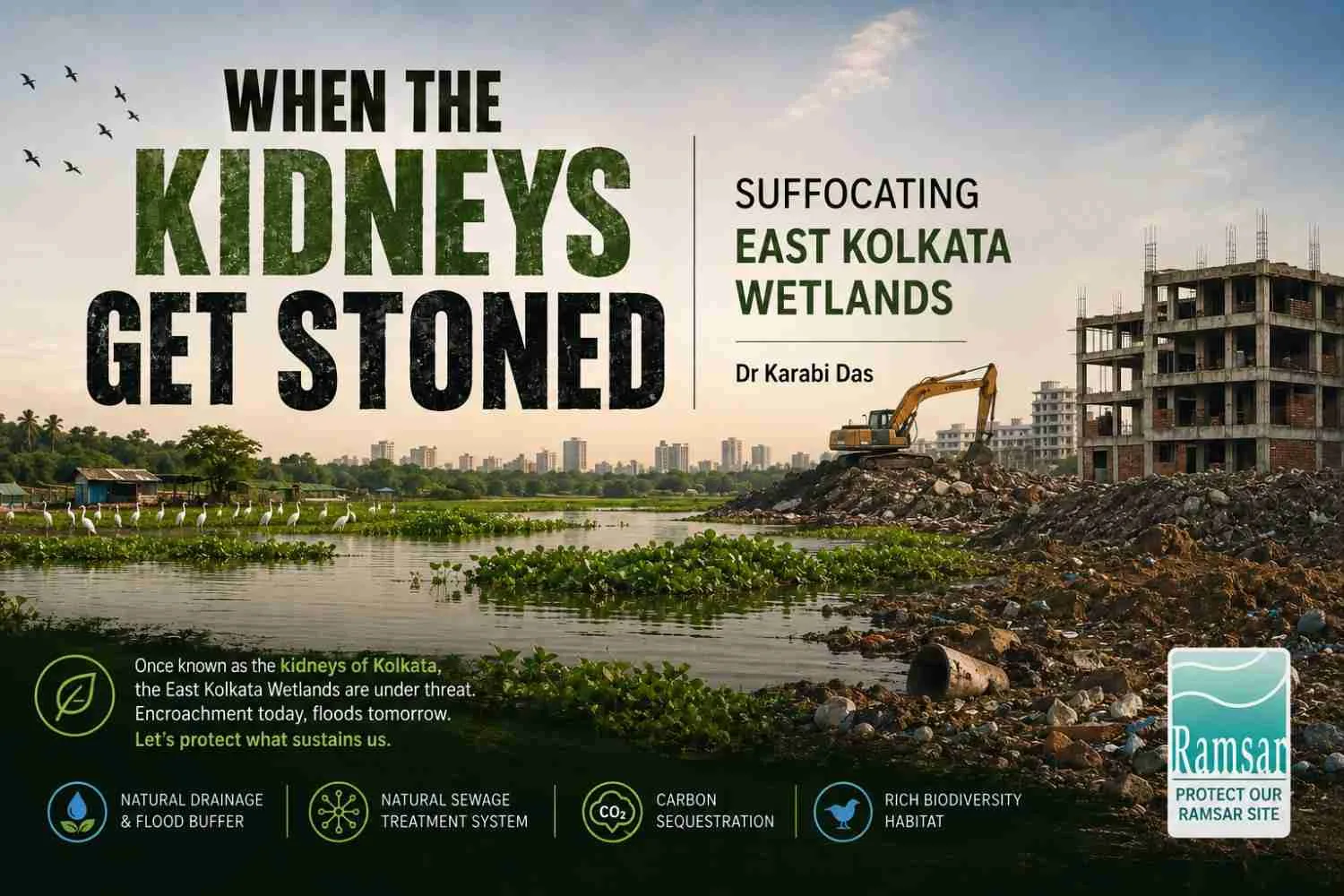
| Summary: Originally acclaimed as the kidney of Kolkata, the East Kolkata Wetlands suffer instances of encroachment in the form of settlements, agriculture and other land use changes. A Ramsar site, the role of East Kolkata Wetlands in Kolkata’s natural drainage and sewage system, water filtering by means of phytoplanktons and algae, maintaining urban micro climate, carbon sequestration and being a rich source of biodiversity can never be left unnoticed. Its time that the East Kolkata Wetlands are preserved for the betterment of our larger society. |
| Keywords: Environment, East Kolkata Wetlands, Urban Heat Island, Carbon sequestration |
Illegal encroachments have surfaced on the eastern fringes of Kolkata with residents accusing land sharks of once again targeting the East Kolkata wetlands (EKW), an internationally recognized Ramsar site by filling up a sprawling waterbody in Nayabad for suspected real estate development. A complaint has been lodged with urban development minister Agnimitra Paul, the Municipal Commissioner and the East Kolkata Wetland Management Authority, alleging that a large pond near Sadhubari on Nayabad Main Road, close to the Upohar Condominium off Eastern Metropolitan Bypass is being systematically filled up in broad daylight without any visible intervention from the authorities.
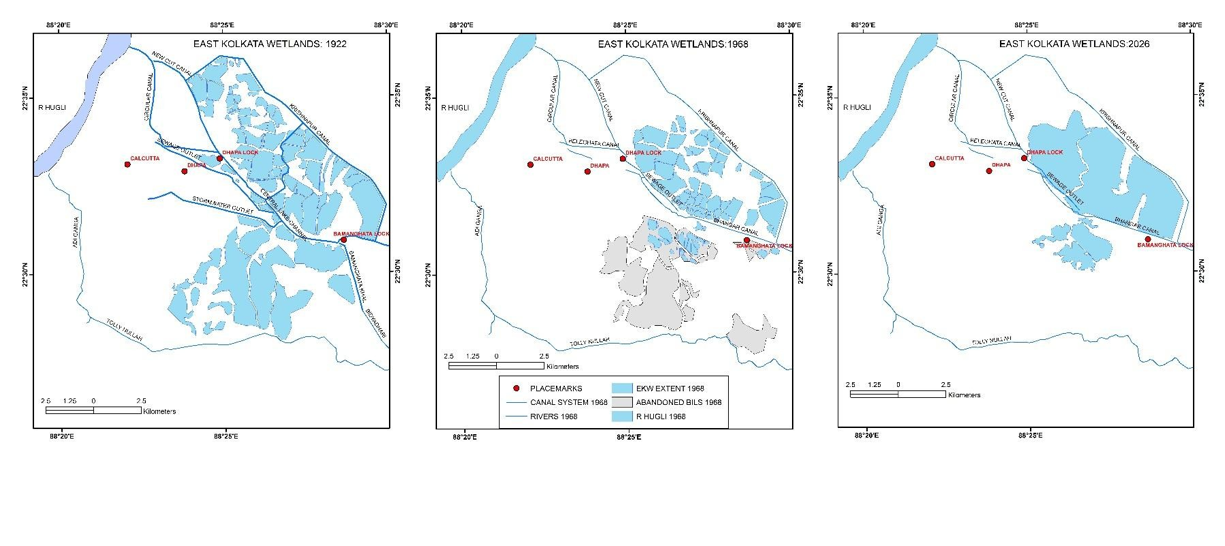
East Kolkata Wetlands has an area of 12,500 hectares with 254 sewage fed fisheries spread across 37 mouzas and is internationally considered to be a Ramsar site. Shrinking wetlands could increase urban flooding, destroy biodiversity, force huge spending on artificial drainage and contribute to urban heating as a result of change in weather.

As climate change brings more intense rainfall, these wetlands absorb these wetlands absorb enormous volumes of water. Losing these will worsen flooding, destroy livelihoods and force the city to spend hundreds of crores in preparing infrastructure for artificial drainage.
The latest allegations come six months after the January 26 blaze in Anandapur that killed 27 people inside a warehouse and an adjacent food manufacturing unit. Investigation later revealed that the gutted warehouses stood on land bordering or forming part of the East Kolkata Wetlands.
Locals and environmental activists alleged the operation follows a familiar pattern seen across the wetlands. Asbestos sheds are first erected; settlers are brought in and after a while the land is cleared for permanent residential or commercial structures.
The role of East Kolkata Wetlands as Kolkata’s natural wastewater treatment system, flood buffer and carbon sink cannot be looked down upon and the shrinking condition of this Ramsar site needs immediate and stringent action.
History of East Kolkata Wetlands: East Kolkata Wetlands owes its formation through the natural avulsions of river Bidyadhari. The evolution of East Kolkata Wetlands dates back to British colonial canal building into the world’s largest natural wastewater fed aquaculture and sewage treatment system and has gone a long way to become noted as Ramsar site.
Originally a marshy saline lake system of the 18th century, East Kolkata Wetlands abounded in fish and birds before tidal flows receded to leave freshwater environments. East Kolkata Wetlands treat about 60-80% of Kolkata’s sewage naturally as the world’s largest organic sewage management system, supporting almost 50,000 agro workers and supplying about 1/3rd of Kolkata’s fish requirement.
East Kolkata Wetlands got its name from late Dhrubajyoti Ghosh, Special Advisory (Agricultural Ecosystem) Commission on Ecosystem Management, who reached this incredible but neglected part of the city, while working as an engineer for the Water and Sanitation Department, Government of West Bengal on his quest for an answer to the question what exactly happens to the city sewage.
These natural waterbodies which were known just as fisheries provided the answer. Devised by the local fishermen and farmers, these wetlands served in effect as the natural sewage treatment plant for the city.
Despite protective legislation enacted since 2006, the East Kolkata Wetlands have experienced severe physical reduction. The total area declined approximately 65 sq km to 41 sq km within just 30 years. This is due to illegal land conversion. This continuous reduction in size has directly harmed the livelihoods of fishing communities and sewage farmers who depend on the ecosystem for their survival. In 1991 the West Bengal Government accepted an offer by a nonresident Indian to build a World Trade Centre and allotted 227 acres of wetlands for this purpose. As a result, the NGO “People United for Better Living in Calcutta (PUBLIC) filed a public interest litigation in the Calcutta High Court arguing for the importance of the wetlands and why they should be left unchanged. The order of Justice Umesh Chandra Bannerjee on this matter is considered a landmark judgement. As an outcome, the proposal for World Trade Centre was turned down in its original form and strict conditions were laid “I do not find any justiciable reason to disagree with the opinion expressed by the environmentalists that wetland should be preserved and no interference or reclamation should be permitted”.
Following the order of the Calcutta High Court in 1992 to its credit, the State Government did not appeal but accepted the ruling. In fact, the environment Secretary Kalyan Biswas applied for the East Calcutta Wetlands to be designed a “wetland of international importance” under the Ramsar Convention. This was observed in 2002.
Methods for Conservation:
To demarcate the boundaries of East Kolkata Wetlands.
To take measures to stop, undo and prevent any unauthorized development project in EKW.
To prevent, prohibit or restrict any mining, quarrying, blasting or other operations in EKW.
To direct demolition or alteration of any hoarding frame, post, kiosk, structure, neon signed or sky sign erected, exhibited illegally for the purpose of advertisement on any land in EKW.
To take measures to abate pollution in EKW and conserve the flora, fauna and biodiversity in general.
To prepare action plans conforming to the resolutions taken and recommendations made from time to time underRamsar Convention and to update the land use maps of EKW.
To promote research and disseminate findings of such research among the stakeholders.
To raise awareness about the utility of the wetlands in general and the EKW in particular.
To promote basic conservation principles like sewage fed pisciculture and ecotourism in the EKW.
To enforce land use control in substantially waterbody-oriented areas of EKW.
To detect changes of ecological characters and land use in EKW.
To conduct enquiry or scientific study within the scope of the project.
About 100 species of flora have been recognized in and around EKW. Several kinds of water hyacinths across these wetlands. The area is also home to large numbers of coconut and betel nut trees. Varieties of vegetables like cauliflower, eggplant, pumpkin, sunflower are farmed.
Numerous species of fish are farmed in sewage fed ponds called bheries in EKW. These include silver carp, tilapia. The area is also home to the marsh mongoose and small Indian mongoose, Palm civet and small Indian Civet.
This sewage fed aquaculture is an example of potential carbon sink. East Kolkata Wetlands can sequester 1.9 MgC/ha/year, mitigating at least 118 Gg atmospheric CO2 per year. Also, carbon intake by harvested fish crop corresponds to 61 Gg CO2 per year rewarding US $ 3.6/kg blue carbon harvested. East Kolkata Wetlands act as vital natural thermal sink and sponge for Kolkata. They regulate the urban microclimate by moderating temperature gradients reducing the Urban Heat Island (UHI) effect maintaining ambient humidity through high evaporation rate and sequestering carbon. High rates of water surface evaporation sustainably regulate relative humidity in the eastern fringes of the urban sprawl. Abundant aquatic vegetation and phytoplankton generate large quantities of oxygen supporting cleaner local air circulation. The wetlands act as a natural retention basin that absorbs heavy monsoon downpours and slowly releases stored moisture during dry spell stabilizing local hydrological micro rhythms.
About Author
 Dr Karabi Das, Masters in Geography from University of Calcutta, former Senior Research Fellow, UGC, PhD on Physical and Socioeconomic changes in the Indian Sundarban is presently working as Assistant Professor of Geography, Dr Kanailal Bhattacharyya College, Howrah.
She has participated in many national and international seminars and has 12 papers and 10 book chapters to her credit.
Her areas of interest include Fluvial Geomorphology, river in equilibrium and human environment relationship.






Add a Comment