

Kolkata | August 6, 2026
| Climate-tech companies are beginning to deliver the kind of investor returns once reserved for mainstream technology start-ups. High-value private equity exits, founder wealth creation and employee stock payouts suggest India's green economy is entering a more mature phase. Yet behind the headline deals lies a more complex reality, although sustainability attracts unprecedented investment globally, many early-stage climate innovators still struggle to secure the capital they need. |
Quick Summary India's climate-tech ecosystem is reaching an important milestone as sustainability-focused start-ups begin generating meaningful financial returns for investors, founders and employees. Successful private equity exits, strategic acquisitions and expanding ESOP wealth creation indicate that green businesses are gradually moving from experimental ventures to commercially viable enterprises capable of attracting institutional capital. These developments could strengthen investor confidence and encourage greater participation from banks, infrastructure funds, venture capital firms and green-bond issuers. However, beneath these success stories, early-stage climate-tech companies continue to face tightening funding conditions, higher investor expectations and longer fundraising cycles. As India's clean economy expands, the real challenge is ensuring that capital supports not only established winners but also the next generation of innovators developing technologies needed for the country's long-term climate transition. |
Keywords Climate Tech, Green Investment, PE/VC, Sustainable Finance, Green Startups, Climate Innovation, ESG Investment, Clean Technology, Startup Funding, India Sustainability |
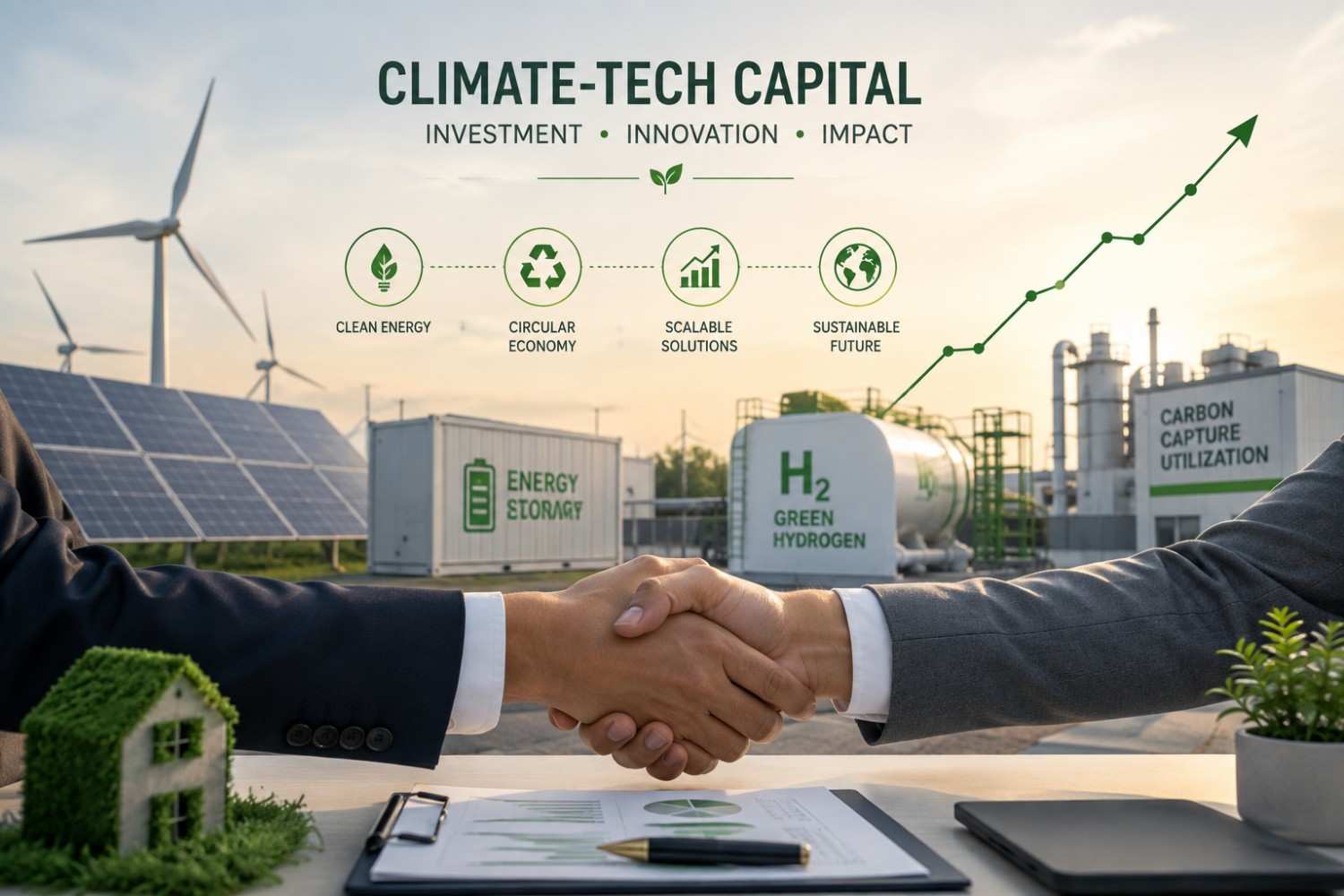
Are Climate-Tech Exits Creating a Stronger Green Investment Cycle?
For years, climate-tech entrepreneurs faced a familiar question: Can sustainability generate attractive financial returns?
Although investors recognised the long-term potential of sectors such as clean energy, battery recycling, carbon capture, green materials and circular manufacturing, many remained cautious about investing.
Climate-tech businesses often require years of research, large upfront investments and supportive government policies before they become profitable, making them a riskier bet than many conventional technology start-ups.
That perception is gradually changing.
Across India, a growing number of climate-tech companies are moving beyond the experimental stage and proving that environmental innovation can also be commercially successful.
High-value acquisitions, private equity exits and strategic investments are giving investors the returns they have been waiting for while rewarding founders who have spent years building businesses around the low-carbon economy.
For venture capital and private equity firms, these deals represent far more than isolated success stories.
Every successful exit strengthens confidence that climate-tech can become a profitable business.
It shows that companies in the sector can grow, attract institutional buyers and generate competitive returns, encouraging more investors to back climate-focused innovation.
The benefits are also reaching employees.
Many professionals who joined climate-tech start-ups in their early years are now benefiting through Employee Stock Ownership Plans (ESOPs), turning years of equity ownership into real financial gains.
In a sector long driven by purpose as much as profit, wealth creation is becoming an important sign of maturity.
These success stories are also helping attract experienced professionals who may once have viewed climate-tech as a risky career choice.
However, the headlines tell only part of the story.
While a handful of established climate-tech companies are securing impressive valuations and rewarding investors, many younger start-ups continue to struggle to raise funding.
Investors have become far more selective, preferring businesses that already have clear revenue streams, strong financial performance and a realistic path to profitability.
As a result, many promising early-stage innovators are finding it difficult to secure the capital needed to grow.
This reflects one of the biggest challenges facing India's green economy.
If the wealth created through successful exits is reinvested across the broader climate-tech ecosystem, it could encourage new ideas, support emerging businesses and accelerate India's transition to a low-carbon economy.
But if investment remains concentrated in a small number of mature companies, many promising innovators may never receive the support needed to develop the technologies that will drive India's future in clean energy, resource efficiency and net-zero development.
The debate is therefore no longer about whether climate-tech can create economic value.
The real question is whether today's success stories will generate enough fresh investment to support tomorrow's innovators and strengthen the ecosystem that made those achievements possible.
From Climate Ambition to Commercial Returns
India's climate-tech sector has changed dramatically over the past decade.
What was once a niche investment space focused mainly on renewable energy has grown into a broad ecosystem of businesses working on electric mobility, battery technologies, sustainable materials, carbon management, resource efficiency and circular economy solutions.
This growth has been fuelled by a combination of government support, rising investor confidence and increasing demand from businesses for low-carbon technologies.
Policies promoting clean energy, electric vehicles and green manufacturing, together with India's net-zero commitment and growing ESG expectations, have encouraged companies to develop solutions that not only reduce environmental impact but also create long-term commercial value.
As the sector has matured, the pattern of investment also evolved.
In the early years, most climate-tech start-ups depended on angel investors, incubators and venture capital firms willing to back high-risk ideas.
Today, many successful companies are attracting larger investors, including private equity firms, infrastructure funds, strategic corporate buyers and institutional investors.
This shift reflects growing confidence that climate-tech can deliver strong and sustainable financial returns.
For investors, a successful exit represents far more than the success of a single company.
When a company is acquired or investors sell their stake, they recover their investment, demonstrate returns to their backers and free up capital to invest in the next generation of start-ups.
This recycling of capital is essential for keeping the innovation ecosystem healthy. Without successful exits, investors become more cautious, fundraising slows and fewer new businesses receive the support they need to grow.
India is beginning to see the benefits of this cycle.
Large infrastructure investors, climate-focused funds and financial institutions are treating green businesses as long-term investment opportunities rather than experimental ventures.
Organisations such as IREDA continue to expand financing for renewable energy and clean technology projects, while SIDBI Venture Capital is strengthening support for innovation-driven enterprises.
Alongside them, specialised climate funds and impact investors are broadening the range of financing available for businesses working on decarbonisation, sustainable manufacturing and resource efficiency.
The country's expanding green finance market is also playing an important role.
Green bonds, sustainability-linked loans and ESG-focused investment products are opening new funding channels and attracting larger pools of institutional capital.
Banks, non-banking financial companies (NBFCs) and infrastructure funds are gradually evaluating climate-tech businesses not only for their environmental benefits but also for their commercial potential and long-term resilience.
While the sector has made significant progress, important hurdles remain.
While established climate-tech companies are attracting larger investments and delivering successful exits, many younger start-ups continue to struggle to raise funding.
Investors have become more selective, favouring businesses with proven revenues, efficient operations and a clear path to profitability.
As a result, many promising start-ups are finding it difficult to secure the funding needed to develop and expand their technologies.
This growing gap raises an important question.
If successful exits are creating wealth and attracting new investors, how can India ensure that enough of this capital reaches the next generation of climate innovators who will drive the country's future green economy?
The Climate-Tech Capital Cycle
Innovation → Seed Funding → Series A/B Growth Capital → Scale-Up → Private Equity / Strategic Investment → Exit → Capital Reinvested into New Climate Start-ups
Key takeaway: Successful exits do more than reward investors- they recycle capital back into the innovation ecosystem.
The Exit Economy: When Green Innovation Starts Delivering Returns
For venture capital and private equity investors, a successful exit is more than a profitable deal- it is a sign that an industry has reached a new level of maturity.
Climate-tech companies have traditionally taken longer to grow than conventional technology start-ups.
Many require significant investment, years of research and supportive regulations before becoming commercially successful.
Because of this, investors often had to wait much longer to see returns.
Today, however, successful acquisitions, private equity exits and secondary sales are changing that picture, showing that businesses built around sustainability can generate strong financial returns alongside environmental impact.
These success stories are boosting investor confidence.
Institutional investors are viewing climate-tech as a promising long-term investment rather than a niche sustainability sector.
Large transactions in renewable energy, electric mobility, battery technology, climate software and sustainable materials are encouraging infrastructure funds, pension-backed investors and growth capital firms to increase their exposure to India's green economy.
The gains are not limited to investors and founders.
Employees who joined climate-tech companies in their early years are also beginning to benefit through Employee Stock Ownership Plans (ESOPs), turning years of equity ownership into significant financial rewards.
These outcomes are helping attract experienced engineers, scientists, sustainability professionals and business leaders who may once have considered climate-tech too risky as a long-term career choice.
For entrepreneurs, successful exits carry equal importance. They validate years of innovation, business development and investor confidence, proving that sustainability-focused businesses can scale successfully while delivering meaningful environmental solutions.
Many founders who achieve successful exits also go on to become angel investors or mentors, using their experience and capital to support the next generation of climate-tech start-ups.
However, these encouraging developments reveal only one side of the story.
While established climate-tech companies are attracting larger investments and delivering strong investor returns, many younger start-ups continue to face a difficult fundraising environment.
Investors are becoming selective, favouring businesses with stronger revenues, clear business models and a faster path to profitability.
As a result, many early-stage companies developing new technologies are finding it harder to secure the funding needed to grow.
This has created an uneven investment landscape.
A small number of mature companies are generating impressive returns, while many promising start-ups continue to struggle for early-stage funding.
Industry experts warn that if investment remains concentrated only in established businesses, India could slow the development of the next generation of technologies needed to support its long-term decarbonisation and sustainability goals.
Successful exits, therefore, are only part of the story.
They prove that climate-tech can create both environmental impact and financial value.
But the long-term strength of the sector will depend on whether today's returns are reinvested in the innovators building tomorrow's clean technologies.
Where the Returns Go
Successful Climate-Tech Exit
⬇
✔ Investors recover capital
✔ Employees benefit through ESOPs
✔ Founders gain liquidity
✔ Confidence in climate-tech grows
✔ Fresh capital flows into future ventures
Key takeaway: Every successful exit has the potential to finance the next generation of climate innovation- but only if capital continues moving downstream.
Beyond the Headlines: Are Green Returns Reaching the Next Generation of Innovators?

The recent wave of climate-tech exits has strengthened confidence in India's green economy.
However, experts caution that headline valuations and high-profile deals alone do not reflect the true health of the sector.
Every successful acquisition or investor exit marks the end of one investment journey.
The bigger question is whether the money generated from these deals is being reinvested in the next generation of climate-tech start-ups or remaining concentrated in a small number of established companies.
Research organisations such as the Council on Energy, Environment and Water (CEEW), Climate Policy Initiative India (CPI India) and WRI India have consistently pointed out that achieving India's climate and net-zero goals will require steady investment at every stage of innovation.
This includes everything from early research and product development to large-scale commercial deployment.
In other words, a strong climate-tech ecosystem depends not only on successful exits but also on a continuous flow of funding for new ideas and emerging businesses.
This is where the funding gap becomes more visible.
While investors continue to announce ambitious climate commitments, much of the available capital is flowing towards companies with proven business models and stable revenues.
Early-stage start-ups working on technologies such as green materials, carbon removal, industrial decarbonisation and advanced battery solutions often face longer fundraising periods and greater difficulty attracting investment, despite their long-term importance.
For policymakers, the challenge is not simply attracting more investment but ensuring that it reaches the right parts of the ecosystem.
Institutions such as the Reserve Bank of India (RBI), SEBI, IREDA, SIDBI and the Ministry of Finance are gradually strengthening India's sustainable finance ecosystem through green bonds, climate-focused lending and improved disclosure frameworks.
However, experts argue that financing must support innovation as much as infrastructure if India hopes to remain a leader in climate technology.
Looking beyond headline numbers is therefore essential.
A large investor exit may signal growing confidence in the sector, but it does not tell the complete story.
Analysts believe that market performance should also be assessed through transparent reporting, realistic valuations and clear distinctions between announced investments and capital that has actually been deployed.
Such disclosures provide a more accurate picture of the sector's long-term growth.
Transparency is equally important.
Large funding announcements often make headlines, but less attention is given to how that capital is used, how projects perform over time or whether they deliver meaningful environmental outcomes.
Experts believe that stronger disclosure around investment deployment, technology adoption and measurable impact would help investors identify businesses creating lasting value rather than short-term optimism.
Ultimately, the future of India's climate-tech sector will not be defined by the size of a few high-profile exits alone.
Its long-term success will depend on whether today's financial gains help fund tomorrow's innovators, ensuring that investment continues to support not only companies already delivering returns but also those developing the technologies that will power India's low-carbon future.
Evidence Check
Evidence Test | What Investors Should Ask |
|---|---|
Methodology | How was the valuation calculated? |
Peer Benchmark | How does the company compare with similar climate-tech firms? |
Implementation Gap | Was announced investment fully deployed? |
Baseline | What was the company's starting scale before investment? |
Reporting Boundary | Are only financial returns measured, or environmental impact too? |
Capital Deployment | How much funding actually reached projects? |
Long-Term Value | Does the exit strengthen future climate innovation? |
Key takeaway: A successful exit proves commercial viability-but a healthy climate-tech ecosystem is measured by how effectively capital is reinvested into future innovation.
The Road Ahead
Climate-tech has reached an important turning point.
Not long ago, many green start-ups depended on bold ideas, supportive policies and investors willing to wait years for returns.
Today, that picture is changing.
A growing number of successful exits show that businesses built around sustainability can create real financial value while helping address environmental challenges.
They also reflect a more mature ecosystem where climate-focused companies are attracting institutional investors, rewarding founders and creating wealth for employees through ESOPs.
But a few high-profile success stories alone cannot define the future of the sector.
For India's climate-tech ecosystem to remain strong, investment must continue across the entire innovation journey- from research labs and early-stage start-ups to companies ready for large-scale commercial growth.
If funding keeps flowing only to businesses that have already proven themselves, many promising ideas may never reach the market.
The real success of climate-tech will not be measured only by billion-dollar exits or investor returns.
It will depend on whether today's gains help build tomorrow's innovators.
If the capital generated through successful exits is reinvested into the next wave of entrepreneurs, India will not only strengthen its green economy but also accelerate the development of technologies needed for a cleaner and, a more sustainable future.
Evidence Check
Evidence Test | Status |
|---|---|
Methodology disclosed | Varies across transactions |
Exit completed or announced | Must be independently verified |
Peer benchmark available | Essential for valuation comparison |
Capital actually deployed | More important than commitments announced |
ESOP wealth disclosed | Limited public reporting |
Long-term reinvestment | Key indicator of ecosystem maturity |
Key Takeaways:
Climate-tech exits are validating India's green innovation ecosystem.
Private equity returns can attract the next wave of sustainable investment.
ESOP payouts are creating wealth and attracting talent to climate ventures.
Early-stage funding remains significantly tighter than growth-stage capital.
Long-term ecosystem strength depends on reinvesting today's returns into tomorrow's climate innovators.
Expert Snapshot
CEEW: Climate innovation requires sustained investment across the entire technology lifecycle.
Climate Policy Initiative India: Long-term climate finance must support both infrastructure and innovation.
IEEFA South Asia: Strong capital flows are essential, but funding must remain diversified across emerging technologies.
Sources:
- Securities and Exchange Board of India (SEBI) – ESG disclosures, sustainable finance and capital markets
https://www.sebi.gov.in/ - Reserve Bank of India (RBI) – Climate risk, sustainable finance and financial stability reports
https://www.rbi.org.in/ - Ministry of Finance, Government of India – Green finance and economic policy updates
https://finmin.gov.in/ - Indian Renewable Energy Development Agency (IREDA) – Annual Reports, project financing and renewable energy lending
https://www.ireda.in/ - Small Industries Development Bank of India (SIDBI) – Venture Capital and MSME innovation financing
https://www.sidbi.in/ - Council on Energy, Environment and Water (CEEW) – Climate-tech investment, energy transition and clean economy research
https://www.ceew.in/ - Climate Policy Initiative (CPI) India – Climate finance reports and investment analysis
https://www.climatepolicyinitiative.org/ - WRI India – Climate innovation, sustainable finance and energy transition research
https://wri-india.org/ - IEEFA South Asia (Institute for Energy Economics and Financial Analysis) – Clean energy investment and financial market analysis
https://ieefa.org/ - Rainmatter Foundation – Climate innovation grants and ecosystem support
https://rainmatter.org/ - Climate Collective Foundation – Indian climate-tech ecosystem and start-up support initiatives
https://climatecollective.net/ - Baring Private Equity Partners India (now part of EQT) – Private equity investment insights and portfolio information
https://eqtgroup.com/







Add a Comment