
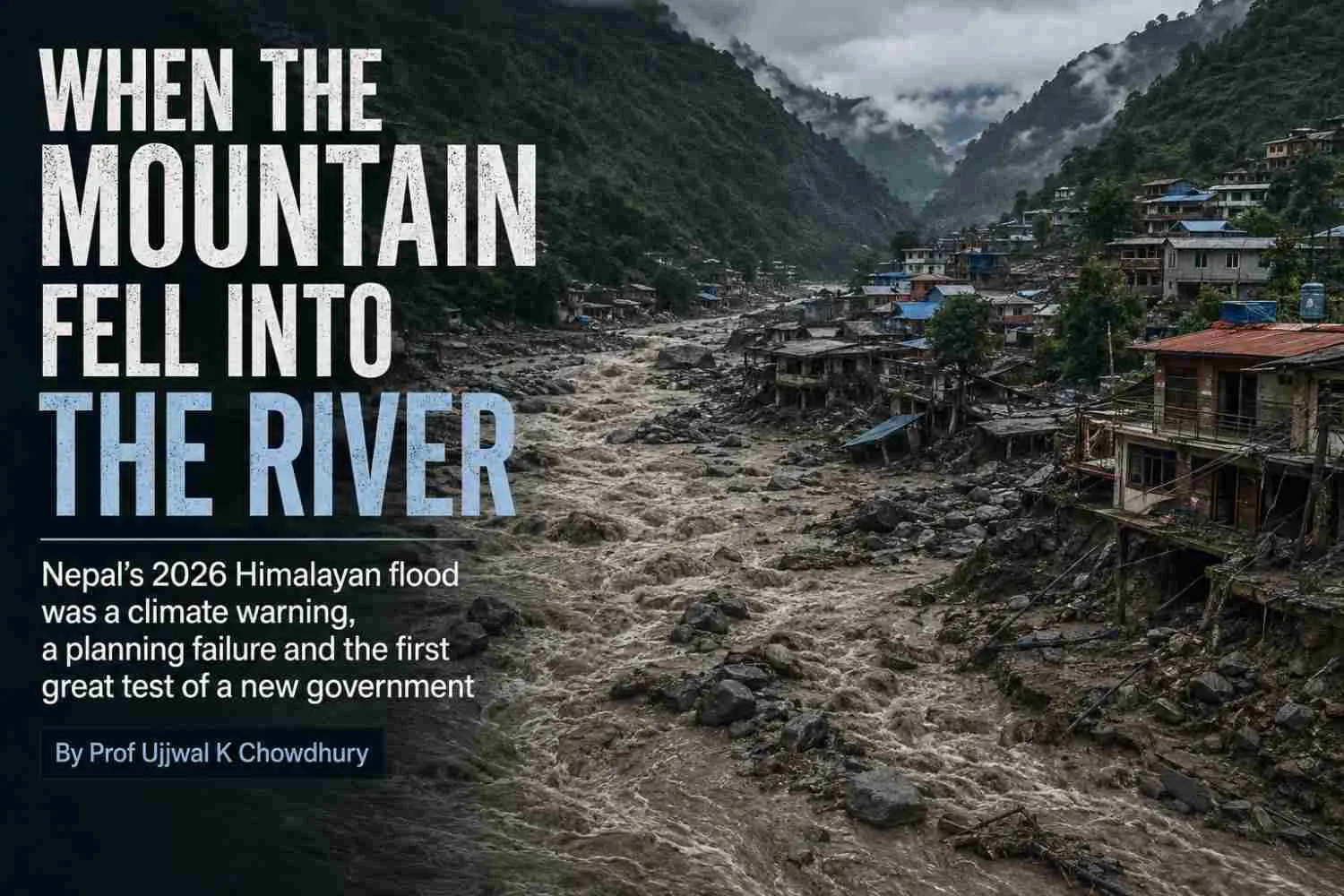
Nepal’s 2026 Himalayan flood was a climate warning, a planning failure and the first great test of a new government
| A mountain of ice and rock collapsed into a Himalayan headwater and sent a wall of debris through Nepal’s Bhote Koshi–Trishuli corridor. The calamity exposed a cruel climate injustice—and the deadly cost of concentrating homes, roads, hydropower and public institutions in a river’s path. |
Evidence cut-off: 30 August 2026. All casualty, missing-person, rescue and damage figures remain provisional and must be read with their stated cut-off.
Summary: A disaster Nepal did not cause—but must now learn to survive Nepal is a low-emission, forest-rich nation living beneath a rapidly destabilising Himalayan cryosphere. The 26 August 2026 flood in Rasuwa appears not to have been a conventional glacial-lake outburst alone, but a cascade: a huge ice-and-rock mass fell into the Lhende valley, probably blocked a headwater temporarily, and released a violent debris flood into the Bhote Koshi and Trishuli systems. Climate warming loaded the background risk; narrow valleys accelerated the surge; and human settlement, hydropower concentration, fragile roads, riverbed disturbance and weak land-use enforcement multiplied the losses. At the evidence cut-off, Nepal had reported 675 confirmed deaths, 2,498 people missing or unaccounted for, more than 3,700 rescues and roughly 93,000 people affected. Damage to roads, bridges, schools, health facilities, border infrastructure and power projects has made this a national systems crisis, not merely a local flood. The new government’s mobilisation saved lives, but shortages of specialised equipment and resilient local command capacity were stark. The central lesson from both this flood and the 2015 earthquake is uncompromising: Nepal must not simply rebuild stronger structures; it must stop rebuilding critical exposure in places no ordinary structure can survive. |
Keywords: Nepal floods; Bhote Koshi; Trishuli; Rasuwa; Himalayan cryosphere; glacier collapse; glacial-lake outburst flood; climate adaptation; hydropower risk; managed retreat; disaster governance; resilient reconstruction; 2015 Gorkha earthquake; Himalayan Resilience Mission. |
| Hashtags: #NepalFloods #HimalayanCrisis #ClimateJustice #BhoteKoshi #Trishuli #GLOF #DisasterResilience #BuildBackSafer #ManagedRetreat #HimalayanResilience |
The morning a mountain entered the river
Nepal did not create the climate crisis now remaking the Himalaya. Through community forestry, it has raised forest cover to an officially estimated 46 per cent, while its carbon emissions per person remain a fraction of the global average. Yet at about 8:40 on the morning of 26 August 2026, the country became the downstream victim of a mountain system changing faster than its scientific surveillance, settlement planning and infrastructure could safely accommodate.
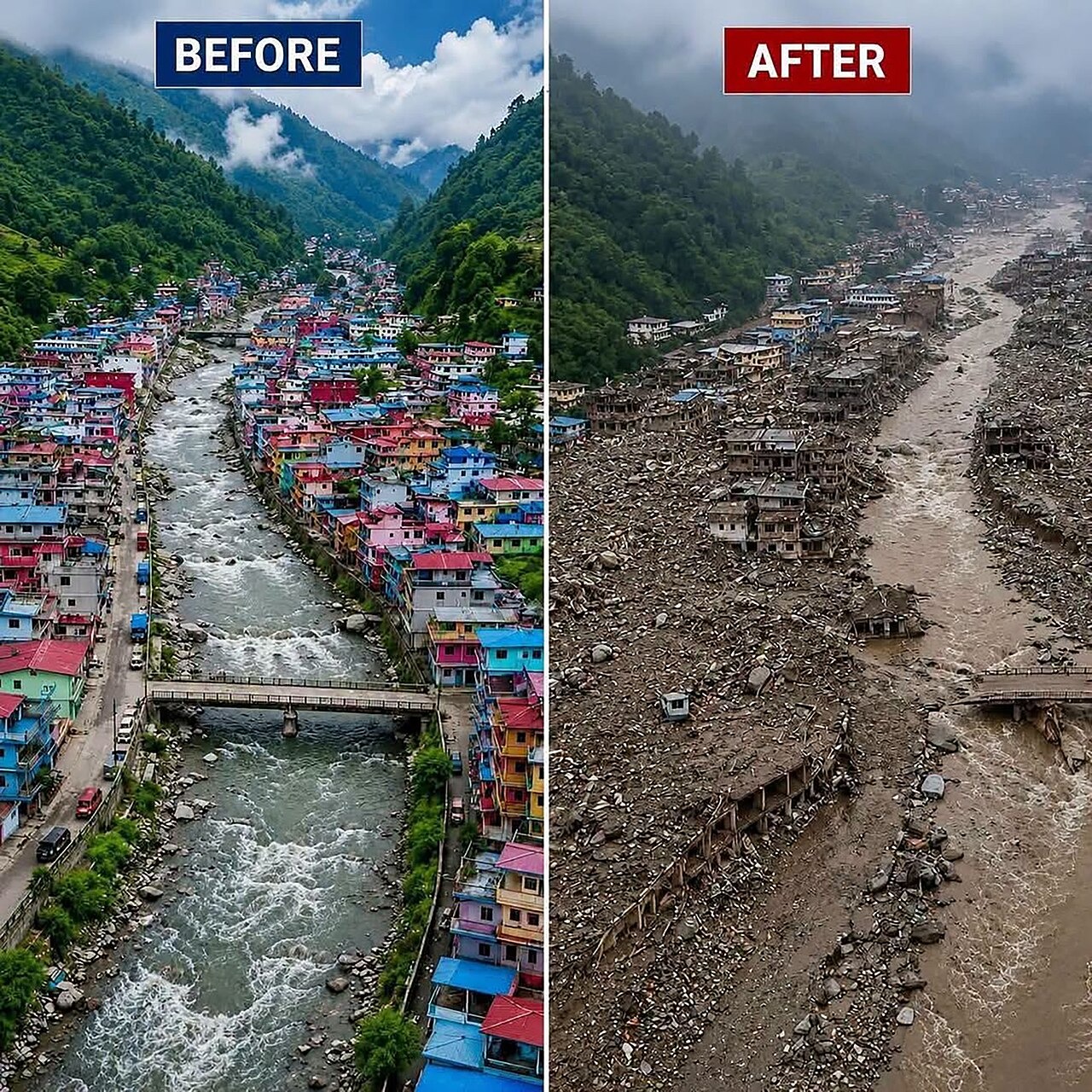
A violent surge entered the Bhote Koshi river system in Rasuwa. This was not an ordinary monsoon flood, carrying only swollen water and silt. Ice, fractured rock, boulders, soil and pulverised debris rushed down together. Timure, Syabrubesi and nearby settlements were struck first. The flood then drove into the Trishuli and farther downstream, erasing roads, bridges, hydropower sites, markets, public offices, vehicles and homes within minutes.
| “Only my body survived.” — Kanchi Nepali, flood survivor |
That sentence captures the human scale of the calamity. It also points to its central public-policy truth. The initial mountain collapse may not have been preventable, but the scale of exposure was not inevitable. Nepal’s ecological values did not fail. Its risk maps, land-use discipline, warning reach, infrastructure standards, emergency equipment and institutional redundancy did.
Not one GLOF, but a chain reaction
Early reports described the event as a glacial-lake outburst flood, or GLOF. The term is understandable, because the final catastrophe behaved like a sudden high-mountain outburst. But the strongest preliminary evidence describes something more complex: a cascading failure of glacier, rock, slope, river and temporary natural dam.
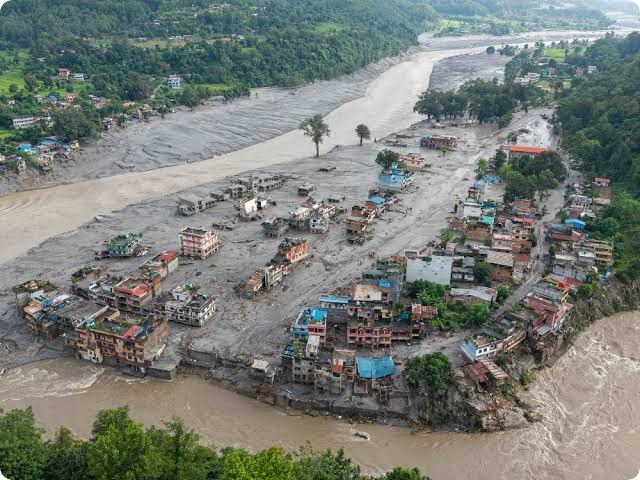
Satellite analysis indicated that a mass of glacier and supporting rock, roughly 600 metres wide, detached near the Langtang Lirung area at an elevation of about 5,200 metres. It fell approximately 1,200 metres into the Lhende valley. The United States Geological Survey initially detected what resembled an earthquake, then concluded that the collapse itself had generated a seismic signal equivalent to magnitude 5.2. The shaking was therefore an effect of the enormous fall, not evidence of a tectonic trigger.
The mass transformed into an ice-rock avalanche. It struck or choked the Lhende Khola, a transboundary headwater running through the Nepal–Tibet border region, and appears to have created a short-lived natural dam. Water accumulated behind the obstruction; the blockage failed; and a high-speed slurry of water, ice, rock and sediment roared into the valley. Scientists are still testing the exact sequence, volume and time between blockage and breach.
This distinction is not academic. A conventional GLOF programme watches known lakes. The Rasuwa disaster shows that a hanging glacier, collapsing bedrock, thawing permafrost or a temporary debris dam can produce a comparable or even more violent flood where no permanent lake has been classified as dangerous. Nepal must therefore graduate from lake monitoring to whole-mountain surveillance.
The valley’s geometry amplified the force. The Himalaya is geologically young, fractured and steep. Rivers plunge through narrow gorges instead of dissipating across broad floodplains. Boulders make the flow behave less like water and more like wet concrete. A blocked channel stores energy; its failure releases a second shock. The mass deposited in one bend can redirect the river across ground that residents had long considered dry and safe.
The event also defeated the assumptions of rainfall-based forecasting. A Nepali technical account reported that the Syabrubesi gauge stopped transmitting at 8:50 a.m.; the Flood Forecasting Division learned at 9:05 a.m. that a large surge had entered from Tibet and sent more than 600,000 SMS alerts at about 9:15–9:16 a.m. Those messages helped people farther downstream, but the upper corridor had almost no usable warning time. In a steep Himalayan basin, ten minutes may separate an evacuation from a mass casualty event.
A green country beneath a warming “Third Pole”
It is too early to claim global heating as the single, courtroom-proven trigger of this particular collapse. Scientists have not eliminated every immediate mechanism. It would, however, be equally misleading to treat the event as an isolated accident in an otherwise stable mountain system.
Warming thins glaciers and changes the pressure they exert on supporting rock. Meltwater penetrates cracks. Freeze-thaw cycles shift. High-altitude permafrost—the frozen “glue” binding some mountain material—weakens. As glaciers retreat, steep rock faces can lose physical support. Rain falling at elevations where snow once accumulated adds liquid water and weight to slopes already approaching failure.
The regional signal is unmistakable. ICIMOD reported that glacier loss across the Hindu Kush Himalaya accelerated by 65 per cent in the 2010s compared with the preceding decade. A 2026 assessment found that the region’s glacier area had contracted by 12 per cent between 1990 and 2020. The cryosphere is not merely shrinking. Its failure modes are changing, and yesterday’s hazard inventory is no longer an adequate guide to tomorrow’s disaster.
Nepal thus faces a profound climate injustice. Nature-friendly practice reduces its contribution to planetary damage, but cannot shield Nepali valleys from heat accumulated largely elsewhere. The response must operate on two levels at once: much stronger adaptation and accountability at home, and a far more forceful international claim for grant-based adaptation, loss-and-damage support and shared Himalayan science.
How a development corridor became a disaster corridor
Human beings did not make the glacier fall. Human decisions did place more people, livelihoods and strategic assets directly in its path.
Homes built where flat land—and safety—were scarce
Mountain valleys offer little level ground. Homes, hotels, markets, schools, truck parks, customs facilities, roads and power projects naturally cluster on river terraces. Over two decades, the Bhote Koshi–Trishuli corridor became an economic spine connecting Kathmandu with Rasuwagadhi and Tibet. Concentration seemed efficient in ordinary times; during an extraordinary debris flood, it became concentrated exposure.
This is why the housing debate cannot stop at whether a dwelling was made of mud, stone, brick or reinforced concrete. Traditional masonry and lightly engineered concrete are vulnerable to scour, saturation, lateral pressure and boulder impact. But no ordinary house can be designed to withstand a fast, multi-metre debris surge at close range. In the most dangerous corridor, safer construction does not mean a stronger wall. It means no permanent construction at all.
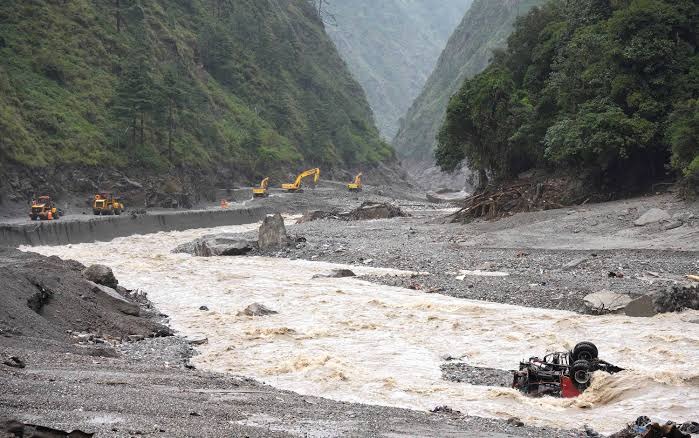
The legacy of the 2015 earthquake deepened the vulnerability. CARE reported, on information from local partners, that hundreds of families displaced by that earthquake had resettled along low banks of the Trishuli, and that a community of about 250 households was swept away. The claim had not yet been independently incorporated into the government’s consolidated damage assessment at the evidence cut-off and must remain provisional. Even so, it raises a devastating question: did one recovery programme move vulnerable people into the path of the next hazard?
Hydropower placed workers and national capacity in one line of fire
Nepal’s hydropower strategy has located operating plants, construction camps, tunnel portals, substations, access roads and worker accommodation along confined river valleys. CARE’s initial assessment identified 14 hydropower and solar projects, with a combined capacity of about 748 MW, as affected. Reuters reported that the damaged power projects represented more than 12 per cent of Nepal’s national generating capacity.
The flood was therefore both a humanitarian calamity and an energy-system shock. Hundreds of hydropower workers were listed as missing. More than 100 people were believed trapped in a mud-filled tunnel at the Upper Trishuli-1 site as rescue efforts entered their fourth day. The image of rescuers entering darkness with inadequate equipment distilled the cost of locating labour, machinery and strategic capacity in the same narrow zone of extreme risk.
The deeper failure was cumulative assessment. A single plant can look acceptable when studied project by project. Fourteen energy projects, multiple worker camps, roads, bridges and substations in one basin can fail together. Environmental clearance must therefore consider the whole river system and the consequences of simultaneous breakdown—not only the footprint of each individual licence.
Roads cut fast, slopes left fragile
Nepal’s “excavator-led development” has often carved roads quickly into steep slopes without adequate drainage, retaining structures or safe spoil disposal. Unregulated crusher operations, riverbed extraction and dumping of excavated muck can raise or divert channels and destabilise banks. None of these activities caused the high-altitude collapse. They can, however, intensify local erosion, add debris, trigger secondary slides and destroy the access routes needed by rescuers.
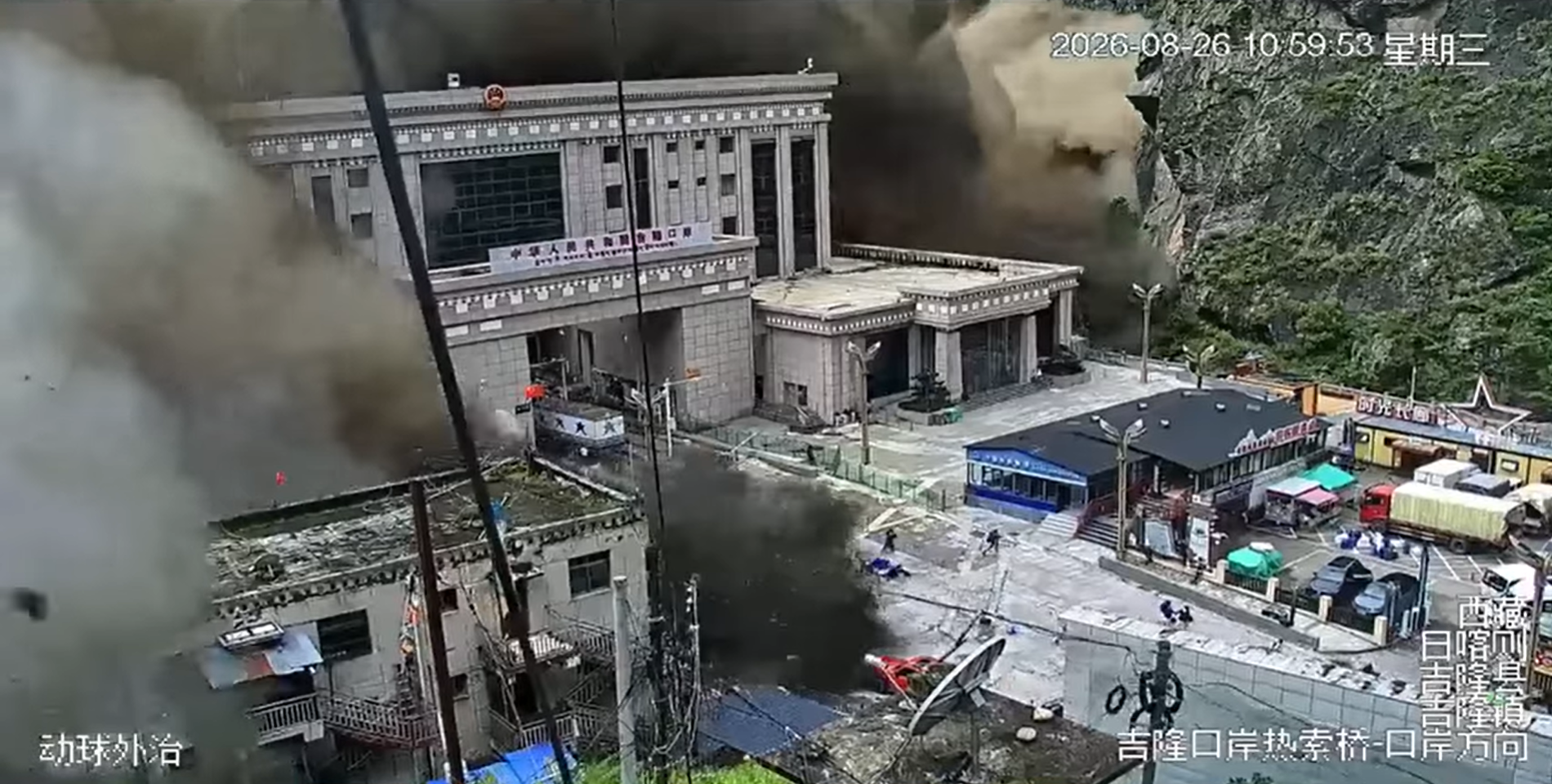
Development is not the enemy. Development that ignores geomorphology is. A road that collapses in every extreme event is not cheap infrastructure; it is deferred public loss. A bridge designed only for water level, and not for boulder-laden debris, is not resilient. Spoil dumped over a slope or into a channel is not disposal; it is material pre-positioned for the next flood.
When local government itself became a casualty
Federalism put municipalities and wards on the front line of disaster response. In Rasuwa and Nuwakot, municipal buildings, ward offices, public records, electricity and communications were lost, while elected representatives and employees were counted among the missing. The institutions expected to map needs, certify losses, release funds and organise shelter became victims of the same flood.
This exposed a critical design flaw. Response authority was decentralised, but redundant communications, off-site data backups, mobile command posts and deployable engineering capacity were not decentralised with it. A local government cannot remain the first responder if the destruction of one building also destroys its records, radios and ability to act.
The human ledger is vast—and still unfinished
Every early disaster count is a moving target. Missing-person lists may contain duplicate names. People cut off by failed communications may later re-establish contact. Bodies and fragments carried far downstream complicate identification. Rescue figures issued by different agencies at different cut-offs cannot simply be added together. With those cautions, the strongest available snapshot by 30 August was nevertheless staggering.
Nepal had recorded 675 confirmed deaths and 2,498 people missing or unaccounted for. The cross-border toll stood at 691 deaths, including 16 in Tibet, and 3,044 missing, including 546 in Tibet. The latest Associated Press account reported more than 3,700 people rescued in Nepal, while IFRC estimated that about 93,000 people had been affected. At least 17,000 children needed urgent assistance. These are not final figures; they are a minimum portrait of national grief.
The physical damage is immense, but no reliable consolidated price existed at the cut-off. Early accounts identified about 40 kilometres of major road destroyed, at least 19 motorable bridges and dozens of suspension bridges lost, devastated customs and security infrastructure, hundreds of vehicles swept away and multiple energy projects damaged. Eighteen schools were destroyed and another 20 damaged, leaving an estimated 10,000 school-age children needing support to continue learning. Health authorities reported three health posts completely damaged, one hospital partly damaged and access to two hospitals disrupted.
No trustworthy national total for homes lost was yet available. Nor should a financing estimate be confused with an audited loss assessment. Finance Minister Swarnim Wagle said Nepal might require US$4–5 billion to rebuild—close to one-tenth of the economy—while clearly warning that assessment work was continuing.
| “This is just an estimate. Loss and damage is being assessed.” — Finance Minister Swarnim Wagle |
That caution should govern all public communication. A disaster dashboard must distinguish confirmed from provisional figures; Nepal from the cross-border picture; people missing from people feared trapped; money pledged from money received; and financial need from verified physical loss.
Balen Shah’s first trial by catastrophe
Prime Minister Balendra “Balen” Shah took office on 27 March 2026 after the Rastriya Swatantra Party won 182 of 275 seats in the lower house. The mandate emerged from the 2025 Gen Z upheaval and rested on promises of competence, clean administration, jobs and a break with old patronage politics. Five months later, the Himalayan flood became the new government’s first existential test.
The state moved quickly on several fronts. The Nepal Army, Armed Police Force, Nepal Police, national disaster authority, health emergency system, provincial and local administrations, helicopters, drones and medical services were mobilised. Downstream alerts were issued; relief centres opened; tracing support was provided to Nepali and foreign families; DNA evidence was preserved before unidentified bodies were buried; and rivers and newly formed barrier lakes were placed under observation.
These actions saved thousands of lives. Helicopters bypassed broken roads. Warnings enabled evacuation downstream. By 29 August, more than NPR 5.44 billion and a further US$1.88 million had reportedly reached official relief accounts. The cabinet committed one month’s salary and began preparing a rehabilitation package.
But the response also exposed the distance between digital aspiration and physical capacity. Agencies deployed dashboards, portals, GIS maps, drones and AI-supported data work, while field footage showed soldiers searching a dark, mud-filled hydropower tunnel with phone lights. Nepali reporting described shortages of heavy breaching equipment, satellite communications, payload drones and specialised tunnel-rescue machinery. Technology is not resilience if the data platform is modern but the rescue team lacks the tools to reach a trapped worker.
The government initially restricted foreign search-and-rescue deployments, arguing that its own forces could manage and seeking to avoid the coordination congestion experienced after the 2015 earthquake. It later asked for defined specialist support in tunnel rescue, survivor detection, forensics and DNA, mortuary refrigeration, communications restoration and modular bridges. Moving from open-ended aid to a precise needs list was sensible; waiting during a narrow survival window nevertheless drew criticism. At the cut-off there was no evidence that the delay caused a specific death, and it should not be claimed otherwise.
The world answered—but a pledge is not a result
International support arrived from multiple directions. India delivered more than 57 tonnes of relief supplies and sent an 11-member tunnel-reconnaissance team. China provided tunnel specialists and emergency goods, while Japan supplied tents and blankets. South Korea deployed a response team and pledged US$1 million. The United Kingdom announced £5 million and a consular rapid-response team; Australia announced A$5 million; and the European Union allocated €2 million and activated satellite mapping. WHO sent medical supplies, UNICEF sought US$17.2 million, IFRC released nearly CHF1 million and launched a CHF25 million appeal, and the World Bank discussed possible emergency assistance of NPR 25 billion.
This support expanded airlift, shelter, health, mapping and specialist capacity. Yet delivered goods, money deposited, expertise deployed, assistance offered, humanitarian appeals and loans under discussion are fundamentally different categories. Nepal should publish each separately. The world’s compassion will be measured not by the largest headline in the first week, but by what reaches bereaved families, displaced communities and damaged municipalities before the next monsoon.
2015 and 2026: two disasters, one unfinished lesson
The 2015 Gorkha earthquake was broader and deadlier. Its magnitude-7.8 main shock and major aftershock killed 8,970 people, injured more than 22,000, affected about eight million and destroyed or badly damaged more than 755,000 homes. Physical damage was assessed at about US$7 billion, while recovery needs reached US$6.7 billion—roughly 30 per cent of GDP.
The 2026 flood has so far killed fewer people, but its damage is intensely concentrated along a strategic, transboundary river corridor. It simultaneously struck energy, trade, tourism, transport, public administration and border connectivity. The earthquake produced aftershocks and landslides; this flood leaves unstable slopes, altered channels and possible barrier lakes capable of triggering new surges. The 2015 engineering lesson was to make structures resist shaking. The 2026 spatial lesson is to keep permanent settlement and critical systems away from extreme debris corridors and to design risk at basin scale.
The contrast in relief is equally instructive. After the earthquake, a huge international influx strengthened medical and humanitarian response but strained logistics and coordination. In 2026, Nepal exerted greater national control and sought more selective foreign technical help. The right model lies between chaotic oversupply and defensive hesitation: sovereign coordination, a transparent needs list and immediate acceptance of capabilities that Nepal demonstrably lacks.
Reconstruction after 2015 began badly. Political conflict delayed a functioning National Reconstruction Authority until 25 December 2015, eight months after the main shock. A border crisis restricted fuel and construction materials. Survivors endured monsoon and winter in temporary shelters while policy, beneficiary lists and housing grants stalled.
The later record was considerably better. Nepal’s owner-driven model paid household grants in stages, connected disbursement to safer construction and added technical inspection and grievance systems. The national programme eventually produced more than 700,000 earthquake-resilient houses; a World Bank-supported component accounted for more than 300,000. Nearly all schools and public buildings were later reported rebuilt to improved standards, and rural housing recovery approached 95 per cent by the tenth anniversary, although urban disputes and exclusion persisted.
The equity failure must not be forgotten. Landless people, tenants, low-caste families, single women, older persons and people with disabilities struggled disproportionately to prove eligibility, secure land or manage construction. The Asia Foundation documented the experience of a landless Dalit widow who remained in temporary housing for five years. National recovery averages can hide the people recovery leaves behind.
Five lessons from 2015 therefore run through every decision in 2026. Stable coordination must be established before another construction season is lost. Households should lead their recovery, but must not be left to carry engineering risk alone. Tenants, informal occupants and landless families must be eligible from the beginning. International aid should be controlled through a public needs list. And Nepal must never rebuild only for the last hazard: an earthquake-resistant house placed in a debris-flow red zone is not a safe house.
The next year: grief, pressure—and political judgment
The social consequences will outlast the television images. Families must endure ambiguous loss while identification continues. Missing-person cases will create disputes over death certificates, compensation, inheritance and land. Displaced children risk losing months of schooling. Crowded shelters and disrupted livelihoods can increase risks of trafficking, exploitation and violence, particularly for women and children. If relocation sites separate people from farms, markets, schools, tourism and transport, economic necessity will drive many families back to the river.
The economic impact will spread well beyond Rasuwa. Emergency expenditure and reconstruction will strain the national budget. Damaged hydropower may reduce electricity exports or force seasonal imports. Disruption on the Rasuwagadhi–Gyirong route will raise logistics costs, while trekking and pilgrimage cancellations will hit local income. Insurers and lenders may price hydropower and mountain infrastructure more cautiously.
Yet a well-designed recovery can become a growth strategy. Demand will rise for resilient engineering, safer materials, satellite and GIS services, river restoration, distributed renewable energy, microgrids, tunnel safety and trained construction labour. If procurement is transparent and local, reconstruction can create jobs rather than merely import equipment and debt.
Politically, the Shah government may emerge stronger if it publishes every rupee received, every contract awarded, every beneficiary selected and every milestone completed. If compensation becomes partisan, procurement opaque or relocation coercive, the same youth constituency that demanded political change in 2025 may turn against the new administration. No-construction zones will inevitably confront landowners, contractors, quarry operators, hydropower interests and political networks; the government will need law, evidence, compensation and public consent—not slogans alone.
Diplomatically, disaster management will move to the centre of Nepal’s balancing relationship with China and India. China controls access to essential upstream territory and data. India is indispensable for downstream coordination, logistics, modular bridges, energy balancing and flood alerts. This calamity gives Kathmandu both the necessity and the moral authority to seek a standing trilateral Himalayan warning and response mechanism.
Twenty actions for a safer Nepal
Nepal should not reduce this recovery to a collection of replacement contracts. It needs a ten-year Himalayan Resilience Mission, backed by law and launched through a first-year compact that assigns duties to the state, citizens and the international community.
What the Nepal government must do
- Create one public source of truth. The federal government should publish a reconciled, time-stamped dashboard for deaths, missing people, rescues, affected families, physical damage, aid received, funds spent, contracts and reconstruction progress. Categories and cut-off times must be explicit so that numbers cannot be inflated, added twice or manipulated politically.
- Give every missing person and family a legal pathway. A unified identification and tracing command should connect DNA collection, hospitals, mortuaries, police records and cross-border information. Fast legal procedures must address presumptive death, compensation, inheritance, guardianship and replacement of lost documents, while protecting families from fraud.
- Map the whole mountain, not only known lakes. Nepal should combine optical and radar satellites, InSAR slope monitoring, seismic and acoustic avalanche detection, high-altitude cameras, field geology and local observation to identify hanging glaciers, unstable rock faces, thawing permafrost, temporary dams and altered channels.
- Freeze unsafe rebuilding before concrete returns. A rapid red-amber-green zoning exercise should precede every permanent reconstruction approval. Red zones need an immediate construction moratorium; amber zones require site-specific engineering and evacuation plans; green zones should receive faster permits and infrastructure support.
- Use managed retreat, never forced eviction. Families leaving extreme-risk areas must receive replacement land with secure title, fair compensation for structures and livelihoods, rental support during transition, and relocation as functioning communities with schools, health care, markets, transport and cultural continuity. Tenants, informal occupants and landless people must qualify.
- Make local government disaster-proof. Every exposed municipality should have cloud-backed records, satellite communications, portable power, a mobile command post and access to regional equipment banks. Authority must travel with capability so that the destruction of a ward office does not paralyse relief.
- Put hydropower safety on a basin scale. All affected tunnels, headworks, substations, camps and access roads must be independently audited before reopening. Future approvals should require cumulative basin assessments, worker housing outside extreme floodways, tunnel refuges and escape routes, emergency power and communications, insurance and dedicated disaster reserves.
- Rewrite road, bridge and extraction rules for debris. New standards must consider boulder impact, scour and channel migration, with greater bridge clearance, replaceable spans, robust drainage, safe spoil sites, bioengineered slopes and independent material testing. Unscientific riverbed mining and dumping into valleys must be stopped and penalised.
- Automate warnings across every last mile. Redundant river gauges, sirens, radio, cell broadcast, satellite fallback and community messengers should be connected so verified thresholds can trigger downstream warnings without waiting for a slow chain of approvals. Schools, hotels, trekking routes, work camps and border posts need regular drills.
- Build an accountable recovery authority quickly. Nepal should avoid the eight-month institutional delay that followed the 2015 earthquake. A time-bound authority or empowered mission unit must include federal, provincial and local government, independent engineers, affected communities and civil society, with open procurement, grievance redress and public audits.
What Nepal’s people, institutions and private sector must do
- Turn every exposed community into a warning network. Residents should map elderly people, children, persons with disabilities, safe routes, high ground, shelters and transport assets. Local volunteers need first-aid, search, radio and evacuation training, with women and young people in leadership rather than treated only as beneficiaries.
- Refuse the dangerous return to business as usual. Citizens, builders and local leaders must respect red zones and resist rebuilding on familiar but lethal river terraces. Community consent is essential, but consent must be informed by accessible hazard maps and paired with genuine land and livelihood alternatives.
- Make citizen science part of national science. Mountain residents, guides, hydropower workers, farmers and schools can report new cracks, unusual river colour, falling water levels, booming sounds, ice movement and blocked channels through verified local protocols. Their observations should feed—not replace—professional monitoring.
- Protect dignity and inclusion throughout relief. Community groups, media and civil society should monitor aid distribution, shelter safety and exclusion. Dalits, Indigenous communities, tenants, migrants, single women, older people and people with disabilities must be represented in beneficiary verification and relocation decisions.
- Convert reconstruction into a resilience workforce. Universities, technical institutes, businesses and municipalities should train young Nepalis as resilient masons, bridge technicians, GIS operators, drone pilots, glacier-monitoring assistants, tunnel rescuers, solar and microgrid technicians, community educators and bioengineering crews. Procurement should favour competent local firms, women-led enterprises and affected districts.
What the world community must do with Nepal
- Send capabilities, not merely consignments. International partners should respond to Nepal’s published needs with specialised tunnel rescue, survivor detection, heavy breaching tools, payload drones, satellite communications, modular bridges, forensic support and mortuary capacity. Equipment must include training, maintenance and local ownership after the emergency.
- Finance adaptation as climate justice, not a debt trap. Donors, multilateral banks and climate funds should prioritise grants and deeply concessional finance, including Green Climate Fund and loss-and-damage resources. Nepal should ring-fence at least 20–25 per cent of reconstruction spending for risk reduction, supported by hydropower royalties, disaster insurance and a transparent diaspora resilience bond.
- Create a Nepal–China–India headwater protocol. The three countries should establish continuous upstream data exchange, common alert language, direct links among technical agencies and border posts, shared satellite imagery, automatic transboundary warnings and annual joint exercises. Rivers and glaciers cannot wait for diplomatic notes.
- Build an open Himalayan science commons. Space agencies, universities, ICIMOD, development partners and Nepali institutions should share high-resolution imagery, glacier inventories, slope data, models and field research in usable formats. Long-term funding must develop Nepali scientists and monitoring capacity instead of creating permanent dependence on foreign analysis.
- Stay for the decade, and measure outcomes. Humanitarian attention should not disappear when rescue ends. Partners must support safe housing, schools, health systems, energy diversification, microgrids, resilient tourism and watershed restoration through the next monsoons. Success should be judged by reduced exposure, restored livelihoods and lives protected—not by money pledged or kilometres rebuilt.
Rebuild the nation, not the next disaster
The 2015 earthquake taught Nepal how to construct walls that shake less. The 2026 flood must teach the country where not to build, how to watch an entire mountain, and how to protect power, roads, communications, government and communities when one valley fails.
The wrong recovery would replace a washed-away bridge at the same height, rebuild a camp beside the same tunnel portal and move a landless family to the nearest available river terrace. It would count expenditure as achievement and convert reconstruction finance into the next catastrophe.
The better recovery would create safer settlements, modern mountain science, a skilled resilience workforce, diversified energy, accountable government and a regional warning compact. Nepal cannot stabilise the global climate on its own. But with justice from abroad and courage at home, it can become the world’s leading laboratory for climate-resilient Himalayan development.
| Build back safer—and, where necessary, build somewhere else. |






Add a Comment