
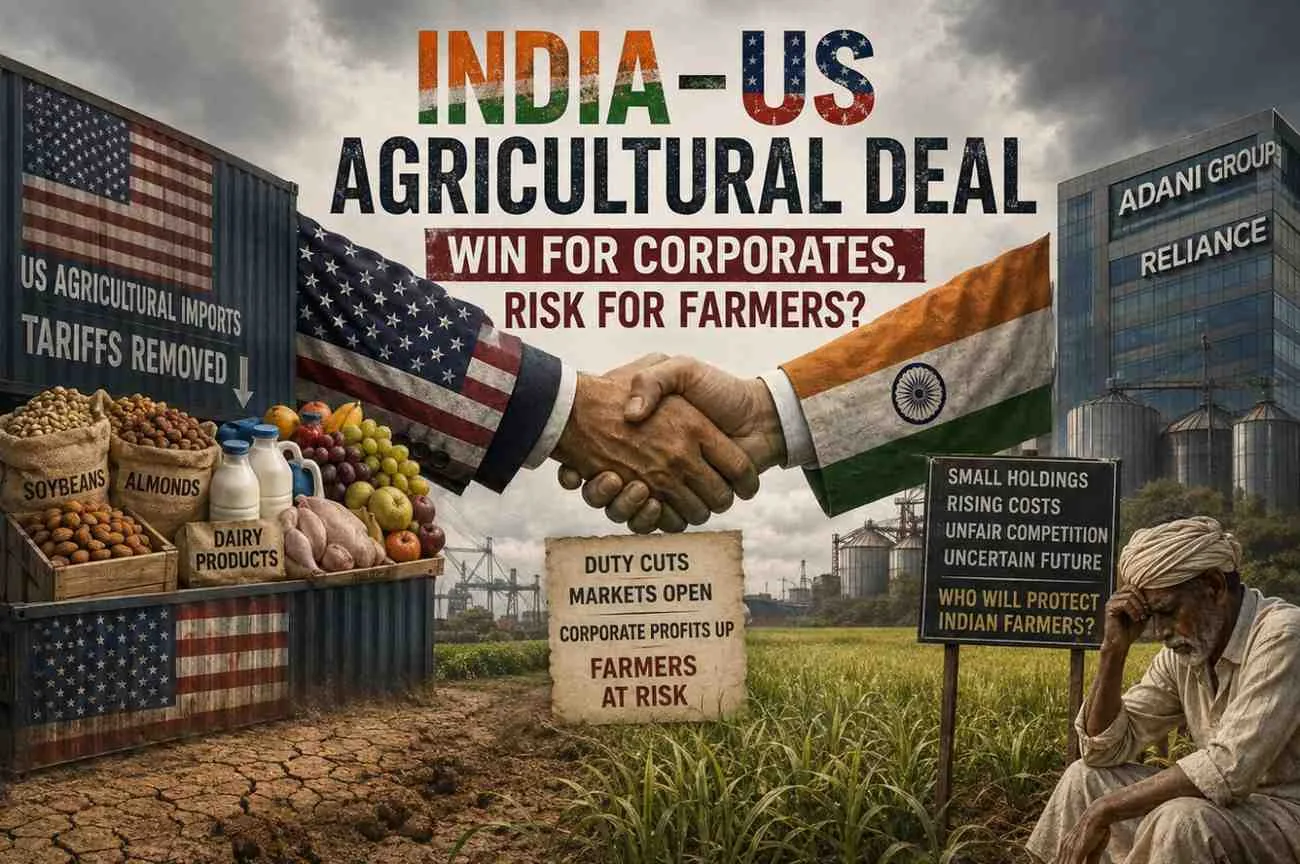
| Summary: Crippled with financial stagnation and vagaries of monsoonal rainfall, Indian farmers are always on the subdued part of the see-saw ride. Enhancing this burden, here comes the most controversial pact of this year – the India-US Agricultural deal. Opening up like a free market to the corporate giants, this deal is sure to feed the corporate sharks let alone the hapless farmers of India. Exemption of import duties shall open the floodgates of American crops and food items flocking the Indian market, forcing the teeming millions to spend a lumsome on the imported items while the production at home is sure to lose it’s share in the market. Disastrous to the common people of India, this deal has opened many questions which are yet to be answered. |
| Keywords: Monsoon, Indian agriculture, India-US Agricultural deal |
by Dr. Kanailal Das
Farmers have small landholdings, so the mechanisation in agricultural sector is not a dominant feature. Moreover Indian agriculture is largely determined by the rainfall pattern of monsoon. As arrival, duration and departure of monsoon winds is uncertain, the production of crops is also uncertain, production varies from year to year. During weak or delayed monsoon production of crops is hampered.
Indian agriculture is also highly labour intensive. Large share of the population is engaged in agricultural activities. Low productivity is also another major feature of Indian Agricultural System.
Crop yields are lower than in many developed countries because of small farms,limited scope of irrigation and traditional farming practices .
But the agriculture has the central role in Indian economy. Large numbers of population select their livelihood from agriculture. Indian agriculture produces essential food grains, vegetables, fruits, pulses and dairy products for India's large population. Many industries depend on agriculture produce. Agriculture supplies raw materials for jute and cotton textile industries. Sugar industry and food processing industries largely depend on the raw materials like sugarcane, fruits and food crops etc.
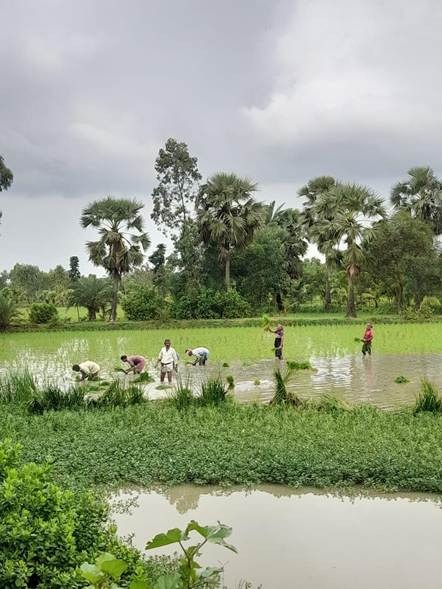
The income of farmers is mostly uncertain and meagre. Crop prices fluctuate sharply, while the cost of seeds, fertilisers, diesel, pesticides and labour costs are increasing rapidly.
Farmers with small and fragmented landholdings cannot use modern technology hence the production cost remain high, production remains low and the market prices are ever fluctuating. Droughts, floods, irregular rainfall and the seasonal and spatial variation of rainfall affect the production and the farmers get into trouble every now and then.
6th February 2026 saw the official announcement of India - US trade agreement by US president Donald Trump.
The United States of America and India agreed on a framework under which India would reduce or eliminate tariffs on selected agricultural products, while the US would reduce its reciprocal tariff on Indian goods to 18%.
The major features as stated are ,
1. The Government of India will completely eliminate or significantly reduce import duties on all US industrial goods.
2. American food grains and agricultural products will be completely waived or drastically reduced in Indian markets .
The major products include animal feed, sorghum, almonds, fruits, soybean and soybean oil, various types of pulses, dairy products, eggs and poultry meat.
3. India agrees to purchase increasingly more industrial goods in future, amounting to 45 to 50 lakh crore rupees over the next 5 years
4. The US Government had imposed a 25% tariff on Indian goods exported to US markets. This amount of tariff will now be reduced to 18%.
A 25% tariff had also been imposed on India as a penalty for importing oil from Russia ( effective from August 2025). Now it has been proposed to lift the tariff on the condition that India will no longer import oil from Russia and India will import oil from USA and Venezuela.
American farmers comprise only 2% of the total population of the country and they get huge amount of subsidy, where as in India nearly 68% of the total population are engaged in agriculture with the traditional methods on the small and fragmented landholdings unsuitable for mechanised and commercial production . In India 84% of the landholdings are unprofitable . US agriculture is highly mechanised and modern in nature . The farmers are rich with large landholdings. The agriculture of America is highly commercial in nature . So Indian farmers are facing great problems as the farmers are not getting remunerative price for their crops .
The price of fertilizer, seeds, pesticides and the cost of irrigation is rising heavily in India. So there is massive gap between income and expenditure in India .
Under these circumstances Indian will definitely be in disaster after the India US trade deal . The import duty shield in India has long been a practice in the field of agriculture to protect the farmer's interest in international competition. Previously, this import duty averaged around 150%, after 1990,with the introduction of new economic and industrial policies it gradually dropped to 37%.
And now import duties on US agricultural products will be eliminated. As a result, Indiast poor farmers will be thrown right in front of American rich farmers .
Some examples can be provided ,
1. At present an import duty of 55% to 81% is to be paid to import foreign dairy products in india. After the agreement , American dairy products will enter without any import duty and it will destroy the country's dairy industry.
2. Until now the import duty on soybean was 55%, with the removal of the import duty nearly 5 crore farmers of India will be affected.
3. In India almost 4 crore farmers are engaged in poultry sector . Apart from chicken farmers produce 14,200 eggs annually. If the import duty on poultry sector is eliminated American cheap poultry products will capture the Indian market and this sector will be ruined.
4. According to the agreement US apples will enter the Indian markets without any import duty. At present apples from Britain are coming to the markets of India on the basis of an agreement signed few months ago . As a result already the apple farmers of Kashmir and Himachal Pradesh are facing problem. Again American apples, grapes, banana, orange will flood the Indian markets creating crisis . Huge production of fruits of India may be decomposed .
5. Cotton is the most important commercial fiber crops of India. India earns huge amount of revenue from cotton and cotton textile goods. According to the agreement if Bangladesh import cotton from America, the industrial finished products , the textile goods can be sold in American markets without any duty.
Till date a major portion of cotton is exported to Bangladesh . After the agreement India will lose the cotton market in Bangladesh. Bangladesh will not import cotton from India and Indian farmers engaged in cotton cultivation will face great loss .
6. Disaster will also strike pulse production. Around 3 crore of farmers are engaged in the production of pulses . There is currently an import duty of around 30% on pulse imports . Once that is lifted the importers will bring pulses from America . Domestic pulse production will face devastating picture .
Now the question is important , who will buy and bring the massive volume of US agricultural goods. Definitely giant import export agricultural business corporates will do this . Mainly Adani Group will play vital role in this sector . They will buy US agricultural products without import duty and sell in the markets by higher prices .. They will get huge amount of profit. But the producers of India , the Indian farmers will be in great dangers . They will not be able to lead an uneven fight with the corporates like Adani Groups.
And what about Ambani?
The India-us Trade agreement is highly profitable for Reliance Industries Limited. The recent agreement signed by the Reliance Industries with America involving a capital expenditure of 27 lakh crore rupees to set up a massive oil refinery in Texas will be immensely aided by the agreement.
But what is the future of the common people?
What is the future of the farmers and workers of the country?
The farmers of India are protesting now against the agreement. The lowering of import tariffs of US products will flood the domestic markets with cheaper, heavily subsidized American agricultural products.
Farmers groups under alliances like the Desh Bachao Morcha launched nationwide demonstration including a major Kishan Mahapanchayat in Delhi citing direct threats to their livelihoods .
Indian Agricultural Policies
Bonfire for Corporate Companies Pyre for Peasants .AIKKMS Publication. Kheye pore banchar golpo , Moitrish Ghatak, Anandabazar Patrika , 22/4/2026
Biswajit Dhar , India -US Trade agreement,13/2/2026.
ABOUT AUTHOR

Dr Kanailal Das
Masters in Geography from University of Calcutta, former senior research fellow, CSIR, PhD on Vulnerability of Gosaba, Basanti, Sundarban from Vidyasagar University.
He has participated in many national and international seminars and has papers and book chapters to his credit.




Add a Comment