
Kolkata |31 August, 2026
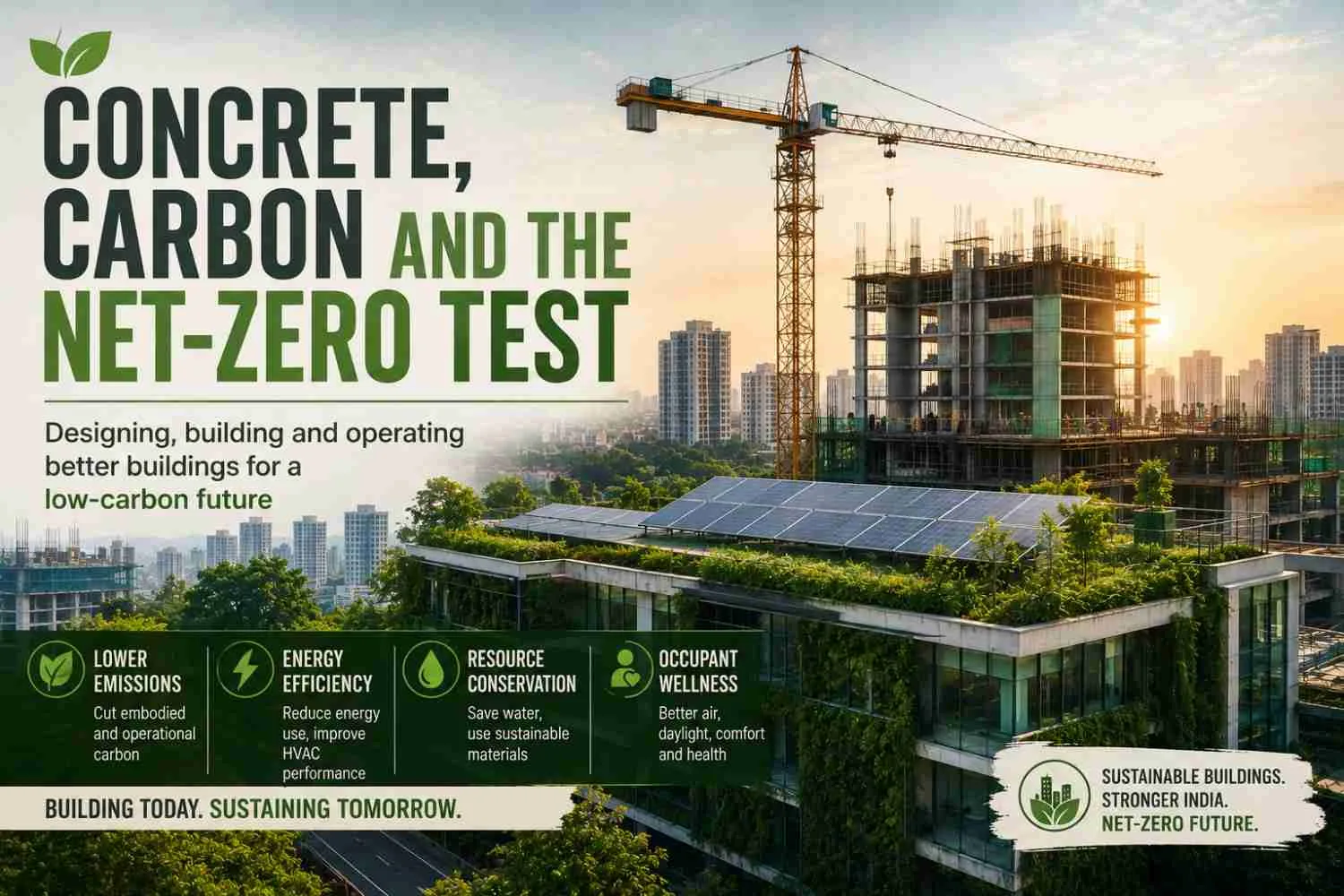
| India’s construction boom is creating a narrow window to cut emissions before new commercial and residential buildings lock in decades of energy demand. Green standards, low-carbon materials, efficient cooling and occupant wellness are becoming central to that transition. |
| Summary India’s building sector is expanding rapidly, making construction and building operations an important part of the country’s decarbonisation challenge. Buildings already account for a significant share of India’s electricity demand, while much of the building stock that will exist in the coming decades is yet to be constructed. Green-building frameworks such as IGBC and GRIHA are pushing developers towards better energy, water, material and indoor-environment performance. BEE has also strengthened the policy framework through the Energy Conservation and Sustainable Building Code 2024 and Eco Niwas Samhita 2024. But certification alone cannot prove that a building is genuinely low-carbon. The bigger test is whether developers reduce embodied carbon in materials, improve HVAC performance, lower actual energy use and deliver measurable benefits for occupants after the building becomes operational. |
Keywords green buildings India, net-zero buildings India, building decarbonisation, embodied carbon, construction carbon emissions, low-carbon construction, sustainable buildings, green building standards India, energy-efficient buildings, HVAC efficiency, green cement, recycled steel, building energy efficiency, occupant wellness, sustainable construction, building emissions, real estate decarbonisation, net-zero real estate, green construction India, building performance |
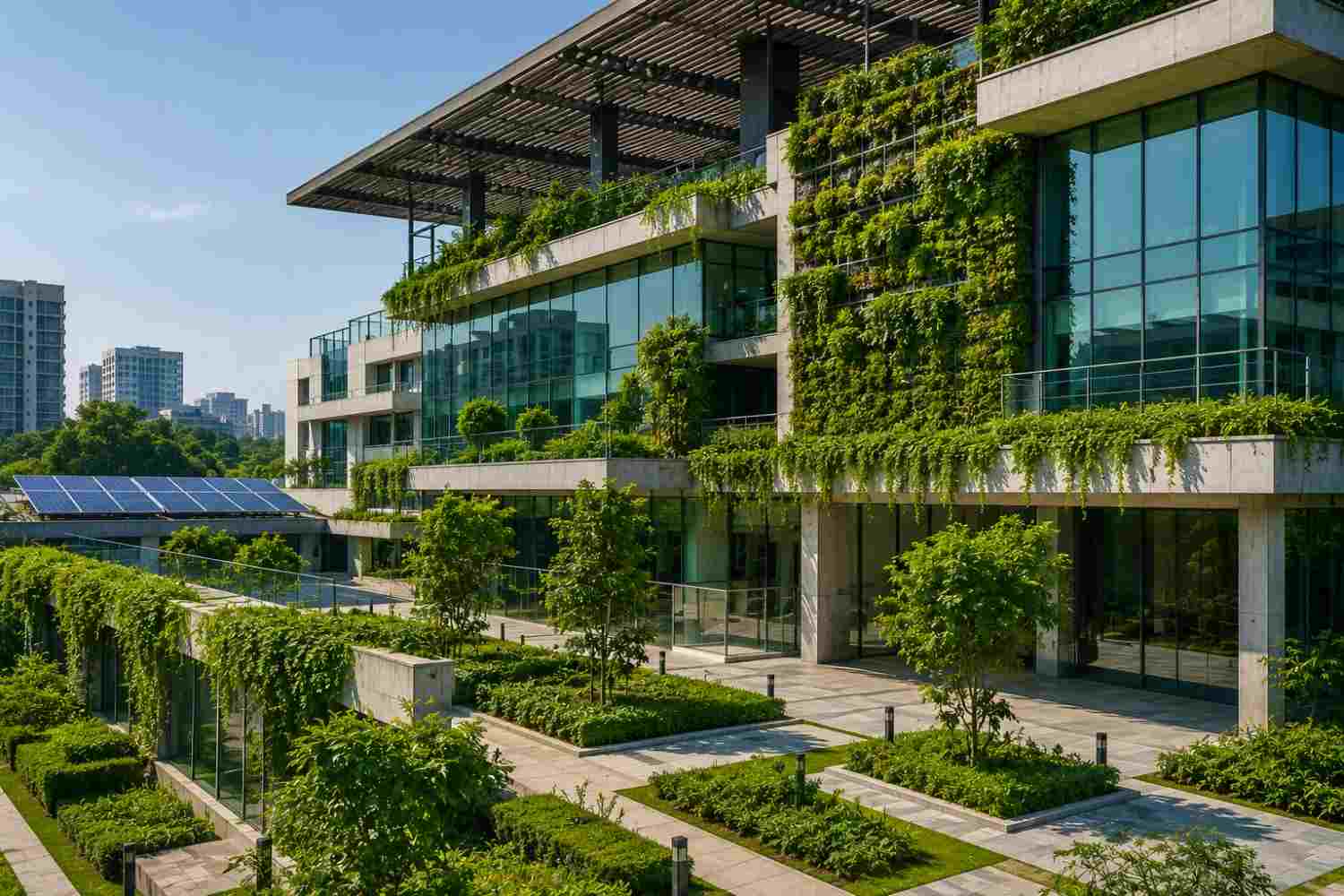
Can India’s real-estate boom become a decarbonisation opportunity instead of an emissions trap?
India is entering a major phase of construction, with new offices, homes, hotels, hospitals and commercial developments expanding across its cities. Every building project makes decisions that can shape energy demand, cooling needs, material use and water consumption for decades.
That creates both a challenge and an opportunity.
A poorly designed building can lock in high energy consumption long after construction is complete. A well-designed one can reduce that demand from the outset through passive design, energy-efficient systems, lower-carbon materials and renewable energy.
This is why the net-zero real-estate conversation is moving beyond visible measures such as solar panels and efficient lighting.
The bigger question is how a building is designed, what materials go into it, how efficiently it operates and whether the people inside it actually experience healthier and more comfortable conditions.
In other words, decarbonising real estate is not just about making buildings consume less electricity. It is about reducing their environmental footprint from construction and material choices through everyday operation and occupant wellbeing.
WHERE A BUILDING’S CARBON COMES FROM
CONSTRUCTION
Cement + steel + glass + transport
↓
EMBODIED CARBON
OPERATION
Electricity + cooling + lighting + equipment
↓
OPERATIONAL CARBON
OCCUPANCY
Thermal comfort + daylight + ventilation + indoor air quality
↓
OCCUPANT WELLNESS
NET-ZERO BUILDING
Materials + energy + people + performance
Are green-building certifications enough to prove that a building is genuinely sustainable?
India has developed two major voluntary green-building frameworks: the Indian Green Building Council (IGBC) and the GRIHA Council. Both assess buildings against a range of sustainability criteria, although their rating systems and approaches are not identical. IGBC offers rating systems for areas including new buildings, homes and net-zero buildings, while GRIHA evaluates factors such as energy and water use, materials, waste management, site planning and occupant-related performance.
But certification should not be treated as simply a green label.
It can demonstrate that a project has met a defined set of sustainability criteria. The harder test comes after the building is occupied.
Does it perform as promised when it is put to real-world use?
A developer may secure certification during the design or construction stage, but the building's real energy and resource performance becomes clearer only after it begins operating. Actual occupancy, cooling demand, equipment use and maintenance can all affect its performance.
That makes the evidence behind the claim just as important as the certification itself.
A credible assessment should establish the baseline, the performance target, the methodology used and the comparison point. It should also show how much energy the building actually consumes per square metre and whether that performance continues to be monitored after certification.
This distinction becomes even more important for net-zero claims. A building may perform efficiently during operation, but its overall environmental footprint also depends on factors such as the materials used in construction and the emissions associated with producing and transporting them.
Certification can show that a building meets a standard. Long-term performance data is what shows whether that standard translates into real-world sustainability.
Can green cement and recycled steel cut the carbon hidden inside construction?
Operational energy is only one part of a building’s carbon footprint.
A building may use relatively little electricity once it is occupied and still carry significant emissions from the materials used to construct it. Those emissions are generated before the building is even ready for use, through activities such as mining, processing, manufacturing and transportation.
This is why cement and steel are at the centre of the embodied-carbon debate. Developers and material manufacturers are increasingly exploring lower-carbon cement, alternative binders, recycled steel and more efficient use of construction materials to reduce emissions at this stage.
But calling a material “green” is not enough.
The real test is what changed compared with the conventional alternative. What material was replaced? What was its original carbon intensity? How much recycled content was actually used? Where was the material sourced from? What lifecycle boundary was used to calculate the reduction? And how much carbon was genuinely avoided?
Without a clear baseline and reporting methodology, a percentage reduction can sound impressive while providing little information about its actual environmental impact.
For a credible net-zero building claim, material-level emissions need to be traceable across the project's defined reporting boundary - from sourcing and manufacturing through construction and, where relevant, the building's future lifecycle.
The goal is not simply to use greener materials. It is to prove how much carbon those choices actually prevent from entering the atmosphere.
THE EMBODIED-CARBON CHECK
CONVENTIONAL MATERIAL
Cement / steel
↓
BASELINE CARBON
LOWER-CARBON MATERIAL
Green cement / recycled steel
↓
ACTUAL CARBON
↓
MEASURED MATERIAL SAVING
Baseline − Actual = Reduction
Add: recycled content + source + lifecycle boundary + quantity used
Could HVAC design become the biggest operational test for green buildings?
For India, cooling cannot be treated as an afterthought. As temperatures rise and air-conditioning becomes increasingly important across offices, homes, hospitals and commercial buildings, the way a building manages heat can have a major impact on both energy use and emissions.
The Bureau of Energy Efficiency (BEE) building-efficiency framework covers areas including mechanical systems, HVAC, building envelopes, lighting, electrical systems and renewable energy. The Eco Niwas Samhita 2024 also focuses on residential building-envelope performance, with measures aimed at reducing heat gain while improving natural ventilation and daylighting.
The logic is simple: a building that absorbs more heat needs more cooling, more cooling requires more electricity, and where electricity remains carbon-intensive, higher demand can mean higher operating emissions.
That is why efficient HVAC systems cannot work in isolation. They need to be combined with insulation, shading, appropriate glazing, building orientation, ventilation and better envelope design.
The more important question is therefore not simply:
How efficient is the air-conditioner?
It is:
Why does the building need so much cooling in the first place?
Building codes also play a crucial role. BEE's energy-efficiency standards provide a national framework, while state urban-development departments and local building authorities influence approvals, enforcement and implementation. MoHUA's urban-building policy framework and local development rules can further determine how sustainability requirements are translated into actual projects.
This creates a potential implementation gap.
A strong national standard can deliver limited results if compliance and enforcement remain weak at the city or project level.
Does a green building still work if its occupants are uncomfortable?
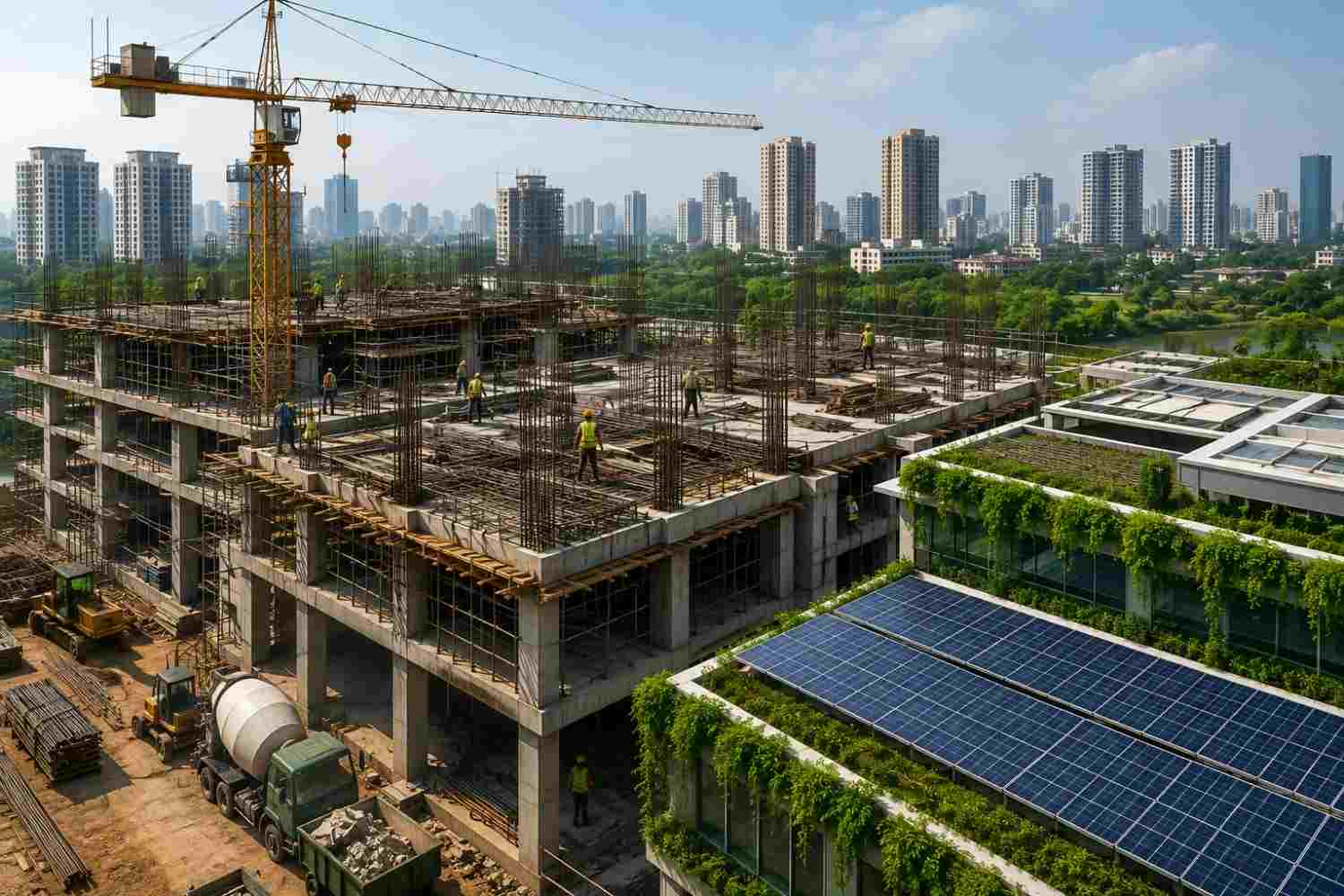
This is where the human side of green construction becomes impossible to ignore.
A building may report lower energy consumption while its occupants continue to experience excessive heat, poor ventilation, glare, noise or indoor-air-quality problems. Lower energy use alone therefore cannot determine whether a building is genuinely performing well.
Occupant wellness needs to be treated as an outcome, not an optional feature added to a sustainability checklist.
For offices, hotels, hospitals and residential buildings, relevant indicators can include:
- Thermal comfort
- Indoor air quality
- Daylight access
- Ventilation
- Acoustic comfort
- Occupant satisfaction
- Access to natural light and outdoor spaces
The evidence should come from the people using the building as well as from its building-management systems.
A developer's sustainability report can show energy consumption and technical performance. Occupant surveys can reveal whether those improvements actually translate into a building that is comfortable, healthy and functional for the people inside it.
A building cannot be considered truly green if it saves energy on paper but compromises the people who have to live or work inside it.
THE GREEN-BUILDING SCORECARD
| Area | What should be measured? |
|---|---|
| Energy | kWh/m²/year |
| Carbon | Absolute + intensity emissions |
| Materials | Embodied carbon |
| Cement | Carbon intensity + alternatives |
| Steel | Recycled content + lifecycle impact |
| HVAC | Energy performance + cooling demand |
| Water | Consumption + reuse |
| Occupants | Comfort + air quality + satisfaction |
| Certification | Rating + post-occupancy performance |
| Investment | Budget/capex + actual spending |
| Continuity | Performance after handover |
Is India's building policy moving fast enough to match the construction boom?
India already has a growing policy framework aimed at improving building efficiency and sustainability. The Energy Conservation and Sustainable Building Code 2024 and Eco Niwas Samhita 2024 provide updated approaches to energy performance and sustainable building design, while BEE also operates a voluntary star-rating programme for commercial buildings based on their actual energy performance.
But a standard has value only when it moves from policy documents into real buildings.
That means looking beyond whether developers have adopted a requirement on paper and examining whether it is followed through design, construction and everyday operation. State urban-development departments, municipal corporations and local building authorities also have an important role in approvals, development rules, implementation and enforcement, particularly where voluntary green-building standards overlap with mandatory regulations.
The evidence should therefore separate five very different milestones: a target announced, a design approved, a certification obtained, a building completed and a building actually performing as promised.
These milestones are not interchangeable, and treating them as one can make a project appear further ahead than it really is.
What happens when green buildings cost more upfront?
Cost remains one of the strongest arguments against more aggressive green-building requirements. Energy-efficient building envelopes, advanced HVAC systems, lower-carbon materials, smart controls and renewable-energy installations can all require greater upfront investment.
That can encourage developers to prioritise measures with faster financial returns.
But the calculation looks different when a building is assessed across its full operating life. Higher initial investment can potentially reduce electricity consumption, cooling requirements and maintenance costs over time.
The better question is therefore not simply how much a green building costs to construct, but what environmental and financial outcomes that additional investment produces?
A credible assessment should ask: How much additional capital expenditure was required? How much energy was saved? How much did annual operating costs fall? What was the payback period? And did the building continue to deliver those savings after handover?
The money itself also needs to be traceable.
A large sustainability commitment announced in an annual report is not the same as money actually spent on a completed project.
Can India's developers move from green certification to genuine net-zero performance?
Ultimately, the answer will depend on what the sector chooses to measure and disclose.
The strongest projects will not stop at reporting the number of green-certified buildings. They will show baseline energy use, actual energy intensity, embodied-carbon calculations, renewable-energy generation, water consumption, occupant outcomes, capital expenditure and post-occupancy performance.
The comparison point matters just as much.
A claim that a building uses 30% less energy may sound significant, but 30% less than what?
Was it compared with a conventional code-compliant building? An earlier version of the same project? Or a comparable building operating in the same climate?
Without a credible baseline, even a large percentage reduction can be difficult to interpret.
Net-zero performance is ultimately about measurable change, not simply the presence of a green label or the size of a sustainability claim.
ANNOUNCEMENT VS OUTCOME
GREEN TARGET ANNOUNCED
↓
DESIGN
↓
CONSTRUCTION
↓
CERTIFICATION
↓
OCCUPANCY
↓
ACTUAL PERFORMANCE
Energy ↓ | Carbon ↓ | Cooling demand ↓ | Water ↓ | Comfort ↑
The real green-building story begins after the ribbon-cutting.
So, can India's real estate sector decarbonise before the grid does?
It can reduce a significant part of the demand it places on the grid.
But “net-zero” requires more than efficient equipment or a green certification.
It requires a clear boundary around emissions, credible assumptions, measurable reductions and transparency about renewable energy and any offset reliance.
The first priority should be reducing demand.
That means designing buildings that need less cooling, using efficient systems, reducing material emissions and improving water and resource efficiency.
Renewable energy can then address part of the remaining electricity demand.
Offsets, where used, should be clearly separated from actual emissions reductions.
The strongest net-zero building is therefore not the one with the most impressive sustainability label.
It is the one that can show what its baseline was, what changed, how much it cost, what occupants experienced and whether the performance continued after the project was completed.
THE REAL NET-ZERO BUILDING TEST
Build less carbon into the structure.
Use less energy to operate it.
Cool it intelligently.
Measure what occupants experience.
Follow the money.
Report actual performance.
Keep measuring after certification.
India's construction boom is creating a narrow window. What gets built today will shape the country's energy demand for decades.
The question is no longer whether India can build greener buildings. It is whether it can prove that those buildings stay green once people move in.
Sources:
Bureau of Energy Efficiency (BEE) — Energy Conservation and Sustainable Building Code 2024 (ECSBC 2024)
Useful for: commercial/office building energy-efficiency requirements, building envelope, HVAC, lighting, electrical systems and sustainable-building provisions. BEE — ECSBC 2024BEE — Eco-Niwas Samhita 2024
Useful for: residential building energy performance, building-envelope requirements, heat gains, daylight and natural ventilation. BEE lists the 2024 ENS among its current building-efficiency resources. BEE — Eco-Niwas Samhita 2024BEE — Building Energy Efficiency / Energy Efficiency Resources
Useful for: India's building-sector energy-efficiency framework, commercial-building performance and retrofit/cooling resources. BEE — Building Energy Efficiency ResourcesIndian Green Building Council (IGBC) — Green New Buildings Rating System
Useful for: IGBC certification, energy efficiency, water conservation, building materials, indoor environmental quality, certification levels and the transition to Version 4.0 from May 2026. IGBC — Green New BuildingsIGBC — Net Zero Carbon Rating
This is especially important for your article. It supports the distinction between design/construction-stage and operations-stage certification, embodied-carbon requirements and operational-carbon requirements. It also states that the certification is valid for three years, reinforcing your argument that performance needs to be monitored rather than treated as a permanent achievement. IGBC — Net Zero Carbon RatingIGBC — Green Existing Buildings Rating System
Useful for: operational performance, mandatory energy/water/fresh-air requirements, certification review and the importance of final documentation rather than relying only on anticipated performance. IGBC — Green Existing BuildingsIGBC — Green Homes Rating System
Useful for: the residential side of your story and current Green Homes Version 3.0 framework. IGBC — Green Homes





Add a Comment