Best Practices

Highlights proven strategies, models, and success stories that drive effective sustainability outcomes.

Showing 12/36

10 Aug 2026

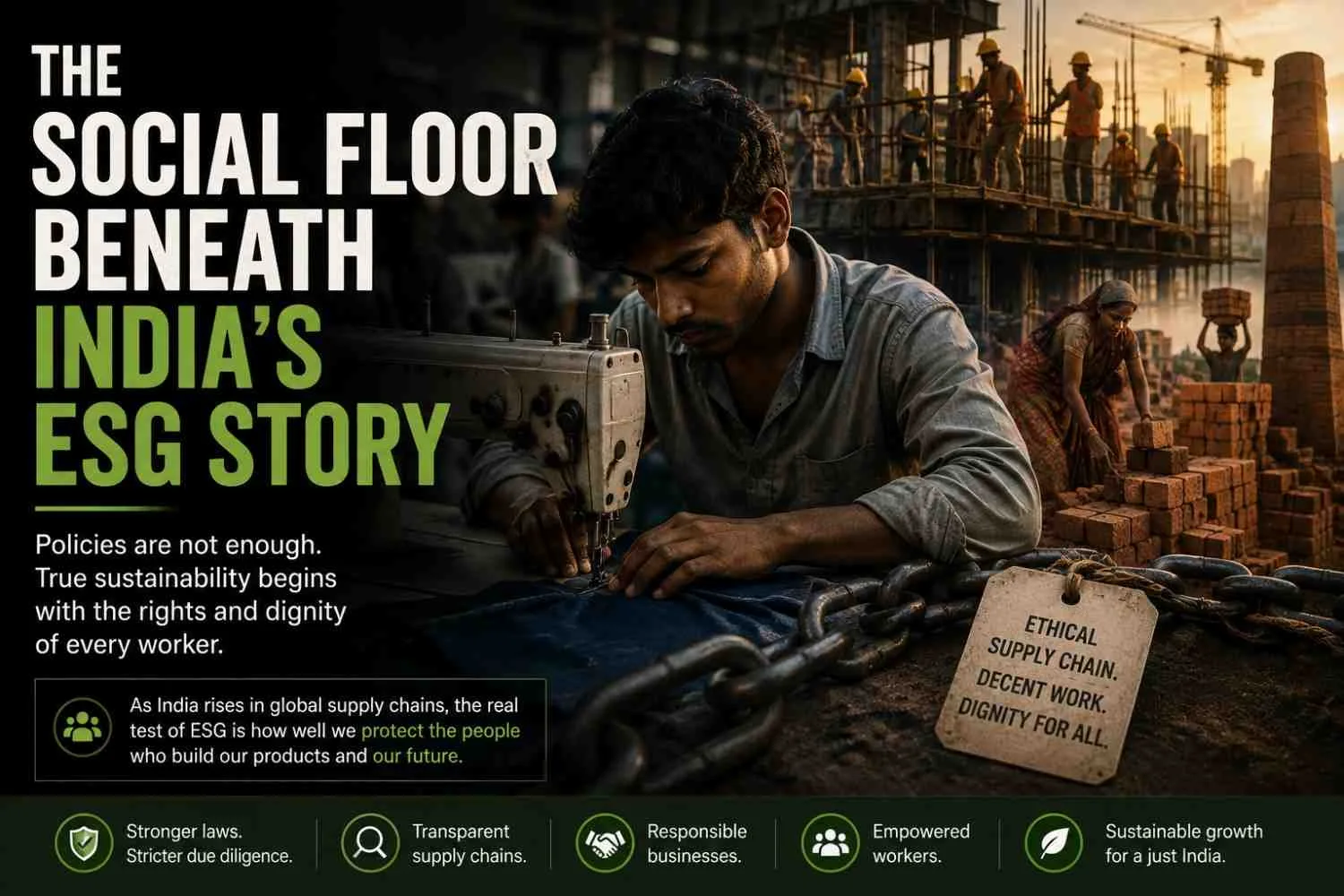
Kolkata | August 7, 2026 As India strengthens its position in global supply chains, responsible sourcing has become just as important as sustainable production. While companies increasingly promote ESG commitments and ethical procurement, concerns over bonded labour, migrant-worker exploitation and weak rehabilitation continue to challenge the credibility of these claims. The real question is no longer whether businesses have policies- but whether those policies protect workers on the ground. Quick SummaryIndia's ambition to become a global manufacturing and sourcing hub is placing greater attention on labour rights across supply chains. International buyers, particularly in Europe, now expect companies to prove that products are made without forced or bonded labour, making human-rights due diligence a critical part of ESG reporting. While governments have intensified anti-bonded labour campaigns and many large companies have strengthened supplier monitoring, challenges remain in sectors such as brick kilns, quarrying, textiles and construction, where migrant workers often face debt, poor working conditions and limited access to legal protections. Experts argue that rescue operations alone are insufficient unless rehabilitation, fair wages and long-term livelihood support are ensured. As global regulations become stricter, India's competitiveness will increasingly depend not only on environmental sustainability but also on how effectively it safeguards the rights and dignity of workers throughout its supply chains. Keywords Bonded Labour, Forced Labour, Human Rights, ESG, Supply Chains, Human Rights Due Diligence, Responsible Sourcing, Migrant Workers, Labour Rights, Ethical Supply Chains, Corporate ESG, India ESG, Worker Welfare, Sustainable Business, Social Sustainability, Global Trade, EU Due Diligence, ESG Compliance, Responsible Procurement, India Labour Can India Build Global Supply Chains Without Leaving Workers Behind? India's ESG journey is no longer judged only by carbon emissions, renewable energy targets or environmental commitments. Gradually, investors, regulators and consumers around the world are asking a more fundamental question: Who made the product, and under what conditions? As global supply chains become more transparent, labour rights have emerged as one of the strongest indicators of corporate sustainability. This shift comes at a critical moment for India. As the country strengthens its position as a global manufacturing hub through initiatives such as Make in India and the Production-Linked Incentive (PLI) schemes, it is attracting companies looking to diversify their supply chains. But with this opportunity comes greater scrutiny. International buyers now expect more than quality products and competitive prices- they also want assurance that goods are produced without forced labour, child labour or exploitative working conditions. At the heart of this challenge is bonded labour, one of India's oldest and most persistent labour-rights issues. Although the practice was abolished under the Bonded Labour System (Abolition) Act, 1976, cases continue to emerge across several industries. Workers caught in cycles of debt, informal employment and labour contracting arrangements often remain trapped in exploitative conditions despite legal protections. The issue goes far beyond legal compliance. Labour rights have become a key part of ESG performance. A company may reduce emissions, invest in clean energy and publish detailed sustainability reports, but if exploitation exists anywhere within its supply chain, those achievements are seen as incomplete. For global investors and responsible businesses, environmental responsibility and human rights are now inseparable. This changing landscape is also reshaping corporate practices. Large listed companies, exporters and multinational buyers are strengthening supplier checks, conducting labour audits and integrating human-rights due diligence into their procurement processes. These measures are aimed not only at meeting international expectations but also at reducing the legal, financial and reputational risks associated with unethical supply chains. However, experts caution that stronger corporate policies alone will not eliminate the problem. A large share of India's workforce remains employed in the informal sector, where monitoring is limited and many workers have little awareness of their rights or access to effective grievance mechanisms. As India seeks to expand its role in global manufacturing and trade, ensuring that economic growth is matched by stronger labour protections has become one of the country's most pressing sustainability priorities.The Hidden Reality of Bonded Labour Despite stronger laws and growing corporate commitments, bonded labour continues to exist across parts of India. Rather than disappearing, it has become less visible, often hidden within informal employment, labour contracting systems and migrant-worker networks that receive limited oversight.Some of the highest risks of bonded labour continue to be reported in sectors such as brick kilns, stone quarries, textiles, construction and small manufacturing units. In many cases, workers are recruited through middlemen who offer advance payments or small loans. What begins as financial support can soon turn into a cycle of debt, leaving workers unable to leave their jobs until the amount is repaid- a practice widely recognised as debt bondage. Migrant workers are particularly at risk. Many travel long distances in search of work without formal contracts, proper documentation or access to social security. Language barriers, dependence on labour contractors and limited awareness of their legal rights often make it difficult for them to report exploitation or seek help. According to labour experts, these conditions can lead to unpaid wages, excessive working hours and restrictions on workers' freedom, especially in labour-intensive sectors. In response, government agencies have stepped up efforts to identify and rescue bonded labourers through district administrations and Bonded Labour Vigilance Committees. States such as Telangana have expanded inspections and rescue operations, while the National Human Rights Commission (NHRC) and organisations such as International Justice Mission India (IJM India) continue to support rescue, legal action and rehabilitation. However, experts stress that rescue is only the beginning of the process. The bigger challenge is helping survivors rebuild their lives. Under the Central Sector Scheme for Rehabilitation of Bonded Labourers, rescued workers are entitled to financial assistance, skill development and livelihood support. However, implementation remains uneven across states. Delays in issuing Release Certificates, slow disbursal of rehabilitation funds and limited follow-up support often leave survivors vulnerable to returning to the same exploitative conditions. Organisations such as Aajeevika Bureau and SEWA Bharat have repeatedly pointed out that financial insecurity remains one of the biggest reasons many rescued workers return to informal employment. Without stable livelihoods, social protection and long-term support, breaking the cycle of bonded labour becomes extremely difficult. Businesses, too, are facing growing pressure to strengthen labour oversight throughout their supply chains. Companies are now expected to look beyond their immediate suppliers by scrutinising labour contractors, monitoring subcontractors and ensuring that temporary and migrant workers receive the same protections and rights as permanent employees.For many organisations, protecting labour rights is no longer just about regulatory compliance, it has become a key part of responsible business practices and long-term ESG performance. Where Labour-Risk Vulnerabilities Are Highest  Brick kilns Quarrying Textiles Construction Small Manufacturing When Human Rights Become a Trade Requirement The discussion around bonded labour is no longer confined to human rights- it has become a business priority. As global markets place greater emphasis on responsible sourcing, Indian companies are finding that labour practices now influence market access, investor confidence and brand reputation as much as product quality or pricing.A major reason for this shift is the European Union's Corporate Sustainability Due Diligence Directive (CSDDD) and other emerging international regulations. These require companies to identify, prevent and address human-rights risks across their supply chains. Global buyers are no longer satisfied with just supplier declarations. They expect evidence that workers are recruited fairly, paid properly and employed under safe and ethical conditions, particularly in sectors that have historically been linked to labour exploitation. In response, many Indian exporters and large listed companies are strengthening their human-rights due diligence processes. Supplier agreements are gradually incorporating labour-rights clauses, mandatory compliance requirements and independent audits. Businesses are also looking beyond their direct suppliers to examine labour contractors and subcontractors, where informal employment practices are often more difficult to monitor. Many companies in sectors such as manufacturing, construction, logistics and platform-based services are investing in digital worker registration, attendance systems and grievance mechanisms to improve transparency. Others are working with independent auditors and civil society organisations to assess labour conditions instead of relying solely on internal reports. These efforts are aimed not only at meeting international regulations but also at reducing legal, operational and reputational risks in an ESG-focused business environment. However, experts caution that due diligence should go beyond paperwork. Audits conducted in the presence of management, pre-announced inspections or supplier self-declarations often fail to reflect the actual conditions faced by workers. Labour-rights organisations argue that meaningful due diligence requires confidential worker interviews, regular field visits and independent grievance mechanisms that allow workers to raise concerns without fear of retaliation. The situation is particularly challenging for migrant workers employed through third-party contractors. While many companies have adopted strong ESG policies, they often have limited visibility into the working conditions of people employed beyond their direct workforce. Bridging this gap between corporate commitments and on-ground realities remains one of the biggest challenges in building truly responsible supply chains. As India strengthens its position as a global manufacturing hub, businesses are realising that long-term competitiveness will depend not only on production capacity and product quality but also on their ability to uphold human rights throughout the supply chain. For global buyers, a sustainable product begins with fair treatment of the worker long before it reaches the consumer. Progress Is Visible, But Challenges Persist Government agencies say India has made significant progress in tackling bonded labour over the past decade. Several states have stepped up rescue operations; labour inspections have become more focused and rehabilitation programmes continue to receive policy support. Authorities also point to stronger coordination between government departments, district-level vigilance committees and awareness campaigns as important steps towards identifying and protecting vulnerable workers. Businesses also highlight improvements in their labour practices. Many large listed companies now require suppliers to follow human-rights standards, conduct regular labour audits and provide grievance mechanisms for workers. ESG reporting has also broadened the focus from workplace safety to issues such as ethical recruitment, fair wages and responsible sourcing.For companies serving international markets, these measures have become essential for maintaining investor confidence and meeting global buyer expectations. However, organisations working closely with affected communities present a more cautious assessment. Groups such as Aajeevika Bureau, SEWA Bharat and International Justice Mission India (IJM India) argue that while rescue operations have improved, long-term rehabilitation remains a major challenge. Many rescued workers continue to face financial hardship, while delays in rehabilitation support, limited livelihood opportunities and difficulties in accessing government benefits often leave them vulnerable to exploitation again. Labour-rights organisations also point out that migrant workers frequently remain outside formal monitoring systems, making it difficult to identify abuse until it becomes severe. Experts also caution that corporate compliance reports do not always reflect the realities of the entire supply chain. Most audits focus on direct suppliers, while smaller subcontractors and labour contractors- where the risk of exploitation is often highest receive much less attention. Without independent worker interviews, confidential grievance mechanisms and regular field verification, important labour issues can remain hidden despite positive ESG disclosures. For this reason, many experts believe that the next stage of India's ESG journey should focus less on expanding policies and more on measuring real outcomes. The true test of progress is not the number of audits conducted or policies announced, but whether workers receive fair wages, safe working conditions, access to benefits and effective protection when their rights are violated.   Closing this gap between policy and implementation will be crucial if India has to build supply chains that meet both national labour standards and rising global expectations. From Compliance to Competitiveness Worker Rights → Responsible Supply Chains → Stronger ESG → Investor Confidence → Export Competitiveness   Why Protecting Workers Is Good for Business Labour rights are no longer seen as just a legal requirement. They have become an important measure of how companies are judged by investors, regulators and global buyers. Today, a strong ESG profile is not defined only by lower emissions or renewable energy investments- it is also shaped by how businesses treat the people working across their supply chains. This shift is changing the way companies operate. Investors are paying greater attention to labour-related risks, while international buyers expect businesses to prove that their products are made under fair and ethical working conditions. Companies that cannot demonstrate responsible recruitment, safe workplaces and effective grievance mechanisms risk damaging their reputation, losing investor confidence and facing challenges in global markets. At the same time, organisations that invest in better labour practices are discovering clear business benefits. Fair wages, transparent supply chains and safe working conditions can improve employee morale, reduce operational disruptions and build stronger relationships with customers and investors. Protecting workers is no longer just about meeting regulations- but becoming a competitive advantage. For India, this shift carries particular significance. As the country strengthen its position as a global manufacturing hub, the credibility of its supply chains will depend not only on production capacity but also on the confidence that goods are produced under fair and lawful conditions. Sustainable economic growth cannot be achieved without protecting the people who drives it. Ultimately, India's ESG journey will be judged not only by how successfully it cuts emissions or expands clean industries, but also by how effectively it safeguards the rights and dignity of its workforce. Ending bonded labour requires much more than rescue operations or compliance reports.   It demands fair wages, timely rehabilitation, secure livelihoods and supply chains where every worker is visible, protected and treated with dignity. As global markets continue to demand greater transparency, businesses that place human rights at the centre of their ESG strategies will be better positioned to earn trust, attract investment and compete internationally. In the end, India's success as a global manufacturing and sourcing destination will depend not only on what it produces, but on how well it protects the people who produce it.    Sources:  Ministry of Labour & Employment, Government of India – Bonded Labour System (Abolition) Act, labour welfare schemes and rehabilitation policies.https://labour.gov.in/ National Human Rights Commission (NHRC) – Reports and advisories on bonded labour, migrant workers and human-rights protection.https://nhrc.nic.in/ International Justice Mission (IJM) India – Bonded labour rescue, rehabilitation and survivor case studies.https://www.ijm.org/india Aajeevika Bureau – Research and policy work on migrant labour, safe migration and labour rights.https://www.aajeevika.org/ SEWA Bharat – Informal workers, women's livelihoods and labour rights.https://www.sewabharat.org/ J-PAL South Asia – Evidence-based research on labour markets, migration and public policy.https://www.povertyactionlab.org/south-asia Telangana Labour Department – State-level bonded labour rescue initiatives, inspections and rehabilitation measures.https://labour.telangana.gov.in/ Central Consumer Protection Authority (CCPA) (for broader ethical business and consumer accountability where relevant)https://consumeraffairs.nic.in/ ESIC (Employees' State Insurance Corporation) – Worker welfare, social security and benefit access.https://www.esic.gov.in/  International Labour Organization (ILO) – Global standards on forced labour, decent work and supply-chain due diligence.https://www.ilo.org/                   ...Read more

07 Aug 2026

From Swadeshi to Sustainability, Why India Must Wear Its Handlooms Into the Future Prof Ujjwal K Chowdhury A century ago, Indian cloth became an instrument of freedom. Today, the handloom faces a different battle—against invisibility, imitation, industrial speed, uncertain incomes and disposable fashion. Yet the same loom offers India something remarkably contemporary: millions of livelihoods, women-led grassroots enterprise, cultural identity, low-energy production and the possibility of a more conscious wardrobe. On National Handloom Day, the question is no longer whether handloom deserves preservation. It is whether India can turn its extraordinary textile inheritance into an aspirational economy of the future. Summary:India celebrates its 12th National Handloom Day on 7 August 2026, linking the occasion to the Swadeshi Movement formally proclaimed on this date in 1905. The sector continues to support more than 35 lakh weavers and allied workers, with women accounting for over 72% of the workforce. But handloom faces formidable pressures: mechanised production, misleading imitations, price competition, unstable artisan earnings, raw-material challenges and changing consumer behaviour. At the same time, new research is strengthening handloom’s environmental case, while design, digital commerce, traceability, branding and technology are opening new markets. The next handloom movement must therefore go beyond nostalgia. India needs to make authentic handloom desirable, verifiable, contemporary and economically rewarding to those who create it. Keywords: Indian Handloom, National Handloom Day, Swadeshi, Indian Weavers, Sustainable Fashion, Slow Fashion, Bengal Handloom, Jamdani, Tant, Banarasi, Ikat, Kanchipuram, Artisa\n Livelihoods, Women Weavers, Handloom Mark, India Handloom Brand, Vocal for Local, Conscious Consumption Hashtags: #NationalHandloomDay #HandloomDay2026 #IndianHandloom #ChooseHandloom #WearIndia #WeaveTheFuture #SustainableFashion #SlowFashion #IndianWeavers #BengalHandloom #SupportArtisans #VocalForLocal #MadeInIndia #ConsciousFashion #SustainableIndia A Freedom Movement You Could Wear There are moments in history when an ordinary object stops being ordinary. For India, cloth became one such object. On 7 August 1905, amid the growing resistance to the partition of Bengal, the Swadeshi Movement was formally proclaimed at a massive meeting in Calcutta Town Hall. Indians were urged to reject imported goods and revive indigenous production. Textiles were central to that political imagination. What one wore could become a declaration of economic independence. More than a century later, India commemorates that moment every 7 August as National Handloom Day. The first observance was inaugurated in Chennai in 2015. This year marks the 12th National Handloom Day.  That history makes handloom different from almost every other consumer product. Handloom is cloth. But it is also memory. Work. Geography. Culture. Enterprise. And, once again, choice. The great question of 2026 is whether India will merely admire that inheritance—or build an economy around it. 35 Lakh People Behind the Fabric The handloom conversation often starts with beautiful saris. It should start with people. India's Fourth All India Handloom Census done in 2019-20 recorded 35.22 lakh handloom weavers and allied workers—about 26.74 lakh weavers and another 8.48 lakh allied workers. Of the total workforce, roughly 25.46 lakh are women, more than 72%. The country had approximately 28.20 lakh handlooms when the census was conducted.  That makes handloom one of India's most important decentralised livelihood systems. Behind a finished piece can stand an entire economic chain: cotton and silk producers, yarn suppliers, reelers, spinners, dyers, warp makers, designers, weavers, finishers, traders and sellers. Unlike a giant garment factory, much of this economy is dispersed through homes and small workshops. A loom may stand beside a kitchen. A grandmother may understand a motif without ever having studied design. A daughter may prepare yarn while another member of the family works the loom. Knowledge passes not through manuals, but through observation, rhythm and repetition. That is why when a weaving household abandons its loom, India does not merely lose a unit of production. It can lose a library that was never written down. India Is Not One Handloom Story. It Is Hundreds Try reducing Indian handloom to one aesthetic and the idea collapses immediately. Banarasi brocades carry one vocabulary. Kanchipuram another. Sambalpuri and Pochampally Ikat make mathematics out of resist-dyed yarn. Chanderi finds elegance in translucence. Paithani speaks through colour and peacocks. Kani weaving turns shawls into painstaking compositions. Assam's textiles carry extraordinary traditions of their own. And then there is Bengal. Tant. Jamdani. Baluchari. Garad. Dhaniakhali. Begampuri. Each belongs not merely to a product category but to a landscape and social history. The scale of India's diversity was visible again in the Ministry of Textiles' Weaves of India Festival, which ran up to National Handloom Day this year and brought together 116 heritage weaves.  One nation has somehow accumulated hundreds of ways of crossing warp and weft. That is cultural capital few countries can replicate. Bengal: Where the Loom Carries Memory The Bengal story deserves particular attention because the Swadeshi story itself is inseparable from Bengal. The latest national census data listed more than 6.3 lakh handloom workers in West Bengal, making the state one of India's largest handloom livelihood centres.  Travel through weaving belts such as Nadia and other traditional clusters and the paradox becomes visible. On one side is extraordinary skill. On the other is economic vulnerability. A Jamdani motif can require extraordinary patience. A Baluchari can carry narrative complexity that turns fabric almost into illustration. A fine Tant derives beauty precisely from an apparent simplicity that machinery can imitate visually without replicating the making. And therein lies the problem. The shopper sees two saris. The weaver knows that they represent two completely different economic systems. If the customer cannot tell the difference, the cheaper system usually wins. When Price Wins, Craft Can Lose Handloom should not wage war on machinery. India needs powerlooms. It needs efficient textile factories. It needs an internationally competitive garment industry employing millions. The problem begins when mass-produced cloth and authentic handloom are placed in the marketplace as though they were identical products—or when machine-made imitations are sold using the cultural prestige of handwoven traditions. A handloom artisan simply cannot compete with the speed of mechanised production on price per metre. Nor should that be the competition. The value of handloom lies precisely in human labour, small-batch production, variations, complex craft, provenance and cultural character. India has long recognised this structural vulnerability. The Handlooms (Reservation of Articles for Production) Act, 1985 protects specified products from being manufactured on powerlooms, and enforcement inspections continue. Parliamentary data released in 2026 showed lakhs of powerloom inspections under the Act in recent years.  Authenticity is therefore not merely a marketing issue. It is an economic justice issue. The China Question Needs More Precision There is understandable concern about cheap synthetic fibres, polyester, imported yarn and low-cost textiles entering Indian markets. An anti-dumping investigation is currently underway into Polyester Textured Yarn imported from China, demonstrating that synthetic-yarn competition is a live issue in India's wider textile economy.  But the handloom debate should resist simplistic slogans. Government data presented to Parliament this year says imports classified specifically as handloom products have remained nominal, averaging around ₹14.1 crore annually over the preceding three years.  So the greater threat to the Indian weaver is not simply "foreign handloom". It is a much wider ecosystem of cheap synthetic substitutes, industrial scale, imitation, weak differentiation and a consumer culture trained to compare everything primarily by price. A patriotic case for Indian handloom therefore does not require hostility towards another country. It requires something more constructive: make Indian craftsmanship economically competitive on value rather than impossibly competitive on speed.     The Poverty Hidden Behind the Beautiful Sari This is where the romance of craft must confront economics. Customers may admire a ₹10,000, ₹20,000 or ₹50,000 handwoven sari without knowing how much of that value finally reaches the people who produced it. The artisan often occupies one of the weakest negotiating positions in the value chain. Production takes time. Cash flow does not wait. Yarn must be purchased. Families must be fed. Unsold inventory ties up scarce working capital. The Government acknowledged in a 2025 parliamentary reply that it had not conducted a specific study assessing the income levels and working conditions of women in the handloom sector, although third-party evaluations of schemes indicated improvements in earnings, working days and working conditions among beneficiaries.  This itself points to the next reform requirement. India needs better real-time livelihood data. How much does the primary weaver receive? How much time does a product require? Who captures the retail margin? Are younger family members staying in the profession? Preserving a craft without ensuring a respectable income for the craftsperson is not preservation. It is museumisation. Sustainability: Move From Poetry to Proof Handloom is frequently called sustainable. That claim needs to be both celebrated and qualified. At the weaving stage, a manually operated loom requires little of the industrial energy demanded by mechanised weaving. That is an enormous inherent advantage. And the environmental argument is becoming measurable. In 2025, the Ministry of Textiles and IIT Delhi released Carbon Footprint Assessment in the Indian Handloom Sector: Methods and Case Studies, examining products including cotton bedsheets, floor mats, Ikat and Banarasi saris.  Subsequent research presented by the IIT Delhi team reported that a studied handloom cotton bedsheet had a carbon footprint of about 1.30 kg CO₂-equivalent—nearly four times lower than the comparable powerloom product assessed. The work also showed why one cannot lazily label every handloom item "green": energy and fuel used elsewhere in production, chemicals, dyeing and other processes still matter.  That distinction is crucial. A handwoven polyester product dyed through a highly polluting process and transported repeatedly across continents does not become environmentally perfect simply because the final weaving was manual. True sustainability must examine: fibre → farming → yarn → dye → water → energy → weaving → transport → durability → reuse → end-of-life. Handloom begins with an enormous advantage. Now India needs to improve the rest of the chain. Slow Fashion Before We Invented the Term The global fashion industry is searching for ideas such as slow fashion, traceability, artisanal production, durability, circularity, local supply chains and storytelling. India has practised many of these ideas for generations. The grandmother's sari becoming the granddaughter's sari is circular fashion. Repairing a border rather than discarding an entire garment is circular fashion. A locally woven textile produced in small quantities is slow fashion. A motif carrying the identity of a particular weaving community is traceability through culture. Handloom therefore should not be positioned merely as something ancient that environmentally conscious consumers must rescue out of sympathy. That is terrible branding. Handloom should be sold as premium intelligence: beautiful, tactile, breathable, distinctive, culturally rich and—when responsibly produced—environmentally compelling. Heritage Must Enter the Wardrobe of the 25-Year-Old If handloom remains associated only with ceremonial saris, government emporia and nostalgia, its market will remain unnecessarily narrow. Handloom belongs in shirts. Jackets. Dresses. Trousers. Sneakers and accessories. Curtains. Cushions. Throws. Bed linen. Tableware. Boutique hospitality. Corporate gifting. Contemporary interiors. The government's own recent outreach acknowledges the need for reinvention. In April 2026, Vishwa Sutra – Weaves of India for the World paired 30 Indian handloom traditions with design inspirations from 30 countries, explicitly placing traditional textiles within a contemporary global design narrative.  The ecosystem has also expanded beyond traditional Khadi institutions, cooperatives and state emporia. Retailers, designer labels and platforms such as Fabindia, Taneira, Jaypore, GoCoop, Raw Mango and Anavila have, in different ways, helped introduce craft-based textiles to contemporary consumers. The lesson is simple. Do not ask the young to dress like the past. Give them the past with which to design the future. The Weaver Needs Technology—Just Not a Replacement Technology need not be the enemy of handloom. Technology can make weaving less physically punishing. It can improve jacquards. Map designs. Predict demand. Verify provenance. Translate an artisan's story. Photograph products professionally. Connect rural clusters directly to urban and international customers. Digitise inventories. Improve payments. Reduce middlemen. The Government's current architecture includes the National Handloom Development Programme and Raw Material Supply Scheme, along with support for upgraded looms, design, skills, marketing, branding, e-commerce, credit and social security.  The government-backed Indiahandmade digital marketplace is another attempt to connect artisans and weavers more directly to online consumers.  The question is not whether technology will enter handloom. It already has. The question is whether technology will replace the artisan—or increase the artisan's power. Choose the second. Ask One Question: Who Wove My Cloth? Consumers finally constitute the last—and perhaps most powerful—policy instrument. You do not need to become a textile historian. Just become slightly more curious. Look for credible authentication such as the Handloom Mark and, where applicable, the India Handloom Brand, which was introduced to combine handloom identity with quality and compliance parameters.  Ask the retailer what the weave is. Ask where it came from. Ask whether it is genuinely handwoven. Ask what fibre was used. Ask how to care for it so that it lasts. And then do something even more important: Use it. Do not turn handloom into precious fabric permanently imprisoned in cupboards. Wear the sari. Wear the shirt. Use the runner. Put the handwoven cushion on the sofa. Gift the stole. Take handloom into offices, campuses, hotels, homes, festivals and international conferences. Traditions survive through use, not reverence alone. A New Swadeshi for a New Century The original Swadeshi asked Indians to understand that consumption had political consequences. The same insight is relevant today, but the vocabulary can evolve. Buying handloom can be pro-jobs without being anti-machine. Pro-India without being anti-world. Pro-artisan without romanticising poverty. Pro-sustainability without greenwashing. Pro-tradition without resisting modern design. And pro-market—provided the market learns to recognise genuine value. India's handloom exports themselves show that opportunity exists: provisional government data puts exports of handloom products at about ₹1,359 crore in 2025–26, up from ₹1,201 crore the previous year.  The ambition should be far greater. India does not merely possess handlooms. India possesses one of the world's greatest distributed design laboratories. Millions of hands. Hundreds of textile languages. Generations of tacit knowledge. An extraordinary archive of colour, geometry, fibre and technique. The real tragedy would not be that machines become faster. They will. The tragedy would be if India became wealthier while the people who carry this knowledge became too poor to continue carrying it. Wear India. Weave the Future. Perhaps somewhere tonight, as National Handloom Day celebrations conclude, a shuttle is still moving. Left. Right. Left. Right. Thread crossing thread. The sound is remarkably similar to the sound it made when Swadeshi entered India's political vocabulary 121 years ago. But the loom is no longer asking us to boycott. It is asking us to choose. Choose authenticity over imitation when we can. Choose durability over disposability. Choose craftsmanship over anonymous sameness. Choose a product whose purchase can travel backwards—from our wardrobe to a retailer, from the retailer to a producer, from the producer to a weaving household. And choose an India where modernity does not require the destruction of memory. Because every genuine handloom contains two stories. One is the story woven into the fabric. The other is the story of the person who wove it. This National Handloom Day, preserve both. Choose Handloom. Wear India. Support the Weaver. Protect the Craft. Weave the Future.   ...Read more

04 Aug 2026

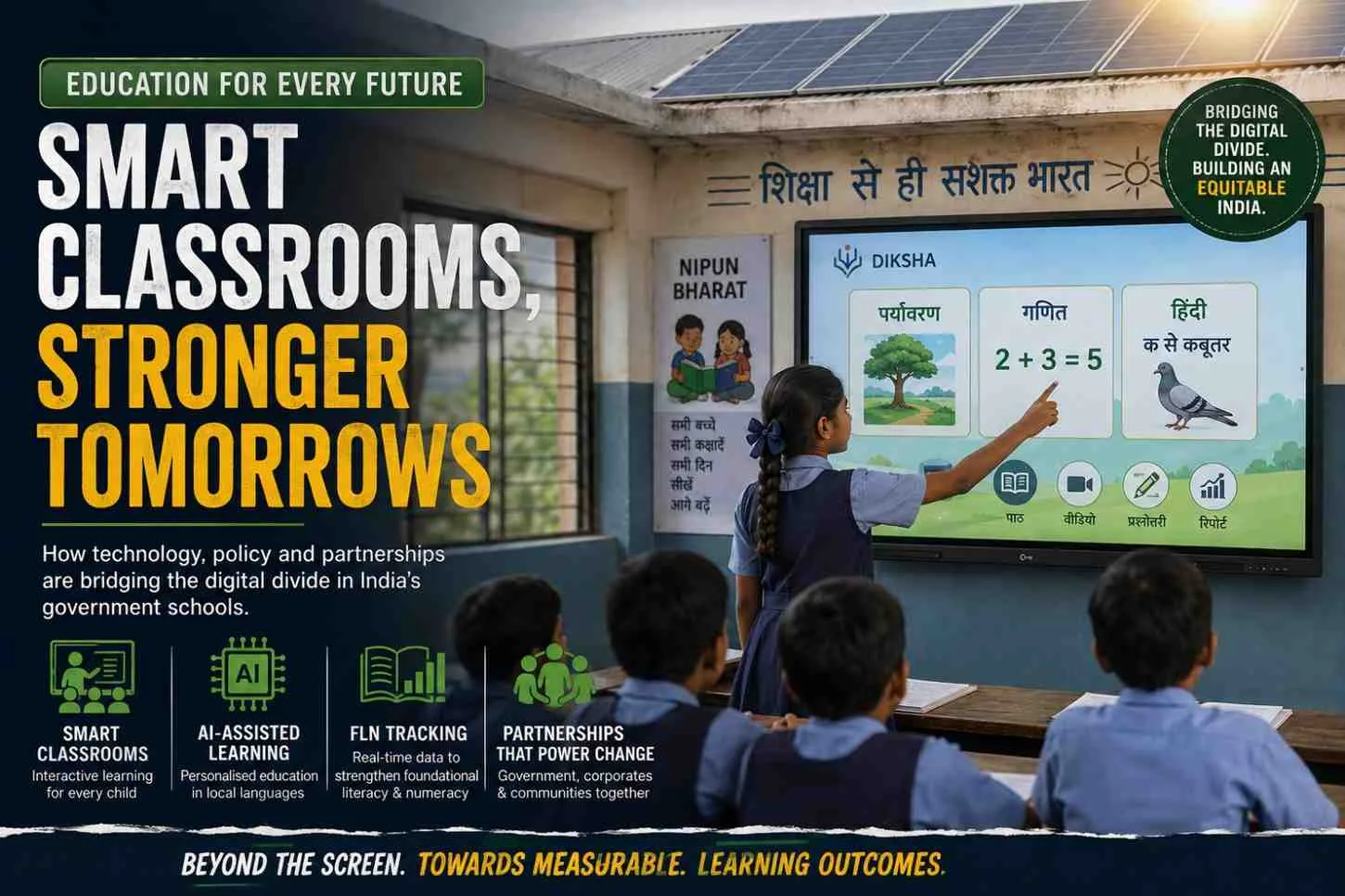
Kolkata | August 3, 2026 As India expands digital classrooms into government schools, the real challenge is no longer connecting villages to technology- but ensuring technology actually improves learning. From AI-powered lessons in regional languages to solar-powered classrooms and foundational literacy tracking, the country's digital education push is entering a decisive phase where infrastructure, teacher readiness and measurable outcomes matter more than announcements. Quick SummaryIndia's digital education journey is entering a new chapter. Classrooms are gradually moving beyond blackboards as smart technologies, AI-enabled learning platforms and digital assessment tools become part of everyday teaching. Backed by governments, private organisations and non-profits, these initiatives are expected to strengthen learning outcomes while expanding educational opportunities for students in rural and underserved communities.Yet technology alone cannot close the learning gap. Its impact depends on reliable electricity, stable internet connectivity, well-trained teachers, quality regional-language content, regular maintenance and continuous evaluation of student progress. As India works towards a more inclusive education system, the focus is moving beyond digital access to a more important goal-ensuring that every technological investment delivers measurable improvements in learning. KeywordsEdTech India, Digital Classrooms, Government Schools, Rural Education, Foundational Literacy and Numeracy, NIPUN Bharat, AI in Education, Smart Classrooms, Digital Learning, Education Technology    Can technology truly bridge India's rural education divide- or does meaningful learning still depend on everything beyond the screen? Shortly after sunrise, children begin arriving at a government primary school in a remote village of Madhya Pradesh. Some have walked several kilometres through fields, carrying well-used schoolbags and notebooks. As they settle into their classroom, a smart display comes to life, using colourful animations to explain basic mathematics in Hindi. For a moment, the familiar blackboard gives way to an entirely different way of learning. For many of these students, it is their first experience inside a digital classroom. The transformation is difficult to ignore. Government schools that once struggled with limited infrastructure are now introducing interactive lessons, AI-powered learning applications, digital attendance systems and online educational resources. Across India, digital classrooms have become a defining image of education reform and technological progress.Yet behind this visible transformation lies a far more challenging question: is digital access translating into better learning? Technology has the potential to reshape education-but only when the basics are already in place. Smart boards require electricity, AI-powered platforms depend on stable internet connectivity, and digital devices remain underutilised without confident, well-trained teachers. More importantly, no technological innovation can replace the foundational literacy and numeracy skills that every child needs to learn effectively. This is the challenge confronting India's education system today. The discussion has moved well beyond introducing technology into classrooms. The real question now is whether digital investments are improving what matters most- how well children learn or whether schools are becoming more technologically equipped without becoming more educationally effective. The reason this question matters is the sheer scale of India's digital education ambition. With more than 250 million school-going children and one of the world's largest public education systems, the country is using technology not simply to modernise schools, but to bridge educational inequalities that have existed for generations. Government initiatives such as Digital India, PM eVIDYA, DIKSHA, NIPUN Bharat and the National Education Policy (NEP) 2020 have accelerated the spread of digital learning. Alongside these efforts, corporate CSR programmes, educational foundations and technology companies are bringing smart classrooms, AI-powered learning platforms and teacher training to thousands of government schools. For millions of children in rural India, these initiatives have expanded access to educational resources that were once concentrated in better-equipped urban classrooms. The experience so far, however, points to a simple reality: technology can support education, but it cannot transform it on its own. The future of digital education will not be shaped by technology alone. Its real impact will depend on whether digital tools strengthen teaching, respond to local needs and help every child learn more effectively.As India builds more digitally enabled classrooms, the success of this transformation will not be reflected in the number of smart boards or tablets deployed. It will be seen in classrooms where learning improves, educational gaps narrow and every child is given a fairer opportunity to succeed. Government's Digital Push: From Access to Learning OutcomesThe pandemic did not introduce India to digital education, but it changed its trajectory.When classrooms fell silent in 2020, millions of students were abruptly disconnected from formal learning. The impact was especially severe in rural India, where limited access to smartphones, internet services and reliable electricity left many children without any meaningful alternative to classroom teaching. In contrast, many students in urban areas were able to continue learning online. The experience fundamentally reshaped the country's approach to digital education, turning a gradual reform into an urgent national priority. The experience of the pandemic reinforced the government's belief that digital infrastructure would become an essential part of India's education system. Rather than allowing technology to remain an emergency alternative, policymakers began embedding it into long-term classroom reforms. The National Education Policy (NEP) 2020 placed digital learning, teacher capacity building and educational technology at the centre of this transformation. Programmes such as DIKSHA and PM eVIDYA expanded digital resources for both students and teachers, while dedicated educational television channels helped extend learning to households with limited internet access. Yet one important lesson soon became clear: digital content alone could not solve India's learning challenges. Long before the pandemic, national assessments had revealed that many children in primary schools were unable to achieve basic reading and arithmetic skills despite attending school regularly. The assessments revealed that the real challenge was not simply making classrooms digital, but ensuring that every child possessed the foundational skills needed to benefit from them. This led to a greater emphasis on Foundational Literacy and Numeracy (FLN), ensuring that every child can read with understanding and perform basic mathematical operations by the end of Grade 3. To achieve this, the government launched NIPUN Bharat in 2021, placing foundational learning at the centre of education reforms. Unlike many earlier programmes that focused largely on expanding access, NIPUN Bharat prioritised measurable learning outcomes. States were encouraged to use digital tools to track student progress, identify learning gaps early and provide timely academic support instead of waiting for annual examinations. The emphasis shifted from using technology to deliver education to using it to understand, monitor and improve how students learn.Digital monitoring is gradually becoming a part of classroom teaching across several states. Teachers now use mobile applications and digital dashboards to record assessments, monitor student progress and identify children who may need extra support, while education departments rely on real-time data to guide interventions more effectively. The challenge, however, lies beyond data collection. Education researchers emphasise that digital information creates value only when it leads to timely action and measurable improvements in student learning. A digital dashboard may indicate that a child is unable to read a simple paragraph, but it cannot reveal the reasons behind that learning gap. Irregular attendance, teacher shortages, language barriers, limited classroom support and socio-economic challenges often remain hidden behind the data. Unless these underlying issues are addressed, experts warn that digital monitoring could become an exercise in collecting information rather than improving education. The challenge is even more pronounced in rural India, where conditions differ widely across districts. While some government schools have introduced smart classrooms supported by reliable internet connectivity and well-trained teachers, others continue to face irregular electricity supply, ageing equipment and inadequate technical support. In many such schools, sustaining digital infrastructure has become just as important as installing it. This is where partnerships are playing a vital role. While government initiatives have laid the foundation for digital education, their implementation is being reinforced through collaborations with corporate CSR programmes, educational technology companies and non-profit organisations. Beyond providing hardware, these partnerships are investing in teacher training, regional-language learning resources and classroom support to ensure that technology is used effectively. As India's digital education ecosystem continues to evolve, the national conversation is also changing. The focus is no longer on how many schools have smart boards or internet connectivity, but on whether these investments are improving how children learn, strengthening foundational skills and keeping students engaged in the classroom. Ultimately, the success of digital education will not be determined by the scale of technology adoption, but by its ability to deliver better learning outcomes and create meaningful opportunities for every child. Evidence Check Are digital classrooms improving learning- or simply increasing digital access? What official reporting often highlights Smart classrooms installed Digital devices distributed Teachers trained Schools connected  What independent evaluations continue to examine Reading proficiency (ASER) Foundational numeracy (NIPUN Bharat) Teacher readiness Regular classroom usage Infrastructure reliability Learning improvements over time  The key challenge: Expanding digital access is measurable. Demonstrating sustained improvements in learning outcomes is considerably more difficult. The Reality Check: Is Digital Learning Delivering Real Results? India's digital education drive is often measured by numbers- how many smart classrooms have been installed, how many tablets have been distributed or how many teachers have been trained. These milestones undoubtedly reflect progress.  But education experts argue that they reveal very little about what truly matters: whether children are learning better than before. This is where the country's digital classroom mission faces its biggest test. Over the past decade, independent learning assessments have repeatedly shown that school enrolment and classroom attendance do not necessarily translate into improved learning outcomes. Annual reports published by Pratham's Annual Status of Education Report (ASER) have consistently found that many children in rural India continue to struggle with reading age-appropriate texts and solving basic arithmetic problems, despite spending several years in school. The results highlight that lasting improvements in learning cannot be achieved through technology alone.Evidence from researchers support this view. Studies conducted by J-PAL South Asia, which has evaluated a wide range of education interventions across the country, consistently show that digital technology delivers the greatest impact when it complements effective teaching, continuous assessment and targeted support for students who are falling behind. Simply introducing computers, tablets or smart boards into classrooms rarely leads to meaningful improvements unless teachers are adequately trained and digital resources are integrated into everyday teaching practices. The experience also varies considerably across states. While some government schools have successfully incorporated digital learning into routine classroom instruction, supported by dependable electricity, internet connectivity and trained educators, others continue to face recurring obstacles. Power outages, unreliable internet services, malfunctioning equipment and limited technical support frequently disrupt implementation. In many rural schools, digital infrastructure may exist, but it often remains underutilised because teachers are unfamiliar with the technology or maintenance and repairs take months to complete. Language adds another layer of complexity. Although AI-enabled learning platforms are now available in Hindi and several regional languages, India's linguistic diversity extends across hundreds of languages and dialects. Education experts point out that language is far more than a medium of instruction- it shapes comprehension, confidence and classroom participation. Digital platforms that fail to reflect local linguistic contexts may struggle to provide the personalised learning experience they are intended to deliver. There is also growing scrutiny over how the success of digital education initiatives is measured. Many programmes report the number of devices distributed, schools covered or students enrolled, yet relatively few present independent evidence demonstrating sustained improvements in literacy, numeracy or classroom engagement. Expanding digital infrastructure is only one part of the story. Without credible baseline data, transparent reporting and regular assessments, it is difficult to know whether technology is improving how children learn or simply changing how classrooms look. The challenge, therefore, is not to justify digital classrooms, but to demonstrate that they are delivering measurable improvements in learning. Education experts believe the next stage of digital education reforms should be defined not by the spread of technology, but by the quality of learning it delivers. Progress will be reflected in stronger reading and numeracy skills, confident teachers who use digital tools effectively and classrooms where technology genuinely enhances everyday learning.Ultimately, India's rural education divide cannot be bridged through technology alone. Sustainable progress will depend on continued investment, skilled educators, dependable infrastructure and rigorous evaluation to ensure that every digital initiative creates meaningful learning opportunities and a stronger future for every child. Reality Check: Beyond the Numbers AnnouncementThe Bigger QuestionSmart boards installedAre they used every day?Tablets distributedDo students have electricity and internet?Teachers trainedHow many actively use digital tools?AI learning launchedIs it available in local languages?Schools digitisedHave reading and maths scores improved? Voices from the Ground: Where Technology Meets Reality India's digital education landscape is no longer being shaped by government initiatives alone. Corporates, non-profit organisations, academic researchers and grassroots institutions have all emerged as key stakeholders in determining how technology is introduced into classrooms and, more importantly, whether it leads to meaningful improvements in learning. For many organisations working closely with government schools, the conversation has already moved beyond simply providing digital devices. The emphasis is now on ensuring that technology addresses learning needs rather than becoming an end in itself. Pratham, one of India's largest education-focused non-profit organisations, has consistently maintained that lasting improvements in learning begin with strong foundational literacy and numeracy. Through its large-scale learning assessments and community-based programmes, the organisation has repeatedly highlighted that many children continue to struggle with basic reading and arithmetic, making foundational learning one of the country's most pressing educational priorities. A similar conclusion emerges from research conducted by J-PAL South Asia. Findings from multiple education evaluations suggest that digital tools are most effective when they strengthen good teaching practices rather than attempt to replace them. Their research indicates that technology delivers stronger outcomes when teachers actively integrate it into classroom instruction, students receive continuous feedback and schools regularly monitor learning progress beyond digital assessments. Grassroots organisations offer another important perspective. Institutions such as SEWA Bharat and Aajeevika Bureau, which work extensively with informal workers and migrant communities, argue that educational inequality often begins long before children enter the classroom. Seasonal migration, unstable household incomes and limited access to digital devices at home continue to interrupt learning for thousands of rural students. Under such circumstances, even well-equipped digital classrooms cannot fully compensate for the broader socio-economic barriers affecting children's education. Similar observations have been made by Smile Foundation through its education programmes in underserved communities. The organisation emphasises that digital inclusion is most effective when it is supported by teacher mentoring, parental engagement and sustained community participation. Without these complementary efforts, the benefits of technology are unlikely to reach every learner equally. Corporate participation has also evolved considerably in recent years. Organisations such as Infosys Foundation, HCL Foundation, Wipro Foundation, Reliance Foundation and Tata Steel Foundation have expanded their education initiatives beyond providing digital infrastructure. Many programmes now combine smart classrooms with teacher capacity building, maintenance support, digital literacy training and locally relevant educational content. At the same time, several technology companies are developing AI-enabled learning platforms designed to operate in regional languages and function effectively even in areas with limited internet connectivity. Despite these advances, educators remain cautious about viewing technology as a complete solution. Teachers involved in various digital education programmes frequently describe digital tools as valuable classroom resources rather than substitutes for effective teaching. Interactive lessons often improve student participation and sustain the attention of younger learners, but explaining concepts, encouraging discussion and supporting students with different learning abilities continue to depend largely on direct teacher engagement. Parents, too, see digital education with both optimism and realism. For many families in rural India, digital classrooms represent an opportunity for their children to access learning resources that were once available mainly in urban schools. At the same time, concerns about unreliable electricity, poor internet connectivity and limited opportunities for learning beyond school hours continue to shape their expectations. Collectively, these observations indicate that the success of digital education extends well beyond the availability of technology. It is shaped by the confidence of teachers, the engagement of students and the broader support systems that enable learning. In practice, the most effective digital classrooms are those where technology is fully integrated into everyday teaching rather than simply being available. Expert Perspectives Pratham Improving foundational literacy and numeracy remains essential before technology can deliver its full potential. J-PAL South Asia Digital interventions are most effective when they strengthen—not replace—good teaching and regular assessment. Smile Foundation Long-term impact depends on teacher support, community engagement and continued investment beyond classroom infrastructure. SEWA Bharat & Aajeevika Bureau Educational inequality is closely linked to migration, livelihoods and socio-economic barriers that technology alone cannot solve. Teachers Digital tools make lessons more engaging, but learning still depends on classroom interaction and teacher guidance. ParentsSmart classrooms offer opportunity, but reliable infrastructure and consistent teaching matter just as much as technology. From Access to ImpactIndia's digital education journey has reached an important turning point. The debate is no longer about whether technology belongs in government schools- it clearly does. The challenge now is ensuring that every digital investment leads to measurable improvements in learning rather than simply increasing the number of connected classrooms. The progress is evident. Smart classrooms are reaching remote villages, AI-powered platforms are expanding access to learning in regional languages, solar-powered schools are reducing dependence on unreliable electricity and digital FLN tracking is helping teachers identify learning gaps much earlier. Together, these initiatives represent one of India's most ambitious efforts to modernise public education. Yet the evidence points to an equally important reality. Technology cannot compensate for weak foundational learning, untrained teachers, irregular attendance or inadequate maintenance. A smart board without electricity, an AI platform that overlooks local languages or a dashboard filled with data but unsupported by timely interventions cannot, on their own, improve learning outcomes. This is why education experts argue that the next phase of reform must prioritise learning outcomes over digital expansion.Progress should be measured not by the number of devices installed or schools digitised, but by stronger literacy and numeracy, better classroom participation and improved student retention. Achieving this will require transparent evaluation, continuous teacher development and sustained investment in the systems that support learning. Corporate partnerships and CSR initiatives will also remain critical. As private investment grows, the focus must move beyond one-time infrastructure towards building long-term educational ecosystems through teacher training, equipment maintenance, local-language content and rigorous assessment of learning outcomes.Perhaps the most important lesson from India's digital education journey is that the rural education divide has never been a technology challenge alone. It is shaped by infrastructure, language, teacher capacity, socio-economic realities and community participation. Technology can help bridge these gaps, but it cannot eliminate them by itself. Ultimately, the success of digital education will depend not on how advanced classroom technology becomes, but on whether it enables every child to learn better. The future of education will be measured not by smarter classrooms, but by smarter learning. Primary Sources: Ministry of Education, Government of India – National Education Policy (NEP) 2020 & School Education Initiativeshttps://www.education.gov.in/NIPUN Bharat Mission – Foundational Literacy and Numeracy (FLN)https://nipunbharat.education.gov.in/DIKSHA – National Digital Learning Platformhttps://diksha.gov.in/ ASER Centre (Pratham) – Annual Status of Education Report (ASER)https://asercentre.org/ J-PAL South Asia – Education Research & Evidence-Based Policyhttps://www.povertyactionlab.org/south-asiaUNICEF India – Digital Learning & Education Programmeshttps://www.unicef.org/indiaNITI Aayog – Digital Public Infrastructure & Education Reportshttps://www.niti.gov.in/ Press Information Bureau (PIB) – Ministry of Education Announcements & Updateshttps://pib.gov.in/ ...Read more

01 Aug 2026

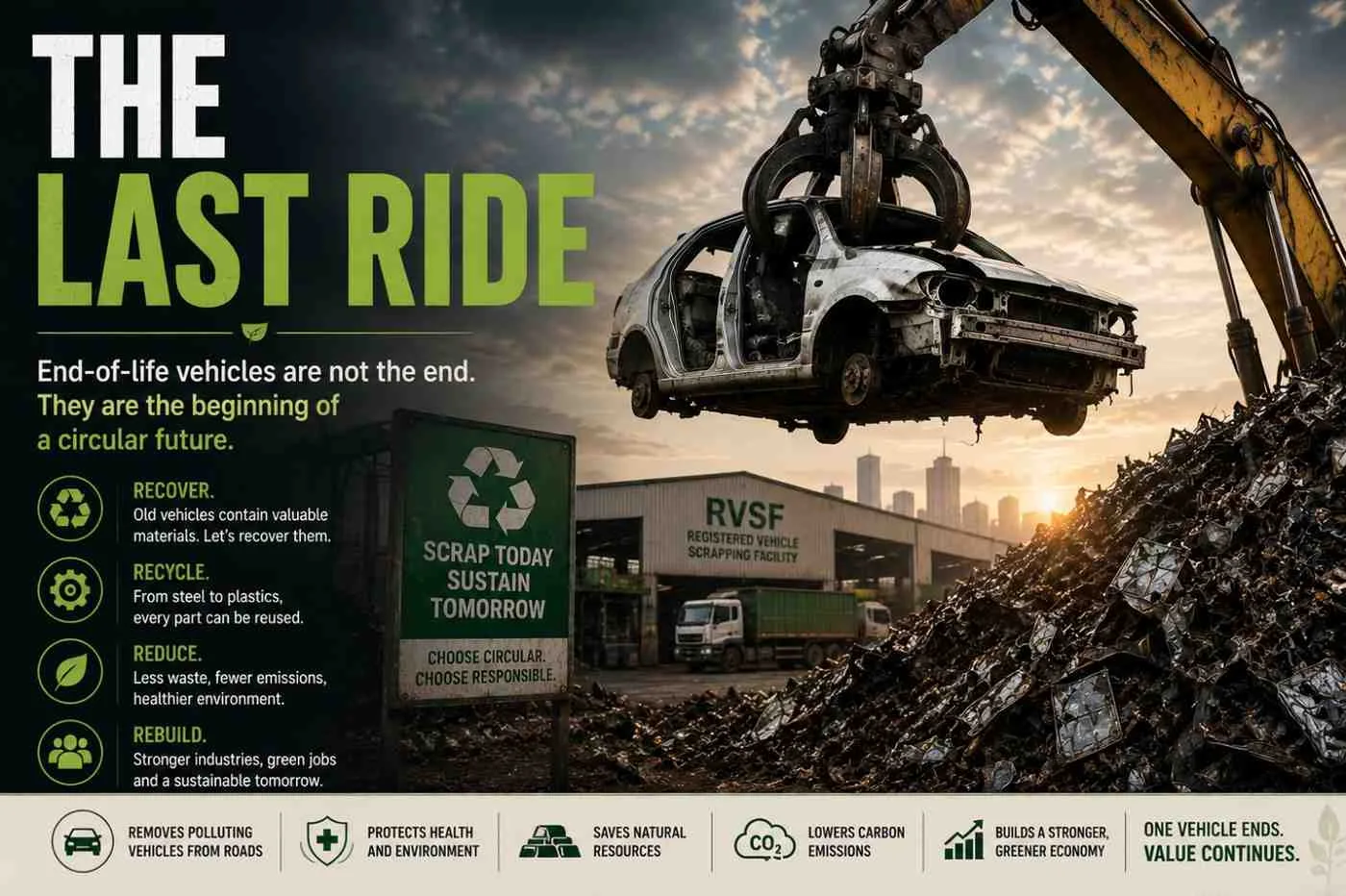
India's growing vehicle scrappage ecosystem is transforming end-of-life vehicles into valuable resources, but the success of a circular material economy will depend on formal recycling, stronger infrastructure and public participation  Kolkata | August 1, 2026:Every vehicle eventually reaches the end of its useful life. The real question is what happens next. For years, old and damaged vehicles in India were largely dismantled in informal scrapyards, where valuable materials were recovered with little environmental oversight or scientific waste management.  Today, that approach is gradually giving way to a more organised system. As India expands its vehicle scrappage programme and establishes authorised recycling facilities, end-of-life vehicles (ELVs) are beginning to play a much larger role in the country's transition towards a circular economy. The shift comes at an important moment. India is one of the world's largest automobile markets, and millions of vehicles are expected to retire from the roads over the next decade. Managing this growing volume is no longer just about disposing of ageing vehicles. It is becoming an opportunity to recover valuable resources, reduce industrial waste and strengthen sustainable manufacturing. Under the government's Vehicle Scrappage Policy, ageing and unfit vehicles are encouraged and in certain cases required- to undergo fitness assessments before being transferred to Registered Vehicle Scrapping Facilities (RVSFs). These authorised centres are designed to dismantle vehicles scientifically, safely handle hazardous components and recover reusable materials such as steel, aluminium, copper, plastics, and rubber. Experts believe this approach could significantly improve India's resource efficiency. Recovering metals from scrapped vehicles requires far less energy than extracting and processing newly mined raw materials, helping reduce both production costs and carbon emissions.Recycled steel and aluminium are also expected to become increasingly valuable as demand continues to grow across the automotive, construction and infrastructure sectors.Yet building an efficient circular material chain remains a complex task. A substantial portion of vehicle dismantling is still carried out by the informal sector, which has supported recycling activities for decades through well-established local networks. While these businesses recover a significant amount of recyclable material, environmental safeguards, worker safety standards and material traceability often remain inadequate. Integrating informal operators into a regulated recycling ecosystem is therefore seen as one of the biggest challenges facing the sector. Infrastructure presents another hurdle. Expanding the number of authorised scrapping facilities is only part of the solution. Experts say the wider ecosystem-including testing centres, dismantling capacity and supporting infrastructure- still falls short in many parts of the country.The transition also faces another obstacle: participation. Public awareness of the scrappage policy remains limited, while logistical constraints and uneven implementation across states continue to slow the growth of formal recycling systems. Experts believe that without meaningful economic incentives, encouraging wider participation from vehicle owners will remain a significant challenge. Vehicle owners are more likely to participate when scrapping offers tangible financial benefits through tax concessions, incentives or discounts on new vehicle purchases. At the same time, manufacturers stand to benefit from a more dependable supply of recycled materials, strengthening supply-chain resilience while reducing dependence on newly extracted resources. The advantages extend well beyond the automobile industry. A well-developed vehicle recycling ecosystem can reduce landfill waste, improve air quality by replacing highly polluting vehicles and create new employment opportunities across dismantling, material recovery, recycling, and secondary manufacturing. It also supports India's wider objectives of improving resource efficiency, lowering industrial emissions and promoting circular economy practices within domestic manufacturing. Environmental experts believe that transition cannot end with vehicle recycling alone.A truly circular automotive sector will require vehicles to be designed for easier recycling, valuable materials to be recovered more efficiently, battery recycling systems to expand and manufacturers to take greater responsibility for the entire life cycle of their products. As India's vehicle population continues to grow, the country's next sustainability milestone may not be measured by how many new vehicles are manufactured, but by how responsibly older ones are managed at the end of their life. The programme's success will not be measured by the number of vehicles it dismantles, but by the value it creates from them. It will be measured by how effectively yesterday's vehicles are transformed into tomorrow's resources, reducing waste, conserving raw materials and strengthening India's circular economy. The journey of a vehicle should not end at the scrapyard. In a truly sustainable economy, it should continue through the materials it leaves behind - fueling new industries, conserving natural resources and reinforcing the idea that the most valuable resources are often those already in our hands. Sources: Ministry of Road Transport and Highways (MoRTH) – Vehicle Scrapping Policy: Notifications and Ruleshttps://www.morth.gov.in/en/Circulars-Notifications-related-to-Vehicle-Scrapping-PolicyPress Information Bureau (PIB) – Vehicle Scrapping Policy: Progress of Registered Vehicle Scrapping Facilities (RVSFs)https://www.pib.gov.in/PressReleasePage.aspx?PRID=2099130&lang=2&reg=48National Government Services Portal – Registered Vehicle Scrapping Facility (RVSF) Portalhttps://services.india.gov.in/service/detail/apply-for-registered-vehicle-scrapping-facilityMinistry of Road Transport and Highways – State-wise Registered Vehicle Scrapping Facility (RVSF) Notificationshttps://www.morth.gov.in/en/rvsf-notificationsCentral Pollution Control Board (CPCB) – Environmentally Sound Management of End-of-Life Vehicleshttps://cpcb.nic.in/NITI Aayog – Reports on Circular Economy and Resource Efficiencyhttps://www.niti.gov.in/Down To Earth – Coverage on vehicle scrappage, recycling and the circular economy in Indiahttps://www.downtoearth.org.in/The Energy and Resources Institute (TERI) – Research on resource efficiency, recycling and circular economyhttps://www.teriin.org/Ministry of Steel, Government of India – Steel recycling and secondary raw materials initiativeshttps://steel.gov.in/Press Information Bureau (PIB) – Voluntary Vehicle Fleet Modernization Programme (Vehicle Scrapping Policy)https://www.pib.gov.in/newsite/erelcontent.aspx?lang=2&reg=48&relid=265928 ...Read more

01 Aug 2026

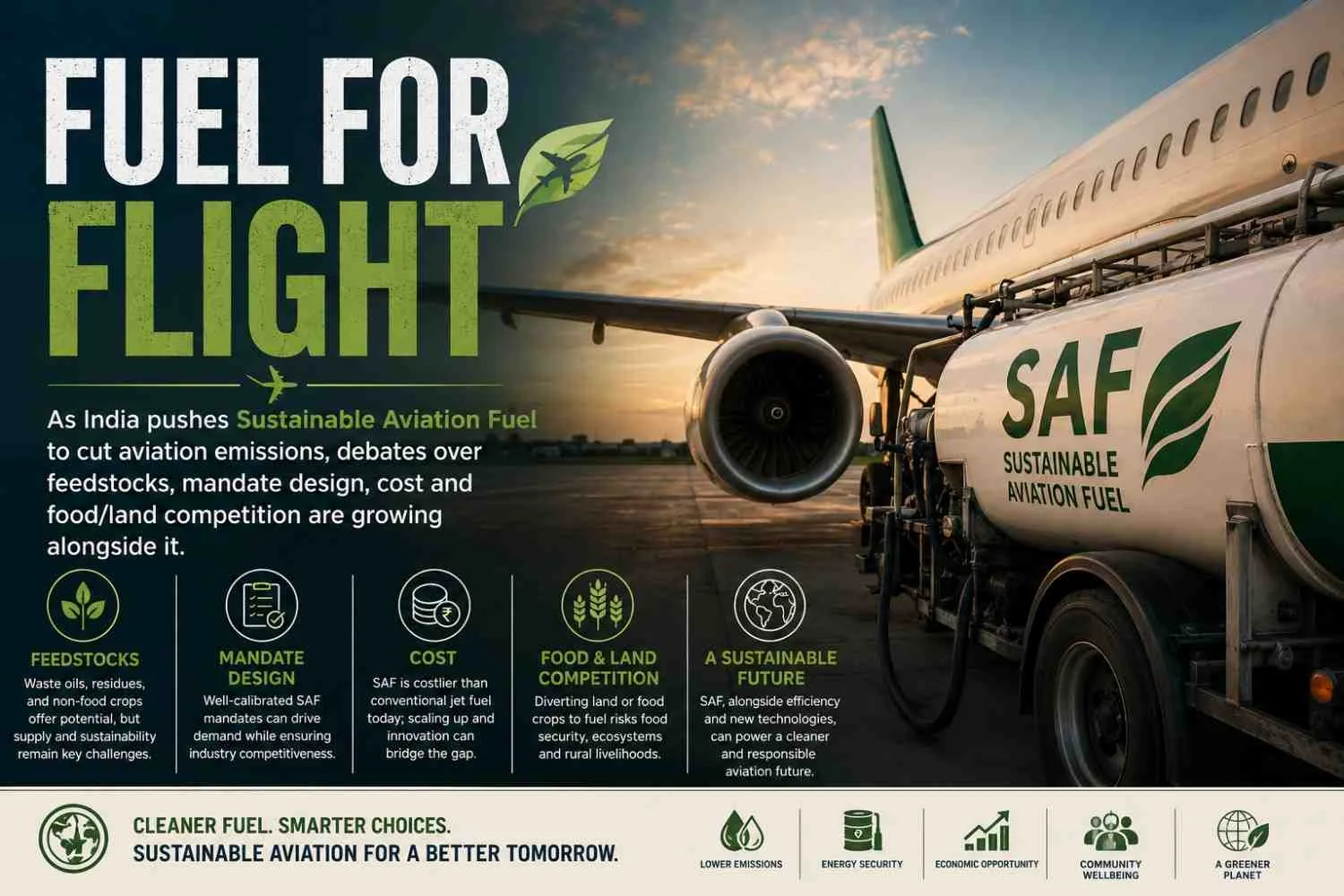
As India pushes sustainable aviation fuel to cut aviation emissions, questions over feedstocks, costs and competition for land and food are beginning to shape the debateKolkata| August 1, 2026: The future of aviation may depend not only on how aircraft are designed, but also on what powers them.Today, aviation contributes around 2–3% of global carbon dioxide emissions, and unlike road transport, long-distance flights still have limited alternatives to conventional liquid fuels. As governments and airlines look for ways to reduce emissions without disrupting air travel, Sustainable Aviation Fuel (SAF) has emerged as one of the sector's most promising solutions. For India, adopting Sustainable Aviation Fuel is not simply a question of replacing one fuel with another. It requires balancing climate ambitions with economic viability, feedstock availability and long-term sustainability. SAF is produced from renewable or waste-based feedstocks instead of conventional crude oil. Depending on the production pathway, it can substantially reduce lifecycle greenhouse gas emissions while remaining compatible with existing aircraft engines and airport infrastructure. Its compatibility with existing aircraft engines and airport infrastructure makes SAF one of the most practical and scalable solutions for reducing aviation emissions. India is gradually bringing Sustainable Aviation Fuel into the centre of its clean energy and climate strategy.Government agencies, airlines, oil marketing companies and research institutions are working to expand domestic production, support pilot projects and prepare for future blending mandates.Beyond reducing aviation emissions, these efforts are intended to strengthen energy security and help India secure a place in the emerging global SAF market. The real challenge, however, extends beyond policy ambition. It lies in ensuring a sustainable and reliable supply of feedstock that can support production on a commercial scale. Experts point to agricultural residues, used cooking oil, municipal solid waste, forestry waste and certain non-food energy crops as the most promising sources for Sustainable Aviation Fuel. Unlike food-based feedstocks, these resources can help reduce emissions without affecting food security. The challenge, however, lies in building efficient supply chains, as collecting, transporting and processing these materials remains expensive and operationally complex. The conversation becomes far more complex when cleaner fuel begins to compete with food and land resources. Using edible oils, sugar crops or fertile agricultural land as feedstocks could place additional strain on food prices, water availability and rural livelihoods. Environmental experts also warn that clearing forests or natural ecosystems to cultivate energy crops may erode many of the climate gains that Sustainable Aviation Fuel seeks to achieve. As a result, the real challenge is not simply producing cleaner aviation fuel- it is ensuring that the path to cleaner aviation does not create new environmental or social pressures along the way.  Cost remains one of the biggest hurdles for Sustainable Aviation Fuel. Production volumes are still limited, supply chains are yet to mature and, as a result, SAF continues to cost significantly more than conventional jet fuel. For airlines already operating in a highly competitive market with narrow profit margins, absorbing these additional costs will not be easy without targeted policy support and market incentives. That is why the design of future blending mandates could determine how quickly SAF moves from ambition to widespread adoption. Rather than imposing immediate large-scale adoption, many countries are introducing phased blending mandates that gradually expand the use of Sustainable Aviation Fuel while supporting domestic production and maintaining industry competitiveness. Experts argue that India will need a similar approach—one that balances climate commitments with commercial realities and gives producers, refiners and airlines the certainty and time needed to expand investments, production capacity and supporting infrastructure.Despite these challenges, experts emphasise that Sustainable Aviation Fuel is only one part of the solution. Reducing aviation emissions will also depend on more fuel-efficient aircraft, improved air traffic management, operational efficiencies and the development of future technologies such as hydrogen-powered aircraft. The future of aviation decarbonisation won’t rest on SAF alone. It will sit alongside efficiency, new aircraft, and operational changes. For India, Sustainable Aviation Fuel represents more than an alternative fuel- it offers an opportunity to reshape the future of cleaner aviation. A successful SAF ecosystem could create economic value from agricultural waste, strengthen energy security, encourage innovation and help the country move closer to its climate commitments. But lasting success will depend on ensuring that the transition protects food security, safeguards ecosystems and supports the communities that depend on them. The future of aviation will not be judged only by how much it reduces emissions, but by how responsibly it achieves that transition. Because sustainable flight truly begins long before it’s take-off - with fuel that is as sustainable in its production as it is in its purpose. Sources: International Civil Aviation Organization (ICAO) – SAF Feedstocks (CORSIA Framework)https://www.icao.int/CORSIA/feedstocksInternational Civil Aviation Organization (ICAO) – Guidance on Policy Measures for SAF Development and Deploymenthttps://www.icao.int/SAF/saf-guidance-policy-measuresInternational Civil Aviation Organization (ICAO) – SAF Rules of Thumb (Feedstocks, Costs & Production Pathways)https://www.icao.int/SAF/saf-rules-of-thumbICAO ACT-SAF Programme – India Sustainable Aviation Fuel Feasibility Studyhttps://www.icao.int/sites/default/files/environmental-protection/Documents/ACT-SAF/Feasibility_Study_India.pdfInternational Air Transport Association (IATA) – Global Feedstock Assessment for SAF Production Outlook to 2050https://www.iata.org/globalassets/iata/publications/sustainability/global-feedstock-assessment-for-saf-production-outlook-to-2050.pdfMinistry of Petroleum and Natural Gas (Government of India) – Biofuels and Sustainable Aviation Fuel policy updateshttps://mopng.gov.in/Ministry of Civil Aviation (Government of India) – Aviation sustainability initiatives and SAF developmentshttps://www.civilaviation.gov.in/NITI Aayog – Reports on biofuels, energy transition and low-carbon transporthttps://www.niti.gov.in/International Energy Agency (IEA) – Aviation and Sustainable Fuelshttps://www.iea.org/Down To Earth – Coverage on SAF, biofuels, feedstock availability and food-versus-fuel concerns in Indiahttps://www.downtoearth.org.in/ ...Read more

01 Aug 2026

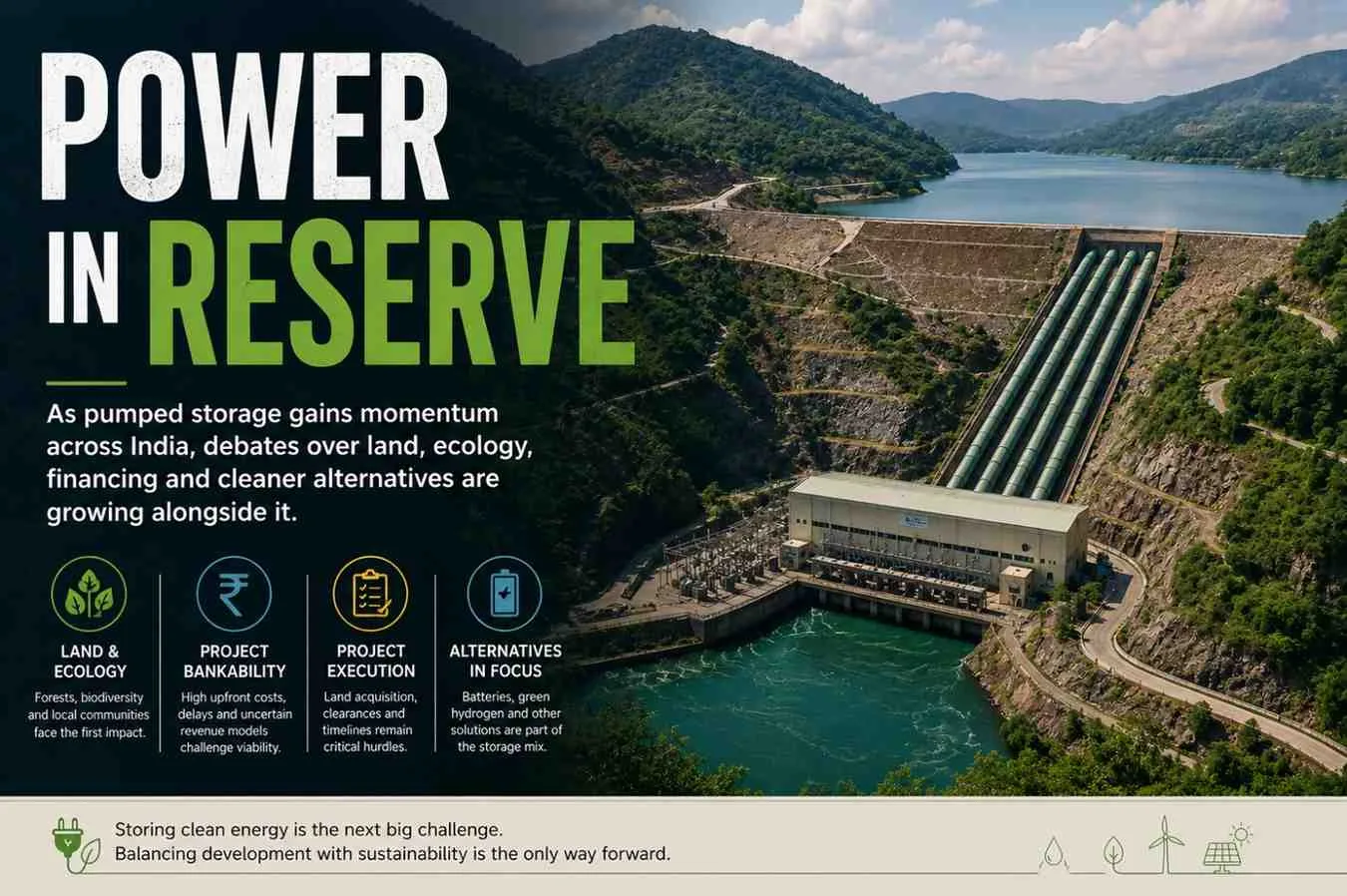
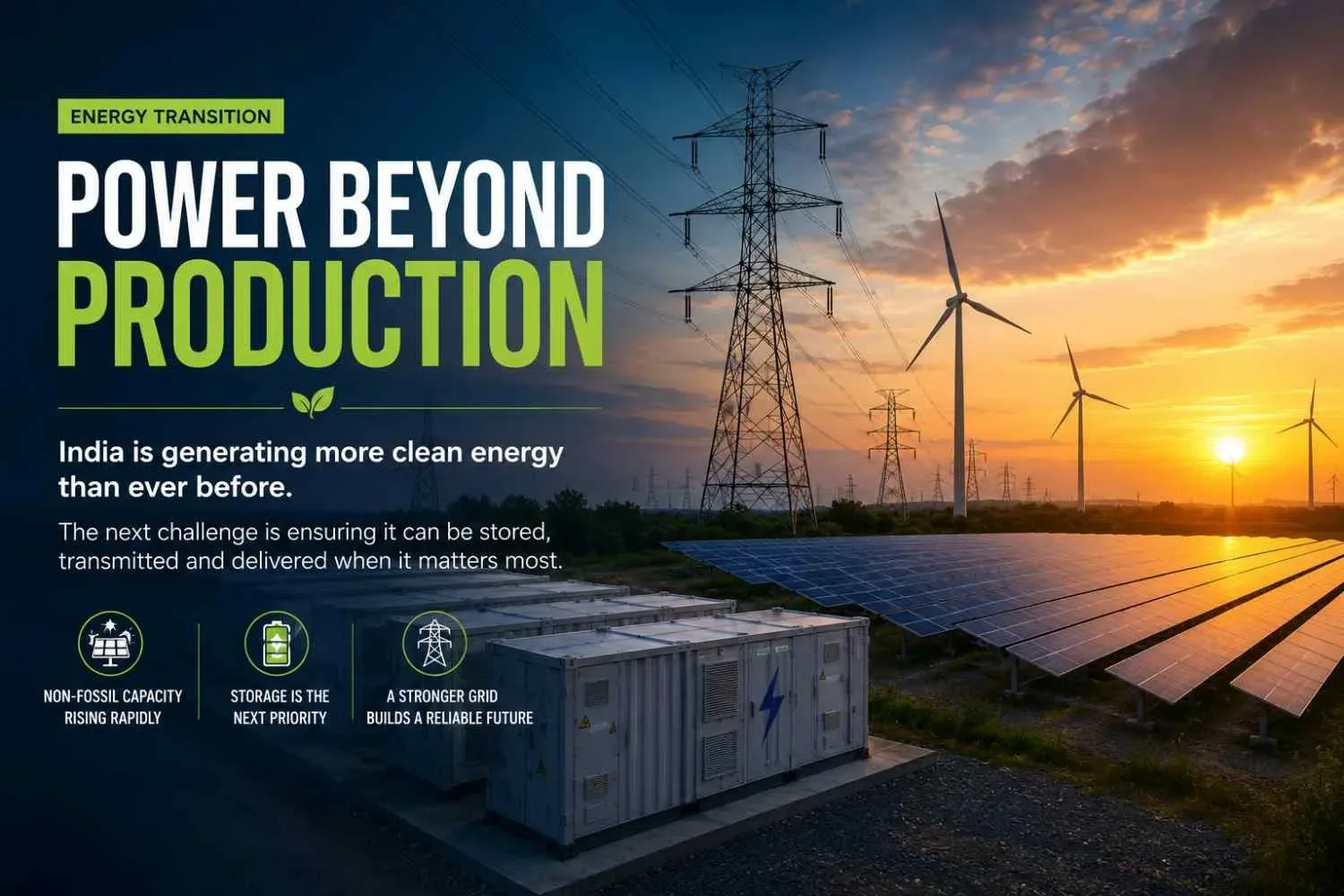
As pumped storage gains momentum across India, debates over land, ecology, financing and cleaner alternatives are growing alongside it KOLKATA | August 1, 2026: India's renewable energy capacity is expanding rapidly, but the next phase of the transition will depend on solving a critical challenge: storing clean electricity when renewable sources are not generating power. Pumped storage hydropower (PSH) has emerged as one of the country's most promising solutions and is now playing a central role in India's energy planning. However, as projects begin moving from policy announcements to on-ground development, they are also raising important questions about land, ecology, financial viability and whether alternative storage technologies can deliver the same benefits with fewer trade-offs. Pumped storage hydropower functions like a giant rechargeable battery. Surplus electricity is used to pump water from a lower reservoir to an upper one, where it is stored until demand rises. When additional power is required, the water is released back through turbines to generate electricity. Its ability to provide long-duration energy storage and stabilise the electricity grid has made pumped storage an important part of India's strategy for integrating larger amounts of solar and wind power. Pumped storage hydropower is emerging as a cornerstone of the Union government's long-term clean energy strategy. Across states such as Maharashtra, Andhra Pradesh, Madhya Pradesh, Odisha and Karnataka, a growing pipeline of projects is expected to play a vital role in integrating larger volumes of solar and wind power into the grid. Yet as development gathers pace, the conversation is expanding beyond energy storage to include questions of land, ecology, financial viability and sustainability. While pumped storage offers important benefits for the power sector, many proposed projects are located in ecologically sensitive hilly and forested areas. Developing two reservoirs often requires significant land acquisition and extensive civil works. Experts caution that large-scale construction, forest diversion and changes to natural drainage systems could have lasting impacts on biodiversity, wildlife movement and local ecosystems. In many regions, residents have also expressed concerns about displacement, water availability and the long-term effects on their livelihoods. Financial sustainability is another issue shaping the debate. The financial challenge begins long before a pumped storage project starts generating electricity. While these facilities can operate for decades with relatively low operating costs, they demand substantial upfront investment and long construction timelines. Delays in environmental clearances, land acquisition or financing can sharply increase costs and affect overall project viability. Developers also need reliable revenue mechanisms that recognise the value of energy storage and grid-balancing services, rather than compensating only for electricity generation. These constraints have led to a broader discussion on whether alternative storage technologies could offer faster or more flexible solutions.Battery Energy Storage Systems (BESS) are emerging as a promising alternative, with declining costs and faster deployment making them well suited for a wide range of energy storage applications.Yet experts believe each technology serves a different purpose. While batteries perform well for short-duration storage, pumped storage hydropower remains better suited for storing large amounts of electricity over longer periods. Other solutions, including green hydrogen and advanced battery technologies, are also making steady progress, but they are still some ways from delivering the scale and reliability needed to support India's national electricity grid. Experts argue that pumped storage and batteries should be viewed as complementary rather than competing technologies. As renewable energy expands, India's electricity system is expected to require a combination of storage solutions capable of meeting different grid requirements. At the same time, policymakers face a broader challenge. Future projects will need rigorous environmental assessments, transparent engagement with local communities, fair compensation frameworks and stronger ecological safeguards to support both sustainable development and investor confidence. As India's renewable energy capacity continues to grow, pumped storage hydropower is expected to play a defining role in keeping the power system reliable. But its legacy will not be determined by storage capacity alone. It will be defined by whether development can balance environmental responsibility, financial sustainability and public trust alongside the country's growing energy needs.In the years ahead, the clean energy transition will be judged not only by how much renewable electricity India generates, but by how responsibly it chooses to store it. Sources: Ministry of Power, Government of India – Pumped Storage Projects Guidelines & Policy Initiativeshttps://powermin.gov.in/ Central Electricity Authority (CEA) – National Electricity Plan (Volume II: Transmission & Energy Storage)https://cea.nic.in/ NITI Aayog – Energy Storage Roadmap for Indiahttps://www.niti.gov.in/ International Energy Agency (IEA) – Electricity Storage & Hydropower Analysishttps://www.iea.org/ International Hydropower Association (IHA) – Pumped Storage Hydropowerhttps://www.hydropower.org/ Central Electricity Authority (CEA) – Status of Pumped Storage Projects in Indiahttps://cea.nic.in/hydro/ Down To Earth – Reports on pumped storage projects, environmental clearances and ecological concerns in India.https://www.downtoearth.org.in/ Mongabay India – Coverage of pumped storage projects, biodiversity impacts and community concerns.https://india.mongabay.com/ The Hindu BusinessLine – Coverage on pumped storage investments, project financing and renewable integration.https://www.thehindubusinessline.com/ Ministry of Environment, Forest and Climate Change (MoEFCC) – Environmental clearance notifications and project approvals.https://moefcc.gov.in/ ...Read more

31 Jul 2026

India is generating more clean energy than ever before. The next challenge is ensuring it can be stored, transmitted and delivered when it matters most     KOLKATA | JULY 31,2026India is making notable strides in its renewable energy transition. The expansion of solar parks, the growth of wind energy projects, and the steady increase in non-fossil fuel capacity highlight the country's progress toward its climate commitments. At the same time, another fundamental question is coming into sharper focus. Can India's electricity grid and energy storage systems keep pace with the rapid expansion of renewable power? The answer will play a decisive role in determining whether India's clean energy ambitions are matched by a resilient electricity system or limited by inadequate grid and storage capacity. India has made substantial progress in scaling up its non-fossil electricity capacity through sustained investments in solar, wind, hydropower, and nuclear energy. As a result, the country is steadily advancing toward its target of 500 GW of non-fossil capacity by 2030 while emerging as one of the fastest-growing renewable energy markets globally. The greater challenge, however, lies beyond generation- it is ensuring that the grid and energy storage systems can efficiently integrate and deliver this growing supply of clean power. While renewable energy capacity continues to expand, its effective utilisation remains a major challenge. Solar generation declines after sunset, and wind power fluctuates with changing weather conditions. For clean electricity to be available whenever and wherever it is needed, sufficient energy storage and a resilient transmission network are essential. Consequently, the focus of India's energy transition is shifting from merely generating renewable power to integrating it efficiently into the electricity system. As the share of renewable energy grows, the role of Battery Energy Storage Systems (BESS), pumped hydro storage projects, and modern transmission networks becomes critical. These technologies provide the flexibility required to store excess electricity, balance demand and supply, and maintain grid stability despite the intermittent nature of solar and wind power. Recent policy initiatives indicate a growing shift towards strengthening these enabling infrastructures alongside renewable energy expansion. Recognising the need for stronger supporting infrastructure, the government has announced large-scale battery storage programmes, accelerated interstate transmission projects, and encouraged investments in flexible power systems. Several states are also co-locating energy storage facilities with new renewable energy parks, reflecting an understanding that future electricity systems must expand generation, storage, and transmission in tandem. Even with these initiatives, critical gaps continue to hinder the pace of the transition. However, the transition is far from complete. Many energy storage projects remain in the pipeline, and utility-scale battery systems continue to be costlier than conventional power alternatives. Transmission infrastructure, too, has struggled to keep pace with the rapid growth of renewable energy, especially where large solar and wind projects are situated far from major demand centres. The expansion of storage and transmission infrastructure is further constrained by delays in land acquisition, regulatory approvals, and access to finance. At the same time, integrating increasing volumes of renewable energy into the national grid requires accurate forecasting, real-time digital monitoring, and smarter grid management technologies. The consequences of these challenges extend beyond the electricity sector, influencing energy security, industrial competitiveness, and the pace of India's broader low-carbon transition. Reliable renewable electricity is becoming the foundation of India's next-generation industries. Clean manufacturing depends on a dependable supply of low-carbon power, electric mobility requires a stable electricity network, and green hydrogen production demands uninterrupted renewable energy. Without sufficient storage capacity and modern transmission infrastructure, these sectors could struggle to realise their full potential despite the country's growing renewable energy capacity. For this reason, experts increasingly argue that India's clean energy transition must now be judged not only by the number of megawatts it adds, but by its ability to build an integrated, resilient, and flexible energy ecosystem capable of delivering clean power whenever and wherever it is needed. Meeting the next phase of the energy transition will require more than expanding renewable generation. It demands greater investment in domestic battery manufacturing, faster development of pumped hydro storage, modernised grid infrastructure, wider deployment of smart grid technologies, and increased private-sector participation in energy storage. Equally vital is effective coordination among central agencies, state utilities, and renewable energy developers to accelerate project execution and strengthen grid reliability. For consumers, the impact of these measures may not be immediately visible. Over time, however, they will translate into fewer power disruptions, a more dependable electricity supply, stronger support for low-carbon industries, and the ability to deliver clean energy generated during the day whenever demand is highest. As India approaches its 2030 renewable energy targets, the real challenge is no longer generating more clean electricity-it is ensuring that every unit of that electricity can be stored, transmitted, and delivered reliably. The next chapter of the energy transition will be written not in solar parks or wind farms alone, but in batteries, transmission corridors, and smarter electricity grids. In the end, India's clean energy future will not be defined by the scale of its renewable capacity, but by the strength of the infrastructure that supports it. Because renewable energy fulfils its promise only when clean power is available - not just when it is generated, but whenever and wherever it is needed. Sources:  Ministry of New and Renewable Energy (MNRE) – Energy Storage Systems (ESS) Overview (https://mnre.gov.in/en/energy-storage-systemsess-overview/)Ministry of New and Renewable Energy (MNRE) – Energy Storage Systems Technical Reports (https://mnre.gov.in/en/document-category/energy-storage-systemsess-technical-reports/)Central Electricity Authority (CEA) – Integrated Resource Planning (https://cea.nic.in/integrated-resource-planning-division/?lang=en)Central Electricity Authority (CEA) – National Electricity Plan (Generation) (https://cea.nic.in/integrated-resource-planning-division/?lang=en)Ministry of New and Renewable Energy (MNRE) – State Resource Adequacy Planning (https://mnre.gov.in/en/state-resource-adequacy-planning/)Ministry of Power, Government of India (https://powermin.gov.in/)Press Information Bureau (PIB), Government of India (https://pib.gov.in/)NITI Aayog – India's Energy Storage Mission: A Make-in-India Opportunity for Globally Competitive Battery Manufacturing (https://mnre.gov.in/en/document-category/other-reports/)International Energy Agency (IEA) – India Energy Outlook (https://www.iea.org/countries/india)International Renewable Energy Agency (IRENA) (https://www.irena.org/) ...Read more

31 Jul 2026

India and the UAE are deepening cooperation in renewable energy, green hydrogen, logistics and sustainable finance, signalling a shift from traditional commerce to long-term clean growth KOLKATA | July 30, 2026: For years, the India-UAE partnership has been driven by trade, investment and energy cooperation. Today, it is being redefined by a new priority- building a low-carbon future together. Renewable energy, green hydrogen, sustainable finance and resilient infrastructure are increasingly moving to the centre of bilateral cooperation as both countries respond to the growing demand for cleaner energy and more sustainable economic growth. For India, the UAE is no longer just an important trading partner. It is emerging as a strategic ally in accelerating the country's clean energy transition. The partnership is no longer just about strengthening economic ties. It is about shaping the future of clean energy.This raises an important question: can India and the UAE together accelerate the transition to a low-carbon economy while creating new opportunities for trade and investment? Recent developments suggest they are moving in that direction. Renewable energy has become a cornerstone of the partnership, with UAE-based companies investing in India's solar and wind sectors and both countries exploring ambitious clean energy projects. The investments are reinforcing India's clean energy ambitions by supporting renewable energy expansion and reducing long-term dependence on fossil fuels.Green hydrogen is quickly emerging as the next frontier of cooperation. With its potential to decarbonise energy-intensive industries such as steel, fertilisers, chemicals and heavy transport, green hydrogen has become a key focus area for both India and the UAE.While India is implementing the National Green Hydrogen Mission, the UAE is positioning itself as a major global producer and exporter of clean hydrogen. As these ambitions converge, collaboration through technology partnerships, joint projects and long-term supply agreements is expected to accelerate.The partnership is also moving beyond energy generation to the infrastructure that supports global trade. Investments in ports, transport corridors, warehousing and digital logistics systems can improve the movement of industrial goods and clean energy equipment while reducing trade costs. In today’s carbon-conscious economy, efficient logistics are shifting from a speed issue to a strategic advantage. Another area witnessing growing collaboration is green finance. Sustainable investment funds, climate finance and ESG-linked capital are playing an increasingly important role in supporting renewable energy projects, resilient infrastructure and low-carbon industrial growth.For Indian businesses, access to these financial resources could accelerate technology upgrades and help meet rising global sustainability expectations. Sectors such as renewable energy manufacturing, battery storage, hydrogen technologies, sustainable construction materials and clean transport stand to gain from stronger investment flows and expanding market opportunities. Even so, translating ambition into action will not be easy. Large-scale green projects require supportive policies, timely regulatory approvals, skilled manpower and modern infrastructure. Affordable financing, technology partnerships and long-term commercial viability will also determine whether these initiatives move beyond announcements and turn into implementation. Experts say continued coordination between India and the UAE will be essential to ensure that investments deliver measurable economic growth alongside meaningful environmental progress. For most citizens, the effects of this cooperation may not be visible today, but its long-term impact could be significant. Cleaner energy investments can enhance energy security, generate employment, support technological innovation and contribute to a healthier environment. At the same time, modern logistics can strengthen supply chains and improve the competitiveness of Indian products in international markets. As climate action reshapes the global economy, the India-UAE partnership is becoming more than an economic relationship - it is emerging as a strategic collaboration for a more sustainable future. The future of the India-UAE partnership may no longer be measured by trade volumes alone, but by how effectively the two countries work together to build cleaner industries, drive innovation and lead the transition towards a more sustainable global economy. Sources: Ministry of External Affairs (Government of India) – India-UAE Bilateral Relationshttps://www.mea.gov.in/Portal/ForeignRelation/India-UAE_Bilateral_Brief.pdfMinistry of Commerce & Industry (Government of India) – India-UAE CEPAhttps://commerce.gov.in/trade/international-trade/trade-agreements/india-uae-cepa/Ministry of New and Renewable Energy (MNRE)https://mnre.gov.in/International Renewable Energy Agency (IRENA) – Green Hydrogen & Energy Transition Reportshttps://www.irena.org/Abu Dhabi Future Energy Company (Masdar)https://masdar.ae/AD Ports Group – India Investments & Logistics Projectshttps://www.adportsgroup.com/DP World – India Operations & Trade Logisticshttps://www.dpworld.com/Invest India – UAE Investment & Clean Energy Partnershipshttps://www.investindia.gov.in/Press Information Bureau (PIB), Government of Indiahttps://pib.gov.in/The Economic Times – Energy & Infrastructurehttps://energy.economictimes.indiatimes.com/ ...Read more

31 Jul 2026

From overseas investments to recycling and responsible mining, India's critical minerals strategy is entering a decisive phase Kolkata | July 30, 2026:Every electric vehicle, solar panel, wind turbine and battery storage system relies on a set of resources that often remain out of public view- critical minerals.    Lithium, cobalt, nickel, graphite and rare earth elements, have become indispensable to the global clean energy transition, making them strategically important today as fossil fuels were in the past. As countries accelerate efforts to decarbonise their economies, India is also strengthening its approach in securing these resources. Through overseas partnerships, investments in mineral-rich regions, domestic refining, recycling initiatives and policy reforms, the country is working to build a more resilient critical mineral supply chain. The objectives extend beyond supporting renewable energy projects. It is also about strengthening energy security, expanding domestic manufacturing and reducing dependence on imports. The urgency has grown as global competition for critical minerals continues to intensify. Much of the world's refining and processing capacity remains concentrated in a few countries, leaving supply chains vulnerable to geopolitical tensions, trade restrictions and market disruptions.In response, India is focusing on a two-pronged approach-strengthening international cooperation to secure mineral supplies while building domestic refining capacity to convert raw minerals into battery-grade materials at home.Experts say this reflects an important shift in the global conversation. Securing access to mineral deposits is no longer enough. Gradually, countries are seeking greater control over the entire value chain - from extraction and refining to manufacturing, recycling and reusing. Recycling is emerging as another key part of this transition. As electric vehicle adoption grows, used batteries and electronic waste are expected to become valuable secondary sources of lithium, cobalt and nickel. Recovering these materials can reduce pressure on fresh mining, lower environmental impacts and strengthen resource security while creating new opportunities in advanced recycling and material recovery. Although recycling alone cannot meet future demand, experts believe it will play an important role in building a more circular economy.Securing critical minerals is necessary, but far from sufficient. Mining often takes place in ecologically sensitive regions that support forests, rivers and Indigenous communities. Around the world, concerns over biodiversity loss, land acquisition, water stress and community displacement have intensified alongside expanding mineral exploration. Conservationists argue that the transition to clean energy should not come at the expense of environmental protection or local livelihoods. This has elevated responsible mining to a core priority.Experts believe every critical mineral project should include transparent environmental assessments, meaningful community consultation, fair compensation and continuous ecological monitoring. They stress on a fundamental shift: local communities must be partners in building the future, not just recipients of its consequences. The discussion reflects a broader evolution in the sustainability agenda. Climate action is no longer measured only by the number of renewable energy projects or electric vehicles on the road. It also depends on whether the resources powering these technologies are extracted responsibly, processed efficiently and managed sustainably throughout their life cycle.For India, the years ahead will determine whether industrial growth, resource security and environmental responsibility can advance together. Progress will depend not only on overseas agreements or new processing facilities, but on building a supply chain that is transparent, resilient and socially inclusive. Ultimately, the clean energy transition will be defined not just by what we build, but by how we build it. It will also be judged by the choices made long before those technologies reach consumers.   The countries that lead the future will not simply be those with the largest mineral reserves, but those that develop supply chains that are ethical, resilient and circular. For India, the real challenge is not only securing the minerals that power a greener economy, but proving that sustainable development begins with responsible decisions at every stage of the journey! The true success of the clean energy transition lies not only in its destination, but in ensuring that every step along the way is sustainable. Sources: Ministry of Mines, Government of India – National Critical Mineral Mission, policy updates and official announcements.Ministry of Mines – Critical MineralsCouncil on Energy, Environment and Water (CEEW) – Analysis on the India–US Critical Minerals Agreement, domestic processing and supply-chain resilience.India–US Critical Minerals: The Midstream Test (CEEW) Ministry of External Affairs (MEA) – Quad Critical Minerals Initiative Framework and international cooperation.Quad Critical Minerals Initiative FrameworkInternational Energy Agency (IEA) – Critical Minerals Policy Tracker covering global supply chains, recycling and responsible mineral policies.IEA Critical Minerals Policy TrackerReuters – Reporting on India's expanding critical mineral partnerships and efforts to strengthen exploration, processing and recycling.India in talks over critical minerals partnerships ...Read more

29 Jul 2026

China's climate emergencies highlight a bigger question: Are Asian cities prepared for multiple disasters at once?  When a typhoon approaches, cities usually prepare for strong winds and heavy rain. But what happens when rivers are already overflowing before the storm even arrives? Experts say this is becoming the new reality. Instead of facing isolated disasters, countries are increasingly confronting compound events- multiple climate hazards unfolding together or in rapid succession, making their impacts far more severe and recovery more complex. China's recent climate emergencies offer a clear example of this growing challenge. Over a short span of time, several regions have experienced heavy rainfall, widespread flooding and the looming threat of typhoons. Together, these overlapping events have tested emergency response systems, disrupted transport networks, increased pressure on dams and forced thousands of people to evacuate. China's response may dominate the immediate headlines, but the larger concern reaches beyond its borders. If one of Asia's largest economies can face multiple climate disasters simultaneously, how resilient are other countries when confronted with the same threat? Across Asia, rapid urbanisation is unfolding alongside frequent climate hazards. Rising temperatures are intensifying heavy rainfall, while sea-level rise and changing weather patterns are making floods more destructive in densely populated cities.Experts say this new reality demands a shift in disaster planning- from preparing for single events to managing multiple climate risks at the same time.The challenge is no longer preparing for a single disaster in isolation. Cities are now being forced to plan for multiple hazards that can occur at the same time or trigger one another. This shift is making compound-event planning a key priority for disaster preparedness. The focus is shifting from isolated disasters to understanding how multiple hazards interact. Heavy rainfall can overwhelm drainage systems, flood roads, trigger landslides, and strain dams and reservoirs- leaving communities more vulnerable if another hazard, such as a cyclone, follows soon after. Disasters can no longer be viewed as separate emergencies, as one event often magnifies the impact of another. China's recent climate emergencies demonstrate why preparing for interconnected risks is becoming an essential part of disaster planning. Another issue moving to the forefront is dam safety.Reservoirs across Asia are vital for water storage, irrigation, hydropower and flood management.  But during extreme rainfall, operators face a difficult choice: retain more water and increase pressure on the dam, or release it quickly and risk worsening floods downstream.Experts say climate change is making these decisions more difficult, turning dam management into more than just a technical challenge.Modern dam management depends on accurate weather forecasts, river monitoring, real-time data and close coordination between multiple agencies. Strengthening these systems can help authorities act before risks escalate.The same principle applies to cities.Urban flooding is no longer caused by heavy rainfall alone. Rapid urbanisation, shrinking wetlands, expanding paved surfaces and inadequate drainage often prevent water from draining naturally, allowing intense rainfall to quickly develop into a major urban emergency. Many cities across Asia are now confronting the same challenge. Whether in China, India, Bangladesh or Southeast Asia, growing populations and expanding infrastructure are increasing exposure to climate-related risks. Experts argue that adaptation must therefore become part of everyday urban planning rather than an emergency response after disasters occur. This requires stronger drainage systems, the protection of natural flood buffers like wetlands and floodplains, more effective early-warning systems, and resilient infrastructure that can continue operating during extreme weather. Technology is becoming a powerful ally in climate adaptation. From satellite monitoring and artificial intelligence to advanced forecasting and digital flood mapping, new tools are helping authorities detect risks earlier and give communities more time to prepare. But technology cannot prevent disasters on its own. Experts say real preparedness depends on how effectively governments, engineers, emergency responders and local communities work together long before a crisis begins. For India, the lessons are particularly relevant. Recurring urban floods, powerful cyclones and rapid infrastructure expansion are increasing the country's exposure to multiple climate hazards. Experts argue that future disaster preparedness will depend not only on responding effectively to individual events but also on planning for the ways different hazards can interact. China's recent floods and typhoon threats are therefore more than a national emergency. They highlight a broader reality: climate disasters are becoming more interconnected, more complex and increasingly difficult to anticipate. China's floods and typhoon threats are more than a reminder of a changing climate- they are a reminder that the nature of disasters is changing as well. The real test of resilience will not be how well countries respond to the next disaster, but how effectively they prepare for a future where climate risks no longer arrive alone. Sources: World Meteorological Organization (WMO) – Multi-Hazard Early Warning Systems & Climate Reportshttps://wmo.intUnited Nations Office for Disaster Risk Reduction (UNDRR) – Compound Disaster Risk & Disaster Resiliencehttps://www.undrr.orgChina Meteorological Administration (CMA) – Typhoon Monitoring, Rainfall & Weather Warningshttps://www.cma.gov.cn/enReuters – Coverage of China's floods, typhoons and emergency responsehttps://www.reuters.com/world/china/ReliefWeb (OCHA) – Floods, Humanitarian Updates & Disaster Situation Reportshttps://reliefweb.int ...Read more

17 Jul 2026

India's Cheapest Battery Storage Deals Are Under Pressure—And Your Future Electricity Could Feel It   by Iffat Zareen   When the evening is windless and the sun goes down the horizon, our first instinct is to switch on the fans and the lights. This first instinct may slowly turn into our last. The electricity that powers them may soon be dependent on a technology facing an alarming reality check. Hailed as the backbone of the country’s clean energy future – India’s battery energy storage projects – are currently feeling the impact of rising costs, triggering concerns casting doubt on whether the lowest bids can be executed without financial strain.  A Reuters analysis issued on July 8th, 2026, has sparked fresh concerns. Against the anticipation of the developers, battery storage projects have become markedly more expensive. This is because of the rising costs of lithium, copper, and aluminium alongside changes in Chinese export incentives and the growing tensions in geopolitics, as suggested by the Reuters analysis.  This comes at a crucial juncture. Presently, solar and wind capacity are on the scale of rapid growth in India. However, renewable energy is not always available when it is most needed by the people, making it just one, but a huge drawback. This problem is solved by batteries. They store the electricity generated during sunny or windy hours and later release it. Hence, ensuring uninterrupted power delivery to hospitals, homes and businesses when renewable generation drops.  But this is where the financial equation becomes more challenging. Contracts were won by many developers based on exceptionally low storage tariffs – the price paid for storing and supplying electricity. When raw material prices were lower, only then did those tariffs look attractive. With the rising manufacturing costs of batteries, it is becoming harder to finance the same projects. Developers have cautioned that some projects may require renegotiation. Growing uncertainty over cost recovery is making lenders more cautious about financing new projects. To understand battery storage, two terms need to be understood as well: megawatts (MW) and megawatt-hours (MWh). The amount of electricity delivered by a battery at one time is represented by MW, whereas MWh indicates how long it can keep delivering that power. For instance, a 100MW/400MWh battery can supply 100 MW for 4 hours with no interruption.  Greater reliability is provided by longer-duration batteries; however, this calls for the requirement of more battery cells, resulting in a significant increase in costs.   The challenge for electricity distribution companies, is balancing affordable tariffs with dependable infrastructure. The ability to integrate new solar and wind capacity could slow down if projects are awarded at unrealistically low prices. This would leave beneficial renewable electricity unused during peak generation and create supply gaps during high-demand periods.      The story is no longer about just building more batteries – it’s about building projects that can remain financially viable. With India’s acceleration in clean-energy transition, the success of battery storage may ultimately rely less on who bids the lowest but on who can deliver when the country is in the most need of power. ...Read more

08 Jul 2026

How Europe's Coldest-Built Continent Became Ground Zero for a Warming Planet — and What Its Scramble for Fans, Ambulances and Answers Tells the Rest of Us Paris residents cooling themselves at the Trocadéro fountains. Berlin police training water cannons on crowds at an open-air concert. Belgian rail managers cutting a hundred trains a day because the tracks themselves could buckle. Currys, the British electronics retailer, reporting a nearly 3,000 percent surge in fan sales in a single weekend. These are not scenes from a disaster film set in some distant, parched future. They are dispatches from Europe in the summer of 2026 — a continent famous for its temperate charm, its centuries-old stone cities, and its assumption that extreme heat was somebody else's emergency. That assumption has now collapsed. Since late May, two successive and increasingly ferocious heatwaves have swept from the Atlantic coast to the Balkans, breaking national temperature records in at least a dozen countries, killing thousands, and forcing governments to improvise a public-health response in real time. The World Health Organization's own director-general, Tedros Adhanom Ghebreyesus, has called heat Europe's "silent killer" and confirmed more than 1,300 excess deaths linked to the June episode alone, a number that kept climbing through early July as France, Belgium, Spain and the Netherlands released their own tallies. This is, by the assessment of the World Weather Attribution (WWA) network of scientists, the most severe heatwave ever recorded over the region studied — and one that would have been "virtually impossible" in a pre-industrial climate. The story of Euro Summer 2026 is not simply a story about weather. It is a story about a civilisation built for cold confronting a climate built for heat — and about what happens when decades of warnings arrive all at once, on schedule, exactly as predicted. Why Europe Is Burning: The Anatomy of a Foretold Crisis The proximate trigger has a name meteorologists use with grim regularity now: the "heat dome," or omega block, so called for the shape it traces on a weather map. A persistent zone of high pressure trapped hot, dry air pushed north from Morocco and North Africa, while low-pressure systems on either side blocked cooler Atlantic air from moving in. The first wave arrived on 24 May, delivering the earliest and most extreme spring heat on record across Western Europe. The second, beginning 17 June, was far worse. France recorded 44.3°C in Pissos and its hottest day nationally since records began in 1947, with an average national temperature of 30°C. Germany hit an all-time national high of 41.7°C at Coschen. Hungary broke its national record at 42°C. Spain touched 45.1°C. The Czech Republic recorded 41.9°C, its highest ever. The United Kingdom broke its June record three days running, and for the first time in the history of its warning system, the Met Office issued red extreme-heat alerts on consecutive days. But a heat dome is only the delivery mechanism. The underlying cause, confirmed by rapid-attribution science, is unambiguous: human-caused climate change. WWA's analysis found that a comparable weather pattern would have produced dramatically less extreme outcomes just decades ago — daytime heat like this June's was roughly ten times more likely than it would have been in 2003, and extreme night-time temperatures were more than a hundred times more likely than in 1976. Put simply, the same weather pattern that once nudged a mild day into an uncomfortable one now pushes a warm day past deadly thresholds, because it is operating on top of a baseline climate that has already warmed by roughly 1.3°C globally — and by nearly double that across Europe. The World Meteorological Organization notes that Europe has warmed by around two degrees since the historic 1976 heatwave, making it the world's fastest-warming continent, heating at roughly twice the global average rate. Crucially, this is not a story of a single freakish season. Europe's vulnerability has been accumulating for a generation. The catastrophic 2003 heatwave killed more than 14,800 people in France alone and became the reference disaster that shaped a first generation of heat policy. It was followed by damaging repeats in 2018, 2019 and 2022 — the latter killing more than 60,000 people continent-wide — and a 2023 summer that still recorded over 47,000 heat deaths despite being comparatively "cool." Academic analysis of heatwave trends between 1921 and 2021 shows a clear upward trend across most European regions, with a marked acceleration beginning in the early 1990s and the decade 2011–2021 recording the highest number of heatwaves on record. May 2026 had already broken spring records before June's crisis even began. What is unfolding this summer, in other words, is not a break from the pattern. It is the pattern, arriving earlier and hitting harder than even recent extremes suggested it would. There is also a structural reason the crisis feels so acute: much of Europe's built environment was designed to solve the opposite problem. Thick masonry walls, small windows, heavy insulation and centralised heating reflect centuries of adaptation to long, cold winters — not the cross-ventilation, shading and cooling that a hotter climate demands. Only around one in five European homes has air conditioning, a figure that in France, Germany and the UK has historically sat below five percent. That mismatch between the climate Europe built for and the climate it now has is the structural fault line beneath every headline this summer. The Nature and Extent of the Crisis: A Continent Under Strain What distinguishes 2026 is not only intensity but breadth. Temperature records fell in Austria, Belgium, Czechia, Denmark, France, Germany, Hungary, Italy, the Netherlands, Poland, Romania, Spain and the United Kingdom. By late June, WHO estimated more than 150 million people across the continent were living under extreme heat. Reuters reported at least 3,700 excess deaths across France, Belgium and the Netherlands alone during the June event, with France's figure — around 2,000 to 2,025 — the largest single-country toll; Belgium recorded roughly 1,200 excess deaths (a 39 percent surge in weekly mortality), and the Netherlands close to 480, overwhelmingly among people over 65. Spain's health authorities separately attributed more than 1,000 excess deaths to the June heat, in what was already the country's second-hottest June on record. The human toll is compounded by a cascade of infrastructure failures that reads like a stress test of a system built for a different climate. In France and the UK, rail lines buckled under thermal expansion, forcing speed restrictions and cancellations; in Germany and Belgium, tram tracks softened into the asphalt and networks suspended service; Deutsche Bahn advised against non-essential travel altogether. France's heavily nuclear grid had to throttle reactor output because river water used for cooling had itself become too warm to be safely discharged, contributing to power outages that left roughly 68,000 households without electricity precisely as demand for air conditioning spiked. Electricity prices in Belgium briefly exceeded €1 per kilowatt-hour at peak demand. Roads and traffic infrastructure literally deformed in several countries. Soil moisture fell to record seasonal lows, sharpening drought and wildfire risk; Portugal requested EU, Spanish and Moroccan support for extra firefighting aircraft as temperatures topped 40°C. The public-health burden goes well beyond heatstroke. Heat is a "silent killer" precisely because it rarely appears on a death certificate — instead it forces the cardiovascular system to work harder to push blood to the skin, straining hearts already weakened by age or illness; it accelerates dehydration and kidney strain; and it degrades cognition, contributing to a spike in drownings as people sought relief in unsupervised rivers, lakes and canals. France alone recorded more than 70 drowning deaths since mid-June, including a professional footballer, Kenzo Kies, who drowned in the Rhône; Poland recorded 17 drownings in a single day. Emergency call volumes in France rose by as much as 61 percent week-on-week. Hospitals in the UK, including East Surrey Hospital, declared critical incidents and restricted services to life-threatening cases only. Layered atop the acute crisis is a slower-burning one: the geographic redrawing of disease. The European Centre for Disease Prevention and Control has documented that Europe's climate suitability for dengue transmission has risen by nearly 300 percent over the past decade against the 1981–2010 baseline, and warns that longer, more intense mosquito-borne disease seasons — West Nile virus, chikungunya, dengue — are becoming the region's "new normal." Warmer coastal and river waters have raised the risk of Vibrio bacterial infections. Pollen seasons have lengthened by one to two weeks, aggravating respiratory conditions, while stagnant, heat-trapped air has driven ground-level ozone and smog warnings in places like the Czech Republic. Heat, in short, is not one health emergency but an amplifier of many. The Public Mind: When Summer Becomes a Season of Hazard Perhaps the most striking dimension of Euro Summer 2026 is psychological. For populations across Britain, France, Germany, the Low Countries and Scandinavia who have long regarded extreme heat as a tropical or Mediterranean problem, this summer has delivered a jarring reversal. Nights that will not cool — Vienna's minimum overnight temperature failed to drop below 27.3°C, and one German weather station recorded a night-time low of 29.4°C — have left millions unable to sleep properly for weeks, contributing to chronic exhaustion, irritability and worsening mental health. The London Underground recorded carriage and platform temperatures above 34°C, turning routine commutes into ordeals. Retailers across Britain, France and Germany report fans and portable air-conditioning units selling out within hours, with Asian appliance manufacturers reporting a European sales boom for products that were, until recently, considered unnecessary luxuries in temperate markets. This is where climate change has stopped being an abstraction debated in policy documents and become a lived, domestic experience — playing out in bedrooms, school corridors, supermarket queues and family group chats about whether to check on an elderly parent living alone. Public discourse increasingly frames this summer as a "dress rehearsal" for worse to come, a phrase the WHO itself has used. That anxiety is compounded by a visible unfairness: the burden of heat falls hardest on those least able to escape it. Roughly 60 percent of hospital admissions during the crisis involved people aged 75 and older. Outdoor labourers, migrants, the homeless, low-income tenants in poorly insulated top-floor flats, and people living alone bear disproportionate risk — a pattern that has sharpened public debate over whether cooling is becoming a luxury good rather than a basic protection. Governments Scramble: The Emergency Response So Far Faced with a crisis moving faster than policy cycles, European governments have leaned on — and in places gone well beyond — the heat-action frameworks built after 2003. France placed a record 58 departments under red alert, closed 845 schools outright and adjusted schedules at 13,500 more, restricted public alcohol sales in high-risk areas, opened rivers and canals for supervised public swimming, and installed more than 1,300 free public water fountains alongside a bottle-refill scheme spanning 1,500 shops. Prime Minister Sébastien Lecornu convened a special cabinet meeting to draw lessons even as the crisis continued, and the government has committed more than €130 million to cooling systems and renovation in schools and nurseries, according to utility EDF and lending partners. Interior Minister Laurent Nunez pushed back on opposition criticism, insisting "this is not a fiasco — we were prepared." Italy restricted outdoor construction and agricultural labour during peak afternoon hours, pairing the bans with furlough schemes so workers did not lose income. Barcelona expanded its celebrated climate-shelter network — libraries, civic centres, pharmacies and parks doubling as refuges — to more than 500 sites, building on a model launched in 2020. Belgium cancelled its annual Battle of Waterloo re-enactment on safety grounds and its rail operator cut roughly a hundred trains daily. Portugal activated the EU Civil Protection Mechanism and sought additional firefighting aircraft as wildfire risk soared. At the European level, the Commission — through figures such as executive vice-president Teresa Ribera — has framed the crisis as a decisive rebuttal to climate-policy complacency, while acknowledging that adaptation spending has lagged badly behind mitigation: Reuters reported that between 2021 and 2025, 72 percent of EU climate-related spending went to mitigation, only 18 percent to adaptation, and 9 percent to both. The WHO, for its part, launched a "KeepCool" public campaign built around four simple pillars — keep out of the heat, keep your home cool, keep your body cool and hydrated, and keep in touch with vulnerable people around you — and has repeatedly urged every European country to adopt a comprehensive heat-health action plan, noting that more than half still lack one. Beyond This Season: What Must Change The consensus among health agencies, meteorologists and urban planners is unambiguous: emergency triage cannot remain the primary strategy. Several priorities stand out for the next few years. Universal, coordinated early warning. Sophisticated monitoring exists through Copernicus and the European Centre for Medium-Range Weather Forecasts, but triggering thresholds and alert protocols still vary by country, producing uneven protection. A harmonised EU-wide framework, with automatic cross-border activation of civil protection resources, would close dangerous gaps. Heat-proofing the built environment. Passive cooling — external shutters, awnings, reflective "cool roofs," cross-ventilation, better insulation calibrated for summer as well as winter — must become standard in building codes, not an optional retrofit. Cities including Paris, Barcelona, Vienna and Amsterdam are already expanding tree canopy, converting public buildings into cooling shelters, narrowing car-dominated streets, and replacing asphalt with permeable, reflective surfaces to fight the urban heat-island effect, in which dense concrete and glass store daytime heat and release it at night, denying residents recovery. That work needs to move from pilot projects to policy default, with low-income neighbourhoods — which typically have less tree cover and older housing — prioritised first. Resilient healthcare and labour protections. Hospitals need independent, blackout-resistant cooling systems and staff trained to recognise both classic heatstroke and the newly arriving vector-borne diseases that were absent from European medical curricula a generation ago. Italy's model of restricting outdoor work during dangerous hours while protecting workers' incomes deserves wider adoption, alongside binding heat-exposure limits, mandatory rest breaks and shaded work zones for construction, delivery and agricultural workers. Smarter, cleaner cooling. Demand for air conditioning will keep rising, and that is not inherently a problem — but unmanaged, fossil-fuel-backed cooling would deepen the crisis it is meant to solve, straining grids and raising emissions. The better path runs through efficient heat pumps, strict appliance standards, solar-powered cooling (which conveniently peaks alongside the sunniest, hottest days), demand-response electricity pricing, and district cooling systems in dense cities. The Long Run: Combating Heatwaves as a Permanent Feature of European Life Beyond seasonal fixes, experts converge on a layered, long-run strategy resting on two pillars that must advance together rather than in sequence. The first is mitigation — the still-unfinished work of rapid decarbonisation. Every fraction of a degree of additional global warming worsens the frequency, duration and intensity of these extremes; the WWA's attribution science leaves little room for doubt that fossil fuel emissions are the primary driver. The EU's own 2030 target of drawing 42.5 percent of energy consumption from renewables remains, on current trends, roughly half-met, according to Lancet Countdown analysis — underscoring how much acceleration is still required even in a bloc that considers itself a climate leader. The second is deep, structural adaptation, treated not as an emergency add-on but as permanent public infrastructure. That means heat-resilient power and water systems engineered for 40°C-plus operating conditions; agricultural systems shifting toward heat-resistant crops and adjusted growing calendars as soil moisture hits record lows; nature-based solutions — urban forestry, restored wetlands, green corridors — that cool cities while improving air quality and mental health; and social protection systems explicit about the fact that low-income households already face a measurably higher risk of food insecurity during heatwaves. Disease surveillance, too, must become a permanent adaptation function: expanded entomological monitoring, coastal water testing for Vibrio bacteria, and public health messaging on now-endemic mosquito-borne risks. None of this is cheap, and none of it is optional. The WHO estimates that adaptation measures already in place — early warning, cooling spaces, outreach to isolated elderly residents — prevented heat deaths in 2023 from being roughly 80 percent higher than they were, with the reduction nearly doubling for people over 80. Prevention, in other words, demonstrably works; the cost of inaction, measured in lives and in economic disruption to transport, agriculture and labour productivity, is demonstrably higher than the cost of building resilience now. The Message for the Rest of the World Europe's 2026 summer carries lessons that travel well beyond its borders, and they arrive with unusual authority precisely because they come from a wealthy, well-governed, scientifically sophisticated part of the world that assumed — wrongly — that it had time. No region is climate-proof. If a continent with Europe's institutional capacity, healthcare infrastructure and monitoring systems can lose thousands of people to heat in a matter of weeks, no temperate or high-income region should assume immunity. For hotter, less-resourced regions of the Global South, already living closer to physiological heat limits with far less adaptive capacity, the implications are correspondingly graver. Adaptation is no longer optional alongside mitigation — it is now equally urgent. For decades the global climate conversation centred on emissions reduction as the primary lever. Europe's crisis demonstrates that severe climate impacts are not a future risk to be pre-empted but a present reality to be survived, simultaneously. Both must be pursued at full speed, not in sequence. Heat is deeply, structurally unequal. The people who died this summer were disproportionately elderly, isolated, poor, or working outdoors. Any credible national or global heat strategy has to be built around equity — ensuring cooling, shelter and early warning reach those least able to secure them privately — or it will simply reproduce climate change's existing injustices in sharper form. Infrastructure built for yesterday's climate fails fast under tomorrow's weather. Rail lines, power grids and buildings engineered for a cooler past are now operating past their thermal design limits across Europe. Rapidly urbanising regions elsewhere have a narrow window to build heat resilience into new infrastructure now, rather than retrofitting under emergency conditions later, at far greater cost. Early warning only saves lives if it triggers early action. The technical capacity to forecast heat is well advanced globally; the harder task, which Europe is still learning in real time, is converting a forecast into welfare checks, cooling centres, adjusted work hours and public trust — before hospitals fill and death tolls rise, not after. Europe's 2026 heatwave is not a freak meteorological accident, nor a one-off tragedy to be mourned and then set aside. It is the visible, measurable arrival of a trend that scientists have tracked and forecast for decades, landing precisely where models said it would. The question now facing European governments — and, by extension, every government watching from elsewhere — is whether this becomes the moment resilience is finally built into the everyday fabric of governance, housing, energy and health systems, or whether it is remembered, a few winters from now, as merely an unusually hot summer. The climate system does not offer many more rehearsals. A Continent at a Crossroads There is a version of this story Europe has told itself before, after 2003 and again after 2022: that a shocking summer would be followed by a burst of reform, and then, as memory faded and budgets tightened, by a quiet return to business as usual. The evidence so far in 2026 suggests both continuity and change. On one hand, the emergency playbook — red alerts, school closures, cooling centres, welfare checks — is more practised and better resourced than it was even five years ago, and officials are right to point out that without it, the death toll would almost certainly be higher. On the other hand, the same officials now openly concede that the playbook is being outpaced by the speed of warming itself. France's own interior ministry has had to defend its preparedness in public even as it activated red alerts across a record number of departments; that defensiveness is itself a signal that the political conversation has shifted from "was this predictable" to "were we ready," and the honest answer, in most of Europe, is only partially. What happens next will likely be decided less by any single EU directive than by thousands of local decisions: whether a municipality retrofits a school before or after the next heatwave; whether a housing authority prioritises shading and insulation for its oldest, poorest tenants or waits for market-driven air-conditioning uptake; whether a national labour ministry writes heat-exposure limits into law or leaves them to voluntary guidance. The European Commission's promised climate resilience strategy, expected later this year, will be an important signal of political intent — but the WHO's own data suggests that the interventions that actually save lives are unglamorous and local: a phone call to an elderly neighbour, a shaded bus stop, a cooling centre with its doors actually open during the hottest hours of the day. For a continent that has spent much of the past two decades debating climate change primarily in the language of targets, treaties and future scenarios, summer 2026 has forced a blunter, more immediate vocabulary: fans, ambulances, buckled rails, and body counts. That shift in language may prove to be the most consequential outcome of this season — not because it resolves the crisis, but because it makes further delay much harder to defend, to voters or to history. Sources and Attributions World Weather Attribution (WWA), "Fossil fuel emissions have rapidly worsened European heatwaves in just a few decades," rapid attribution analysis, June–July 2026World Meteorological Organization (WMO), "Record-breaking heat spreads through Europe," WMO News, June 2026World Health Organization (WHO) Regional Office for Europe, statements by Director-General Tedros Adhanom Ghebreyesus; "KeepCool" campaign guidanceReuters, reporting on excess mortality in France, Belgium and the Netherlands; energy grid and nuclear generation impacts; EU adaptation-vs-mitigation spending data (2026)Euronews, "Europe's record-breaking heatwave: what you need to know," June 2026France 24, "More than 1,300 excess deaths linked to record-breaking Europe heatwave, WHO says," June 2026Al Jazeera, "More than 1,300 deaths in Europe amid heatwave: What can countries do?" June 2026The Week, coverage of infrastructure damage and mortality figures, July 2026Wikipedia, "2026 European heatwaves," compiled contemporaneous news sourcing (Météo-France, Robert Koch Institute, BBC, The Guardian, NBC News, AP, CNN, France 24)European Centre for Disease Prevention and Control (ECDC), guidance on mosquito-borne disease trends, dengue climate suitability, and Vibrio bacterial riskThe Lancet Countdown, 2026 Europe report on health impacts of climate change and renewable energy targetsEuropean Commission and EU Mission on Adaptation to Climate Change, urban resilience and climate-shelter reportingAdditional synthesis drawn from contemporaneous reporting compiled in the "EuroHeat" background briefing, including French, German, Spanish, Belgian and UK national meteorological and health authority data This report reflects information available as of early July 2026. Excess mortality figures are preliminary in several countries and are expected to be revised as data collection continues.   ...Read more