17 Aug 2026
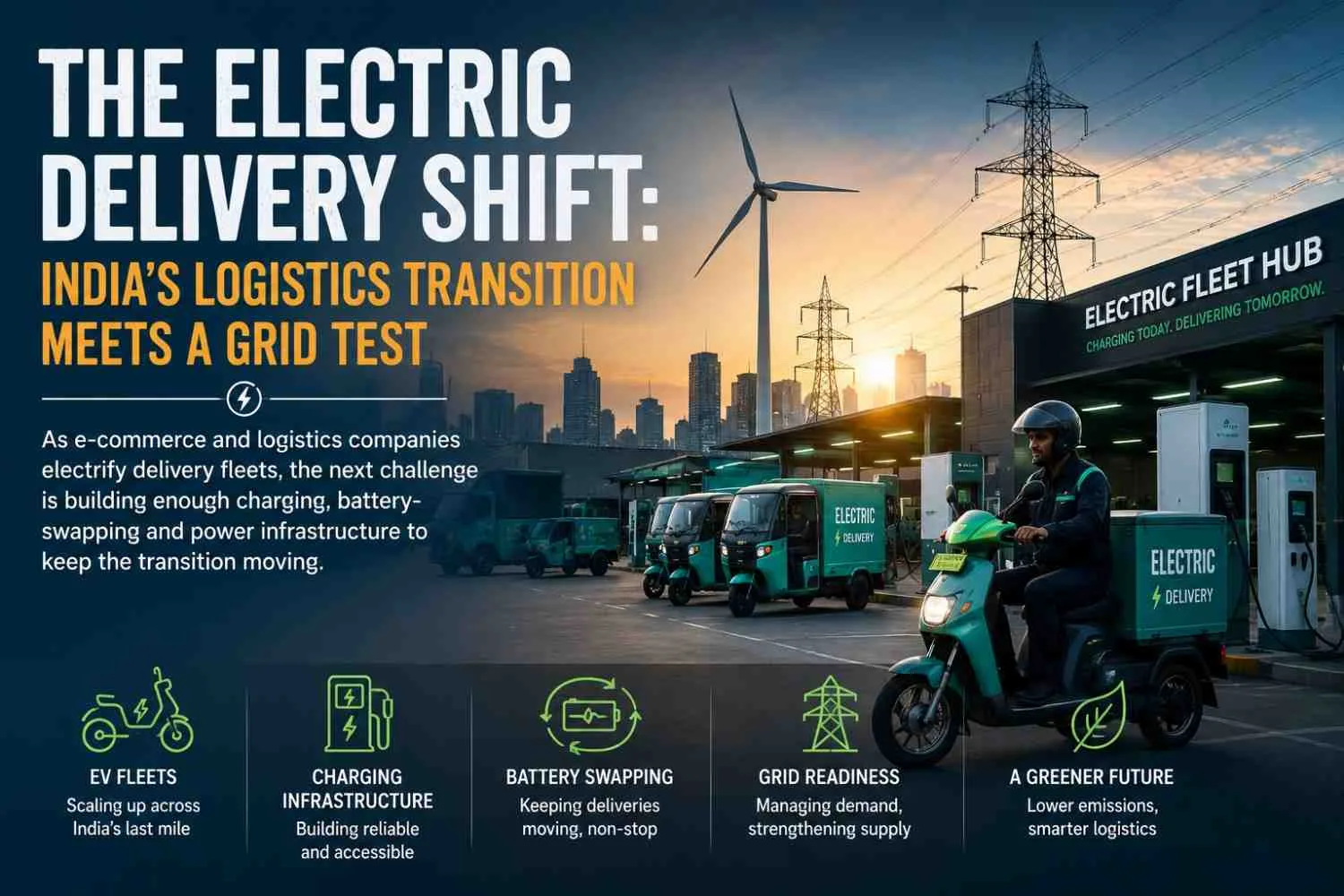
Kolkata | 17 August 2026 As e-commerce and logistics companies electrify delivery fleets, the next challenge is building enough charging, battery-swapping and power infrastructure to keep the transition moving. SummaryIndia’s e-commerce and logistics sector is steadily shifting towards electric delivery vehicles as companies seek to reduce fuel costs and transport emissions. Amazon has already crossed its target of 10,000 electric delivery vehicles in India, while Flipkart has reported more than 13,000 EVs in its delivery ecosystem and is working towards a fully electric fleet by 2030. However, the transition involves more than replacing conventional vehicles with EVs. Commercial fleets also require dependable charging and battery-swapping infrastructure, adequate grid connections and careful management of electricity demand. As electric fleets expand across delivery hubs and logistics networks, the availability and capacity of supporting power infrastructure will become central to the success of India’s commercial e-mobility transition. Is India’s E-commerce Sector Ready to Electrify the Last Mile? Every day, thousands of delivery vehicles carry parcels across Indian cities. These vehicles often follow fixed routes, return to warehouses or delivery hubs and operate for long hours, making last-mile logistics one of the areas where electric vehicles can be adopted at scale. The transition is already underway. Amazon India set a target of deploying 10,000 electric delivery vehicles by 2025 and reached that goal ahead of schedule. Flipkart has set a longer-term target of making its last-mile delivery fleet fully electric by 2030. The shift is also spreading beyond the country’s largest e-commerce companies. Electric mobility firms are supplying vehicles to quick-commerce platforms, food-delivery companies and logistics operators, expanding the market for electric two-wheelers, three-wheelers, vans and other commercial vehicles. But the size of an electric fleet alone does not show whether the transition is working or not. For an EV to be useful in commercial delivery, it must be able to complete its route, recharge within the required time and return to service without disrupting operations. That makes charging infrastructure one of the biggest challenges in India’s move towards electric last-mile delivery. What Happens When the Vehicle Is Ready but the Charger Isn’t? For a private EV owner, charging can usually be planned around personal schedules. For a commercial delivery fleet, however, charging directly affects business operations. Every hour a delivery vehicle spends waiting for a recharge is an hour it is not on the road making deliveries. The challenge becomes even greater when several vehicles return to the same warehouse or delivery hub around the same time, creating a sudden increase in electricity demand. This is why companies are gradually exploring dedicated fleet-charging hubs instead of relying entirely on public charging stations. Tata Power has been expanding its charging network across public, semi-public and fleet locations, while oil and energy companies are also becoming part of the growing EV-charging ecosystem. The wider transition involves companies such as NTPC, NTPC Green, Tata Power, Reliance New Energy, ReNew, Adani Green, Indian Oil and GAIL. Their roles vary from renewable power generation and electricity supply to charging infrastructure, energy storage and existing fuel-station networks - but they are connected to the same shift towards electric mobility. The last-mile EV transition, therefore, is no longer just about replacing petrol and diesel vehicles with electric ones. But also, about building the energy and charging infrastructure needed to keep those vehicles moving.Could Battery Swapping Help Delivery Fleets Stay on the Move? Charging time matters even more for electric two- and three-wheelers that spend most of the day making deliveries. For these high-use vehicles, battery swapping can offer an alternative to conventional charging. Instead of waiting for a depleted battery to recharge, a delivery vehicle can exchange it for a fully charged one and get back on the road. Reliance’s Jio-bp has explored battery-swapping and Battery-as-a-Service models for electric mobility, while India’s policy framework has also started recognising battery swapping as part of the broader EV-charging ecosystem. For delivery companies, the benefit is clear: less time spent charging can mean more time making deliveries. However, battery swapping also creates new challenges. Companies will also need to address key questions around battery ownership and maintenance, compatibility across different vehicle models, the location of swapping stations and who will bear the cost of setting up and operating the network. Without common standards and enough vehicles using the network, swapping stations may struggle to reach the scale needed to remain commercially viable. Battery swapping can help reduce charging downtime, but it does not remove the need for a strong and reliable infrastructure network. Instead, it shifts the focus from charging stations to a wider network of batteries, swapping points and supporting systems. Could Faster Charging Put More Pressure on India’s Power Grid? One of the less visible challenges of the EV transition is its growing impact on India’s electricity network. Electric vehicles reduce dependence on petrol and diesel, but they also shift transport energy demand from fuel stations to the power grid. For commercial delivery fleets, this shift can be particularly significant because vehicles often operate for long hours and need to recharge within tight schedules. A large delivery depot could have dozens or even hundreds of vehicles requiring power within a limited period. If several vehicles charge at the same time, the local distribution network could face a significant increase in demand. This does not necessarily mean that India’s power grid cannot support the growth of electric vehicles. The bigger issue is where, when and how that electricity is consumed. Smart-charging systems can shift charging to periods of lower electricity demand. Battery storage can help manage peak loads, while renewable energy can reduce the emissions associated with charging. Careful planning can also help companies avoid placing large charging facilities in locations where the local power network is already under pressure. The move towards electric delivery, therefore, cannot be managed by fleet operators alone. Companies and electricity providers will need to plan charging capacity together so that the growth of electric fleets does not create unnecessary pressure on the power system. Can India’s Commercial Freight Sector Make the Bigger Shift to Zero Emissions? Electrifying two- and three-wheelers may be relatively easier, but heavy commercial vehicles present a much bigger challenge. Electric trucks require larger batteries, higher-capacity charging systems and careful route planning to ensure they can cover long distances without disrupting delivery schedules. India is beginning to identify priority freight corridors for zero-emission trucking, with charging infrastructure being planned along major routes. Over time, this could help connect warehouses, logistics hubs and cities through dedicated electric freight networks. However, the financial and operational challenges of this transition cannot be overlooked. Companies will need to account for vehicle purchase costs, battery replacement, charging infrastructure, land requirements, grid connections, electricity tariffs and ongoing maintenance. For investors and corporate sustainability teams, therefore, the important question is not simply whether a company has announced a target for electric trucks. The real test is whether the company has the business model, infrastructure and financial capacity to achieve that target at scale. Could Renewable Energy Make Commercial EVs Even Cleaner? The environmental benefits of commercial electric vehicles become stronger when the electricity used to charge them comes from renewable sources. In other words, the transition is not only about replacing petrol and diesel vehicles with EVs, but also about ensuring that the electricity powering those vehicles comes from cleaner sources.This is where India’s renewable-energy and power-sector companies have an important role to play. Companies such as NTPC Green, ReNew and Adani Green can contribute to the broader clean-energy ecosystem supporting electric transport, while Tata Power can help connect electricity supply with the charging infrastructure needed by commercial fleets. The future may therefore involve a much more integrated system: THE LAST-MILE ELECTRIFICATION CHAIN Renewable electricity↓Grid & energy storage↓Charging / battery swapping↓Electric delivery fleet↓Zero-emission last-mile deliveries The success of the transition depends on how well these different parts work together. A growing EV fleet needs sufficient charging capacity to operate smoothly, while charging infrastructure must be supported by proper grid planning to avoid new pressure on the electricity network. At the same time, powering electric vehicles with cleaner electricity can further increase their overall emissions benefits. The EV Is Only the Beginning The real test of India’s commercial EV transition will not be the number of targets companies announce. It will be the evidence they provide on what has actually changed. A company promising a 100% electric fleet by 2030 has set a target. It has not yet achieved an outcome. To show real progress, companies should disclose how many electric vehicles are currently in operation, what share of deliveries they handle, how many kilometres they travel and how much petrol or diesel use they have replaced. Charging infrastructure also needs to be measured by what it can actually deliver, rather than simply the number of stations announced or installed. Similarly, battery-swapping investments should be assessed through their actual use and operational performance. The financial picture matters too. Companies should clearly report the amount they committed to the transition, the amount actually spent, the number of EVs deployed, the charging capacity brought into operation, the baseline from which progress was measured and the changes achieved as a result.This evidence can help investors assess whether electrification is becoming an integral part of a company’s operations or remains largely a sustainability commitment on paper. The bigger question, then, is whether India can electrify its last-mile delivery network without creating new pressure on the systems that support it. The answer will depend not simply on how quickly companies purchase EVs, but on how effectively the wider ecosystem develops. India needs more electric vehicles, but it also needs well-planned charging hubs, reliable electricity connections, battery-swapping networks where they make economic sense and smart-charging systems that can manage peak demand. Most importantly, companies need to report what happened after the announcement. The case for electrifying commercial delivery is strong. These vehicles operate frequently, travel extensively through cities and account for significant fuel costs. Switching to EVs can help businesses reduce operating costs while also cutting local air pollution and transport-related emissions. But replacing a petrol or diesel vehicle with an electric one is only the beginning. The vehicle may be the most visible part of the transition, but it is supported by a much larger system of batteries, chargers, electricity networks, distribution infrastructure, renewable energy and investment. India’s e-commerce boom has already created the demand for this transition. Now the energy system has to build the capacity to support it. And that is the real story of India’s electric last mile: the shift may begin with an EV, but achieving genuinely lower emissions will depend on the entire system behind it - from batteries and charging infrastructure to the power grid and clean energy. Primary sources Amazon India — 10,000 EV milestoneSupports Amazon’s 10,000-EV target, its achievement ahead of schedule, deployment across 500 cities and its continuing work on electric heavy goods vehicles. Amazon India — 10,000 electric vehicles milestone Flipkart — Sustainability JourneySupports Flipkart’s 13,300 EVs and its commitment to 100% electric mobility by 2030. Flipkart — Building for tomorrow: sustainability journey Flipkart — EV Assist, June 2026Supports the current figure on delivery-partner adoption, including the 6,000+ delivery-partner study and 46% willingness to transition to EVs, as well as the 2030 ambition. Flipkart — EV Assist Tata Power — Integrated Annual Report 2025–26Supports the article’s discussion of commercial/fleet charging infrastructure, with 5,800+ public, semi-public and fleet charging points and 1,200+ e-bus charging points reported as operationalised. Tata Power — Integrated Annual Report 2025–26 Reliance Industries / Jio-bp — EV and battery-swapping initiativesSupports the claims about Jio-bp exploring battery swapping, Battery-as-a-Service and charging/swapping points, including applications for three-wheelers and commercial/last-mile mobility. Reliance — Jio-bp and Mahindra EV partnership Central Electricity Authority — EV Charging Station / Power Consumption ReportsThis is the key government source for the article’s grid and electricity-demand section. CEA maintains dedicated EV Charging Station/Power Consumption Reports as part of its energy-transition work. CEA — EV Charging Station / Power Consumption Reports Ministry of Power — EV Charging Infrastructure GuidelinesSupports the article’s discussion of charging infrastructure, grid-support requirements and fast charging for long-range/heavy-duty EVs. The guidelines specify fast-charging stations for heavy-duty vehicles at 100-km intervals on designated highways and call for supporting infrastructure such as transformers and feeders. Ministry of Power — EV Charging Infrastructure Guidelines WRI India — Electrifying India’s HighwaysSupports the section on electric freight and explains why e-truck charging requires high-capacity grid connections, larger sites and carefully planned electrical systems. WRI India — Electrifying India’s Highways WRI India — Accelerating India’s Freight DecarbonizationSupports the article’s discussion of electric freight, charging constraints, corporate adoption and the structural challenges facing zero-emission trucking. It currently reports 869 electric medium- and heavy-duty freight vehicles and identifies charging infrastructure and upfront costs as major barriers. WRI India — Accelerating India’s Freight Decarbonization WRI India — Fi-ZET: Financial Impact Assessment for Zero-Emission TrucksSupports the article’s discussion of the financial and operational feasibility of electric trucks, including vehicle costs, financing and route-specific economics. WRI India — Fi-ZET ...Read more